Map: GSI Japan Murin-an is a compact Meiji-period villa in Kyoto where private power, modern landscape design, municipal infrastructure, and high politics meet in one surviving ensemble. Yamagata Aritomo commissioned the property in 1894–1896 and worked closely with the garden designer Ogawa Jihei VII. Its stream uses water from the Lake Biwa Canal, while the Western-style house preserves the setting of a 1903 conference on policy toward Russia. The place is historically valuable not as a timeless retreat but as a deliberately made modern environment whose buildings, water, borrowed scenery, and political room expressed an elite vision of the new state.
A Meiji Villa Built as a Single Political Landscape
Attraction
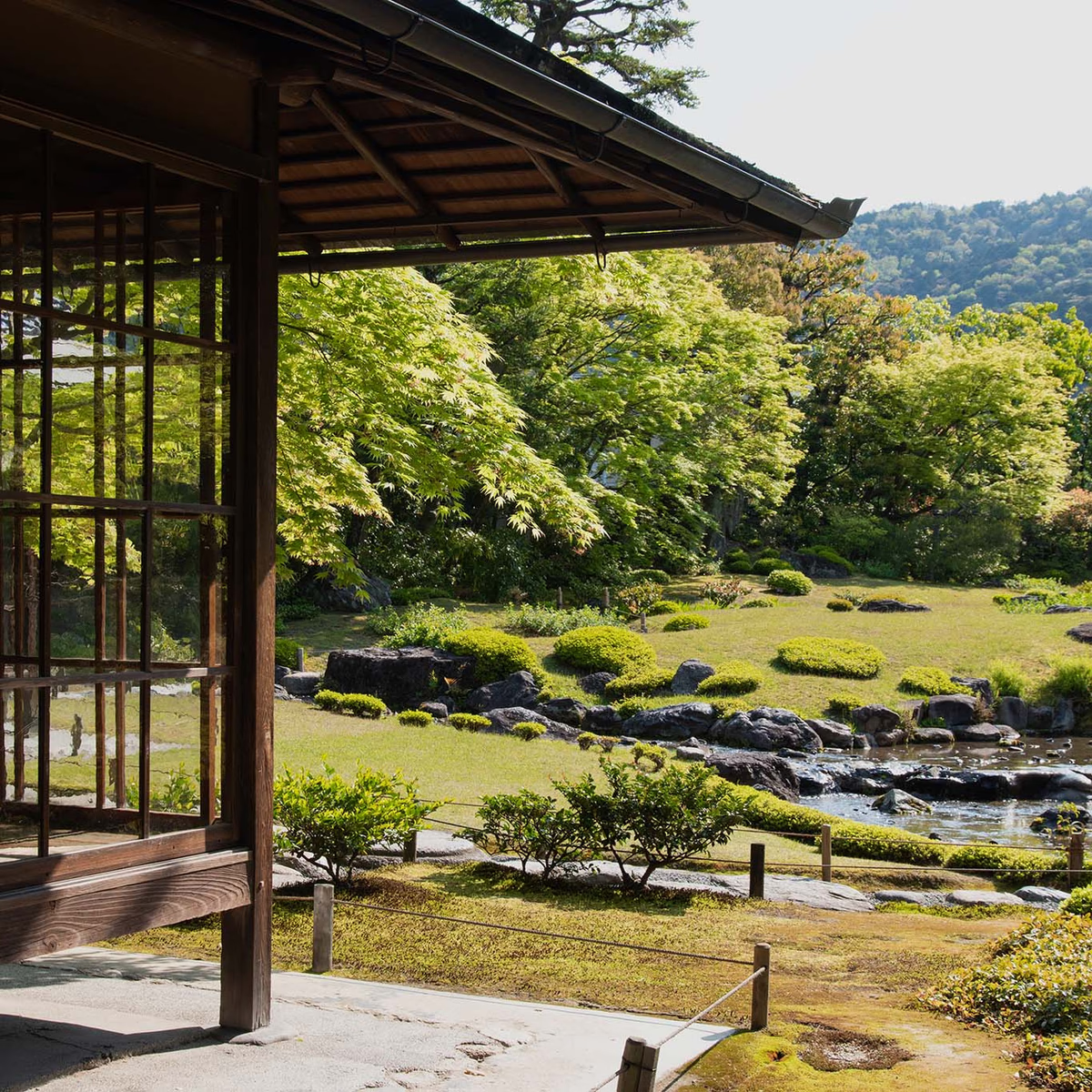
Yamagata Aritomo created Murin-an in 1894–1896 as a villa composed of a Japanese main house, a small Western-style building, a tea house, and the garden that binds them together. The ensemble is modest in area compared with a palace, yet each element serves a different mode of elite life: domestic reception, Westernized political conversation, tea practice, and carefully framed landscape. Reading the property as one designed unit matters because isolating the garden from the rooms would erase the way movement, views, hospitality, and authority reinforced one another. The surviving structures are maintained historic fabric within a protected property, not a newly invented scenic set.
Current visibility
The garden, main-house first floor, and Western-style house are normally included in admission; other interiors have separate conditions.
Yamagata and Ogawa Jihei VII Recast the Garden
Attraction
The garden was made from Yamagata's directions by Ogawa Jihei VII, a designer central to Kyoto's modern garden history. Instead of relying primarily on a large still pond and miniature symbolic islands, Murin-an emphasizes shallow moving water, open turf, irregular planting, and a progression from a bright foreground toward a more secluded waterfall. Higashiyama is treated as the garden's principal mountain beyond the boundary. This was not nature left untouched: grading, stones, water engineering, plant choice, and controlled viewpoints produced a landscape meant to appear immediate and alive. Later moss growth and continuing horticultural care also show that the protected garden changes biologically even while its design intent is conserved.
Current visibility
The designed ground, stream, waterfall, turf, moss, plantings, and Higashiyama view remain visible, subject to conservation barriers.
Lake Biwa Canal Water Turned Public Works into Private Scenery
Attraction
Murin-an's stream depends on the Lake Biwa Canal, the major municipal project completed as Kyoto sought economic renewal after the imperial court moved to Tokyo. Canal water was not merely a decorative supply. It connected the villa to a new system built for transport, power, irrigation, and urban development, and it helped make the Nanzen-ji area attractive for a cluster of modern estates. At Murin-an, water is raised toward the waterfall and then directed through the garden as an apparently natural current. The visible stream therefore joins engineering and aesthetics: a public infrastructure project became the physical medium of a private elite landscape, while the villa district in turn reshaped the canal's urban afterlife.
Current visibility
Canal-fed water continues to move through the garden, but the upstream municipal system extends beyond this Place.
The 1903 Murin-an Conference Room
Attraction
On 21 April 1903, Yamagata Aritomo, Ito Hirobumi, Prime Minister Katsura Taro, and Foreign Minister Komura Jutaro met in the upper room of the Western-style house to discuss policy toward Russia. The meeting belongs to the tense diplomatic approach to the Russo-Japanese War; it should not be simplified into a single room deciding an inevitable war. Its importance lies in showing how a private villa could operate as an unofficial decision space for a small circle of senior statesmen. The Western room, fireplace, and decorative interior survive as the material frame of that conversation, placing foreign-policy deliberation inside the same estate that projected natural retreat and cultivated privacy.
Current visibility
The Western-style house is normally included in admission, but access to or viewing of the upper conference room follows the current managed route.
A Conserved Garden That Is Still Growing
Attraction
Murin-an is a nationally designated Place of Scenic Beauty and a Kyoto City property, but preservation does not mean holding every plant at one historical instant. Moss displaced portions of Yamagata's preferred turf, mature trees altered light, and continual pruning, water management, and ground protection became necessary to retain the intended spatial relationships. Staff barriers and timed capacity are therefore part of conservation rather than evidence that the entire villa is freely explorable. The main-house second floor and tea house have separate use arrangements, and temporary restrictions may protect fragile surfaces or ongoing work. The most accurate present-day reading is of a living cultural property whose historical design is maintained through visible intervention.
Current visibility
The property is regularly open with capacity controls, while protected zones, separately booked rooms, and temporary conservation restrictions vary.