Read the article below. Interactive reading tools are available when scripts load.
Quick
Sugawara no Michizane was born in 845 into a family known for scholarship and service in the court's literary bureaucracy. His father Koreyoshi became a senior scholar-official, and earlier Sugawara generations had cultivated the same institutional field.
This background supplied training, texts, models, introductions, and a family name associated with learning. It did not provide the marriage network through which the Fujiwara northern house connected itself repeatedly to emperors and heirs.
Later Tenjin tradition celebrated Michizane as a prodigy from childhood. Early ability is plausible, but polished scenes of a future god displaying destiny belong to later biography unless independently secured.
The boy could learn; he could not know the 901 exile, the 930 lightning, or his later worship as a god of learning.
Michizane followed the literary-bureaucratic path cultivated by his family. He studied literary Chinese, classical history, composition, and forms of political argument used by the court.
In 870 he passed the demanding hōryaku examination. Success marked high scholarly competence and supported entry into government service.
The examination did not make the system open to everyone. Candidates came from a narrow world shaped by birth, family teaching, access to manuscripts, university connections, and patronage.
Michizane's achievement was real precisely because the test required developed skill. It should be celebrated without turning one exceptional career into proof that inherited hierarchy no longer mattered.
After passing the examination, Michizane entered government and advanced through offices connected to records and learning. In 877 he became monjō hakase, often translated as professor of literature.
The role was larger than teaching elegant writing. Literary Chinese served official history, memorials, formal orders, diplomacy, ritual explanation, and elite education.
Michizane trained students and produced texts inside a network of other scholars, scribes, archivists, ministers, and patrons. Expertise gave him access to policy because rulers needed reliable language and precedent.
It did not automatically give control. A scholar could formulate the state's expression while a minister or sovereign decided whether to use it.
In 886 Michizane became governor of Sanuki and spent roughly four years away from Kyoto. The provincial office handled tax, land, agricultural conditions, official stores, legal disputes, ritual, reporting, and relations with district authorities.
His writings describe places, people, hardship, and administrative experience. They are rare direct evidence from a named governor, but poems remain crafted works rather than full accounts of revenue, conflict, and policy results.
Records also associate him with a 888 prayer for rain during drought. The ritual act is historical; claims about supernatural causation belong to belief and later local tradition.
Sanuki did not interrupt his real career. It gave the scholar practical responsibility inside the provincial machinery that sustained the capital.
After returning from Sanuki, Michizane rose quickly under Emperor Uda. His literary expertise, administrative record, and ability to formulate policy made him valuable to a ruler governing beyond the shadow of dominant Fujiwara marriage politics.
Uda's trust did not place Michizane outside faction. Using a learned non-Fujiwara official changed the distribution of access and threatened people whose families expected to mediate the throne.
Michizane gained central offices, audiences, and responsibility because personal sovereign confidence amplified professional capital.
That foundation was powerful but fragile. A marriage network could survive a change of ruler across several households; a scholar's exceptional access depended more heavily on continuing confidence and the allies produced while it lasted.
In 894 Michizane was appointed to lead a new mission to Tang China. He submitted advice that the plan should be reconsidered, pointing to deteriorating conditions in Tang and the danger of the voyage.
The court did not send the mission, and no later official embassy restored the old cycle. This made the decision a major turning point.
Michizane did not single-handedly abolish foreign learning. The emperor and court adopted the recommendation; Tang collapsed in 907; previous voyages had demonstrated severe maritime risk; merchants, monks, texts, objects, and regional contacts continued moving outside the embassy system.
His achievement was policy judgment: he used transregional information to ask whether an inherited institution still justified its human and material cost.
Uda abdicated in 897 and the young Emperor Daigo succeeded. Michizane remained highly placed and in 899 became minister of the right, serving beside Fujiwara no Tokihira as minister of the left.
For a man whose main inherited resource was scholarly office, the promotion was exceptional. It did not prove that learning had displaced birth.
Uda's retired influence, Daigo's household, Tokihira's office and kin network, Michizane's children and marriages, and questions of royal succession all converged around the two ministers.
At this level, a scholar's advice distributed appointments and dynastic possibilities. The abilities that justified Michizane's rise also made him a political rival who needed more protection than reputation alone could supply.
Later accounts often present Michizane's fall as Fujiwara no Tokihira's jealous destruction of a better man. This moral pattern preserves the injustice remembered by Tenjin worship but oversimplifies the political field.
The conflict involved Emperor Daigo, retired Emperor Uda, Prince Tokiyo, Michizane's marriage connections, Fujiwara interests, scholarly lineages, and fears about succession.
Tokihira's position and benefit make him a central actor. They do not turn every other participant into his instrument.
Before describing the 901 accusation, the canonical account must separate evidence of rivalry from a complete private motive. The scale of punishment points to a struggle over legitimate government, not an insult between two writers.
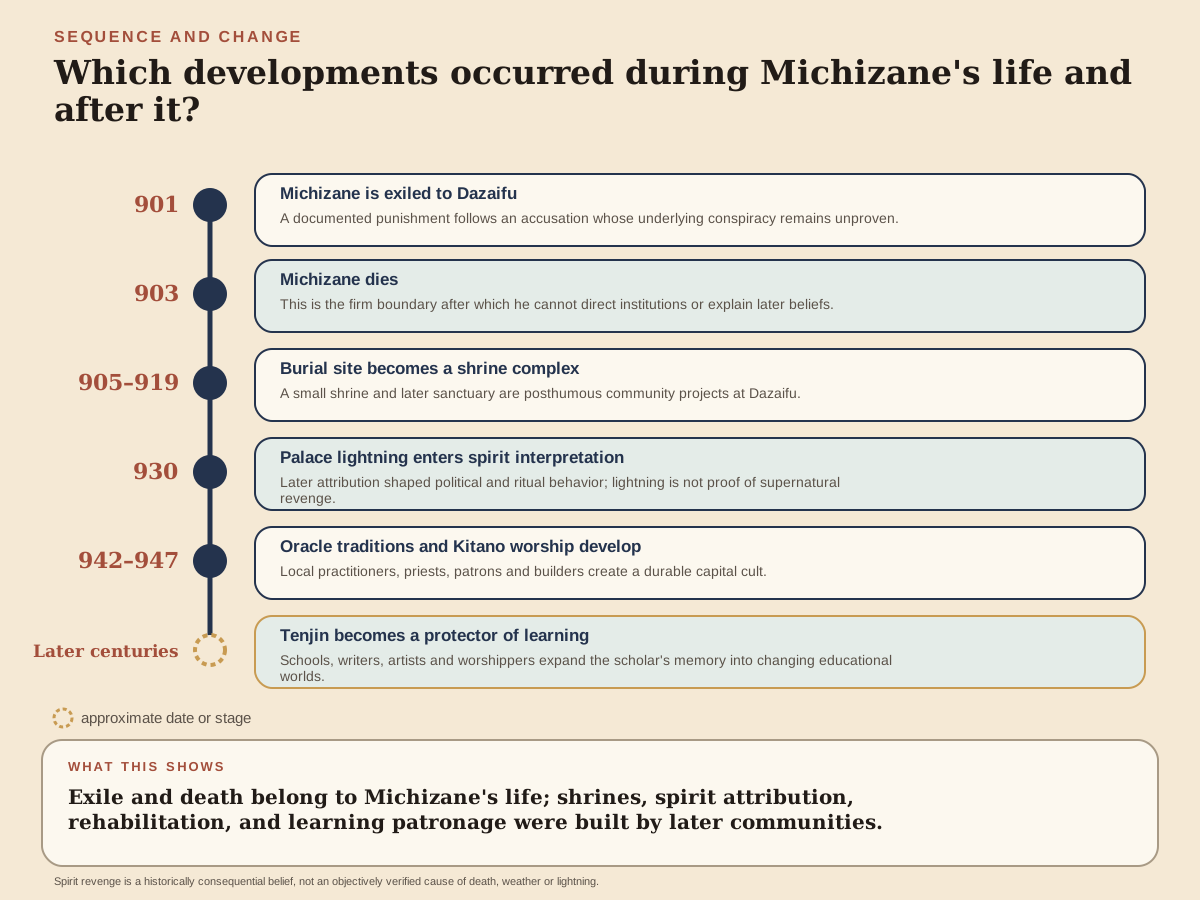
In 901 Michizane was accused of plotting against Emperor Daigo's succession order and was abruptly removed from right-minister office. He received the title of a provisional Dazaifu governor but was sent west without normal governing authority.
His children and associates also suffered demotion or dispersal. The collective punishment shows that the action targeted a political network, not only one writer.
The accusation must be recorded as an accusation. The surviving archive does not permit a complete reconstruction that proves the alleged plot as objective fact.
What is certain is the exercise of power: Daigo's government accepted the charge, Uda could not reverse the outcome, officials implemented it, and Michizane's place at court disappeared within days.
Michizane spent his final years in Dazaifu under severe political restriction and reduced material support. He remained near a major regional administration but did not exercise the authority normally associated with his title.
He composed poems and prose about exile, distance, loss, memory, and his political position. These works are direct authored evidence unavailable for many historical figures.
Authorship does not make a poem a stenographic record of the mind. Genre, allusion, audience, revision, and self-presentation shape expression.
The texts can support what Michizane chose to say and how he fashioned experience. They cannot by themselves reconstruct every private thought, settle the 901 case, or supply dialogue for attendants and separated family.
Michizane died in Dazaifu in 903, about two years after his removal from court. His death ended his ability to write, defend his family, recover office, or shape political events.
He was buried at the site later occupied by Dazaifu Tenmangū. Institutional history places a small shrine at the grave in 905 and a larger sanctuary in 919.
The tradition that an ox carrying his body stopped and thereby revealed his desired burial place became central to shrine memory. It should be preserved as tradition and belief, not narrated as an objectively verified final command.
Burial workers, followers, custodians, and later worshippers own the actions after death.
After Michizane's death, a sequence of deaths and disasters was increasingly associated with his resentful spirit. Tokihira died in 909; royal heirs died in the following years; lightning struck the palace in 930 and killed or injured people.
Modern history need not accept that Michizane's spirit caused these events. It must recognize that court society treated the connection as credible enough to shape restoration, ritual, and institutional action.
Belief provided a language for unresolved responsibility. If an unjust political decision had angered a powerful dead person, disaster could reveal moral failure that the official case had concealed.
The dead Michizane did not perform a historical revenge plan. Living witnesses, rulers, ritual specialists, victims, and record makers created the causal interpretation and acted upon it.
Michizane's rank and reputation were restored in stages as the court responded to fear and political memory. In 942, tradition records an oracle received by Tajihi no Ayako, who maintained a small shrine. Kitano worship was established on a larger site in 947.
The resulting deity was not immediately limited to school examinations. Tenjin carried meanings of dangerous spirit, pacification, weather and agriculture, protection, honesty, literary skill, and public order.
Imperial and Fujiwara patronage eventually incorporated the cult into official ritual. Commoner practitioners, shrine specialists, monks, local communities, and donors also shaped it.
Michizane's scholarly biography made learning a powerful attribute, but the familiar modern learning god emerged through accumulation, not through a plan made during his life.
Dazaifu Tenmangū stands at the place associated with Michizane's burial. A small shrine was established by 905, and a larger sanctuary replaced it in 919.
The institution developed through a temple-shrine complex, patronage, pilgrimage, destruction, rebuilding, and changes in ritual administration. The present main sanctuary dates to 1591.
Place continuity is therefore strong but layered. Visitors reach the historical death-and-burial landscape through structures and practices made by many later generations.
The shrine's oxen, plums, poems, and origin narratives preserve sacred memory. They should be labeled as belief, tradition, art, and reception where appropriate rather than made into eyewitness facts from 903.
Across the medieval and early modern centuries, Tenjin worship spread through Kitano, Dazaifu, and thousands of regional shrines. Michizane's historical scholarship supported association with writing and learning, while older roles in weather, agriculture, protection, honesty, and arts remained important.
Schools, teachers, students, calligraphers, printers, artists, pilgrims, and local patrons made the deity relevant to changing educational systems. Prayer for examination success was a later extension, not the original purpose of worship in the tenth century.
Medieval origin scrolls and stories expanded the biography, sometimes sending Tenjin on supernatural or continental journeys impossible within Michizane's life.
Through 1912, the canonical legacy must preserve four related but separate layers: historical official, punished political actor, feared and pacified spirit, and protective deity of learning.
Classic
The Sugawara were not socially marginal people whose child entered court by talent alone. Their name already carried learned specialization and government service.
Michizane's father Koreyoshi occupied high scholarly and administrative positions. A child in that household encountered books, models of literary Chinese, teachers, and conversations about office unavailable to most people.
Family expertise could be inherited because education was material. Manuscripts cost labor; paper and ink required production; instruction required adults with time; correction required accepted standards.
The household also offered networks. Former students, colleagues, patrons, and officials knew which abilities mattered and how a young man might be presented for advancement.
Mothers, nurses, siblings, servants, and maternal kin belonged to this formation even when official genealogy foregrounds the male scholarly line.
Their work sustained health, clothing, meals, ritual, and the disciplined time in which literary distinction could be practiced.
This privilege should not be renamed modern meritocracy. Most children in ninth-century Japan could not compete for the same training, examinations, or offices.
Women could be learned and culturally influential while being excluded from the formal career path that made Michizane's scholarship a route to ministerial office.
Within the male aristocratic field, family knowledge still differed from Fujiwara power. The Sugawara could train specialists; they did not possess an equivalent sequence of empresses, maternal grandfathers, and heir-making households.
Learning could bring appointment because the state needed literary Chinese for records, histories, diplomacy, ritual, education, and formal expression.
It could also define a ceiling. An expert might remain valuable as the person who wrote, taught, or advised while others controlled succession and marriage.
Michizane's later rise makes childhood look like proof that scholarship would break this ceiling. That is outcome bias.
Many trained men did not become right minister. Examination performance, patronage, vacancy, faction, health, family position, and sovereign preference remained contingent.
Later devotional biographies intensified the backward pull. Once Michizane became Tenjin, childhood poems or precocious acts could be read as early manifestations of divine nature.
Such stories are historically important as reception. They show what worshippers wanted the god of learning to have been.
They are not all equal evidence for the lived child. A tale recorded generations later cannot automatically supply a conversation, emotion, or exact performance in the 850s.
The safest account retains strong structure: 845 birth, scholarly family, exceptional access to learning, and a court where learned service could matter.
It also retains limits: aristocratic birth still mattered, marriage politics distributed higher power, and the future was not visible.
This makes Michizane's eventual career more intelligible. He rose by developing a resource his family genuinely possessed and by finding rulers who needed it.
It also makes the fall more intelligible. Expertise that reached beyond its customary place could provoke fear without creating the kin network needed for protection.
The child belongs at the beginning of that structure, not at the end of a divine prophecy. His formation was privileged, demanding, collective, and uncertain.
An examination can test knowledge rigorously while the opportunity to prepare remains unequal. These two facts are compatible.
Michizane devoted years to literary Chinese, historical examples, argument, and composition. Passing in 870 represented trained intellectual performance, not an empty ceremony.
The test placed candidates before recognized judges and converted learning into an official credential. Failure could delay or narrow a career even for a well-born student.
Preparation began long before the examination room. The Sugawara household preserved texts, teachers, habits of composition, and knowledge of what examiners valued.
Family members could correct work and interpret difficult passages. Former students and colleagues connected private study with formal institutions.
Paper, brushes, ink, light, food, and protected time were part of the educational system. They rarely appear in narratives of genius because material support looks ordinary after success.
Other learners lacked such support. Provincial distance, household labor, poverty, gender, status, and weak patronage excluded most of the population before ability could be compared.
Even among eligible men, examination did not erase ancestry. Rank, office availability, family reputation, and the willingness of superiors to appoint a successful scholar remained decisive.
Japan's court did not operate as a fully examination-selected bureaucracy modeled on an idealized version of China. Aristocratic office and hereditary expertise coexisted with testing.
The Sugawara themselves demonstrate this mixture. Scholarship was a family resource passed through generations, so Michizane's learned rise was both achieved and inherited.
This dual character is more historically accurate than choosing between genius and privilege. He worked within advantages that did not guarantee the result.
The examination also tested conformity to accepted intellectual forms. Originality mattered only when expressed through genres, authorities, and language recognized by the institution.
Literary Chinese was not Michizane's everyday spoken language. Mastery required the ability to think and write through a prestigious transregional textual system.
That system linked composition to government. Historical analogy could advise rulers; formal prose could represent the state; textual accuracy could settle ritual or institutional questions.
Examiners therefore judged capacity relevant to office, not merely private taste. Their own schools and alliances could nevertheless shape evaluation.
Success gave Michizane a stronger claim to appointment, but it did not make every aristocrat accept him as an equal participant in succession politics.
The later god of examinations creates another retrospective distortion. Modern worshippers may imagine 870 as the first sacred prototype of their own entrance tests.
The resemblance is limited. The social field, curriculum, institutional purpose, and consequences differed sharply from mass modern education.
What connects them is not sameness but reception: later societies selected Michizane's tested scholarship as a meaningful model for disciplined learning.
In his own time, passing converted family-trained competence into state recognition. It opened a route while leaving the architecture of inherited power intact.
That combination—real assessment inside unequal access—would define both the possibility and fragility of his exceptional career.
The distinction also prevents later devotion from flattening study into luck. Worship could seek assistance, but Michizane's historical credential depended on sustained preparation and judgment inside a restrictive institution. Effort and inherited access both remain visible.
The modern word literature can make the office sound ornamental. In the early Heian court, literary Chinese carried much of the state's formal intelligence.
Government needed people who could read earlier records, recognize precedent, compose appropriate forms, and train the next generation of officials.
Diplomatic writing represented Japan to foreign courts and visitors. Historical compilation decided how reigns and actions entered institutional memory.
Memorials and formal prose converted advice into a genre the sovereign could receive. Ritual explanation linked present action to textual authority.
The monjō hakase stood within this infrastructure. Michizane's appointment in 877 recognized both personal competence and a family tradition suited to the office.
Teaching mattered because knowledge had to reproduce. Students learned not only vocabulary but how to build arguments, select examples, and inhabit official roles through written form.
They were not passive copies of one master. Students came with different kin, ambitions, skills, and future patrons.
Other scholarly lineages also competed over appointments and interpretive authority. The court's learned world contained faction, inheritance, and professional rivalry.
Scribes converted drafted language into working documents. Archivists preserved sources that scholars cited. Messengers and office staff moved the resulting texts.
No celebrated professor personally performed all of these tasks. Distributed labor made learned authority usable.
Accuracy itself was political. A mistaken title, precedent, date, or ritual form could insult rank, weaken a claim, or expose government to criticism.
Elegance also mattered because cultivated expression signaled order. A court that wrote badly could appear unable to govern the tradition it claimed.
Michizane's poems and prose built reputation beyond routine service. Authored works reveal extraordinary command of genre without becoming a transparent diary of every thought.
Literary accomplishment could attract sovereign trust. It could also invite a limiting label: the expert summoned to formulate another person's decision.
Moving from scholarly office into broad policy required patrons willing to treat textual judgment as administrative capacity.
That transition was never guaranteed. Ministers whose power rested on marriage and household networks could value a scholar without wanting him beside them at the top.
Michizane's later political ascent should therefore not be projected back as the normal reward for becoming professor. It was an exceptional redirection of specialist capital.
The office also shaped how he saw government. Texts taught ideals and precedent; daily bureaucracy exposed compromise, delay, and unequal enforcement.
His knowledge could identify contradictions between official principle and actual practice. Whether that knowledge improved government depended on authority, allies, and administrative follow-through.
The decisive point is that words were not outside power. They authenticated office, framed problems, recorded outcomes, and disciplined institutional memory.
Michizane became formidable because he mastered that political technology. He remained vulnerable because mastery of language was not the same as control of every household that acted through it.
His work also trained rivals and successors. Institutional teaching gives knowledge to people whose later loyalties cannot be owned by the teacher. The stronger the educational system became, the less its competence could remain one family's private possession.
The capital received grain, textiles, revenue, reports, and service from provinces that elite narrative often treats as distant background.
A governor stood at the junction between central demand and local capacity. Orders arrived in formal language; crops, transport, households, and disputes determined whether those orders could be fulfilled.
Michizane's appointment in 886 gave him nominal authority, but provincial government was not one man's presence. District officials, clerks, tax collectors, storehouse workers, guards, and messengers held operational knowledge.
Local elites could cooperate, delay, conceal, bargain, or exploit. Farm and fishing households experienced policy through assessment, labor, weather, debt, and the conduct of intermediaries.
Archaeology at the Sanuki provincial center preserves material evidence that official writing was ordinary work. Inkstones and office remains restore clerks who disappear behind the famous governor.
Michizane's literary skill allowed him to record provincial scenes with unusual force. The poems are authored evidence of what he chose to notice and how he framed it.
They are not an audit ledger. Genre can intensify compassion, convention, self-presentation, seasonal awareness, or political complaint.
A poem about suffering does not prove that every tax was reduced. A benevolent image in later local memory does not document each administrative decision.
Conversely, literary form does not make the social observation unreal. It supplies evidence whose claims must be matched to genre.
Drought demonstrates the interaction of governance and belief. In 888 Michizane performed a rain petition associated with a local deity.
The act addressed agricultural danger and the governor's ritual responsibility. It could reassure communities and make authority visible even before any change in weather.
Modern history need not accept divine production of rain. It should still recognize that ritual was part of the administrative repertoire.
The province also exposed enforcement problems. Central quality requirements for tribute textiles could lead to sanctions when goods failed standards, but responsibility might fall unevenly on producers and officials.
Tax extraction depended on estimates vulnerable to weather and manipulation. Litigation brought competing accounts that no classical precedent could resolve automatically.
Temples and shrines held land, ritual roles, and local relationships. A governor navigated institutions whose authority was not reducible to his office term.
The four-year appointment created a temporal problem. Officials could postpone cooperation while waiting for another governor; a departing governor could avoid long-term consequences.
Michizane's reputation, however, followed him. Provincial service could demonstrate that textual skill translated into administration and provide evidence useful to later patrons.
It also risked losing central access. Distance from Kyoto meant fewer audiences, slower news, and vulnerability to changes in office networks.
Sanuki therefore tested two capacities at once: governing a province and preserving a capital career.
Later Tenjin devotion multiplied local sites connected to Michizane, sometimes attaching stories of travel, rain, or residence whose evidentiary strength varies.
The canonical account anchors place in the secure governorship and contemporary works, then layers later shrine memory separately.
Sanuki matters because it reveals the state below court ceremony. Michizane encountered people and material systems on which learned government depended but which its polished documents could obscure.
Uda did not govern an empty court. Fujiwara houses, royal relatives, ministries, scholarly families, and office networks already held accumulated expectations.
The legacy of Fujiwara no Mototsune demonstrated how a senior maternal relative and minister could shape the conditions of imperial action.
A sovereign seeking room to govern needed more than a personal wish. He needed officials capable of drafting, interpreting precedent, transmitting orders, and supplying alternative advice.
Michizane offered rare competence. His scholarly career gave command of formal language; Sanuki gave administrative experience; family specialization supplied a recognized professional identity.
Uda's promotion made those resources politically central. It allowed a person outside the dominant Fujiwara northern marriage network to enter decisions from which specialists were often excluded.
This was balancing, but balancing should not be imagined as neutral selection of the best person. Every new access relationship creates winners and losers.
Officials aligned with Michizane could gain opportunity. Families whose influence depended on controlling approach to the sovereign could see a threat.
Tokihira possessed his own ability and office base. Treating him as a dull aristocrat jealous of intelligence reproduces later moral drama rather than explaining competition.
Michizane likewise was not a disembodied mind. Promotion affected his children, marriages, students, colleagues, and the future of the Sugawara scholarly network.
High office required decisions about appointments, ritual, finance, provincial reports, and royal succession. Learned judgment became attached to distributive power.
That change could unsettle people who had accepted Michizane as a writer or teacher. Expertise seemed less harmless when it shaped who governed.
Uda benefited from an adviser whose authority derived substantially from the throne. Dependence could make Michizane loyal and responsive compared with a minister backed by an autonomous kin coalition.
The same dependence created fragility. When Uda ceased to reign, the office title could remain while the original personal channel weakened.
Michizane attempted to turn access into durable service by building a record of policy, students, and administrative competence.
Yet no amount of competence instantly produced marital ties equivalent to generations of Fujiwara strategy.
Court scholars also had their own rivalries. Elevating one literary lineage could change examinations, appointments, historical writing, and educational patronage.
The emperor's trust was therefore neither pure friendship nor merely cynical use. It was a working political relation built on intersecting needs.
Uda needed skilled alternatives and reliable expression. Michizane needed a sovereign willing to let professional capital cross into ministerial politics.
The relationship produced real government, including the coming reassessment of a Tang mission. It also made later opponents able to describe Michizane's influence as improper proximity.
Outcome bias turns Uda into the wise discoverer and Tokihira into the envious destroyer. Before 901, all actors were configuring a court whose succession and household alignments remained open.
Michizane's rise should therefore be understood as structural exception: expertise became political authority because a ruler selected it, and that selection created the coalition problem that expertise alone could not solve.
Michizane's own career makes a rejection-of-China interpretation implausible. Literary Chinese, classical history, and continental institutions formed the basis of his authority.
He was appointed to the 894 mission because the court recognized both learned capacity and diplomatic standing. Refusing all foreign knowledge would have undermined the professional world he represented.
The question was narrower and more practical: should the state send this expedition under current conditions?
Tang political order had deteriorated. A mission designed for a powerful and predictable court faced uncertainty about reception, routes, and the value of formal credentials.
The sea crossing had always been dangerous. Earlier embassies had lost ships, diverted far from intended ports, stranded travelers, and killed crews and passengers.
Risk belonged not only to famous envoys. Sailors, navigators, interpreters, servants, monks, craftsmen, and their families bore the consequences of departure.
Ship construction, provisions, gifts, documents, training, coastal coordination, and return transport required large public resources.
An inherited institution can accumulate prestige after its practical conditions change. Continuing it may look more orthodox than asking what it now accomplishes.
Michizane's advice converted knowledge of Tang disorder and maritime history into a policy challenge. He did not merely express personal fear of travel.
The emperor and other court actors retained decision. A memorial could persuade; it could not cancel an embassy by itself.
Officials appointed to the mission had interests of their own. Some may have welcomed study and status; others faced danger or disruption.
The nondeparture also depended on implementation. Ships were not sent, resources were redirected, and the court accepted the reputational consequences of discontinuity.
Later memory says Michizane abolished the Tang missions because a single named cause is easy to remember. The phrase compresses appointment, advice, court adoption, structural decline, and non-revival.
Tang's collapse in 907 reinforced the judgment after Michizane's fall and death. He could not control that later confirmation.
Foreign contact did not cease. Commercial exchange, religious movement, imported objects, shipborne information, and relations through neighboring regions continued under different arrangements.
Nor did Chinese-derived culture disappear. Japanese scholars kept reading and adapting texts already accumulated across centuries.
Stopping official embassies could even intensify local selection: court and religious institutions decided how to use inherited knowledge without regular renewal through the old diplomatic form.
The decision therefore belongs to the history of institutional adaptation, not national isolation.
It also shows the political value of a scholar able to question the ritual weight of precedent. Michizane used mastery of the tradition to argue that faithful government might require changing it.
The human-cost perspective is essential. An embassy celebrated for cultural exchange could also be a fleet in which unequal participants faced drowning, illness, capture, and permanent separation.
The strongest conclusion gives Michizane consequential authorship of advice, the court authorship of policy, maritime workers ownership of risk, and larger geopolitical change a role in non-revival.
This distribution keeps the decision from becoming either solitary genius or anonymous inevitability. Michizane mattered because he framed a choice at the moment when several structural pressures made institutional change possible.
High office changes the meaning of expertise. A scholar below the summit can advise; a minister helps decide whose advice, appointment, and succession will prevail.
Michizane's 899 promotion placed him beside Tokihira in the central ministerial order. Their ranks were not a literary prize table.
Tokihira belonged to the Fujiwara northern house, whose strength joined office to marriage, maternal kinship, and expectation about imperial heirs.
Michizane possessed deep learning, Uda's trust, a body of students and colleagues, and a family whose marriages now mattered more because of his position.
His daughter was connected by marriage to Prince Tokiyo, one of Uda's sons. Kinship made abstract succession anxiety concrete.
Uda had abdicated but did not become politically irrelevant. His continuing prestige could support Michizane while raising concern about influence over Daigo's reign.
Daigo was young, but he must retain agency. Describing him as a helpless object between a retired father, Tokihira, and Michizane would repeat the simplification applied to other early Heian rulers.
He received reports, judged accusations, appointed officials, and developed his own household interests within constraints of age and coalition.
The right-minister appointment demonstrated that aristocratic systems can produce exceptional upward movement. Exception does not equal open access.
Michizane's own scholarly birth, education, and patronage remained elite. No provincial farmer could reproduce his route simply by studying harder.
Nor did one promotion dissolve Fujiwara capacity. Marriage networks worked across reigns and could mobilize relatives in multiple offices.
The title gave Michizane formal authority but also visibility. Every appointment could be read as expansion of a Sugawara, Uda-aligned, or anti-Fujiwara network.
Students and scholar-officials gained or lost opportunity through his influence. Professional patronage became factional evidence whether or not he intended a faction.
His children carried the benefits and risk of elevation. A minister's family could be rewarded, married, watched, and punished as a political unit.
Tokihira also faced pressure. A talented minister from outside his house, backed by a retired emperor, could alter the future distribution of regency and kin power.
Reducing this to jealousy of genius turns institutional fear into private emotion. Private emotion is possible, but it does not explain why the court could later punish a large network.
The government still needed both men. Tokihira's experience and family reach and Michizane's documentary and policy ability were not interchangeable.
Cooperation at the summit could therefore coexist with strategic rivalry. Surviving records rarely expose every moment when one became the other.
The right-minister office also removed a familiar defense. Michizane could no longer claim that he merely supplied words for decisions owned elsewhere.
He had entered the level where succession and punishment attached directly to ministerial presence. His career had crossed its family's conventional boundary before it built an equivalent protective structure.
The promotion was a genuine achievement and a warning. Learning had become power, but power would now be judged by coalitions that no examination could settle.
Jealousy offers psychological clarity. One minister envies a scholar's brilliance, tells a lie, and destroys him.
The story fits later devotion because a falsely accused god of honesty needs a recognizable persecutor. It is not sufficient political explanation.
Tokihira was younger than Michizane and strongly placed within the Fujiwara northern house. He had administrative ability, kin support, and an interest in the future of Daigo's line.
Michizane was not merely a poet. As right minister and Uda's trusted adviser, he held access capable of shaping appointments and succession.
Prince Tokiyo's marriage connection to Michizane's family made an alternative royal future imaginable to opponents even if no proven coup plan existed.
Retired Uda retained his own interests in sons and policy. Daigo's court needed to establish that the reigning emperor, not his father, controlled the next political generation.
This does not prove a simple father-son conflict. It means that every accusation against Uda's leading former adviser carried implications for retired influence.
Scholar-official networks added another layer. Appointments in education, archives, and composition could affect which lineage controlled the state's learned memory.
Fujiwara interests were not perfectly unified. Houses and individuals competed within the wider name, and benefit from Michizane's removal could be distributed unevenly.
Royal relatives, Minamoto courtiers, informants, guards, and document makers determined how suspicion moved from conversation into state action.
An accusation of succession manipulation is uniquely dangerous because waiting for decisive evidence may appear to risk the throne itself.
This gives rulers incentives to act quickly and opponents incentives to frame ambiguous relations as imminent treason.
The record surviving after punishment was produced within the order that punished. It tells us what charge authorized action more securely than it reveals every prior intention.
Later rehabilitation then altered memory in the opposite direction. Once the court restored Michizane and feared his spirit, official injustice became a useful explanation for disaster.
Historians therefore face two strong narrative pressures: the victorious accusation and the vindicated saint.
Neither should be accepted whole. Evidence must be split into charge, institutional action, likely interests, uncertain conduct, and later reception.
Tokihira's role remains central because he stood at the summit, benefited politically, and became named in later accounts.
Central does not mean solitary. Daigo authorized the decision; officials executed it; families accepted or resisted it; Uda's intervention failed; punished relatives carried the result.
Private dislike may have sharpened conflict, but no surviving access to emotion can make it the canonical engine.
Michizane's own agency also needs care. He may have defended his network and policy interests without planning the specific succession offense alleged against him.
The months before 901 should therefore remain a field of escalating vulnerability rather than a melodrama whose ending was certain.
The rigorous account explains how an accusation became credible enough to act upon while leaving the underlying conspiracy unresolved.
The first obligation is grammatical. A government accused Michizane; history should not silently change that verb into Michizane plotted.
The accusation concerned the throne and an alternative royal connection associated with Prince Tokiyo. Such a charge justified urgency.
Urgency narrowed procedure. Removal, rank change, travel orders, and family penalties followed quickly enough to prevent the accused network from organizing an effective defense.
Michizane's new Dazaifu title could look like promotion or ordinary provincial service if read without institutional context.
In practice it displaced him from central government and denied the normal authority and resources of the office. The title managed status while enforcing exclusion.
Dazaifu was not a remote village. It was a major administrative center for Kyushu and foreign-facing affairs.
Sending Michizane there while preventing ordinary command made the humiliation sharper: a highly experienced official lived beside government machinery he could not direct.
Family punishment reveals the charge's structure. Children and associates were dangerous because officials viewed political capacity as relational and inheritable.
Dispersal disrupted communication, income, education, marriage, and the possibility of restoring a coalition.
These people did not all possess identical knowledge or intention. Collective liability converted kinship into evidence of risk.
Retired Uda's inability to save Michizane marked a shift in authority. Whatever intervention occurred, Daigo's reigning government maintained the decision.
Daigo should not disappear behind Tokihira. An emperor constrained by advisers still owned the state act carried in his reign unless evidence demonstrates incapacity.
Tokihira's political benefit and later reputation remain central. Yet calling the action his private lie alone understates institutional participation.
Orders had to be drafted, authenticated, announced, enforced at gates, and transmitted along the route. Officials made the fall materially real.
The archive contains the victor's categories. Records of office and punishment are often stronger than records of informal planning, destroyed defense, or conversations that never entered official form.
Michizane's own poems and later writings supply a counter-position but not a complete case file. Self-defense is evidence of his claim and literary strategy.
Later restoration supplies evidence that the court changed its official treatment. It does not automatically reveal what every actor knew in 901.
The supernatural narrative that followed gave injustice a cosmic verdict. Modern scholarship cannot use lightning as proof of legal innocence.
It can still find the accusation insufficiently demonstrated and preserve the asymmetry between documented punishment and uncertain guilt.
The journey west carried further human costs. Attendants, guards, transport workers, hosts, and local administrators were drawn into the enforcement of high politics.
Michizane lost office; his family lost security; the Sugawara scholarly field lost a patron; opponents gained control of classification.
It is a rapid succession accusation whose institutional consequences are certain and whose underlying truth remains unresolved.
That unresolved state is not editorial weakness. It accurately represents an archive in which the machinery of punishment is more visible than the conversations that supposedly justified it, and where later sanctification introduced its own powerful simplifications.
Michizane's Dazaifu writings narrow the distance between event and voice. They are not later worshippers inventing what the exile should have felt.
He selected words, forms, images, and learned references while living under the consequences of the 901 decision.
This gives the works exceptional evidentiary weight for expression. It does not make them unmediated access to consciousness.
Literary Chinese poetry carried conventions through which separation, season, injustice, loyalty, age, and landscape could be rendered intelligible to trained readers.
Using convention does not make feeling false. It means emotion and craft cannot be separated by treating one line as a clinical measurement.
Audience matters. A poem might address the self, family, court readers, learned peers, gods, posterity, or several imagined audiences at once.
Circulation could preserve a defense that direct political petition could not secure. Writing let Michizane maintain authorship after losing administrative command.
It also shaped his later vindication. Compilers and devotees selected works that fit the image of a loyal, injured scholar.
Other texts may have disappeared. Survival therefore reflects copying, family custody, anthology practice, and institutional interest.
Material life in Dazaifu should not be reduced to solitary composition. Attendants, local officials, servants, messengers, physicians, religious figures, and nearby communities occupied the same space.
Evidence for exact deprivation varies. The broad fall from ministerial resources to constrained residence is strong; every dramatic detail requires source-specific evaluation.
Dazaifu itself remained connected to maritime and regional administration. Michizane's exclusion occurred inside a place of considerable government importance.
He could observe officials performing functions he had once been qualified to direct. That proximity intensified the distinction between title and authority.
Family separation was political technology. Dispersed children and reduced communication made recovery of the prior network harder.
Writing could bridge some distance but depended on messengers and permission. A surviving poem does not prove that its intended recipient received it unchanged.
Later famous plum traditions attach landscape and loss to Michizane's departure or Dazaifu life. They belong to the historical growth of Tenjin memory.
The canonical biography should not quote or rewrite them as an objective botanical miracle. It can explain why plants became durable carriers of displacement.
The 901 accusation also remains unsettled. Exile writing supports Michizane's self-understanding and defense; defendants are not automatically neutral historians of their cases.
This symmetry matters: the court accusation is not fact merely because it is official, and Michizane's innocence is not proved merely because his poetry is moving.
Historiographical rigor preserves both evidentiary classes and their institutional imbalance. One side controlled punishment; the other retained literary authorship.
The final years therefore reveal a different form of power. Michizane could no longer appoint, tax, or command, but he could produce language that outlived the officials who removed him.
That survival did not let him plan Tenjin worship. It let later people encounter a crafted historical voice around which vindication and devotion could form.
Authored proximity is precious precisely when bounded. The poems allow the publication to place Michizane's expression beside the official archive without converting literary authority into omniscience.
Death in 903 is a firm chronological boundary. A living official and writer became a body whose treatment depended on survivors.
The available evidence does not justify an invented diagnosis, deathbed speech, or exact last emotion. Years of hardship make suffering plausible without supplying clinical detail.
Attendants and local associates managed immediate needs. Burial required labor, route decisions, land, ritual, tools, and people willing to preserve memory under a government that had punished the dead man.
The grave gave Dazaifu a material anchor. Unlike a purely legendary visit, burial tied Michizane's body and the later institution to a specific site.
Institutional chronology places a small shrine there in 905. This is already a posthumous event, however close it stands to the death.
A larger sanctuary followed in 919. Expansion indicates growing patronage and religious meaning rather than a completed foundation delivered at burial.
The ox story explains the location through the animal's refusal to move and the interpretation of that refusal as Michizane's will.
As sacred tradition, it makes place selection morally legible: human planning yields to a sign linked to the revered dead.
As objective history, the mechanism cannot be verified at the same level as death date and site continuity. The two layers should remain adjacent but not merged.
Ox imagery later became a visible part of Tenjin devotion. Repeated sculpture, ritual, story, and visitor practice gave the tradition historical effects independent of literal proof.
The grave also changed how Dazaifu was remembered. A regional administrative center became the resting place of a wronged court scholar and eventually a national devotional destination.
Local actors were not passive recipients of Kyoto memory. Custodians, monks, officials, donors, residents, and pilgrims built the institution.
Later accounts identify loyal followers and specific foundation agents. Each personal detail needs source-level evaluation because shrine origins often organize collective work around exemplary names.
Michizane's family and literary descendants contributed another line of continuity. Texts and genealogy could connect the grave to the career known in the capital.
The central court did not immediately control every meaning formed at the site. Local burial memory could grow before full political rehabilitation.
Death therefore split the biography into two architectures. The living-person record ends with a constrained official in Dazaifu.
The posthumous record begins with body, grave, custodian, story, shrine, and later claims about spiritual power.
Using first person after this point would corrupt that distinction. It would make Michizane explain institutions and beliefs he could no longer encounter.
Even saying that he became Tenjin at death compresses a process. Worship developed through disasters, restorations, oracles, ritual, and sites across decades.
The place connection remains exceptionally strong without supernatural inflation. Dazaifu holds the end of the historical life and the beginning of a layered sacred afterlife.
The responsible narrative lets the grave be material evidence, the ox be named tradition, and the shrine be the work of living communities.
Historical causation has two levels here. Weather, illness, and mortality occurred through physical processes; belief about those events altered political behavior.
Tokihira's death in 909 became especially available for interpretation because later memory named him as Michizane's persecutor.
Deaths among royal heirs raised the stakes. Succession loss could make the 901 action appear to have endangered the dynasty it claimed to protect.
The 930 palace lightning strike provided a dramatic public event inside the physical center of rule. People were killed or harmed; the court experienced danger directly.
Victims should not disappear into a story about Michizane. Their deaths and injuries belonged to their own households and to the material vulnerability of palace space.
Record makers selected how the event entered institutional memory. Later narratives then arranged several calamities into a coherent sequence.
Sequence is not proof of one cause. Political culture nevertheless made a resentful-spirit explanation intelligible.
Earlier goryō practices had already addressed dangerous dead persons whose anger was believed capable of producing epidemic or disaster.
Michizane's case connected this ritual logic to a named high official with a documented punishment and celebrated writings.
The spirit interpretation could serve different interests. His descendants and allies gained vindication; rulers could acknowledge danger without conducting a modern retrial; ritual institutions gained responsibility for pacification.
The explanation could also protect hierarchy. Disaster became the anger of one exceptional dead minister rather than evidence of systemic injustice affecting many punished people.
Restoration of rank and destruction or revision of hostile records could change official memory. Exact stages need chronological care; rehabilitation was not one instantaneous declaration.
Ritual response sought practical safety in the court's own terms. Offerings, titles, shrines, Buddhist rites, divination, and prayer redistributed responsibility among specialists.
An onmyō practitioner, monk, medium, official, and emperor did not necessarily share one theology. They could cooperate around danger while interpreting it differently.
Calling all of this superstition and deleting it would erase why institutions changed. Calling supernatural causation fact would erase the distinction between belief and evidence.
The canonical layer can say that people believed, attributed, feared, recorded, and acted. It should not say the dead Michizane hurled lightning.
Later visual narratives personified anger and confrontation, giving the spirit a body and intention suitable for storytelling.
Those works are evidence for medieval reception, not eyewitness images of tenth-century supernatural events.
Daigo's role became morally charged because the punishment occurred under his reign and the palace disaster struck his court. Later tradition intensified links between the lightning and his death.
Modern analysis must resist turning temporal proximity into a diagnosis or cosmic verdict.
The event's historical power lies in consequence. An uncertain 901 case became harder to sustain when disaster was interpreted through the injured official's spiritual agency.
Living society converted fear into rehabilitation and worship. That conversion, rather than an objective ghost attack, belongs to canonical historical fact.
The belief had measurable institutional outputs: titles changed, rites were funded, sites gained support, and later officials reconsidered the moral memory of 901. Those consequences are historical even when the supernatural premise remains outside objective verification.
Rehabilitation and worship solved related but distinct problems. Restoration addressed status and political memory; worship addressed perceived spiritual power.
The court could reverse rank without reconstructing every detail of the 901 case. It could honor Michizane while preserving the institutions that had punished him.
Titles made amendment visible. They also increased the prestige of descendants and ritual sites connected to him.
Oracle traditions shifted agency toward people outside the highest court. In 942, Tajihi no Ayako was said to receive a divine message and maintain worship in her home area.
Her role matters because a woman and local practitioner helped create an institution later associated with emperors and ministers.
Another oracle movement associated with Tarōmaru and a shrine family added separate testimony. Multiple origins should not be collapsed into one scene.
The establishment at Kitano in 947 joined these movements to a durable place in the capital's northwest.
Kitano already had environmental and agricultural sacred associations. Michizane's spirit could merge with older Tenjin meanings rather than replace an empty religious landscape.
Priests, Buddhist monks, mediums, donors, builders, and neighborhood communities made the site function. Imperial authorization alone did not perform daily worship.
Fujiwara patronage presents a historical irony only if the family is imagined as one unchanging will. Later Fujiwara elites could support pacification and official cult regardless of Tokihira's earlier conflict.
The cult's incorporation into public rites by the late tenth century marked a major institutional shift. A feared dead person's power became a resource for state prayer.
Pacification did not simply eliminate fear. A deity can protect because the capacity to harm is recognized and ritually ordered.
Agricultural and weather meanings followed naturally from lightning, rain, and older Tenjin associations. Farmers and urban worshippers could approach the deity with needs far from court succession.
Michizane's learning supplied another transformation. A renowned scholar wronged by politics could protect writing, honesty, memory, and disciplined study.
This learning dimension was early and important, but modern examination success was not yet the sole or original function.
Students, teachers, schools, calligraphers, poets, and families expanded the attribute over centuries. Each educational system reshaped what assistance from Tenjin meant.
Regional shrines localized the deity. They attached Michizane to routes, villages, offices, landscapes, and stories not all grounded in lifetime travel.
Origin narratives and paintings made the cult teachable. They turned complex political and ritual development into sequences of injustice, anger, revelation, and pacification.
These narratives are evidence for religious history even when their supernatural episodes are not objective event cores.
The move from spirit to deity was not a linear replacement of terror by kindness. Protective and dangerous powers could coexist.
Nor did deification erase the historical official. His writing, family profession, ministerial rise, and exile supplied the biography that distinguished Tenjin from an anonymous weather god.
Authenticity is not one substance. A site can preserve location, burial association, ritual continuity, institutional descent, design memory, reconstructed fabric, and accumulated devotion in different degrees.
Dazaifu's strongest foundation is spatial. Michizane died in the region and was buried at the place around which the shrine developed.
The 905 shrine and 919 replacement already demonstrate change. Sacred attention began small and acquired larger resources as reputation grew.
The institution was not always a neatly separated modern Shinto shrine. Buddhist and kami practice intertwined through Anrakuji and wider temple-shrine arrangements.
Monks, priests, custodians, local officials, and patrons could share the site while holding different ritual responsibilities.
Buildings required timber, roofing, metalwork, carpentry, painting, drainage, roads, food, and continual repair. A founder name cannot replace this labor history.
Fire and political conflict could destroy fabric while leaving claims, rites, and place attachment alive. Reconstruction selected what to restore and what to change.
The present main sanctuary built in 1591 belongs to that history. It is an early modern reconstruction, not a surviving ninth-century burial shelter.
Calling it inauthentic because it is later would misunderstand Japanese religious continuity. Calling it unchanged since 903 would erase workers and historical transformation.
Pilgrimage broadened the site's social world. Travelers required routes, lodging, food, guides, markets, and stories that made arrival meaningful.
Local residents lived with the economic, ritual, and environmental consequences of a major sacred destination. They were not scenery for distant worshippers.
The ox tradition became material through statues and visitor practice. The plum tradition became landscape through planting, donation, horticulture, seasonal ritual, and artistic repetition.
Plants die and are replaced; sacred botanical continuity is cultivated rather than frozen.
Poems associated with exile connect authored history to later display. Responsible interpretation distinguishes secure works, traditional attribution, and modern translation.
The Dazaifu administration provides another layer. Michizane's constrained title and political exile occurred inside a major historical government center whose own archaeology and continental connections exceed the shrine story.
Guide architecture should therefore let the Place open several histories: regional state, exile, grave, temple-shrine development, reconstruction, and present devotion.
It should not force every visible object into Michizane's lifetime. A bridge, hall, tree, sculpture, or festival may belong to a much later phase.
Institutional accounts naturally emphasize continuity and moral devotion. They are authoritative for how the shrine understands itself and often preserve useful chronology.
They are not neutral proof of every miracle, motive, or dialogue in an origin story. Source role must remain visible.
By 1591 the site had survived nearly seven centuries of reinterpretation. Its endurance came from repeated decisions to rebuild and continue, not from untouched material.
The most accurate visitor-facing conclusion is stronger than a myth of sameness: this is the burial-centered place where successive communities made Michizane into a durable sacred presence.
Material dating therefore deepens rather than weakens connection. Knowing that the present sanctuary is from 1591 lets a visitor see reconstruction as a historical act of commitment and ask which earlier forms, rituals, and claims its patrons chose to preserve.
His lifetime supplied unusually useful material for transformation. He belonged to a scholarly family, passed a demanding examination, taught, wrote, governed, advised emperors, and reached ministerial office.
The fall added moral drama. Learning appeared virtuous but vulnerable to political falsehood, making Michizane a protector for people whose future depended on judgment.
The resentful-spirit phase gave divine power. A harmless memorial scholar would not have carried the same capacity to punish disorder and protect petitioners.
Kitano and Dazaifu supplied durable places where these qualities could be ritualized. Regional shrines then adapted them to local needs.
Education changed repeatedly. Aristocratic literary Chinese, monastic learning, warrior-house cultivation, temple schooling, domain academies, popular literacy, and modern examinations were not one institution.
Each could reinterpret Tenjin. Teachers presented a model of disciplined study; students sought memory, skill, recognition, or favorable judgment.
Calligraphy and poetry connected bodily practice to the historical scholar. Copying, hanging images, reciting narratives, and making offerings turned biography into pedagogy.
Printers and artists expanded access. Illustrated engi, devotional texts, amulets, images, and popular objects circulated forms of Tenjin beyond direct shrine instruction.
The narratives did more than repeat history. Medieval paintings dramatized exile, anger, or divine confrontation; later continental-travel stories placed Tenjin in relationships impossible for the man who died in 903.
These inventions are not useless errors. They reveal communities using Michizane to think about religious authority, cultural origin, and transregional legitimacy.
They must remain Reception or Tradition rather than canonical lifetime events. A god can travel in sacred narrative after the historical person cannot.
Agricultural meaning persisted because Tenjin also related to weather, rain, and older local sacred power. Urban academic branding should not erase rural devotion.
Honesty and relief from false accusation grew from the political biography. Performing arts and culture expanded the sphere of cultivated protection.
Examination prayer became especially visible as education and competitive testing reached larger populations. The practice resembles Michizane's 870 experience only at a high level.
Modern candidates sat within schools, bureaucracies, and mass institutions that did not exist in the ninth century. The god's relevance came from adaptation, not unchanged purpose.
Meiji administration reorganized shrines, education, public ritual, and the place of historical figures in national memory. Local institutions navigated new classifications while continuing devotion.
The principal historical narrative stops at 1912. Later entrance-exam culture and tourism belong to modern reception or present-day Guide information.
The copyright and evidence boundary remains important because Michizane's image appears in countless literary and visual works.
No posthumous first person can unify the layers. The historical official did not decide to become a god, approve every shrine, or anticipate modern students.
The enduring figure was collectively produced. Rulers rehabilitated, mediums transmitted oracles, priests and monks maintained rites, builders renewed sites, teachers moralized, artists visualized, and worshippers asked for help.
Michizane's historical learning made that production persuasive. The resulting Tenjin cannot be reduced back to the man, but neither can it be understood without him.