HO Guides
Kitano Tenmangū: Writing for a God
Painted legends, linked verses, and poems kept in the sanctuary explain how literary accomplishment became something to offer Tenjin, rather than simply something to ask him for.
Quick · About 2 min
The story in five points
A short route through the argument. Follow a point into Classic for its context and sources.
A literary minister became a religious recipient
Sugawara no Michizane died in exile in 903; Kitano’s foundation followed in 947. His posthumous restoration of rank and worship as Tenjin created distinct relationships, while his remembered scholarship offered ways to approach him beyond fear of disaster.
Read in contextSacred histories gave worship a setting
Kitano’s illustrated origin narrative connects Michizane’s life with revelations and the shrine’s authority. The version dated 1219 records medieval understandings more than three centuries after his death, rather than an eyewitness picture of his courtly life.
Read in contextPoetry needed organization as well as devotion
Literary praise appeared in early offerings to Tenjin. Later linked-verse gatherings acquired a shrine institution and specialists, including Sōgi’s 1488 appointment; living practitioners supplied the judgment needed to turn literary skill into a suitable offering.
Read in contextCollaboration became a durable gift
Renga participants linked new verses to preceding contributions, guided by a master and recorded by a scribe. A 1702 thousand-verse manuscript preserves a devotional undertaking in decorated booklets, joining individual contributions within an offering addressed to Kitano.
Read in contextLearning could lead to fresh composition
Research reported in 2023 identified six hundred shrine-held waka connected with imperial offerings and privileged poetic teaching. Their sanctuary custody shows that writing could serve religious dedication without continuous public display; later study adds another chapter to their history.
Read in context
Opening
The history of Kitano's poetry gatherings includes a participant who never supplied the next verse. A portrait of Tenjin was hung before the people who did. The shrine records this arrangement for linked-verse meetings held on the twenty-fifth, the day associated with its deity. The composition had living contributors and a divine recipient.[1]
Tenjin was Sugawara no Michizane, the scholar and minister who died in exile in 903. His angry spirit became an explanation for disasters, yet he also became a patron of letters. At Kitano Tenmangū, these associations generated stories and practices extending far beyond a warning about the dangers of mistreating a court official.
The poetry gatherings reveal one particular development. Worshippers could bring the deity an accomplishment made through the skills he was understood to protect. How did writing become an offering here? Following that question takes us from the shrine's foundation to its illustrated histories, from a room for collaborative verse to manuscripts whose material form preserved both a poem and its dedication.
1. The minister who received a shrine
Michizane's learning belonged to his public career. He held the court's office of professor of literature before rising to minister of the right in 899. In 901 he was demoted and sent to Dazaifu in Kyūshū, far from the capital. He died there two years later. His removal from office and his literary work remained parts of the same remembered life.[2]
Events after his death supplied another sequence. His former rank was restored posthumously in 923. Lightning struck the Seiryōden, a hall of the imperial palace, in 930. Deaths and disasters were interpreted as manifestations of his anger. The attribution is central to the history of belief; it does not establish supernatural responsibility for the lightning.[2]
Kitano's foundation followed in 947. Shrine tradition connects the choice of place with messages received from the deity. The institution gave worship a location in the northwestern part of the capital. In 959, Fujiwara no Morosuke supported substantial sanctuary construction. The new cult acquired a built setting and influential patronage.[3]
The interval matters. Kitano was not the minister's residence converted intact into a monument at his death. It was a place made for a posthumous religious relationship. The living Michizane had never occupied the shrine founded decades after him.
Nor was the relationship exhausted by reversing a dismissal from office. A restored rank could revise the court's treatment of a dead minister. A shrine provided a place to address him as a deity. The two actions altered his standing in different ways: one within the record of public office, the other within religious life.
That religious identity could retain more than the story of anger. The person addressed at Kitano had also been a writer and scholar. His remembered accomplishments offered ways of approaching him other than responding to calamity. The shrine's later manuscripts show those relationships being made through activities, not simply added as titles to a list of divine powers.
2. A life remade as sacred history
The shrine's celebrated illustrated history, the Kitano Tenjin engi, connects Michizane's life with the events and revelations through which his worship developed. An engi recounts the origins and sacred associations of a religious place. Biography supplies part of its material, but the larger purpose includes explaining why this particular institution has religious authority.[4]
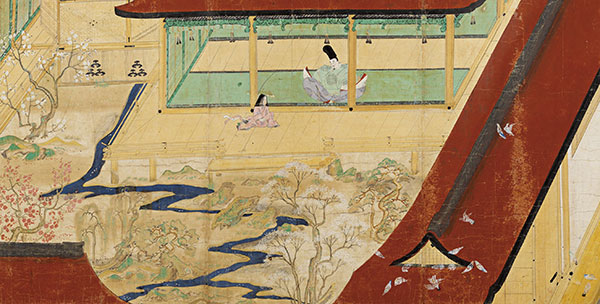
The Jōkyū version preserved by Kitano has a textual date of 1219. Its physical distance from the minister's lifetime is substantial: the narrative was being presented more than three centuries after his death. It is evidence for medieval understandings of Tenjin, not an illustrated eyewitness report of the ninth-century court.[5]
A reproduced scene from its first scroll makes the courtly setting tangible. An opened architectural view gives access to verandas and rooms; robed figures appear within them. Flowering branches occupy the garden, and a curving band of water passes through the composition. Buildings, cultivated ground, and figures situate the story within an ordered human environment.[5]
The image does a different kind of work from a modern chronological list. It gives readers a world in which the remembered person can act. His literary identity and his relation to the court have a setting, while the larger origin narrative carries his story towards the religious place that preserves it.
The genre also made such stories adaptable. Kyūshū National Museum's account of the 1311 Matsuzaki Tenjin engi at Hōfu Tenmangū describes a sequence that joins the wider Tenjin story to the foundation and associations of that particular shrine. A shared sacred biography could acquire a local destination.[6]
At Kitano, the destination was already embedded in the work's title and custody. The scrolls linked the figure worshipped in the sanctuary with a history of events, revelations, and benefits. That framework helped explain whom an offering addressed. Poetry would enter a relationship already supplied with a life story and a place, rather than being directed towards an anonymous god of examination results.
3. Literary authority was an early part of the worship
The literary dimension need not be postponed until the development of modern schooling. Kitano's research chronology identifies a dedicatory text by Yoshishige no Yasutane in 986 that praises Michizane as an “ancestor of letters” and “master of poetry.” A further offering text by Ōe no Masahira in 1012 similarly invokes his authority over literature and the poetic world.[7]
These are religious addresses, not retrospective school prospectuses. Their praise places literary accomplishment within the relationship between the worshipper and the deity. The same person whose anger had been invoked to explain disaster could be honoured for cultivated knowledge. We do not have to imagine one identity being completely discarded before the other could be used.
A literary patron also presented a particular possibility for devotion. Someone seeking skill could address him through the exercise of skill. The offering could be a composed work, with the effort of choosing and arranging words embodied in what was presented. Its appropriateness depended on the recipient's literary identity.
At Kitano, this connection eventually acquired an institutional setting for renga, or linked verse. The shrine records a poetry assembly hall, a kaisho, and in 1488 the poet Sōgi's appointment to administer it. The office connected a named practitioner with an establishment at the shrine; it was more specific than the general admiration of a famous poet.[8]
The shrine's account of its renga tradition also identifies the master of the assembly with the title hana no moto sōshō, “master beneath the flowers.” It describes meetings before Tenjin's portrait and associates a surviving well beside the Kōbaiden with the former assembly site. The well, the record of an office, and the portrait arrangement preserve different traces of the poetry institution.[1]
Together they restore something easily lost when a shrine is described only through its sanctuary. Literary activity needed a setting and organization. The deity supplied the dedication; living specialists supplied the judgment required to make a composition. A religious recipient did not remove the practical demands of the art.
4. Many voices, one sequence
Renga made those demands collaborative. A sequence alternates longer and shorter contributions: seventeen and fourteen Japanese sound units, conventionally arranged as 5–7–5 and 7–7. Each new verse links with its immediate predecessor, while the composition moves onward rather than maintaining a single plot. Rules regulate the recurrence and spacing of such subjects as seasons and poetic motifs.[9]
This asks something different from a recital in which each guest presents a finished, independent poem. A contributor has to find a relation to words supplied by someone else. The next contribution may in turn lead away from the world the previous poet expected. The work belongs to the sequence as well as to its separate makers.
Heidi Buck-Albulet's study of renga distinguishes the participants, the master who guides the proceedings, and the scribe who records the composition. In her account of the premodern model, verses were submitted orally and written down by the scribe. The creation of a manuscript was consequently part of the activity, not merely a record commissioned after every other aspect of it was finished.[9]
At Kitano, that model helps explain why a poetry assembly needed more than a roomful of people willing to write. Contributions had to be coordinated, and a sequence had to be preserved in an intelligible order. An office such as the one associated with Sōgi gave literary expertise an institutional place.
The portrait added another relationship. The assembled poets responded to one another in the making of the work, while its religious dedication addressed Tenjin. Horizontal exchanges among contributors and the shared offering could coexist within the same occasion. The god did not have to become a character in a continuous story for the composition to belong to his worship.
This also gives the finished paper a double significance. It contains words that can be read as literature, but its dedication identifies a religious purpose. To keep only the poem and discard the dedication would lose part of the work's history; to treat the paper solely as a votive object would lose the coordinated literary activity that produced it.
5. A thousand verses become something that can be kept
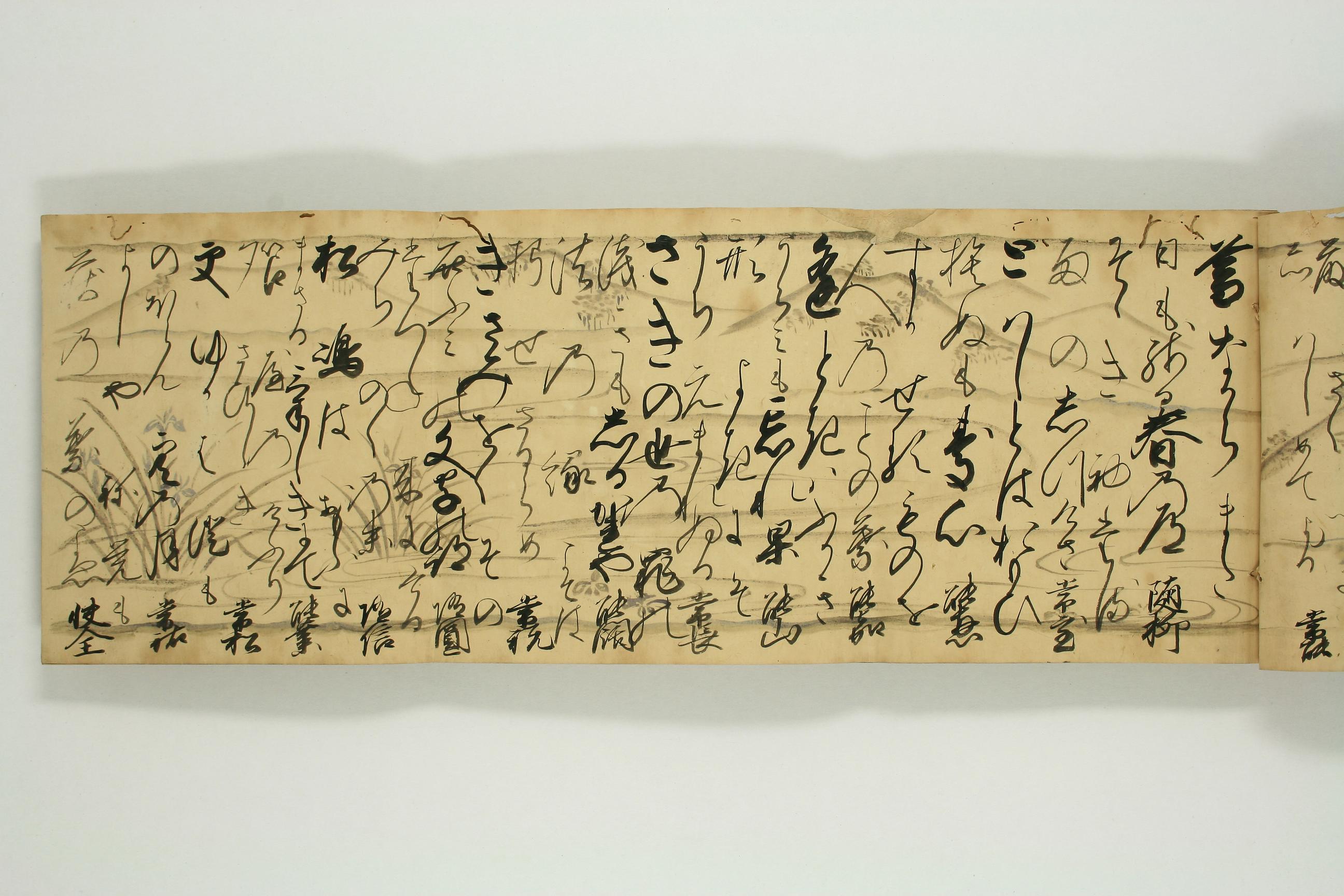
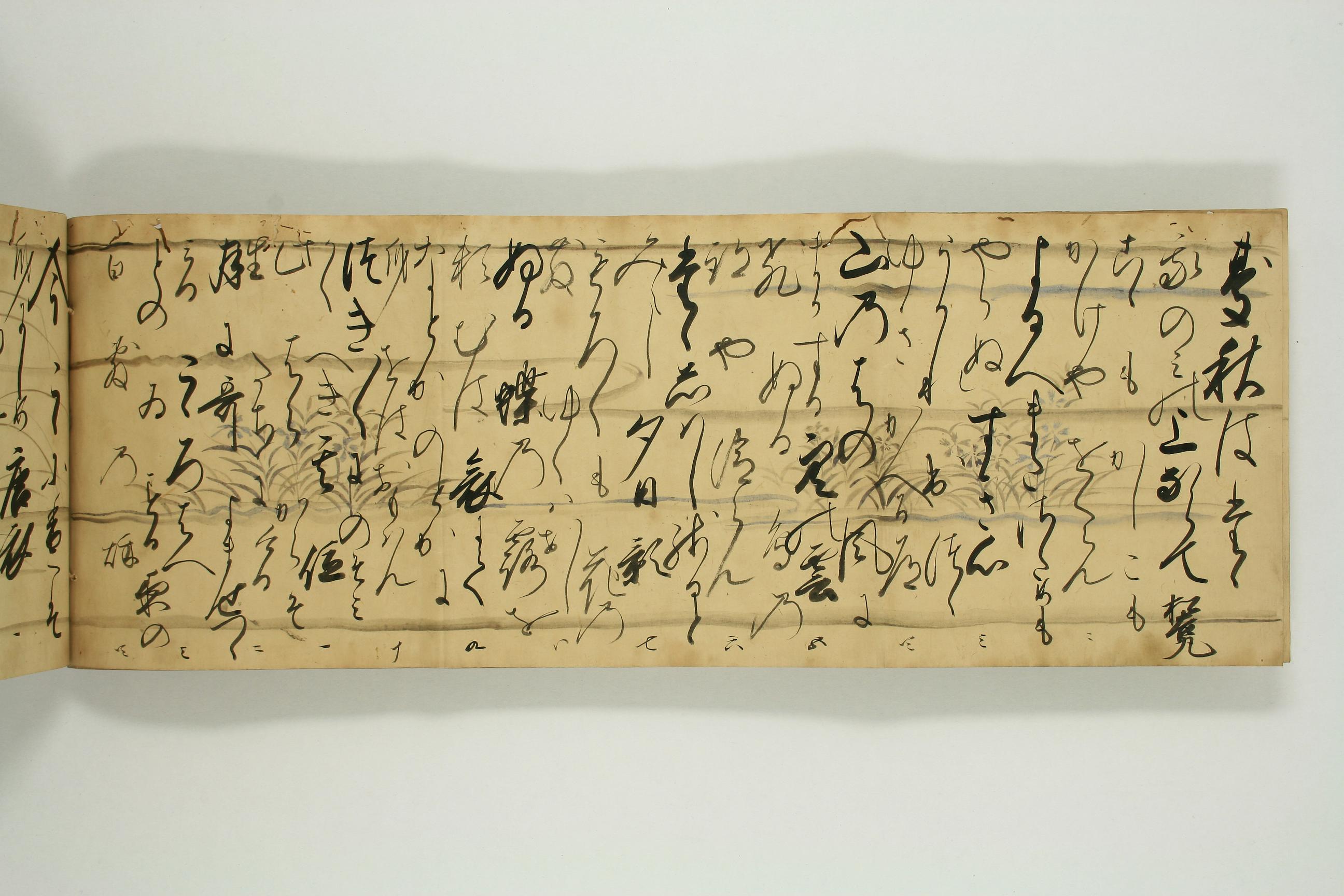
A manuscript set now at Waseda University Library gives that double identity a surviving material form. Catalogued as A Thousand Linked Verses Offered to Kitano Tenmangū, it dates to 1702 and records sponsorship by a member of the Sagara family. Ten booklets and an additional sheet preserve the sequence. The wrapper labels it linked verse for prayer.[10]
The title counts contributions to poetry, not worshippers. A thousand verses need not imply a thousand different people, a single uninterrupted meeting, or a crowd assembled at the shrine. What survives is a named devotional undertaking in a particular manuscript form.
In two reproduced openings from the first booklet, vertical columns of writing occupy long, folded sheets. Smaller names appear below the verse text. Drawn vegetation and water extend beneath the writing. The catalogue identifies the set's decorative repertoire as including pine, bamboo, plum, cranes, and tortoises.[11]
The visual arrangement keeps individual contributions within a common surface. Names remain available, yet no single name turns the whole sequence into one person's poem. Decoration also gives the paper a presentation beyond the minimum required to preserve words. The work has been made into something suitable to keep and offer.
Buck-Albulet distinguishes records produced during composition from fair copies made for particular purposes, including offerings on elaborately decorated paper.[9] The Waseda manuscript should therefore not be treated as a transcript of everything spoken at a gathering. Its appearance supplies evidence of the finished written object, not a reconstruction of the order in which every brushstroke or spoken suggestion occurred.
The manuscript's present location adds another useful distinction. A work dedicated to Kitano can now be studied in a university collection elsewhere. Its title and wrapper preserve the shrine as its religious address even after the object has entered a different custodial setting. The paper connects literary history to Kitano without requiring us to pretend that every related manuscript remains in the shrine's treasury.
6. Poems deep inside the sanctuary
Other literary offerings did remain at Kitano. Research announced in 2023 identified a group of six hundred waka, short Japanese poems, preserved in seven boxes. The group begins with an offering by the retired emperor Go-Sai in 1664 and includes later imperial donations. Some sheets bear imperial handwriting. The poems had been kept deep inside the sanctuary before transfer to the Treasure Hall in the early Shōwa period.[12]
The researchers connected the offerings with kokin denju: the transmission of privileged interpretations of the Kokin Wakashū, the early tenth-century anthology of Japanese poetry. Receiving that teaching was followed by the composition and dedication of new poems. Learned interpretation and fresh literary work were brought into a devotional sequence.[12]
The location of the poems is revealing. Something presented to a deity need not be continually displayed to a human audience. Custody in the sanctuary preserved the dedication even when the sheets were not circulating as reading matter. Their later movement to the treasury and eventual study made another part of their history accessible.
These offerings differ from the collaborative thousand-verse undertaking. The imperial group consists of waka associated with episodes of literary transmission; the renga set preserves linked contributions. The forms of learning and composition were not identical. What they shared was a recipient whose cultivated identity made literary accomplishment an appropriate gift.
A donation of writing could therefore carry information that a financial sum alone would not. It associated a named donor with a learned practice and presented an actual result of that practice. For the historian, the sheet records both composition and an act of religious address. For the shrine, its custody retained a relationship with the giver.
The existence of these boxes does not make Kitano the exclusive centre of poetic devotion. It makes its own role demonstrable through specific offerings. The evidence is richer than a general title such as “god of learning”: it shows what some people did with learning when they approached this god.
7. More than a story about becoming harmless
Kitano's principal sanctuary was completed under Toyotomi Hideyori's patronage in 1607. Its joined worship spaces and elaborate roof composition belong to that early modern building history, centuries after both Michizane and the shrine's foundation. The poems later kept inside consequently entered a setting that was itself another act of patronage.[13]
The shrine's religious life was renewed through practices as well as architecture. Its account of the Yokōsai describes a poetry observance revived in the Taishō period after a long interruption. Submitted poems were selected and presented before the deity. Revival, rather than an assertion of uninterrupted performance, is part of the institution's stated history.[14]
Neither development requires Tenjin's earlier associations to disappear. A shrine can receive prayers for protection and literary offerings within the same religious life. The evidence from Kitano does not form a simple progression from a frightening spirit to a harmless educational mascot. It records several ways in which people addressed a deity with a remembered human career.
Poetry made one of those relationships unusually demanding of its participants. The gift had to be composed. A linked sequence required people to respond to one another, a master to guide the work, and writing to give it a durable form. An imperial waka offering connected received learning with new composition. Kitano supplied a place where those accomplishments could become acts of devotion.
The result is a history of worship expressed through literary production. Tenjin's scholarship was not only a reason to ask for help. It gave worshippers a reason to make something worthy of being presented to him.
Next topic · HO Guides
Daikaku-ji: The Emperor's Other Inheritance
A royal pond, an emperor's instructions, and the guarded handling of sacred writing reveal how an imperial temple joined family memory to religious transmission.
Continue readingSources and NotesView sourcesHide sources
Sources consulted 16 September 2026. Dates of historical Japanese observances are not treated as converted Gregorian dates or as current event listings.
- [1]
Kitano Tenmangū, “もみじ苑・KNF期間中 諸行事一覧,” section “京都連歌の会 もみじ連歌,” historical paragraphs on the assembly hall, its master, the twenty-fifth, Tenjin's portrait, and the well beside Kōbaiden: https://kitanotenmangu.or.jp/news/%E3%82%82%E3%81%BF%E3%81%98%E8%8B%91%E3%83%BBknf%E6%9C%9F%E9%96%93%E4%B8%AD%E3%80%80%E8%AB%B8%E8%A1%8C%E4%BA%8B%E4%B8%80%E8%A6%A7/. The page carries a 2022 publication label; its event schedule is not used. The historical arrangement is attributed to the shrine, not reconstructed from an imagined gathering. No surviving portrait is identified as the particular image used at every meeting, and no current ceremony or physical visit is claimed.
Return to the reference ↑ - [2]
Kitano Cultural Research Institute, “天神信仰ならびに北野天満宮関連年表,” entries for 877, 899–903, 923, and 930: https://kitanotenmangu.or.jp/related-organizations/kitano-bunka/. Used for offices, demotion, death, posthumous reinstatement, and the palace lightning. The essay does not adopt the site's assessments of governing ability, national character, private emotions, or proof of an opponent's concealed motives. The attribution of disasters to the spirit is also described in Kyoto National Museum's historical introduction, note 3.
Return to the reference ↑ - [3]
Kyoto National Museum, 2026 special exhibition “北野天神,” historical introduction and first-section discussion of the 947 foundation and Fujiwara no Morosuke's 959 support: https://www.kyohaku.go.jp/jp/exhibitions/special/2026_kitano/. Compare Kitano Tenmangū, “北野天満宮について,” “御由緒”: https://kitanotenmangu.or.jp/about/. Shrine oracles are presented as foundation tradition. The distinction between restoring an official's rank and establishing worship of a deity is the essay's analysis, not a claim that a single act instantly completed deification.
Return to the reference ↑ - [4]
Miyajima Shin'ichi, Kyūshū National Museum, discussion of its Kitano Tenjin engi acquisition: https://www.kyuhaku.jp/museum/museum_info04-04.html. Complete short essay read, used only for the origin narrative's combination of life, exile, spirit, foundation, and religious benefits. The author's broad generalizations about Japanese society and artistic character are not adopted. This note explains the genre and narrative functions; it does not imply that the museum's later fragment and Kitano's Jōkyū scrolls are the same physical work.
Return to the reference ↑ - [5]
Kyoto National Museum, “北野天神,” section on “北野天神縁起絵巻(承久本),” same URL as note 3. The textual dating to Jōkyū 1 (1219) is distinguished from Michizane's lifetime. The reproduced first-scroll scene: https://www.kyohaku.go.jp/jp/exhibitions/assets/special/2026_kitano/tenjin_02-01_050-01.jpg. The description is limited to the displayed architecture, robed figures, flowering branches, and water. It does not identify every figure, reconstruct a real floor plan, or imply inspection of the complete scroll sequence. No unseen thunder scene is described.
Return to the reference ↑ - [6]
Kyūshū National Museum, “天神縁起の世界”: https://www.kyuhaku.jp/exhibition/exhibition_pre170.html. Relevant account of the 1311 Matsuzaki Tenjin engi and its locally specific narrative read. Used as one documented comparison showing adaptation of Tenjin origin narratives, not as a second principal Place or proof that every Tenjin shrine followed an identical process. The complete Hōfu scrolls were not independently examined.
Return to the reference ↑ - [7]
Kitano Cultural Research Institute chronology, entries for 986 and 1012, URL in note 2. It identifies Yoshishige no Yasutane's “賽菅丞相廟願文” and Ōe no Masahira's “北野天神供御幣并種々物文.” The brief English phrases are the writer's translations of the public-domain expressions “文道之祖” and “詩境之主,” not quotations from an unread modern translation. The source supports early literary praise in devotional texts; it does not measure the beliefs of the entire population or establish a single date when one divine identity replaced another.
Return to the reference ↑ - [8]
Kitano Cultural Research Institute chronology, 1488 entry naming Sōgi's appointment as “北野連歌会所奉行,” URL in note 2; Kitano Tenmangū, “北野天満宮について,” “和歌・連歌の神,” URL in note 3. See also the assembly-hall account in note 1. The essay uses the appointment and institutional location, not a complete personnel list, attendance record, or claim that the historic hall survives intact.
Return to the reference ↑ - [9]
Heidi Buck-Albulet, “Performing Renga with Manuscripts,” in Manuscripts and Performances in Religions, Arts, and Sciences (De Gruyter, copyright 2024), pp. 425–452, especially the introduction and discussions of composition, roles, and manuscripts on pp. 426–431; DOI 10.1515/9783111343556-014: https://www.researchgate.net/publication/375810746_Performing_Renga_with_Manuscripts. These actual sections were read in the full-text transcription, not merely the abstract. The host dates the upload November 2023; the chapter itself carries the 2024 copyright. The source combines a model of premodern practice with contemporary fieldwork. Only the explicitly relevant premodern model and general verse structure are used here; modern charts, individual participants' record-keeping, and reported present-day scenes are not projected onto Kitano. No unseen chapter figure is described. “Sound units” renders morae without treating them as identical to English syllables.
Return to the reference ↑ - [10]
Waseda University Library, Kitano Tenmangū hōraku senku renga, parts 1–10 and supplement, call number 文庫20 00049, Ijichi Tetsuo Collection: https://www.wul.waseda.ac.jp/kotenseki/html/bunko20/bunko20_00049/index.html. It gives 1702, sponsorship by 相良頼喬, ten booklets and one sheet, and wrapper title “御祈祷之御連歌.” The historical second-month date is not converted to Gregorian February. The essay does not infer the number of participants, length of a session, or that composition necessarily occurred inside the shrine from the dedicatory title alone.
Return to the reference ↑ - [11]
Waseda, same record, decoration and contents fields, and the actual reproductions of first-booklet openings p0003 and p0004: https://archive.wul.waseda.ac.jp/kosho/bunko20/bunko20_00049/bunko20_00049_0001/bunko20_00049_0001_p0003.jpg and https://archive.wul.waseda.ac.jp/kosho/bunko20/bunko20_00049/bunko20_00049_0001/bunko20_00049_0001_p0004.jpg. Observations concern columns, names, folds, and underdrawing. The complete thousand verses were not transcribed or interpreted, and the manuscript is not asserted to be an unrevised onsite performance record. Its earlier route from a devotional undertaking into the present university collection has not been reconstructed.
Return to the reference ↑ - [12]
Nishida Kensaku, “『古今伝授』後の和歌600首、北野天満宮に 天皇・上皇の直筆など、道真への崇敬示す?,” Asahi Shimbun, 4 October 2023; reproduced 7 October in Kōsho Kōjitsu: https://book.asahi.com/article/15021822. Includes direct comments from researcher Hasegawa Chihiro and the shrine. The findings are reported as the research team's identification: six hundred poems in seven boxes, the first offering in this series in 1664, and association with kokin denju. Some, not all, sheets are imperial autographs. The complete newly published edition and every poem were not read. The sanctuary-to-treasury move is the report's account; “early Shōwa” is not silently changed to an exact year.
Return to the reference ↑ - [13]
Kitano Tenmangū, “北野天満宮について,” paragraph beginning “現在の御本殿,” URL in note 3; Kyoto National Museum, “北野天神,” discussion of the early modern sanctuary, same note. Used for Hideyori's patronage, 1607 completion, and the connected sanctuary complex. The building's existence is not treated as proof of the donor's private motives or as a surviving tenth-century shrine. No detailed floor-plan inference or promise of interior admission is made.
Return to the reference ↑ - [14]
Kitano Tenmangū, “北野天満宮について,” “余香祭(10月29日),” URL in note 3. The entry explicitly reports interruption followed by revival in the Taishō period, with selected poetic submissions presented. The essay uses that stated history, not a current calendar invitation or a guarantee that an unchanged rite ran continuously from Michizane's lifetime. The reading Yokōsai was also checked against the shrine’s annual-events entry, https://kitanotenmangu.or.jp/event/. The same page's erroneous conversion of Engi 3 as 909 in its separate “明祭” entry is not repeated; the research chronology's 903 death date is used.
Return to the reference ↑