Read the article below. Interactive reading tools are available when scripts load.
Quick
Sakamoto Ryōma was born in Kōchi castle town in Tosa, on Shikoku, to a gōshi family. The familiar fifteenth day of the eleventh month of Tenpō 6 converts to 3 January 1836; its era-year is commonly labeled 1835. The National Diet Library also records an alternative tenth-month birth. Gōshi were samurai but ranked below Tosa's upper retainers, affecting etiquette, office, and opportunity. This hierarchy formed part of Ryōma's environment, but it does not by itself explain later domain departure or cross-domain politics. His commercial family resources and samurai status also gave him advantages unavailable to most residents. [1]
Ryōma traveled to Edo, today's Tokyo, in 1853 to study swordsmanship with Chiba Sadakichi. Perry's American squadron arrived while he was there, and he was mobilized for coastal defense. Ships required crews and government support beyond an individual's sword skill. The Kōchi memorial museum identifies a further contact in winter 1854: painter Kawada Shōryū, who had recorded John Manjirō's overseas experience, explained the need for ships and trained personnel. Ryōma's practical naval work came later through shogunal official Katsu Kaishū, building on training and contacts rather than one sudden conversion.
Ryōma joined the Tosa Loyalist Party formed by Takechi Zuizan as loyalist and expulsionist politics expanded. In 1862 he left Tosa without authorization, becoming a domain fugitive. Dappan removed official protection, income, and lawful mobility and could expose relatives or associates to investigation. It was not the exercise of a modern right to choose employment. The break enabled cross-domain activity, but its motives cannot be reduced to a timeless desire for freedom or assumed complete rejection of everyone in Tosa.
Ryōma joined naval reformer Katsu Kaishū's network around 1862. Katsu's later recollections say he arrived intending to kill him and became his disciple. Former Fukui lord Matsudaira Shungaku's account instead describes a letter of introduction, supporting a less hostile interpretation. Their subsequent work together is better established than the famous meeting's exact dialogue and intentions. Katsu supplied protection and projects through which Ryōma could learn maritime organization.
From 1863 Ryōma joined Katsu's private naval school at Kobe. The official establishment opened in 1864 under shogunal support. Recruits came from different domains, but students' involvement on Chōshū's side in Kyoto raised suspicion. Chōshū was a western Honshū domain resisting shogunal authority. Katsu lost office in 1864; the official establishment closed in 1865. These were related but separate events. Ryōma and associates retained contacts and sought sponsors such as Satsuma, a southern Kyushu domain, for new work.
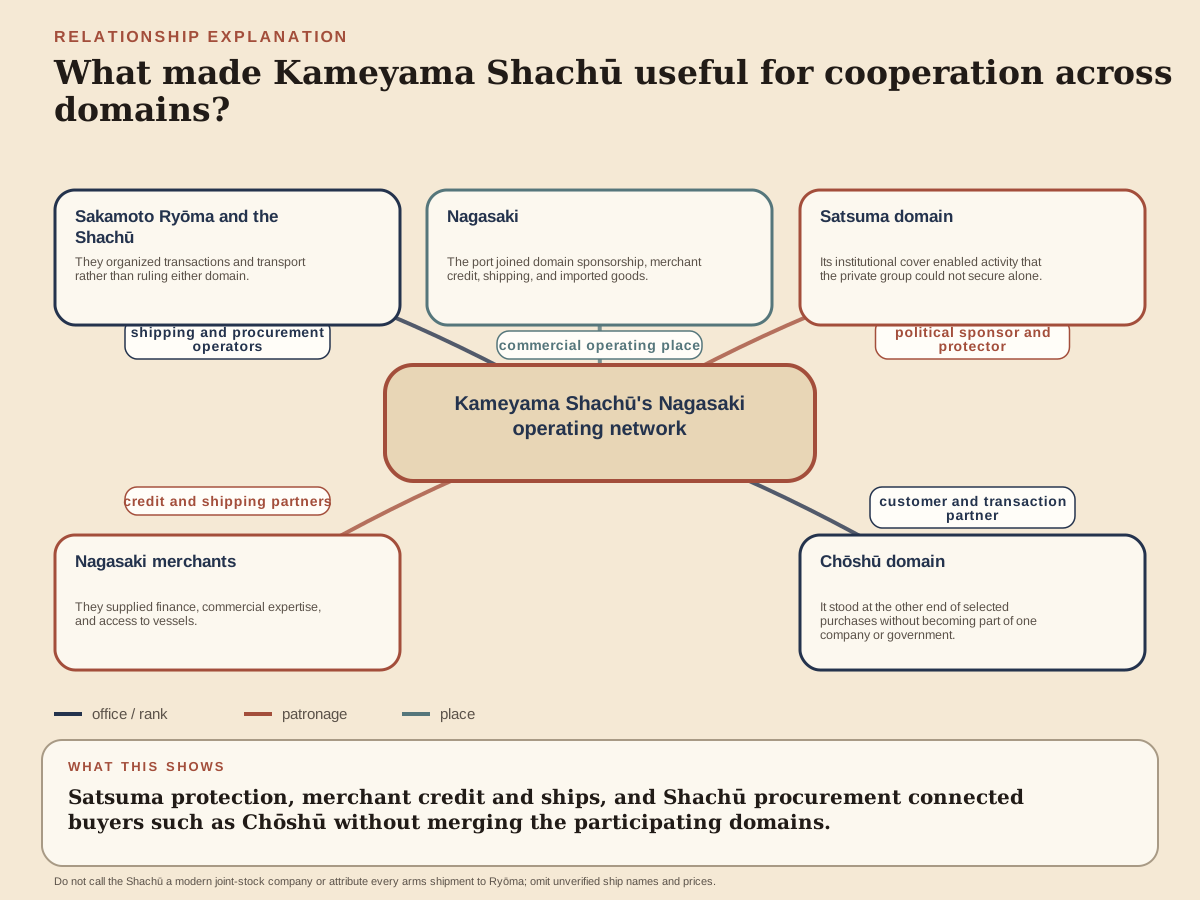
Around 1865 Ryōma and associates formed the Kameyama Shachū, a maritime association in Nagasaki, with Satsuma protection. Shipping and procurement made political cooperation practical by moving goods and establishing credit. Its popular description as Japan's first company applies a later corporate category to an organization dependent on patrons and partners. Its substantial contribution was joining commerce to communication between domains.
Ryōma and fellow Tosa activist Nakaoka Shintarō carried messages as Satsuma and Chōshū moved toward cooperation. Arms procurement supplied practical channels alongside shared concern about shogunal power. Senior Satsuma leader Saigō Takamori and Chōshū leader Kido Takayoshi reached their 1866 agreement; Ryōma later confirmed its six terms on the reverse of Kido's document. He helped make the understanding trustworthy, while the two domains' leaders retained control of policy, money and troops.
Fushimi magistrate's officers came to Teradaya to arrest Ryōma in 1866. His partner Oryō warned him; Miyoshi Shinzō, a Chōfu domain retainer, helped him escape after he was wounded. Satsuma supplied shelter and care, followed by recovery travel with Oryō. Her recollections place their marriage in 1864, while the memorial museum's narrative places it after this escape. Ryōma explicitly called her his wife in later 1866 correspondence. Those differences do not diminish her role in his survival.
Tosa sponsorship and pardon for unauthorized departure allowed the Kaientai to form in 1867 under Ryōma's leadership. Its rules included navigation and English studies. The Iroha Maru sank after collision with the Meikō Maru of Kishū, a Kii Peninsula domain. Ryōma pressed a compensation claim through negotiation and publicity. A letter to his brother reported acceptance of his case, but that self-report was not an independent judgment on every cargo valuation. The group's commercial work depended on maritime and administrative specialists.
The New Government Program of Eight Proposals, dated to Keiō 3's eleventh month, calls for talented advisers, substantive offices for capable lords and a new common body of law. Upper and lower deliberative bodies would sit alongside army and navy bureaus. This surviving later text is distinct from the traditional Senchū Hassaku, or Eight Proposals While Aboard Ship, associated with an earlier 1867 journey. Chino Fumiya argues that the celebrated shipboard story developed in Meiji biography. Concrete reform proposals survive without resolving that earlier text's transmission.
Ryōma worked with Gotō and other Tosa figures advocating that Tokugawa Yoshinobu, the head of the warrior government, return governing authority to the court and participate in a reorganized polity. Former Tosa lord Yamauchi Yōdō submitted Tosa's proposal, and Yoshinobu made his own strategic decision to accept return of rule in 1867. Ryōma's mediation and programmatic ideas mattered, but he did not command Tosa, the court, Satsuma, Chōshū, or the shogun. The act did not peacefully complete regime change: disputes over Yoshinobu's lands, office, and military power soon led to restoration conflict and war.
Attackers struck Ryōma and Nakaoka Shintarō at Kyoto's Ōmiya premises on 10 December 1867 in the Gregorian calendar—the old calendar's eleventh month, fifteenth day of Keiō 3. Ryōma died that night; Nakaoka survived briefly. The Kōchi memorial museum presents the shogunal Kyoto Mimawarigumi patrol as the leading perpetrator explanation, based on later participant-linked testimony. It also notes differences among accounts associated with Imai Nobuo, Watanabe Atsushi and Nakaoka. Patrol involvement does not settle each assailant's role or identify a hidden sponsor. The apparent birthday coincidence depends on one disputed birth tradition.
Preserved letters and photographs helped sustain Ryōma's reputation after his death. In 1883 Sakazaki Shiran portrayed him in the serialized novel Kanketsu Senri no Koma in Doyō Shimbun. Later book adaptations changed the narrative. Its popular-rights politics presented Ryōma's nephew Sakamoto Namio as a successor to his ideals. By 1912 such biography had attached an unfinished 1867 career to later political causes. His documented brokerage remained substantial without making him the sole author of national transformation.
Classic
Sakamoto Ryōma was born in Kōchi castle town in Tosa, on the island of Shikoku. His parents were Hachihei and Kō, and he was the youngest of their children. The family's main line ran the Saitaniya merchant business; his own branch had acquired gōshi status. These lower-ranked samurai had recognized warrior standing but did not enjoy the same access and appointments as the domain's upper retainers. [1]
The household's commercial resources gave Ryōma opportunities unavailable to most townspeople. He could pursue training and travel with family support while encountering a hierarchy that limited a gōshi's place in government. That combination shaped his starting position without determining his later political course.
His birth date has more than one presentation. The Kōchi museum uses the fifteenth day of the eleventh month of Tenpō 6, converted to 3 January 1836. The National Diet Library also records a theory placing the birth in the tenth month. The 1835 era-year and an 1836 Western date can therefore coexist, while the alternative lunar month is a separate question. The popular claim that he died on his birthday depends on accepting a particular birth tradition. [1][2]
Family support later sustained study in Edo and helped preserve his correspondence. His sister Otome became one of the recipients through whom his changing interests can be followed. His relatives' lives continued beyond the career that eventually made their household famous.
Later biographers made stories of childhood bullying or weakness into a dramatic transformation. The Kōchi memorial museum notes that such a childhood reputation lacks surviving records. His documented place in Tosa society and subsequent sword training supply a clearer starting point. Foreign-policy crisis and contacts beyond the domain would intervene before he became a political intermediary. [1]
Ryōma learned swordsmanship in Tosa and went to Edo, today's Tokyo, in 1853 to study with Chiba Sadakichi in the Hokushin Ittō-ryū school. A dōjō, or martial training school, supplied instruction and contacts among warriors from other domains. For a provincial samurai, study in Edo widened the people he could meet and the political news he could hear. [1][3]
Training depended on family resources and permission to travel. Ryōma's movement into the capital's wider society began through an accepted samurai pursuit, before he left Tosa's service relationship behind.
Commodore Perry's American squadron arrived near Edo in 1853, demanding that Japan open relations under the pressure of naval force. Ryōma was in the region for sword training and was mobilized for coastal defense. The alarm drew a provincial student into a national crisis without giving him the knowledge or authority of the officials negotiating with the Americans. [1]
The Kōchi memorial museum identifies a further contact in the winter of 1854, after his return to Tosa: Kawada Shōryū, a painter who had recorded the overseas experiences of the returned traveler John Manjirō. Kawada explained the need for large ships and people trained to operate them. This gives the maritime learning a more concrete connection than an instant conversion at the sight of Perry's squadron.
Steamships and naval artillery exposed the limits of defense centered on individual warrior skill. Maintaining a fleet required navigation, technical training and reliable supplies. Decisions over ports and treaties belonged to government, where learning from foreign powers and resisting their demands could be competing or combined purposes.
The crisis developed through Perry's return, agreements and later commercial treaties, sharpening disagreement between the imperial court and the shogunate, Japan's warrior government. Ryōma's practical participation in naval work came later through Katsu Kaishū, a shogunal naval official. Coastal alarm and conversations about ships preceded access to the crews and institutions needed to operate them.
In 1861 Ryōma joined the Tosa Loyalist Party organized by Takechi Zuizan, also known as Takechi Hanpeita. Its members sought a stronger role for imperial authority amid the crisis over foreign relations. The movement operated within Tosa's politics; it was not simply an early version of Ryōma's later naval network. [1][3]
In 1862 he left Tosa without permission. Dappan, unauthorized departure from a domain, broke the service relationship under which a samurai held status and protection. Outside it, he could encounter activists and reformers from other domains, but he also became dependent on new patrons for safety and opportunity. [1][3]
Leaving without permission weakened his protection while widening the people he could approach. New patrons controlled the resources that could make travel and work possible. Ryōma could communicate across domain boundaries without being a fully authorized envoy, but he could not promise another lord's support on his own authority. His later Tosa sponsorship belonged to a different stage, after those connections had acquired value.
Ryōma entered the network of shogunal naval official Katsu Kaishū around 1862. Katsu advocated learning foreign techniques so that Japan could build maritime strength. He could connect that argument to ships and training projects, offering work as well as ideas to a fugitive who lacked an office of his own. [1][3]
Two accounts give their first meeting different meanings. Katsu's later recollections say Ryōma came intending to kill him and became his disciple. Former Fukui lord Matsudaira Shungaku's account describes providing a letter of introduction, which permits a less hostile explanation. Their subsequent association is firmer ground than the exact intentions and dialogue of the celebrated conversion scene. [1]
Katsu held office and connections; Ryōma needed protection and useful employment. Naval projects brought him into practical cooperation with men beyond one domain. Katsu, in turn, gained capable recruits with local knowledge and political contacts. Learning foreign navigation could serve a concern with Japan's defense without requiring approval of foreign coercion. The relationship changed what Ryōma could do through participation over time.
Discipleship gave Ryōma access to sustained naval work, while tying his opportunity to Katsu's standing in the shogunate. Katsu retained his own policy and would later negotiate Edo's surrender. Ryōma used the contacts for more mobile organizations and mediation. Their collaboration opened possibilities without requiring identical careers.
From 1863 Katsu developed naval training at Kobe, near Osaka and the Inland Sea. Ryōma joined his associated private school and worked among recruits from different domains. The official naval establishment opened in 1864. Its institutional backing and facilities were distinct from the private school, even though the two belonged to the same reform project. [1][9]
Kobe's position near Osaka and the Inland Sea connected training to maritime routes and the political centers of the region. Learning to navigate and operate ships required shared discipline as well as technical instruction. Cooperation among mobile warriors could therefore become an institutional experiment in who was eligible to serve.
Recruitment beyond one domain allowed mobile warriors to enter technical work under shogunal sponsorship. Their political contacts also made the schools vulnerable. Students' involvement on the Chōshū side in the 1864 Kyoto crisis raised suspicion of a project protected by Katsu. Chōshū was a powerful domain in western Honshū opposed to shogunal policing in the capital.
Katsu lost office in 1864, and protection for his private recruits weakened. The official establishment closed in 1865, not at the same moment as his dismissal. Knowledge and contacts survived those changes. Ryōma and associates sought new sponsors, including Satsuma, a domain in southern Kyushu, and moved toward Nagasaki's commercial networks. [9][10]
Around 1865 Ryōma and associates organized the Kameyama Shachū in Nagasaki under Satsuma protection. Shachū meant an association; this group combined maritime activity with procurement and political communication. Nagasaki already contained the merchants, interpreters and trading connections through which domains obtained foreign goods. The new organization assembled particular relationships within that established port economy. [1][3]
Satsuma sponsorship gave men with weak independent legal standing resources and protection. It made their work possible while tying the association to a domain's purposes.
Members needed income, and ships needed financing. Political mediation became effective when it could move arms or cargo and establish credit. The Shachū connected those practical tasks to cooperation between domains. Its small size meant that outside merchants and sponsors supplied resources it could not own outright. A vessel used by the group might be chartered or supplied by a partner rather than purchased from its own capital. [1]
The popular description of the Shachū as Japan's first company applies a later corporate label to an association dependent on patrons and partners. Its members performed shipping and brokerage, but those activities alone do not establish the legal form of a modern joint-stock company. Their contribution lay in making cooperation work through repeated transactions.
After their confrontation in Kyoto, Satsuma and Chōshū leaders had reasons to reconsider cooperation. Pressure from the shogunate threatened Chōshū, while Satsuma sought a stronger role in national policy. Direct trust remained difficult. An intermediary could carry proposals and check whether the other side would perform a promise without either domain immediately committing its forces.
Nakaoka Shintarō, a fellow Tosa activist, worked to bring the domains together. Ryōma's commercial connections helped make cooperation practical: Chōshū could acquire arms through Satsuma-linked channels despite political barriers to direct purchase. Trade supplied a test of whether promises could be performed. [1][3]
In 1866 Saigō Takamori, a senior Satsuma leader, and Kido Takayoshi, a Chōshū leader, reached an understanding whose terms Ryōma helped confirm. The agreement coordinated domains that still possessed their own leaders and forces. It did not create a single government or permanently settle their interests. [1][7]
The Kōchi memorial museum describes Kido writing the six agreed terms and asking Ryōma to confirm them on the reverse. Ryōma supplied that confirmation after the Teradaya attack had wounded his hands. The surviving document gives his brokerage a specific task: checking an agreement made by leaders who still controlled their own domains and troops. [7]
In early 1866 the agreement's success was uncertain. Disclosure or military defeat could undo it, and each domain still had to decide how to act. Ryōma made communication and confirmation easier without commanding either side's troops or treasury. His contribution depended on leaders willing to turn mediated proposals into policy.
Soon after the Satsuma–Chōshū agreement, officials from the Fushimi magistrate's office came to the Teradaya inn to arrest Ryōma. He resisted, was wounded and escaped with help. His partner Oryō, later explicitly named as his wife in correspondence, warned him of the danger; the Chōfu retainer Miyoshi Shinzō also helped him reach safety. Satsuma protection then made care and recovery possible. [1][7][11]
Ryōma's subsequent correspondence supports the warning and escape, while later accounts expanded their dramatic presentation. Oryō made a consequential judgment during an emergency. The much-repeated image of her running from a bath could turn that action into spectacle and obscure the danger she faced. [7][11]
Escape from the inn was only the first stage. Helpers arranged shelter and care, and the wound affected Ryōma's ability to travel. His subsequent journey with Oryō to Satsuma combined recovery with visits under their patrons' protection. The familiar description of this journey as Japan's first honeymoon gives it a later national superlative that the couple's travel does not establish. [11]
Their marriage has more than one chronology. Oryō's recollections place it in 1864; the memorial museum's narrative places marriage after the 1866 escape and nursing. Ryōma explicitly called her his wife in a letter dated to the twelfth month's fourth day of Keiō 2. The difference concerns when the marriage was recognized, not whether her warning and care mattered to his survival.
In 1867 Tosa sponsorship brought Ryōma's maritime group back into a relationship with his original domain. The former Kameyama association became the Kaientai, with Ryōma as leader. Domain officials arranged pardon for his unauthorized departure. Its written rules admitted men who had left domains and others wishing to go overseas, and set navigation and English among their studies. [1][7]
Nagaoka Kenkichi helped with documents and administration, while captains and crews operated the vessels. Merchants and sponsors supplied credit. Ryōma's leadership depended on this shared capacity, which became visible when the Iroha Maru collided with a Kishū domain vessel and sank.
The Iroha Maru, operated through the group's maritime network, collided with the Meikō Maru of Kishū, a domain on the Kii Peninsula south of Osaka, and sank. Loss of the ship and its alleged cargo became the subject of a compensation claim. Ryōma used negotiation and publicity to press it, invoking maritime principles in an environment without one settled national admiralty court. [1][7]
A letter to his elder brother, dated to the sixth month's twenty-fourth day of Keiō 3, reported that his position had been accepted. That was Ryōma's account of success, not an independent court judgment establishing every cargo valuation. The settlement showed his ability to mobilize commercial and political leverage against a powerful domain. [7]
Specialized members and outside partners supplied skills and credit that Ryōma could not provide alone. Leading a compensation negotiation did not make him the group's most experienced navigator or accountant. The organization combined those capacities, rather than concentrating all its work in one celebrated man.
The proposals associated with Ryōma's discussions with Gotō Shōjirō in 1867 sought to replace government divided between court and shogunate with a broader political arrangement. Gotō was a senior Tosa official who could bring proposals to Yamauchi Yōdō, the former domain lord. Nagaoka Kenkichi helped prepare related documents. The route from discussion to submission depended on officials with authority to act. [5]
Two texts need to be distinguished. The traditional Senchū Hassaku, or Eight Proposals While Aboard Ship, is associated with a journey in the sixth month of Keiō 3. A later New Government Program of Eight Proposals is dated to the eleventh month of that year. The National Diet Library displays a copy of the latter in Ishida Hidekichi's papers and supplies a transcription; another version survives in Shimonoseki. [3][5]
The later program proposes recruiting prominent talent as advisers and giving substantive court offices to capable lords while removing empty titles. It calls for a new body of law that all lords would follow in governing their dependents. Upper and lower deliberative bodies, together with army and navy bureaus, would place discussion and military organization within a central framework. These are changes to how government would operate, not just a promise of reorganization.
The final passage also allows armed action against powerful people who resist public deliberation. This limits the familiar portrait of Ryōma as committed to peace under every circumstance. The text does not specify popular elections or the full distribution of powers later defined by a constitution.
Historical disagreement · Where did the shipboard eight proposals originate?
The shipboard origin has a separate dispute. The traditional account treats the earlier eight proposals as Ryōma's program composed on the journey. Chino Fumiya's 2013 study, discussed in a memorial-museum lecture announcement, argues that the celebrated shipboard story developed through Sakazaki Shiran's Meiji biography.
The surviving later program gives concrete policy content without settling the earlier text's exact authorship and transmission. [4][6]
In 1867 Ryōma worked with Gotō and other Tosa figures to support return of the shogun's governing authority to the court. Yōdō submitted the domain's proposal. A council centered on the court could preserve places for major lords, including Yōdō and perhaps Tokugawa Yoshinobu, the shogun, while reducing the likelihood of immediate armed overthrow. Tosa's support had its own political purposes. [1][3][5]
Yoshinobu also had reasons to accept. Returning authority could preserve Tokugawa influence within a new arrangement while drawing on the house's substantial lands and administrative experience. The decision was his own strategic response, not a surrender produced solely by Ryōma's persuasion. [1][5]
The return of authority left important decisions open. Tosa hoped to retain places for major lords in a court-centered arrangement; Satsuma and Chōshū leaders did not necessarily share its preference for including Yoshinobu. The Tokugawa house still held substantial lands and forces, so acceptance of the proposal did not itself determine who would command the new government.
Taisei hōkan, the return of governing authority, did not abolish the Tokugawa house or domain rule in one act. The subsequent court coup changed offices and status under a different coalition. Control of lands and military force remained contested. Ryōma helped give a negotiated transition language and a route through Tosa; he did not live to determine the conflict over its implementation. [1]
On 10 December 1867 in the Western calendar, attackers entered the Ōmiya premises in Kyoto and struck Ryōma and Nakaoka Shintarō. Ryōma died that night; Nakaoka survived the attack briefly before dying. The two men belonged to overlapping political networks, but Nakaoka also had his own work in mediation and the Rikuentai, a Tosa-supported land force. [1][11]
The attack came after Yoshinobu's return of governing authority, while competing patrols and domain forces still operated in Kyoto. It removed two intermediaries before the struggle over the new government was settled.
The death date corresponds to the fifteenth day of the eleventh month of Keiō 3. Its apparent coincidence with Ryōma's birthday relies on one of the birth traditions described earlier. The attack's occurrence and victims are much clearer than its full command chain. Accounts of entry and words spoken acquired detail through testimony and later reconstruction; a compelling final scene cannot establish who authorized the killing. [1][11]
Statements attributed to the briefly surviving Nakaoka became part of attempts to identify the assailants. The memorial museum compares versions transmitted by people who reached the victims after the attack. Their reported words differ, and later publication is not a direct transcript of the room. [11]
Historical disagreement · Who was responsible for Ryōma’s assassination?
The Kōchi memorial museum presents Kyoto Mimawarigumi involvement—the shogunate's patrol organization—as the leading perpetrator explanation. It notes differences among Imai's statements and those attributed to Watanabe Atsushi and Nakaoka. Participant-linked testimony gives this explanation more substance than an argument based only on who benefited, but it leaves individual actions and superior authorization uncertain. [11]
Other explanations connect the attack to the Shinsengumi or a hidden domain sponsor, including Satsuma.
Such claims concern different levels of responsibility. Evidence linking patrol members to the killing cannot by itself establish a secret sponsor, and repetition of the same testimony does not create another independent witness. [11]
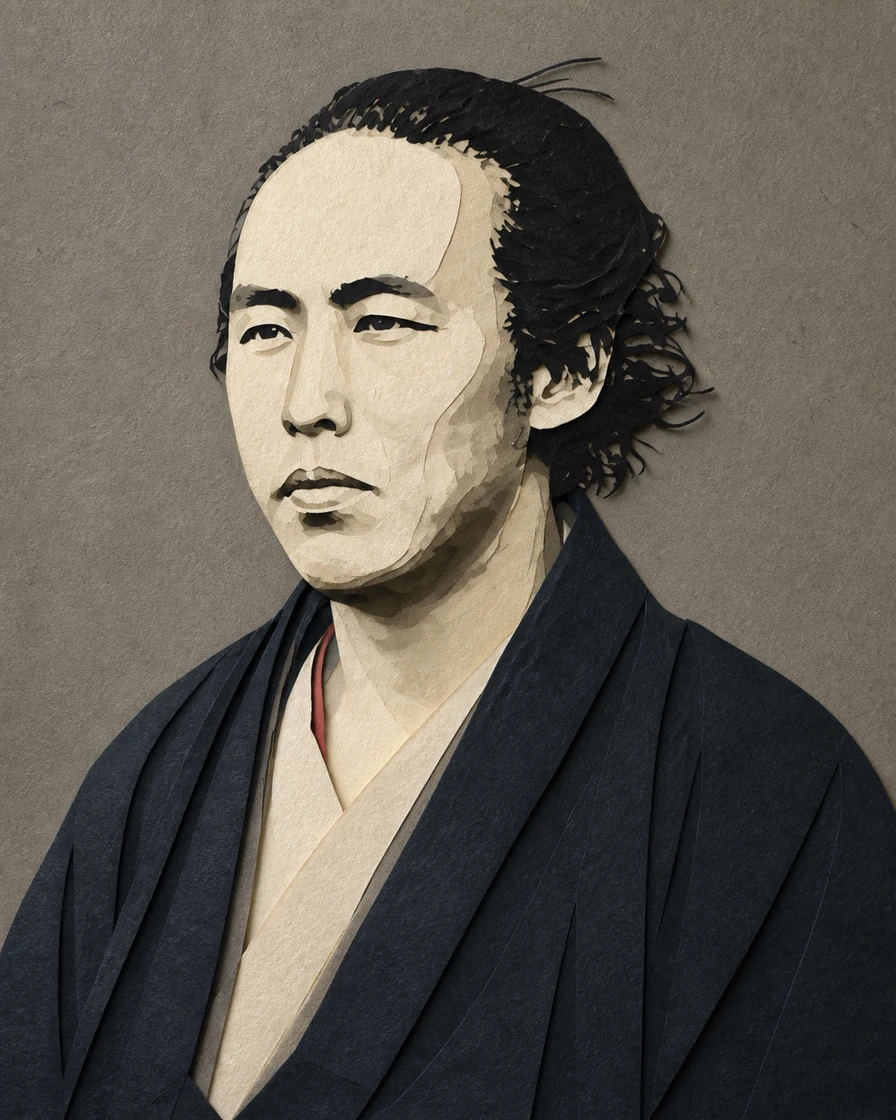
Ryōma left no long government career against which later generations could test the promise of 1867. Family members and associates preserved letters, photographs and memories of a mobile activist whose formal office had been limited. Those materials made him recognizable while allowing different accounts of what his work had meant. [1]
Tosa could reclaim the domain fugitive as a participant in national transformation. His role connected the region to naval enterprise, alliance and proposals for a new order. The unfinished career made those contributions particularly open to expansion by biographers.
In 1883 Sakazaki Shiran's Kanketsu Senri no Koma began serialization in the Tosa newspaper Doyō Shimbun. Publication ran from January to September, with interruption during the author's imprisonment. Book versions were then revised by other writers; the literary museum distinguishes Udagawa Bunkai's incomplete adaptation from Saiga Ryūkō's more dramatic completed version. [8]
The Kōchi Literary Museum reads the work as a political novel as well as an early portrayal of Ryōma. Its ending presents his nephew Sakamoto Namio, a popular-rights activist, as a successor to his ideals. The movement sought wider political participation in Meiji Japan. This reception attached Ryōma's unfinished career to a later political cause, rather than simply recording all his intentions in 1867.
His documented achievement does not require the full later image. Maritime organizations and mediation connected people whose offices and domain loyalties made direct cooperation difficult. Others supplied final decisions and resources. Ryōma's influence could exceed his rank because he worked between those institutions, not because he controlled them all.