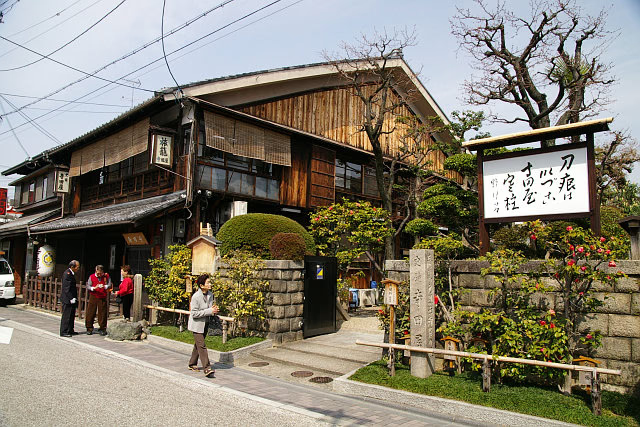
A boat inn in Fushimi's transport economy
Attraction
Teradaya belonged to Fushimi's river-port economy, serving travelers and traffic moving between Kyoto and Osaka by boat and road. That ordinary function explains why political activists, domain retainers, messengers, and officials could meet here without entering a formal palace or barracks. The surviving neighborhood is no longer the same working port, and the present building is later, but canals and the wider Fushimi landscape keep the transport logic legible. Teradaya's political importance grew from its position inside circulation rather than from isolation as a heroic residence.
Current visibility
Fushimi's waterways and district remain legible, but the transport system and inn building have changed substantially since the Bakumatsu period.
The 1862 Satsuma-on-Satsuma confrontation
Attraction
In 1862 Satsuma retainers acting under domain orders confronted fellow Satsuma men and allied activists gathered at Teradaya. The clash left several dead and others arrested, exposing how imperial loyalism did not produce one unified political camp. A memorial stone erected in 1894 honors the men later remembered as the Nine Satsuma Martyrs. The monument is an important Meiji act of commemoration, not a surviving object from the fight. This incident must remain distinct from the better-known attack on Sakamoto Ryōma four years later.
Current visibility
The 1894 memorial is visible near the later property; the original room and 1862 building fabric do not survive.
Attraction
In 1866 officials attempted to seize Sakamoto Ryōma at Teradaya. Accounts connect his warning and escape with Oryō, whose action became central to the episode's later memory. Ryōma was injured but escaped the inn and obtained help. The event reveals how Fushimi's lodging and waterways could serve surveillance, pursuit, refuge, and communication at once. The present building offers an evocative setting, but its baths, stairs, room arrangement, and alleged weapon marks cannot be used as untouched physical proof of the escape because the original inn was later destroyed.
Current visibility
The 1866 event occurred at the earlier inn, which no longer survives; the current interior is not an original crime or escape scene.
The original inn burned; the footprint shifted
Attraction
Kyoto City's historical research concludes that the Bakumatsu Teradaya burned during the 1868 Battle of Toba–Fushimi and that its former footprint lay slightly east of the present building. The current structure is therefore a later successor or reconstruction, not original fabric from the 1862 and 1866 incidents. This finding changes how every interior story must be read. The building can preserve institutional and popular memory, but marks in its wood cannot authenticate violence that occurred in a predecessor. The adjacent spatial distinction is the Place's most important visibility fact.
Current visibility
The present building is later; the earlier inn burned in 1868 and its documented site lay slightly to the east.
Meiji stones and the shaping of Teradaya memory
Attraction
Two Meiji-period memorial layers show how Teradaya was historicized after the Restoration. The 1894 stone commemorates the men killed in the 1862 incident, while a 1904 monument honors Otose, the inn's proprietor remembered for assisting political activists. Neither stone stood here during the violent episodes. Their inscriptions and dates reveal selection: former outlaws or divided loyalists could be recast as exemplary participants in a national transition. The monuments make later public memory visible even where the earlier architecture and exact incident rooms have disappeared.
Current visibility
The memorial stones are visible as later objects; they do not mark intact Bakumatsu rooms or original incident fabric.
A successor interior, not a forensic exhibit
Attraction
The present Teradaya building may operate with interior viewing, interpretation, or lodging functions, but those conditions can change and must be checked directly. Its rooms help explain the scale and atmosphere of an inn only if the later-building status remains visible in the text. Claims that a particular post, blade cut, bullet hole, bath, or stair survives directly from 1862 or 1866 require evidence stronger than tradition attached to the successor property. The honest experience is still rich: it shows how a rebuilt place can carry memory without being the material scene of the remembered events.
Current visibility
Current interior admission, operating function, displayed objects, and closures require official confirmation; no feature is treated as original incident evidence without specific proof.