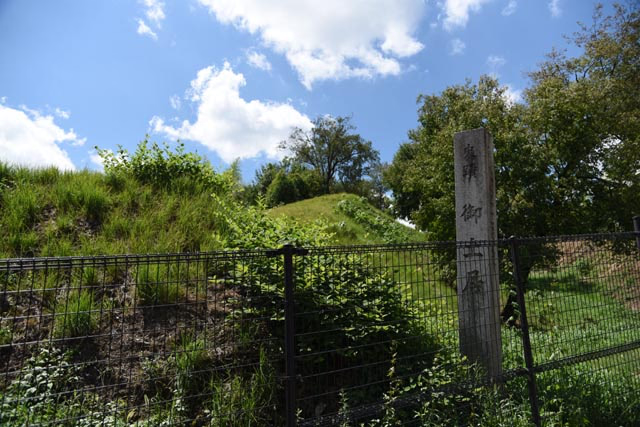
A 1927 marker for a vanished inn
Attraction
Kyoto City's stone marker, erected in 1927, fixes the former Ōmiya inn to a central urban site. No inn façade, guest room, stair, or original interior survives there, and the adjacent commercial premises should not be treated as a reconstruction. The marker is valuable because it distinguishes a documented location from the many later objects and stories attached to Sakamoto Ryōma's death. It also makes the century of change visible: political violence occurred in an ordinary lodging house, while modern commemoration condensed that lost building into one inscribed stone.
Current visibility
The inn is gone; a 1927 marker identifies the site within a modern commercial streetscape, and no historical interior can be entered.
The attack on Ryōma and Nakaoka
Attraction
On 10 December 1867, assailants entered Ōmiya and attacked Sakamoto Ryōma and Nakaoka Shintarō. Ryōma died that night; Nakaoka survived briefly before dying from his wounds. The timing placed the killing between the shogunate's return of authority and the approaching military struggle that would open the Meiji Restoration. The event is commonly centered on Ryōma's assassination, but the Place also preserves Nakaoka's distinct presence and fate. What survives at the address is location and chronology, not an untouched forensic scene.
Current visibility
The event location is marked, but the room, physical crime scene, and original building no longer survive.
A strong attribution without a complete command chain
Attraction
Later testimony and historical research make members of the Kyoto Mimawarigumi the strongest attribution for the immediate attack. That conclusion does not settle every question. Accounts differ in detail, testimony was recorded after the event, and the wider political chain—who ordered, approved, or benefited from the killing—remains debated. The marker cannot resolve those issues by itself. Its most honest interpretive role is to hold certainty and uncertainty together: two men were attacked at Ōmiya, while identifying all assailants and responsibility requires comparison of documents rather than confidence borrowed from a modern site label.
Current visibility
No physical evidence at the modern site independently identifies the attackers; attribution rests on historical testimony and research.