HO Guides
Ōmiya: The House Behind the Assassination
How a merchant household's belongings, correspondence, and acts of preservation carried the history of a vanished room.
Quick · About 2 min
The story in five points
A short route through the argument. Follow a point into Classic for its context and sources.
Ōmiya was a connected merchant household
A soy-sauce business supplying Tosa accommodated Ryōma during unfinished political work in 1867. Calling it simply an inn obscures the household relationship, while Nakaoka brought his own inter-domain connections rather than merely accompanying a more famous visitor.
Read in contextThe attack reached later readers through transmission
Ryōma died that night and Nakaoka two days later. Accounts passed from an injured participant through listeners into publications decades afterward; differing recollections should not be assembled into an apparently verbatim record of the room.
Read in contextA furnishing acquired another purpose
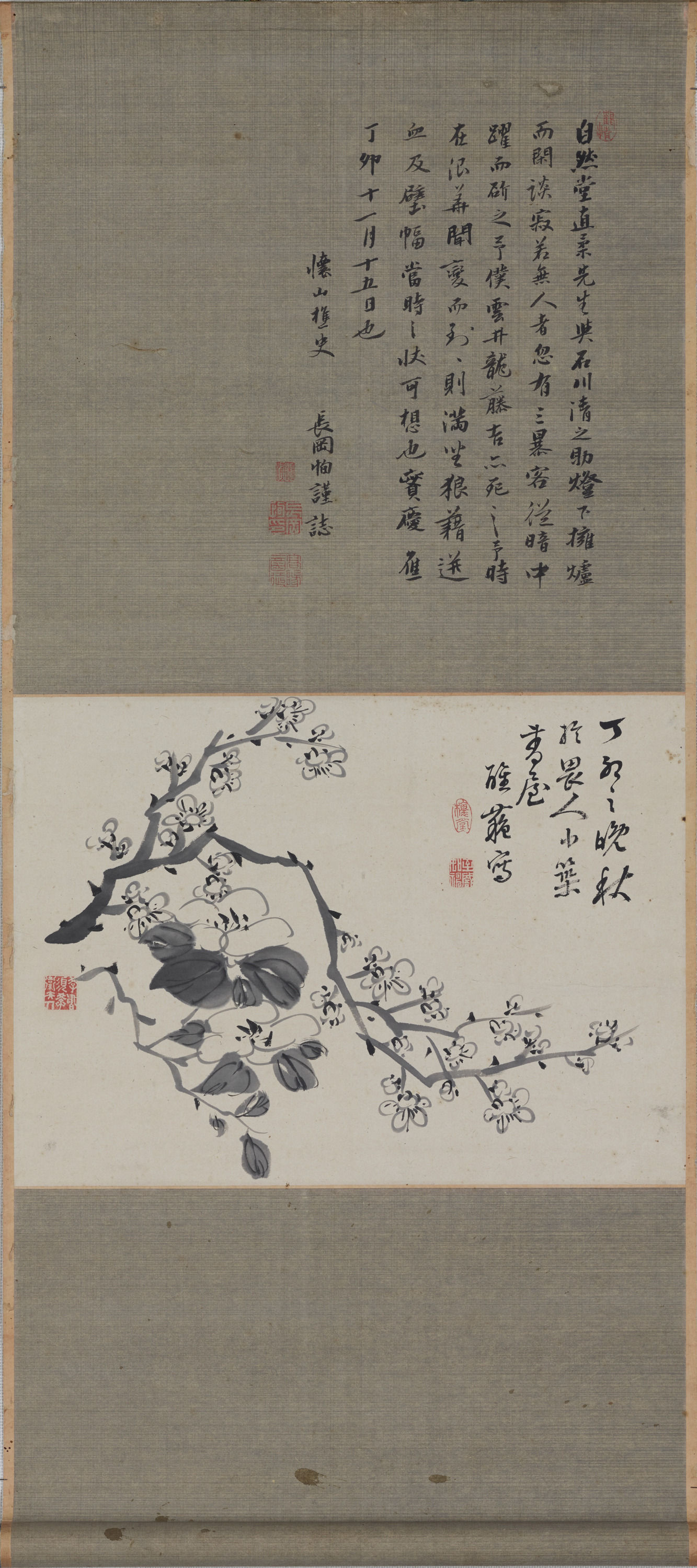
A flower painting associated with the room received Nagaoka Kenkichi’s post-assassination account. The scroll now joins a domestic object, material traces and authored interpretation, none of which automatically verifies every claim supplied by the others.
Read in contextThe household helped create public memory
The Iguchi family preserved furnishings, clothing and papers through different routes into commemorations and museum collections. A robe remembered Ryōma’s life, while correspondence extending into 1868 records relationships and practical business continuing after his death.
Read in contextObjects and address preserve different things
The 1927 marker names the victims and Iguchi household, while dispersed originals and identified reproductions carry the story elsewhere. Their survival preserves specific acts of keeping; it does not restore the vanished upstairs room or resolve every question about the killing.
Read in context
Opening
The stone marking the Ōmiya site gives Sakamoto Ryōma and Nakaoka Shintarō the prominent face. Another face identifies the former house of Iguchi Shinsuke. Erected by the Kyoto City Education Association in 1927, the monument preserves both the celebrated victims of an assassination and the less familiar household at whose address they were attacked.[1]
The second name opens a history that the first two can overshadow. Ōmiya was a soy-sauce business connected with the Tosa domain, and its premises accommodated Ryōma during his last period in Kyoto. After the killing, the Iguchi household also became a custodian of things associated with him. Some entered commemorative exhibitions; others passed through family hands before reaching a museum.[2][8][10]
The building itself has disappeared.[13] Its history survives through these different journeys: from household possession to memorial object, from conversation to recollection, and from a merchant's address to a place marked on the street. Following them brings the house back into the story without pretending to restore the room.
1. Accommodation for unfinished business
Ryōma had previously lodged at Suya, a timber dealer whose premises served as a base for his Kaientai trading and maritime organization. He moved to Ōmiya, which supplied the Tosa domain, during the dangerous final weeks of 1867. Kyoto's historical signboard explains the move in relation to the threat of pursuit after the earlier attack on him at Teradaya.[2]
The important feature of the new address was its existing relationship with Tosa. A domain was a territorial lordship with its own retainers and establishments. A merchant serving it already participated in the practical work of supplying that institution. Lodging at such premises placed Ryōma within an established connection, rather than simply in a room available to any passing traveler.
For that reason, calling Ōmiya an inn obscures more than the shop's product. It removes the household and business relationship that helps explain why this particular man could be accommodated here. The upstairs room belonged to premises with purposes and possessions of their own. The visitors' political work entered that setting; it did not create it.
Nakaoka, like Ryōma, came from Tosa. He had worked between political groups and domains, including Satsuma and Chōshū, and in 1867 organized the Rikuentai, a force intended for intelligence gathering and military service.[3] He was a political participant with his own connections, not simply the companion present when a more famous man died.
Their work belonged to a transition still being negotiated. Tokugawa Yoshinobu had offered to return governing authority to the imperial court. What would follow required decisions about personnel, institutions, and money. A surviving draft associated with Ryōma's journey to Fukui concerns consultation with Matsudaira Shungaku about the future political arrangement and with Mitsuoka Hachirō about finances. The museum identifies it as a probable report to the Tosa official Gotō Shōjirō; the dispatched version has not been found.[4]
The draft gives the weeks before the attack a different shape from an account that ends national politics with Yoshinobu's announcement. There was still work to be done. Returning authority did not supply a treasury, select everyone who would serve, or settle how the new arrangement would operate. These questions explain the continuing traffic of people such as Ryōma between political centers.
A much shorter note to Mutsu Munemitsu shows another kind of unfinished business. Conventionally dated two days before the attack, it discusses a promised blade, an Osaka messenger who had not returned, and the inscription and shape of another weapon. Ryōma also offers to show his own long wakizashi, a type of short sword.[5] The note looks forward to ordinary exchanges still to be completed. It is not a farewell prepared for the ending later readers know.
2. A room becomes a reported event
On the fifteenth day of the eleventh month in Japan's calendar of 1867, assailants attacked Ryōma and Nakaoka at Ōmiya. Ryōma died that night; Nakaoka survived for two more days. The city's account also remembers Yamada Tōkichi among the victims.[2] The familiar pairing of two political names does not exhaust the people caught in the violence.
The interval before Nakaoka's death mattered to what could subsequently be known. According to the Sakamoto Ryōma Memorial Museum, he described the encounter to people who came afterward. Recollections associated with those listeners became part of the record through which later generations reconstructed the attack.[6]
That transmission is visible in the museum's comparison of accounts of Ryōma's last words. It identifies versions in a posthumous collection published in 1912 and in autobiographies published in 1919 and 1926. They differ in what they report.[6] The publication dates place the surviving narratives decades after the room's violent interruption.
There is a human sequence behind that gap. An injured participant spoke to arriving people; listeners retained or recorded what they understood; subsequent texts brought those accounts to readers who had never entered the house. A polished scene assembled from all the versions can conceal that sequence, making separate recollections sound like a transcript recorded while events were unfolding.
The problem is not that nothing can be said. Two men were attacked here, and their deaths followed on different days. It is that a narrative of exact gestures and last sentences makes a different demand on the sources. The address and the basic sequence are firmer ground than a complete reconstruction of what every person said or saw.
Meanwhile, the room left material traces of a different kind. Its furnishings did not depend on a listener remembering a sentence. But they, too, would reach the future through particular people and decisions.
3. The painting that acquired an account of the killing
A hanging scroll by Itakura Kaidō depicts plum and camellia. Kyoto National Museum identifies it as the painting that hung in the alcove of the upstairs room and describes bloodstains on its lower portion. Above the painting is a written account by Nagaoka Kenkichi, a member of the Kaientai, added after the assassination.[7]
The object consequently carries two moments together. The flowers belong to the room's furnishing. The writing responds to the deaths. On the surviving scroll, the text occupies a substantial upper field, while the painted branches and blossoms extend below it. The later account has become part of the object through which the earlier room is remembered.
This was an act of interpretation close to the event, not merely the discovery of a ready-made relic. Nagaoka supplied a written account where there had been a painting. A domestic object could now be encountered through a colleague's response to what had happened beside it. The addition preserved a connection while changing the work's function.
It also put different kinds of evidence on the same support. The museum's identification of the stains concerns material associated with the attack. Nagaoka's writing is an authored account. The one does not automatically verify every statement in the other, and the inscription does not make its author an eyewitness to the assault. Their value lies in the relationship between a furnishing and the effort to record the violence that transformed its significance.
The scroll later moved through another relationship. The museum records an Iguchi family tradition that it passed from their household to the Sakamoto family. In 1931, Sakamoto Yatarō of Sapporo donated it to the museum. Before that transfer, it had already been exhibited at Suikōkan in 1906 during the joint fortieth-year commemoration of Ryōma and Nakaoka; a postcard survives as a record of its public presentation.[7]
Household memory, a colleague's inscription, an exhibition, and a museum donation thus made successive contributions to the scroll's survival. Its route was not simply from a sealed room to a display case. At each stage, someone retained it or brought it before a new audience.
4. What the Iguchi family kept
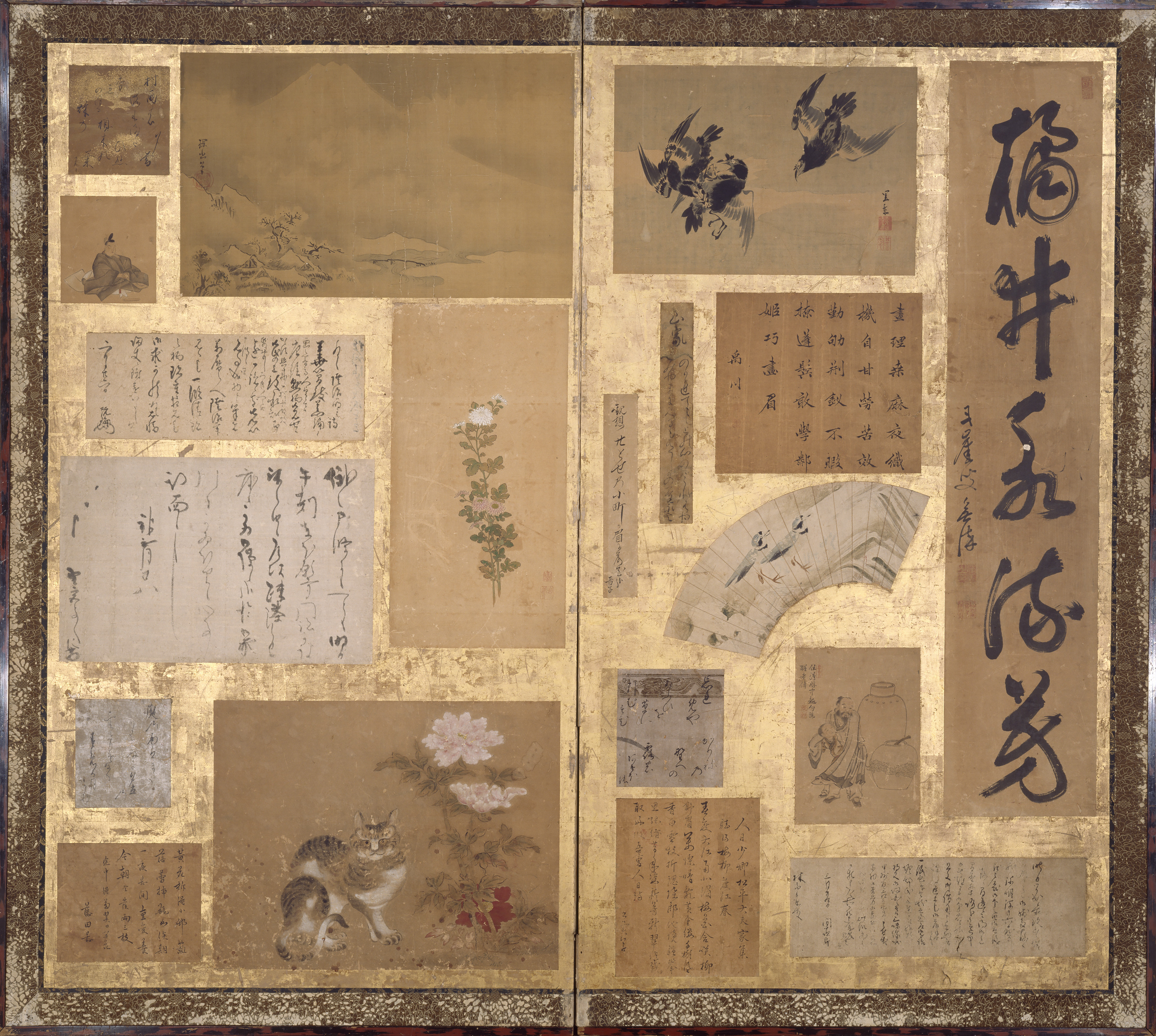
A folding screen followed a different route. Now cataloged by Kyoto National Museum as a screen assembled from paintings and calligraphy, it remained in the Iguchi family's custody before its donation in 1940.[8] The painting and the screen associated with the same room did not enter the museum in the same year or through the same donor history.
The screen is visually busy. Across its two panels, pieces of different sizes combine writing, landscapes, birds, and a cat beneath peonies. Some are rectangular; one is fan-shaped. The museum locates blood traces near the cat at the lower left.[8] Attention usually travels straight to that connection with the killing. Looking at the whole surface restores the furnishing's other identity: a collected arrangement of images and writing, made to occupy a lived-in room.
That earlier function is important to the history of Ōmiya. The room's contents were not assembled in advance to illustrate an assassination. Objects used and appreciated for other reasons became attached to the event because they were there. Preserving them kept part of the household's material life as well as traces associated with its visitors' deaths.
The folding screen also makes clear what cannot travel with a furnishing. Its hinged form could be moved; the complete arrangement of the upstairs room could not accompany it into a collection. The screen preserves surfaces and a history of custody, not the exact positions of every person and piece of furniture during the assault. A surviving object is valuable without becoming a scale model of everything around it.
The family's preservation extended beyond furnishings linked to the violence. A black silk formal robe bearing the Sakamoto crest, identified by the museum as worn by Ryōma, also came through the Iguchi household. It was shown at memorial observances in 1906 and 1916 and donated to the museum in 1940.[9]
The robe's recorded significance is its association with Ryōma's life and use; the catalog does not identify it as his clothing during the attack. Its place beside more dramatic relics widens the commemorative purpose. A gathering could remember the person through something he had worn, rather than only through something marked by his death.
These exhibition histories also reveal work that an inscription alone cannot show. Preserved possessions had to be selected and made available for public presentation. The family collection supplied material for repeated commemoration before museum ownership gave the objects another institutional home. The household was participating in the making of public history, not merely holding forgotten belongings until someone eventually discovered them.
5. The papers continued past the death
One surviving group of papers gives the household's connection a longer chronology still. A scroll of correspondence associated with Ryōma and Kaientai members was donated to Kyoto National Museum in 2000 by Iguchi Shinsuke of Mukō. Its first letter is from Ryōma to Oryō, his wife, dated in the fifth month of 1867. Other items concern Kaientai members in the first part of 1868, including a letter from Nagaoka and borrowing receipts associated with Mutsu.[10]
This is not a bundle that can have been closed at the moment of the assassination. Its contents extend beyond Ryōma's lifetime. A commemorative collection bearing his name also preserves exchanges involving people who continued to act after he was gone.
The letter to Oryō concerns negotiations following the Irohamaru shipping incident and plans to travel to Kyoto with Gotō. The collection description connects its preservation with Oryō's later stay with the Iguchi household after returning to Kyoto in the early Meiji period.[10] Her relationship with the household belongs to the aftermath, not to an invented place for her inside the attack scene.
Read beside the later receipts, the letter changes what “Ryōma material” can mean. It includes a wife's correspondence and the business of surviving colleagues. The papers were brought together through continuing associations, rather than all being recovered from one desk at one instant.
Nagaoka and Mutsu appear here in less monumental roles than the commemorative setting might suggest. The colleague who wrote above the flower painting also appears among the subsequent letters. The recipient of Ryōma's short note about swords appears in borrowing records. Their presence connects the handling of memory with ongoing practical affairs, without requiring every document to have been written in the same house.
The difference between these papers and the stained furnishings is therefore productive. The furnishings keep a connection to an interrupted room. The correspondence follows relationships that went on. Together they prevent the Iguchi household from disappearing when the narrative reaches the deaths of its visitors.
6. The collection does not close the case
The surviving material is substantial, but identifying the perpetrators involves another documentary problem. The Sakamoto Ryōma Memorial Museum regards members of the Kyoto Mimawarigumi as the generally accepted attribution. It also points to discrepancies among later accounts associated with Imai Nobuo and Watanabe Atsushi and the reports transmitted from Nakaoka.[11]
A strong attribution to a group and an agreed account of every participant are not the same conclusion. Nor does either establish a complete chain of authorization. The distinction leaves the historical discussion open at specific points without treating every proposed conspiracy as equally supported.
The house's surviving objects cannot supply the missing chain by themselves. A stain does not name the person who made the attack. A later inscription tells us how an associate recorded it. A donor's name establishes part of a collection history. Their different capacities are the reason to preserve all of them, rather than demand that one famous relic answer every question.
This also allows the site to retain its importance without depending on a final solution to the killing. The merchant premises, the two political visitors, the interrupted work, and the household's subsequent preservation are not merely preliminary clues awaiting a detective's verdict. They form a connected history of their own.
7. An address and its dispersed belongings
By the time the stone was erected in 1927, some Ōmiya-associated possessions had already appeared in public commemorations. Others would enter the museum in 1931, 1940, and much later. The marker and the collections were therefore being made through overlapping efforts, not one coordinated act that preserved the whole house at once.[1][7][9][10]
Their separation continues in the way the history is presented. The Sakamoto Ryōma Memorial Museum in Kōchi identifies its displayed versions of the scroll and screen as reproductions and names Kyoto National Museum as the holder of the originals.[12] An image can carry the room's story to another city while the original object remains elsewhere. Neither is the surviving room at Ōmiya.
The stone has a different task: it fixes remembrance to the address. Its identification of the Iguchi house restores the people who provided the premises and later kept part of their contents. The location, the transmitted accounts, and the dispersed objects need one another, but they do not need to be mistaken for one another.
Ōmiya's history continued after the building disappeared and its belongings moved elsewhere. It continued in an inscription added to a painting, a robe brought to a memorial, papers retained beyond their most famous correspondent's death, and donations that placed private possessions in public care. The house is gone; those specific acts of keeping are still recoverable.
Next topic · HO Guides
Iwakura's Retreat: A Voice Outside the Court
News, introductions, and a proposal for national deliberation at the rural home of an excluded courtier.
Continue readingSources and NotesView sourcesHide sources
Sources were consulted on 16 September 2026. Historical month-and-day references retain the Japanese calendar and are explicitly identified as such; they are not Western November dates. Catalog descriptions establish the recorded identity and custody of objects, not independent forensic findings. See the photographed screen and hanging scroll as images. No claim to have visited the site, examined the originals, or read complete unpublished family papers is made.
- [1]
Kyoto City Historical Museum, stone-marker record NA011, 「坂本龍馬・中岡慎太郎遭難地」, location, erection, and inscription fields. https://www2.city.kyoto.lg.jp/somu/rekishi/fm/ishibumi/html/na011.html . It dates the marker to 1927 and transcribes 「旧井口新助氏宅」 on its north face, distinct from the donor names. Used for the monument and former household, not an exact reconstruction of the lost building's footprint or an assertion that the marker stood during the attack.
Return to the reference ↑ - [2]
Kyoto City Tourism Association, historical-signboard text, 「坂本龍馬中岡慎太郎遭難之地」. https://ja.kyoto.travel/tourism/single02.php?category_id=9&tourism_id=2130 . It identifies Ōmiya as a soy-sauce merchant serving Tosa, the earlier Suya lodging, the Japanese-calendar attack date, Nakaoka's two further days of survival, and Yamada Tōkichi among the victims. The sign's explanation of the move is attributed; its precise staging of the visitors' conversation and the attackers' entry is not adopted as eyewitness evidence. Birth years and traditional counted ages are not used.
Return to the reference ↑ - [3]
Nakaoka Shintarō Museum, 「中岡慎太郎とは」, introductory career summary and sections 「薩長連合を結ぶ」 and 「陸援隊の結成」. https://www.nakaokashintarokan.jp/about.html . Used for Nakaoka's inter-domain activity and the Rikuentai's 1867 formation. The intended roles of both organizations are specified in the Sakamoto Ryōma Memorial Museum's FAQ answer 「海援隊・陸援隊の活動、あるいは役割について教えて下さい。」, https://ryoma-kinenkan.jp/feat/faq/ . The museum's evaluative descriptions are not adopted. This limited background distinguishes the two visitors' activities without turning the essay into Nakaoka's biography.
Return to the reference ↑ - [4]
Sakamoto Ryōma Memorial Museum, 「常設展 常設展示室」, object description 「龍馬書簡(慶応3年11月初旬)」, commonly identified as 「越行の記」. https://ryoma-kinenkan.jp/collection/exhibition.html . It identifies a probable draft report to Gotō, consultation with Shungaku on the political arrangement, and Mitsuoka on finances. The dispatched original has not been found. The draft's full text was not read, and its composition is not assigned to a particular Ōmiya room.
Return to the reference ↑ - [5]
Sakamoto Ryōma, 「手紙 慶応三年十一月十三日(推定)陸奥宗光あて」, complete transcription, Aozora Bunko. https://www.aozora.gr.jp/cards/000908/files/52032_41191.html . Base edition: Miyachi Saichirō (宮地佐一郎), 龍馬の手紙, Kōdansha Gakujutsu Bunko, 2003, printing used 2008. The heading's full date is editorially inferred; the text itself specifies the thirteenth day. The museum description under the corresponding letter, URL in note 4, explains its conventional late-1867 dating. The essay does not certify it as the last letter ever written or locate its writing at Ōmiya.
Return to the reference ↑ - [6]
Sakamoto Ryōma Memorial Museum, 「龍馬FAQ」, question beginning 「龍馬が近江屋で」, introduction and three quotations identifying 谷干城遺稿 (1912), 男爵安保清康自叙伝 (1919), and 伯爵田中光顕自叙伝 (1926). https://ryoma-kinenkan.jp/feat/faq/ . The books themselves were not read. Used for the museum's account of transmission through Nakaoka and the differing reported last words, not for a composite dialogue or three independent eyewitness accounts of the attack.
Return to the reference ↑ - [7]
Kyoto National Museum, 「血染懸軸(梅椿画)」, collection M甲162, complete description and donor field. https://knmdb.kyohaku.go.jp/7439.html . The museum's image is also available at https://knmdb.kyohaku.go.jp/art_images/271/270303_difile2-L.jpg . The record identifies the alcove association, Itakura painting, Nagaoka text, recorded 1906 exhibition, 1931 donation, and the Iguchi-to-Sakamoto transfer as family tradition. The Kōchi museum's object description, URL in note 4, explicitly places the added writing after the deaths. The entire inscription was not independently translated; stains are not assigned to a particular victim through visual inspection. No precise transfer year between families is asserted.
Return to the reference ↑ - [8]
Kyoto National Museum, 「書画貼交屏風」, collection A甲53, complete historical description and object fields. https://knmdb.kyohaku.go.jp/606.html . The record and full object photograph: https://knmdb.kyohaku.go.jp/art_images/148/147704_difile2-L.jpg . Used for the Iguchi custody, 1940 donation, two-panel form, and the collection's identification of traces near the cat. The description of the arrangement derives from viewing the image; it is not a reconstruction of the screen's exact position during the attack or a measurement of stain trajectories.
Return to the reference ↑ - [9]
Kyoto National Museum, 「紋服」, collection I甲22, complete historical description and material fields. https://knmdb.kyohaku.go.jp/5676.html . It identifies black silk habutae, the Sakamoto crest, Iguchi custody, exhibitions during the 1906 and 1916 memorial observances, and donation in 1940. The record identifies clothing worn by Ryōma, not clothing conclusively worn during the assassination. Its photograph was not used to infer wear, damage, or the circumstances of use.
Return to the reference ↑ - [10]
National Diet Library, Japan Search gallery 「坂本龍馬」, complete collection entry 「坂本龍馬・海援隊士書簡類」, reproducing the museum description for collection M甲171. https://jpsearch.go.jp/gallery/ndl-7oGj0Ak9BoFkp7k . It records the 2000 donor, Ryōma's 1867 letter to Oryō, early-1868 papers, and the description's connection to Oryō's later stay with the household. The underlying ColBase page did not provide readable text, and the complete letters and receipts were not transcribed. This essay does not infer exact loan terms or that every item was originally produced or received at Ōmiya. The donor of 2000 is not identified with the nineteenth-century host merely because their names coincide.
Return to the reference ↑ - [11]
Sakamoto Ryōma Memorial Museum, 「龍馬FAQ」, question 「龍馬は誰に殺されたのですか。」, URL in note 6. The museum gives Mimawarigumi the generally accepted attribution while noting disagreements in Imai Nobuo's and Watanabe Atsushi's later accounts and the reports derived from Nakaoka. Those underlying testimonies were not independently collated. No definitive roster, individual weapon attribution, order-giver, or wider conspiracy is asserted; the manuscript requires targeted independent review of this qualified attribution before final acceptance.
Return to the reference ↑ - [12]
Sakamoto Ryōma Memorial Museum, 「常設展 常設展示室」, 「暗殺現場にあった屏風と掛軸 *複製」, URL in note 4. Used for the explicit distinction between reproductions and Kyoto National Museum originals, not a guarantee that a particular display arrangement will remain unchanged. The screen and scroll are not assigned to the modern commercial property at the historical address.
Return to the reference ↑ - [13]
Japan Automobile Federation, JAF Navi, 「近江屋跡(坂本龍馬・中岡慎太郎遭難之地碑)」, complete short site description. https://drive.jafnavi.jp/map/spots/271126X00159/ . Read for its explicit statement that the building no longer exists and the site is marked by a stone. Its compact dramatic account of the entry is not used. No demolition date, exact modern business, unrestricted access, or unchanged nineteenth-century street width is inferred.
Return to the reference ↑