Read the article below. Interactive reading tools are available when scripts load.
Quick
Go-Toba was born Prince Takanari in 1180, a son of Emperor Takakura and the woman later known as Shichijō-in. His older half-brother Antoku was the son of Tokuko, daughter of the warrior leader Taira no Kiyomori. In 1183 the Taira left Kyoto with Emperor Antoku and the sacred regalia—the mirror, jewel and sword associated with succession. Their retired grandfather Go-Shirakawa chose Takanari to reign in the capital as Go-Toba. Two child emperors briefly headed rival courts; adults arranged their claims and protection. [1]
The Taira were defeated at the naval battle of Dan-no-ura in 1185, where Antoku died. In the received account the mirror and jewel were recovered, but the sword was lost. Go-Toba's government continued without it. Later writers debated whether that absence made his reign troubled or whether recognition and court rites established its authority. The lost sword has also been linked to his later interest in swordmaking, but that remains an interpretation of his motives. [1][4]
Antoku's death ended the rival imperial court, but the pre-1180 order did not return. Go-Shirakawa continued cloistered government around the young Go-Toba. Kujō Kanezane became regent, while the warrior leader Minamoto no Yoritomo's Kamakura coalition secured military appointments, land relationships, and enforcement capacity through negotiation with Kyoto. Go-Toba's reign developed inside this settlement. The court supplied rank, commissions, and ritual legitimacy; Kamakura organized its gokenin, warriors directly bound to Yoritomo and his Kamakura government, and increasingly intervened in estates and provinces. Their jurisdictions overlapped rather than occupying two sealed territories. The child emperor learned kingship within a political system in which retired sovereign, regent, and eastern military lord all possessed necessary power. [1][8]
Go-Toba underwent adult coming-of-age rites in 1190 and married Kujō Kanezane's daughter Ninshi. After Go-Shirakawa died in 1192, the young emperor's own political choices became more visible. Minamoto no Ariko, connected to Minamoto no Michichika's household, bore Prince Tamehito in 1195. Kanezane lost power in 1196. The episode is often described as Michichika's coup; historian Tomohiro Saeki's research instead emphasizes Go-Toba's own political decisions before the realignment. Go-Toba abdicated in 1198 and placed the child Tamehito on the throne as Emperor Tsuchimikado. Michichika remained highly influential until 1202, so abdication did not instantly create solitary Go-Toba rule. It did give the young retired sovereign a durable household through which he would shape succession and government across several reigns. [1][7][8]
Go-Toba directed retired-imperial government during the reigns of Tsuchimikado, Juntoku and briefly Chūkyō. His administrative household sent orders, managed estate income and influenced appointments and succession. After Michichika died in 1202, Go-Toba's personal leadership grew more pronounced. Yet regent families and reigning emperors retained roles, and a ruling still depended on officials and local recipients able to carry it out. Estate income sustained the court while also bringing it into disputes with Kamakura's stewards. [1][2][8]
Go-Toba repeatedly traveled to Kumano, a major shrine and pilgrimage region on the Kii Peninsula south of Kyoto. Yamakawa's historical dictionary counts twenty-eight visits. His surviving poetry sheets and Fujiwara no Teika's travel diary preserve traces of a devotional court on the move, supported by local provisions, lodgings and escorts. Go-Toba also strengthened warrior service around his household, including the group later called western guards. Riding and archery belonged to his aristocratic life; the guards protected the court before some fought for it in 1221. [1][9]
Go-Toba ordered compilation of the eighth imperial waka anthology, Shin Kokin Wakashū, in 1201. Waka were classical Japanese poems of thirty-one syllables. Court poets including Fujiwara no Teika and Fujiwara no Ietaka selected and arranged the work; a major version was presented in 1205, while revision continued. Go-Toba participated as a poet, critic and demanding patron, not the sole author. His judgment affected poets' reputations and the sequences in which their poems appeared. He would return to the collection during exile. [5][6][9]
Go-Toba's court patronized music, games and martial skills alongside poetry. Chrysanthemum-marked blades called Kiku-gosaku, traditionally understood as imperial sword work, are associated with him and summoned master smiths. Later accounts differ over whether he forged, hardened, approved or marked blades. They also describe smiths serving by monthly rota. Yuki Imoto's 2026 study considers that system plausible but unconfirmed by contemporary records. Kyoto National Museum's suggestion that the lost sacred sword inspired his interest remains a possible motive, not an established explanation. [1][3][4][9]
Patronage brought valued smiths into the court's circle and gave Go-Toba a place in a craft respected by warriors.
Go-Toba's court and Kamakura cooperated and competed for decades. Yoritomo received rank and the 1192 shogunal commission; Kamakura enforced warrior relationships; Kyoto managed office and ritual legitimacy. Estate proprietors and Kamakura stewards often claimed rights in the same land, making conflict structural rather than evidence of permanent war. Minamoto no Sanetomo, Kamakura's third shogun and head of its warrior government, developed a strong court-facing identity. He wrote poetry, received rapid promotion, and became minister of the right. Go-Toba's cultural and political influence mattered, but Sanetomo pursued rank and verse actively. Hōjō Masako, Yoritomo's widow and Sanetomo's mother, met Fujiwara no Kaneko in 1218. The meeting shows succession negotiation through powerful women's households, not merely exchange between two male institutions. [1][9][10]
After Sanetomo's assassination, Kamakura requested an imperial prince as shogun (the head of a warrior government appointed through a court title). Go-Toba refused; the infant Mitora from the Kujō line was sent instead. Dispute also sharpened over the Nagae and Kurahashi estates, where the retired court sought removal of Kamakura-linked steward rights and Hōjō Yoshitoki, Kamakura's administrative leader, refused. Go-Toba was cultivating armed capacity, but no single quarrel created the war. In 1219 his forces destroyed the Kyoto warrior Minamoto no Yorimochi after suspicion of rebellion, with fire damaging the imperial palace area. Court guards, western warriors, and contacts among gokenin offered possible force. The central problem was whether those relationships could outweigh Kamakura's land-and-service bonds when openly tested. [1]
In the fifth month of the traditional calendar in 1221, Go-Toba summoned armed supporters, moved against opponents in Kyoto, and issued orders calling for pursuit of Hōjō Yoshitoki. He attempted to separate Yoshitoki from the gokenin by making imperial loyalty superior to Hōjō command. Later shorthand calls this an order to overthrow the shogunate, but the documentary target was the executive leader rather than a surviving complete blueprint for abolishing every warrior institution. The calculation failed. Miura Taneyoshi urged his brother Yoshimura to join the court, but Yoshimura reported the approach to Kamakura. Kyoto guardian Iga Mitsusue resisted and died. The same messages that sought defections warned Yoshitoki and allowed Masako's coalition to define the order as an attack on the whole Kamakura service system. [1][9][10]
Kamakura chose immediate advance rather than waiting in the east. Armies under Hōjō Yasutoki, Hōjō Tokifusa and other commanders moved west on several routes, drawing on warrior service obligations. Court forces under Fujiwara no Hideyasu and Miura Taneyoshi resisted, including at Uji and Seta. Kyoto fell within roughly a month. Modern explanations emphasize Kamakura's ability to unite and mobilize its followers; recent research also argues that the court had a real chance to win. Medieval army totals are too uncertain to make sheer numerical superiority a sufficient explanation. Victory enabled Kamakura to reshape the postwar settlement. [1][9][10]
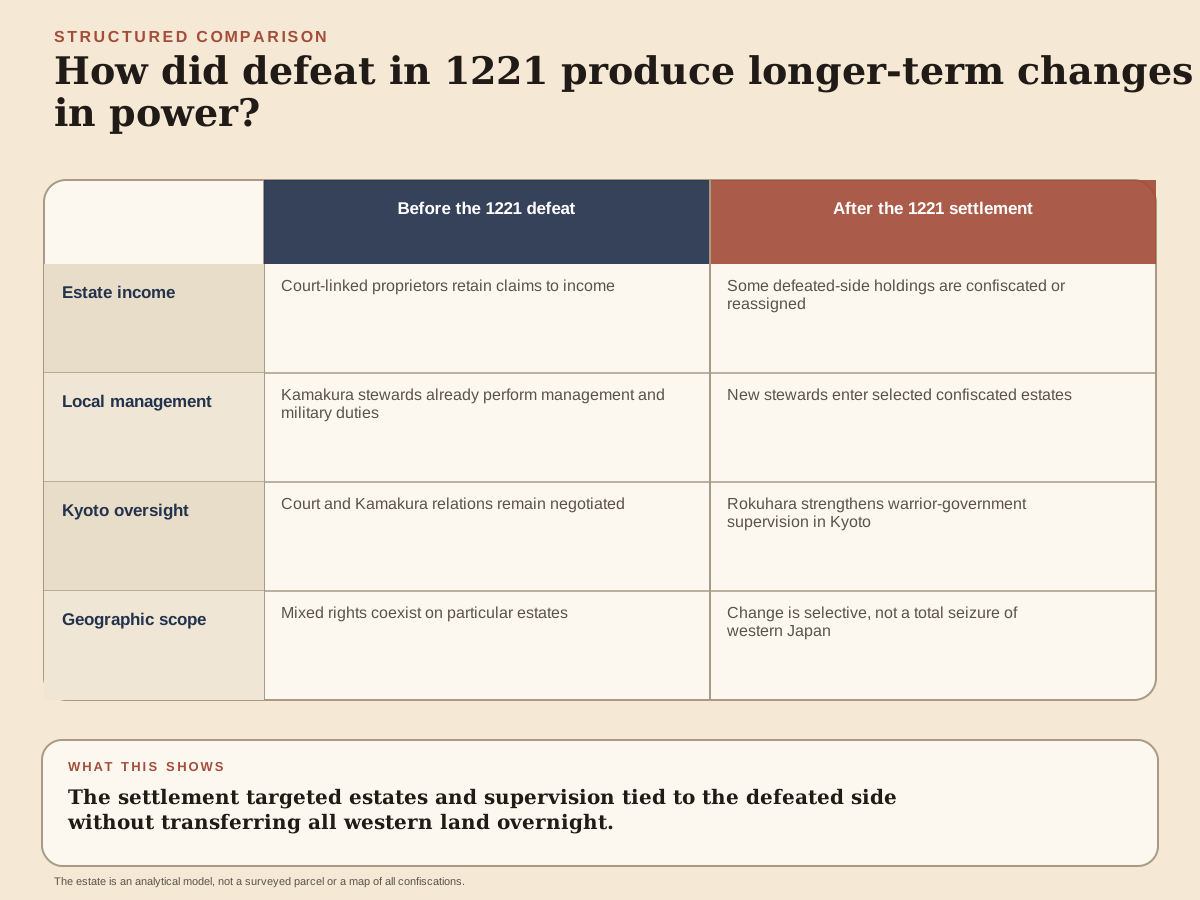
After defeat, Go-Toba was sent to the Oki islands in the Sea of Japan. Juntoku, who had supported the action, was exiled to Sado. Tsuchimikado had not joined the rising. Scholarly accounts describe him as requesting departure to Tosa and later moving to Awa, provinces on Shikoku southwest of Kyoto. The young Emperor Chūkyō was deposed after a reign of only weeks, and Kamakura intervened in selecting Go-Horikawa from a different imperial line. The victors executed or punished court supporters, confiscated many estates, installed new stewards, and strengthened supervision in Kyoto through Rokuhara, its administrative base in Kyoto. These measures turned a short campaign into durable power. Exile preserved royal lives while separating sacred persons from the officials, land, guards, and ceremonies that had made their authority operational. [1][2][9]
Go-Toba spent the remainder of his life on Oki. He composed poetry, practiced religion and revised the Shin Kokinshū into a shorter Oki selection. Exile ended large-scale government without ending his ability to judge and transmit literature. He died there in 1239. Portraits, memorial sites and rites later honored or sought to pacify the defeated sovereign. His cultural work endured beside the political consequences of the Jōkyū defeat. [1][5][6][11]
Classic
Go-Toba was born Prince Takanari in 1180, a son of Emperor Takakura and the woman later known as Shichijō-in. His older half-brother Antoku was the son of Tokuko, daughter of the powerful warrior leader Taira no Kiyomori. Their different maternal households supplied attendants, protection and access to the court. In the year of Takanari's birth, Takakura abdicated and Antoku became emperor. War soon divided the dynasty. Minamoto no Yoritomo rose against the Taira in eastern Japan, while the retired emperor Go-Shirakawa, grandfather of both children, remained an important center of authority in Kyoto. [1]
In 1183 the Taira withdrew west from Kyoto, taking Antoku, his mother and the sacred regalia with them. Go-Shirakawa selected another grandson, the young Takanari, to reign in the capital as Emperor Go-Toba. Officials there could continue appointments and ceremonies under a reigning sovereign; the traveling Taira court still recognized Antoku. For a time, two child emperors had households and supporters who acted on their claims. Go-Toba was three and could not have designed his accession. His descent made him eligible, but the decision and the protection that made it effective belonged to adults. [1]
The imperial regalia were a sacred mirror, jewel and sword, emblems of succession and divine ancestry. Go-Toba began his reign without the complete set, which remained with Antoku. In 1185 the Taira were defeated at the naval battle of Dan-no-ura. Antoku died, and his mobile court collapsed. In the received account the mirror and jewel were recovered, while the sword was lost at sea. The disaster killed or dispersed members of the imperial household as well as the Taira warriors. For Go-Toba's court, military victory ended the rival reign without restoring every object associated with succession. [4]
Substitute-sword traditions answered later ceremonial needs without claiming to recover the drowned blade. Kyoto performed rites, appointed officials and sustained a court under Go-Toba. The missing sword remained a potent subject for later interpretation.
Evidence and interpretation · The missing imperial sword
Kyoto National Museum cautiously suggests that the loss of the regalia sword may have helped stimulate Go-Toba’s later sword-making patronage. Its wording offers a possible connection, not evidence of a lifelong program formed at accession. Reference biographies also describe a functioning reign and later retired-emperor government despite the irregular beginning. [4][12][13]
The missing object mattered symbolically, but that does not prove Go-Toba’s rule was simply unrecognized or explain his later war against Kamakura by itself. No surviving account establishes an infant resolve to fight. His political choices developed over an adult career. [4][12][13]
After the Taira defeat, Go-Toba was the uncontested reigning emperor, but still a child. His grandfather Go-Shirakawa directed retired-imperial government, and Kujō Kanezane, a senior aristocrat and diarist, served as regent. In eastern Japan, Yoritomo's warriors expected him to confirm holdings and protect their service. Those bonds survived the war. Kyoto's authorization and Kamakura's enforcement both mattered, while disagreements among court leaders prevented either government from dealing with a single, unified partner. [1][8]
Go-Toba learned court rites, poetry and religious practice within that government. Estate disputes made its limits visible: a proprietor in Kyoto might claim revenue from land where a Kamakura-linked steward controlled collection. Cultivators could face demands from both, and a court ruling still needed someone able to enforce it. [1]
One field could be inside several legal and political maps at once. Yoritomo's destruction of the northern Fujiwara in 1189 and formal visit to Kyoto in 1190 displayed the settlement at two scales: independent campaigning capacity in the provinces and deliberate submission to courtly rank, audience, and authorization in the capital. The new order was not yet stable or fully named. Later histories choose foundation dates such as 1185 or 1192, but functions accumulated. Go-Toba grew up while these arrangements were still being improvised and before “court versus shogunate” hardened into a simple pair. Go-Shirakawa's death in 1192 was therefore a major personal and institutional transition. The grandfather who had selected Go-Toba and managed the postwar settlement disappeared. The emperor, now approaching adult political agency, faced Kanezane, other court factions, and Yoritomo without the same retired-sovereign intermediary. [1][8]
Go-Toba inherited a negotiated order created before he could choose. As he grew older, he would have to exercise authority within arrangements that protected both court proprietors and landholding warriors.
Go-Toba underwent genpuku, a formal coming-of-age rite, in 1190. Marriage to Ninshi, daughter of the regent Kujō Kanezane, linked the imperial household to her father's family. Go-Shirakawa's death in 1192 removed the dominant retired sovereign, making Go-Toba's own choices more consequential. Another consort, Ariko, was connected with the household of the influential courtier Minamoto no Michichika. Her son Tamehito, born in 1195, offered a succession route outside Ninshi's Kujō line. Access to the child and his mother helped reorganize court alliances. [1][7][8]
Historical disagreement · Who drove Kanezane’s removal in 1196?
Kanezane's removal in 1196 has long been described as Michichika's coup. Historian Tomohiro Saeki offers a different emphasis: Go-Toba was already making final political decisions in 1195, so Michichika's maneuvering operated within an emperor's growing authority rather than directing a passive child.
The difference concerns agency, not whether the court realigned.
Ariko's son gave Michichika's household a stake in the succession. Ninshi left the palace when her father fell, a consequence that court appointments alone do not convey. [7]
Abdication in 1198 transferred the throne to Go-Toba's young son Tamehito, now Emperor Tsuchimikado. Go-Toba could direct a retired household as his grandfather had done. Michichika nevertheless remained influential until his death in 1202, limiting how quickly the new retired sovereign could take independent control. Changing the occupant of the throne did not remove the need for experienced court families. [1][7]
Authority accumulated rather than appearing complete on abdication day. Leaving the throne therefore began a new political phase. As retired sovereign, Go-Toba could manage estates, appointments, religious journeys, cultural circles, and later succession with fewer constraints of daily imperial ritual. This was not escape from kingship; it was a different architecture of kingship.
After abdication in 1198, Go-Toba governed through the in no chō, a retired-imperial administrative office. Its officials drafted inzen, orders issued in the retired sovereign's name, and sent them to recipients at court and beyond. Estates supplied rice, goods and service for the household. Their income also tied it to local managers and cultivators. A ruling about an estate could meet resistance from a Kamakura-appointed steward whose position depended on armed support. Go-Toba's status gave force to his documents, but the people receiving them helped determine how far that force reached. [1][8]
Women structured succession and access. Mothers of imperial sons, ladies around Go-Toba, and powerful intermediaries such as Fujiwara no Kaneko held household routes that formal male office lists understate. Their kin and property could affect which prince was favored. Tsuchimikado acceded as a child in 1198. Go-Toba later preferred a different dynastic route and arranged Juntoku's succession in 1210. In 1221 the very young Chūkyō briefly took the throne. These transfers show the retired sovereign's power to shape reigns, while each emperor retained a distinct person and maternal network. Go-Toba also sought a broadly staffed court. After Michichika's death, he used people from competing aristocratic backgrounds rather than allowing one house to monopolize government. This could expand his personal arbitration while multiplying those dependent on his favor. [1][2]
Court ceremony and cultural patronage helped Go-Toba organize the people around him. Invitation to a poetry gathering or a place in a procession marked access and precedence. Religious foundations and journeys offered further occasions for service. These relationships complemented appointments and estate income; they did not ensure that every recipient of favor would follow the court into armed conflict.
Palace guards and Kyoto warriors could protect the retired court and act against opponents. That force could be formidable locally while remaining weaker than Kamakura's hold on dispersed landholding warriors. Strong personal direction in Kyoto did not amount to reliable command over all those whose property was protected by Hōjō Yoshitoki, the shikken, or administrative leader of the Kamakura warrior government.
Go-Toba repeatedly traveled to Kumano, the great shrine and pilgrimage region on the Kii Peninsula south of Kyoto. Yamakawa's historical dictionary counts twenty-eight journeys; Uwayokote's World Encyclopedia account describes roughly thirty. Both convey repeated royal pilgrimage rather than a single ceremonial visit. Fujiwara no Teika's pilgrimage diary and surviving Kumano poetry sheets preserve traces of a devotional court on the move. Worship and royal patronage drew shrine personnel into the household's orbit, while travel demanded lodging, provisions and escorts. The journeys gave religious purpose to substantial movements of people and resources. [1]
Local communities supplied transport and lodgings, and estates supported the household's travel obligations. Roads and river crossings could delay even a royal procession. Teika's diary records these journeys from a courtier's position, while Go-Toba's surviving Kumano kaishi, poetry sheets written on pilgrimage, bring his calligraphy and verse into the same setting. The named poets and officiants are more visible than the people who carried their belongings or prepared their food. Repeated visits built relationships with shrine personnel while placing substantial demands on the communities along the route. [1][9]
Guards protected the mobile household and offered another route to imperial favor. Go-Toba strengthened western-facing warrior service around 1200, recruiting Kyoto and provincial men, including some with ties to Kamakura's gokenin, warriors directly bound to its government. Their duties and continuity varied. They attended and protected the court; some later fought for it in 1221, but that participation does not prove the guard was created solely for the later war. Riding, archery and hunting also belonged to an aristocratic culture in which trained physical skill could carry honor. [1]
Displaying those skills gave Go-Toba a more active public presence than ceremonies alone. His guards could protect a traveling court, but could not guarantee obedience from distant warriors whose property confirmations and inherited obligations tied them to Kamakura.
In 1201 Go-Toba ordered the Shin Kokin Wakashū, a new imperial anthology of waka, classical Japanese poems of thirty-one syllables. A poetry bureau and named compilers, including Fujiwara no Teika and Fujiwara no Ietaka, selected and arranged the work. Go-Toba participated as a poet, critic and demanding patron. A major presentation took place in 1205, but revisions and variant textual lines continued afterward. Choosing poems gave authors and lineages recognition; arranging their sequence created echoes across seasons, love and lament. [5][6][9]
The anthology depended on compilers who selected poems, scribes who copied them and earlier poets whose language supplied allusions. Access to Go-Toba could advance a poet's reputation; disagreement could threaten that favor, as Teika's later conflict with him shows. The poems also had purposes beyond faction. Their seasonal and emotional sequences demanded technical judgment, and the court valued the art enough to debate it intensely.
Arrangement gave individual poems a new setting. A winter poem acquired neighbors whose images changed its force; allusion connected it to older collections. Go-Toba's authority operated through this detailed work as well as through the original commission. He would continue revising the anthology after defeat and exile, a later phase of the story rather than the fulfillment of a plan fixed in 1201.
Minamoto no Sanetomo, Kamakura's third shogun, the head of its warrior government, belonged to the same poetic world. Warriors read and composed waka, and Kyoto's cultural influence reached into their households. Shared literary interests did not settle disputes over government. Copies and later teaching nevertheless carried the anthology beyond the court that commissioned it. [1]
Go-Toba's interest in swords brought master craftsmen into his court. Accounts of goban kaji, smiths serving by monthly rota, describe men summoned from Yamashiro, Bizen and Bitchū. Blades traditionally associated with his participation are called Kiku-gosaku, imperial work bearing a chrysanthemum mark. Kyoto National Museum preserves a thirteenth-century example with such a mark near the base of the blade. An attributed object and a detailed workshop roster are different kinds of evidence. [3][4][9]
Traditions differ over Go-Toba's own work: some credit him with forging, others with hardening blades or approving and marking them. Modern scholarship treats the monthly rota as plausible but not confirmed by contemporary records. Yuki Imoto's 2026 study traces its lists through later medieval sword books, including manuscripts copied in 1351 and 1423. Those traditions preserve an early reputation for imperial participation without settling each smith's duties. A finished sword also needed specialist polishing and mounting; the emperor did not work alone. [3]
Historical disagreement · Why did Go-Toba make swords?
One possible explanation links his swordmaking to the sacred sword lost at Dan-no-ura. Kyoto National Museum presents that connection tentatively, not as a documented private motive. Martial accomplishment provides another context: historian Masataka Uwayokote's encyclopedia account treats imperial guards and weapon expertise as suitable attributes of a ruler in a warrior age rather than simply preparations for overthrowing Kamakura.
Go-Toba also practiced music and kemari, a court game of keeping a ball aloft with the feet. Summoning smiths extended that cultivated household into a craft highly valued by warriors. [1][4]
Later polishing, remounting and interrupted custody make an individual blade's attribution a separate question from the workshop traditions. Go-Toba's patronage still placed the court in a field valued by warriors as well as aristocrats. Masters could receive recognition from him, and the emperor could judge weapons without ceasing to be a poet or a religious patron.
Court documents and shogunal confirmations authenticated overlapping claims to authority. Kyoto appointed; Kamakura recommended, enforced, or disciplined; proprietors petitioned; gokenin sought confirmation; messengers carried complaints and honors. Cooperation was frequent because each center possessed capacities the other could not cheaply replace. The 1192 shogunal appointment did not transfer sovereignty in one package. It recognized Yoritomo through court office while his eastern government already exercised developed functions. Go-Toba was still young, and Kanezane's role was substantial. Later conflict cannot make the title his personal concession to an enemy. After Yoritomo died in 1199, succession crises increased Hōjō influence. Kyoto did not simply exploit weakness or rescue Kamakura. It continued to confer rank and respond to requests while watching a military household transform through violence. Land produced repetitive friction. [1][9]
Estate proprietors and Kamakura-linked stewards could make competing demands on the same land, leaving cultivators to face both. Sanetomo supplied a human bridge between the governments. He sought poetry, court recognition and high office, and Go-Toba could reward him. Rapid promotion enhanced the shogun's dignity while raising questions about his obligations and precedence. Cultural intimacy could not resolve disputes over steward rights. [1]
The Wada conflict of 1213 strengthened the Hōjō position within Kamakura while Sanetomo survived as shogun. His subsequent court promotion belonged to that altered political setting as well as his literary interests. In 1218 Hōjō Masako, Yoritomo's widow and Sanetomo's mother, met Fujiwara no Kaneko in Kyoto; their household access made women central to discussion of a possible imperial successor. Sanetomo's poetry and Go-Toba's martial pursuits crossed any simple cultural division between court and warrior society, but shared interests did not settle the institutions' rival claims. [1][10]
Discussion of a possible imperial successor to Sanetomo depended on household access and reproductive dynasty. No surviving transcript turns their exchange into an unconditional treaty. Sanetomo's assassination in 1219 therefore destroyed more than a person and direct line. It removed a channel through which court and Kamakura shared rank, poetry, and succession expectations. What followed was not the release of an ancient hatred, but negotiation after a relationship-bearing actor vanished.
After Sanetomo was assassinated in 1219, Kamakura asked Go-Toba to send an imperial prince as the next shogun. An imperial prince in Kamakura would give the military household unmatched pedigree and place a royal child under Hōjō-controlled guardianship. Go-Toba refused, leaving both governments to negotiate another successor. Mitora's Kujō descent provided compromise. The child retained high aristocratic and distant Minamoto connections while avoiding immediate imperial blood. He arrived as household head before formal shogunal appointment in 1226, showing that succession and office could be separated. The Nagae and Kurahashi estates made overlap concrete. Received accounts connect them to Kamegiku, a woman close to Go-Toba, and say the retired court sought removal of stewards. Local rights, personal household property, and Yoshitoki's obligation to protect gokenin positions collided. [1]
The precise sequence of the estate dispute is not equally secure in every account. It exposed a practical limit to imperial orders: the retired court sought relief, while Yoshitoki protected the stewards whose rights sustained Kamakura's governing credibility. Another confrontation took place in Kyoto in 1219. Go-Toba's forces attacked Minamoto no Yorimochi, a prominent warrior suspected of plotting rebellion; fire damaged the palace area. The operation showed both the court's coercive capacity and the danger of using it in the capital.
Court recruits had different obligations, and some held Kamakura ties as well as imperial favor. The arrival of Mitora preserved an aristocratic head for the military household without supplying the imperial prince Kamakura had requested. Negotiation continued alongside Go-Toba's preparations to press his authority by force.
The earlier disputes did not all begin as a plan to abolish Kamakura. Guards had protective duties, while estate litigation and succession negotiation were ordinary parts of government. By 1221, however, Go-Toba was ready to use his court and armed followers against Yoshitoki. Whether eastern gokenin would obey his orders would be decided by their response, not the authority claimed in a document.
In the fifth month of the traditional calendar in 1221, Go-Toba issued orders to pursue Hōjō Yoshitoki, Kamakura's executive leader. In Kyoto his forces also moved against people unwilling to join. Iga Mitsusue resisted and died; Miura Taneyoshi appealed to his brother Yoshimura, who reported the approach to Kamakura. Courtiers, including Hamuro Mitsuchika, drafted the orders and messengers carried them. Surviving copies and later quotations do not provide one complete plan for the political system Go-Toba intended to put in place after victory. [1]
Historical disagreement · Did Go-Toba aim to abolish the shogunate?
The orders named Yoshitoki. Removing him need not have meant abolishing every warrior institution, but he directed the protection and coordination on which Kamakura's gokenin depended. Pursuing him by imperial force would change the government that upheld their holdings. Older summaries describe a plan to overthrow the shogunate; newer interpretations emphasize the named target and the possibility of a reorganization under imperial authority.
The surviving orders establish the challenge more clearly than Go-Toba's intended arrangements after victory. [9][10]
Masako's counter-address, transmitted through Adachi Kagemori in received sources, invoked Yoritomo's benefits and the honor of those who had served him. A landholding warrior who changed sides risked the protections that Kamakura had given his household. Yoshimura's response to his brother's appeal illustrated that pressure: family contact brought warning to Kamakura rather than a defection to the court. [10]
The address is a received account, not a transcript. Historian Shinpei Iwata's 2022 explanation emphasizes how Kamakura turned an order against Yoshitoki into a threat to its whole service community. He also points to rivalries among warrior kin, allowing eastern men to see their enemies as Go-Toba's armed followers rather than the emperor himself. The political effect was collective mobilization. Once a common response formed, Go-Toba faced a coalition able to move armies, not an isolated Hōjō household. [10]
Kamakura responded by advancing west rather than waiting for an attack. Received accounts credit Ōe no Hiromoto with urging that choice. Armies under Hōjō Yasutoki, Hōjō Tokifusa and other commanders moved on several routes, using established gokenin obligations to summon warriors. Speed reduced the time in which Go-Toba could gather recruits or encourage defections. Masako's appeal to Yoritomo's benefits gave that mobilization a common cause; Kamakura's land and service relationships supplied men willing to act on it. [1][10]
Court forces under Fujiwara no Hideyasu, Miura Taneyoshi and other commanders resisted the advance. Kamakura's columns approached along the Tōkaidō, Tōsandō and Hokurikudō, major eastern routes connecting the capital with coastal and inland regions. Several approaches forced the defenders to divide their resistance. At Uji and Seta, rivers and bridges became strategic obstacles. The armies depended on provisions, transport and local cooperation, but enormous totals in the Azuma Kagami chronicle and war narratives are not dependable headcounts. [1][9]
Kamakura won quickly, but Go-Toba's defeat was not inevitable. Iwata cites Yoshitomo Nagamura's research for the view that the court side had a real possibility of victory. Mobilization and common service helped Kamakura turn support into an advance before Go-Toba's coalition consolidated. Exact army numbers remain uncertain, so numerical superiority alone cannot securely explain the outcome.
A warrior supporting the court risked losing family land if Kamakura won. Civilian communities also bore the advance: armies requisitioned food and transport, damaged fields and occupied buildings. Their labor helped make rapid movement possible. Victory gave Kamakura the means to alter property rights and supervision in the west.
After defeat in 1221, Go-Toba was exiled to the Oki islands and Juntoku, who had supported the action, to Sado, another island in the Sea of Japan. Tsuchimikado had not participated. Scholar-written encyclopedia accounts say Kamakura did not pursue him, and he requested departure to Tosa, later moving to Awa; both provinces were on Shikoku, southwest of Kyoto. The child Emperor Chūkyō was deposed after only weeks. Kamakura helped select Go-Horikawa from another branch, removing the reigning household through which Go-Toba had directed succession. [1][2][9]
Exile preserved Go-Toba's life and status while breaking his access to government. He retained attendants and continued religious and literary work, but could no longer gather western guards or manage estates at scale from Kyoto. Property redistribution extended Kamakura's victory into villages.
Received estimates speak of roughly three thousand confiscated holdings associated with the court side, though the counting and categories are uncertain. New or rewarded stewards brought eastern victors into western estates. Commanders and courtiers faced punishment, and families could lose property or position without having fought. The changes reached cultivators and local managers through new demands for collection and enforcement. Rokuhara became Kamakura's Kyoto supervisory center, linking western affairs to the eastern government.
Yasutoki and Tokifusa's roles linked military victory to monitoring, justice, and court communication. The relationship between centers continued, now under a markedly different balance. Go-Toba's defeat therefore did not end imperial government or establish one warrior sovereign over all functions. It removed a particularly active retired-imperial network, narrowed dynastic choice, and strengthened Kamakura's ability to arbitrate succession and western land. The dual order survived by being reweighted.
Go-Toba spent the rest of his life on Oki, an island group in the Sea of Japan far from Kyoto. A reduced household and local supply routes sustained him. He continued religious practice and composed poems on seasons, distance and devotion. He refined the roughly two thousand poems of the Shin Kokinshū into an Oki selection of about sixteen hundred. That work preserved another form of authority: he could still select and judge poetry after losing the officials and guards through whom he had governed. Island communities also bore the demands of supporting this exceptional exile. [1][5][6][11]
The Oki selection survives both in manuscripts marking poems for retention or removal and in copies extracting the selected poems. They reflect a changing text rather than one untouched final edition. Testament traditions, portraits and handprints also connected Go-Toba's last years with later memory, though their individual histories differ. He died in 1239. Medieval belief in the dangerous spirits of defeated rulers helped shape later rites and commemoration; such beliefs are evidence of how people remembered him, not proof of supernatural causes. [1]
Later communities remembered different parts of the life. Literary history valued the Shin Kokinshū; sword traditions preserved Kiku-gosaku attributions; imperial movements could invoke resistance to warrior government. Oki centered exile, while Minase, the site of a former detached residence, developed another focus of worship. Memorial rites and sites show how the defeated sovereign remained significant after death, without proving that an angry spirit caused later disasters.
Go-Toba's literary influence outlasted the government he directed. The Jōkyū settlement reduced the power of his household and strengthened Kamakura, while poets continued to read the anthology he had helped shape. These were distinct legacies of a career that joined an unusually active retired court to personal artistic judgment.