Read the article below. Interactive reading tools are available when scripts load.
Quick
Yoshitsune was born in 1159, a son of Minamoto no Yoshitomo and Tokiwa. Yoshitomo's defeat in the Heiji conflict broke the family's position. Later accounts associate Yoshitsune's youth with Kurama temple near Kyoto and with Fujiwara no Hidehira, ruler of the Hiraizumi region in northeastern Japan, but his education and early travels cannot be reconstructed securely. His better-documented career began in 1180, when he joined his half-brother Yoritomo, who had raised forces against the Taira warrior house, at the Kisegawa River in Suruga. By 1183 Yoritomo had sent him toward Kyoto as a military representative. He entered the struggle for the capital through authority delegated by his brother. [1] [3] [5]
In early 1184 Yoshitsune and his half-brother Noriyori attacked Minamoto no Yoshinaka, the rival commander established in Kyoto. Yoshinaka's defeat cleared the way for an offensive against the Taira at Ichi-no-Tani, on the coast west of the capital. The brothers commanded different parts of the attack. Yoshitsune's association with a daring downhill assault became famous, but the precise route and even the leader of the mountain attack remain disputed: a contemporary diary's received report names Tada Yukitsuna, while later war tales emphasize Yoshitsune. The Taira lost the battle and withdrew by sea, leaving the commanders to pursue them through the western provinces. [1] [4] [5]
After Ichi-no-Tani, Yoshitsune remained in Kyoto to maintain order and pursue Taira remnants while Noriyori continued the western campaign. He accepted appointment as a kebiishi, an officer concerned with policing and criminal justice, and as a junior officer of the Left Gate Guards, without Yoritomo's prior approval. The appointments contributed to their conflict, although Yoshitsune continued commanding in the following year. His marriage in 1184 to Kawagoe Shigeyori's daughter had been arranged by Yoritomo. Her brother Shigefusa accompanied her to Kyoto with retainers. The marriage connected Yoshitsune to an eastern warrior household and to the family of Hiki no Ama, Yoritomo's former nurse. [1] [3] [5] [11]
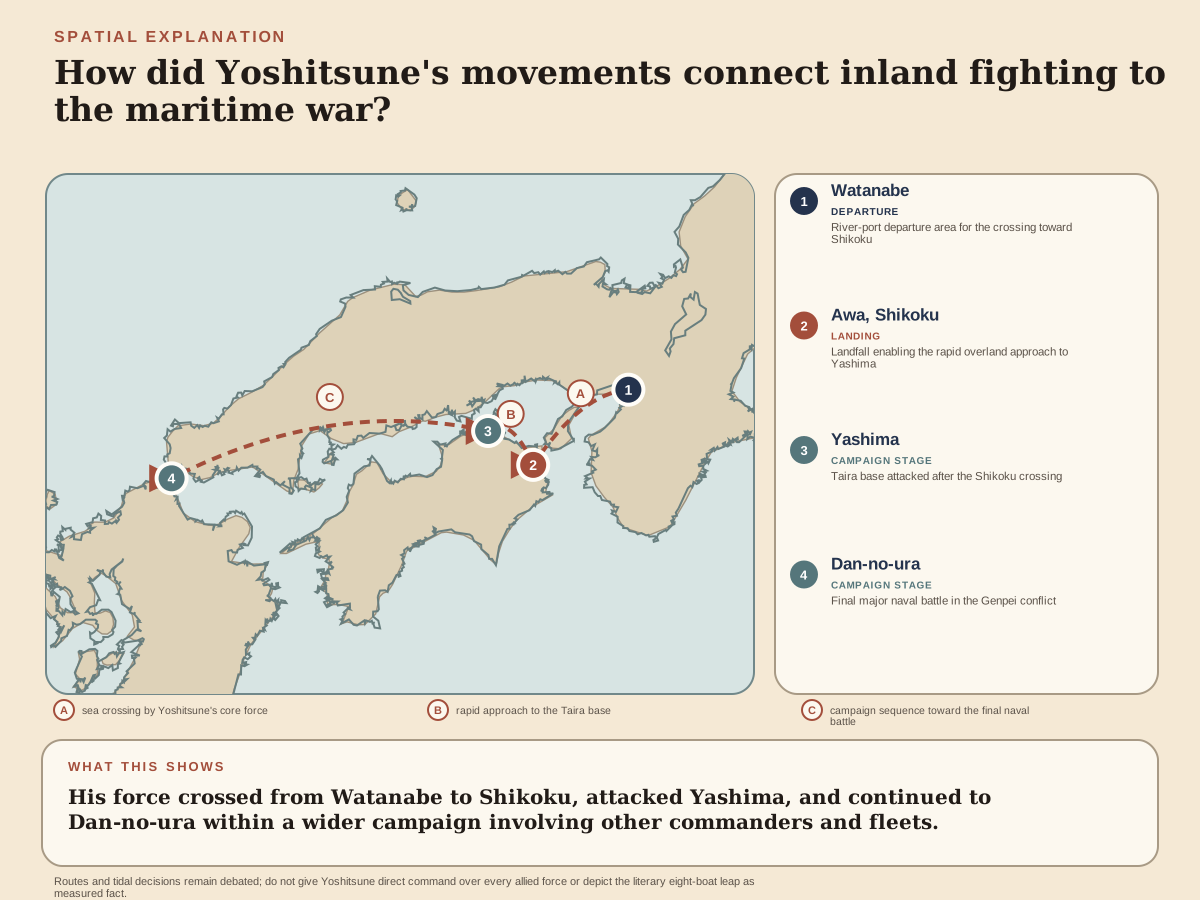
In 1185 Yoshitsune crossed from Watanabe in Settsu to Awa on Shikoku, then advanced overland against the Taira base at Yashima. His retainer Satō Tsuginobu died there. Naval forces associated with Kōno and Kumano subsequently joined the pursuit. At Dan-no-ura, in the strait between Honshu and Kyushu, Yoshitsune commanded the principal naval force while Noriyori's army pressed from Kyushu. The battle, dated to the twenty-fourth day of the traditional third month, destroyed the Taira leadership's remaining military position. Emperor Antoku died; his mother Tokuko was rescued, and Munemori and his son Kiyomune became prisoners. The victory involved cooperating armies and fleets, rather than one commander's exploits alone. [5] [6] [7]
Yoshitsune escorted Munemori and Kiyomune east in 1185 but was stopped at Koshigoe, outside Yoritomo's center at Kamakura. An appeal to Yoritomo's official Ōe Hiromoto is preserved as the Koshigoe letter in Azuma Kagami, a chronicle compiled later under the Kamakura regime. Its authenticity is uncertain, and it did not secure Yoshitsune's admission. Nevertheless, the rupture did not immediately end every military task: Yoshitsune executed Munemori and Kiyomune in Ōmi in the traditional sixth month on Yoritomo's orders. He returned to Kyoto with battlefield prestige but without restored access to his brother. [5] [8]
Azuma Kagami places an attack by Tosabō Shōshun on Yoshitsune's Kyoto residence in the tenth month of 1185; Satō Tadanobu and Yoshitsune's uncle Yukiie helped repel it. The next day Go-Shirakawa, a retired emperor still exercising political authority, issued an order against Yoritomo. Yoshitsune and Yukiie failed to attract a substantial army, despite attempts to recruit western warriors. Their westward departure ended in shipwreck off Daimotsu in Settsu. Go-Shirakawa reversed his position, and Yoshitsune became the object of pursuit. His consort Shizuka, a shirabyōshi singer and dancer, was captured after their separation. Taken to Kamakura, she bore a son in 1186 who was killed; she was later released, and her subsequent fate is unknown. Yoshitsune's route north is less certain than the later escape stories suggest. [1] [3] [9] [12] [14]
Yoshitsune returned to Hidehira's protection around the winter of 1186–1187, accompanied by his wife and daughter. Hidehira died in 1187. His reported final arrangements called for his sons to support Yoshitsune, but repeated court and Kamakura demands for pursuit placed his successor Yasuhira under pressure. In 1189 Yasuhira attacked Yoshitsune's residence at Koromogawa. The received Azuma Kagami account says Yoshitsune killed his wife and daughter before killing himself; its description of the final moments comes from a later compilation. His head was sent east for identification. His death did not preserve the northern regime: Yoritomo invaded later in 1189, and the Hiraizumi Fujiwara lost their power. [10] [11] [13] [16]
The Heike monogatari, a war tale about the Taira's fall, made Yoshitsune's attacks and battlefield feats memorable. Gikeiki, probably compiled in the Muromachi period, concentrated instead on his youth and downfall. Benkei, sparsely attested as a follower in earlier material, became a resourceful companion whose loyalty carried the fugitive through danger. Stories of supernatural training, escape checkpoints and survival beyond Hiraizumi filled gaps that the historical biography cannot. Commemoration also attached the commander to particular places: Date Tsunamura established a Yoshitsune hall at Takadate in 1683, and Bashō visited Hiraizumi in 1689. These later acts belong to the history of his remembrance, following his death in 1189. [5] [13] [14] [15]
Classic
Minamoto no Yoshitsune was born in 1159 to the warrior Yoshitomo and Tokiwa, a woman serving an imperial household. The Heiji conflict at the end of that year destroyed Yoshitomo's position; his defeat and death left his young son outside the leadership his father had contested. His childhood name, Ushiwaka, became central to later stories about his youth. [1] [3] [14]
Accounts place him at Kurama, a mountain temple near Kyoto, and later with Fujiwara no Hidehira, the ruler at Hiraizumi in the northeast. Beyond that broad framework, secure particulars are scarce. Stories supplied teachers, secret martial training and adventurous journeys; different versions even disagreed over his rank among Yoshitomo's sons. The familiar title Kurō does not settle those genealogical differences. A detailed itinerary from the temple to Hiraizumi would depend on the later stories themselves. [1] [2] [10] [14]
His political and military career becomes much clearer in 1180. Hearing of his half-brother Yoritomo's rising against the Taira, a rival warrior family, Yoshitsune left Hiraizumi and joined him at the Kisegawa River in Suruga, in eastern Honshu. Within Yoritomo's forces he was treated as a member of the leading Minamoto family. Their kinship gave him a position from which to command, but the force into which he entered was Yoritomo's organization. [1] [2] [3]
By 1183 Yoshitsune was being sent toward Kyoto as Yoritomo's representative. Another half-brother, Noriyori, also commanded on Yoritomo's behalf. Their immediate problem was Minamoto no Yoshinaka, whose army had established itself in the capital. Yoshitsune's ascent therefore began inside a divided Minamoto coalition, with brothers carrying delegated authority against another Minamoto commander. The rivalry preceded the western victories that would later dominate his reputation. [1] [3] [5]
In the traditional first month of 1184, Yoshitsune and Noriyori defeated Yoshinaka's forces around Kyoto. Yoshinaka died in Ōmi, and Yoritomo's representatives gained the military initiative in the capital. In the following month they moved against the Taira positions around Ikuta and Ichi-no-Tani, on the coast of what is now Kobe. Noriyori led the main-front attack; Yoshitsune attacked Ichi-no-Tani. Their success drove the Taira back to the sea. [1] [4] [5]
Historical disagreement · Who made the mountain attack at Ichi-no-Tani?
The remembered centerpiece is Yoshitsune leading mounted men down an almost impassable slope. Yet the contemporary diary Gyokuyō, kept by the courtier Kujō Kanezane, records a report naming Tada Yukitsuna as the attacker on the mountain side. Yukitsuna was a Minamoto warrior based in Settsu. Kanezane heard news in Kyoto rather than witnessing the battle, so this account is evidence of an early report, not a complete survey of the fighting. [4]
The terrain further complicates the famous story. Hiyodorigoe, the mountain route named in the Heike monogatari war tale, lies well away from Ichi-no-Tani. The Hyogo museum's research essay sets out competing explanations: Yoshitsune may have changed direction toward Ichi-no-Tani, Yukitsuna may have attacked through Hiyodorigoe, or the two may have made separate mountain attacks. Another interpretation places Yoshitsune's descent immediately behind Ichi-no-Tani. The essay favors a decisive attack through Hiyodorigoe, while leaving the attacker’s identity open.
The alternatives change both the route and the division of credit. None warrants a precise reconstruction of Yoshitsune's ride. [4]
Politics also accompanied the attack. Gyokuyō records the retired emperor Go-Shirakawa's interest in sending peace emissaries while the Kamakura forces advanced. A letter attributed to Taira no Munemori in the later-compiled Kamakura chronicle Azuma Kagami complains that a ceasefire message had preceded the assault. The museum essay considers whether negotiation helped leave the Taira exposed, while recognizing that Munemori's complaint cannot simply establish what his side believed before defeat. The fighting occurred amid conflicting military and diplomatic signals. [4]
Ichi-no-Tani consequently shows Yoshitsune as an effective commander within a larger operation whose collaborators and details are only partly recoverable. The defeat did not end Taira resistance. Their surviving leaders withdrew west, and the victorious brothers acquired different responsibilities: Noriyori resumed the western pursuit, while Yoshitsune remained involved in the capital. [4] [5]
After Ichi-no-Tani, Yoshitsune's work included maintaining order in Kyoto and pursuing Taira remnants. Noriyori's continuing western expedition depended on provisions and ships, while Yoshitsune held a position closer to Go-Shirakawa's court. His career between the major battles included the exercise of military authority in an inhabited political center, with duties extending beyond an advance against an enemy army. [5]
Yoshitsune accepted court appointments as a kebiishi, an officer charged with policing and criminal justice, and as a junior officer of the Left Gate Guards without Yoritomo's prior approval. Court office gave him standing distinct from his brother's commission, raising the question of whose authorization governed advancement.
Historical disagreement · A court intrigue or a problem of command?
Yasuda Motohisa’s biography emphasizes Go-Shirakawa’s attempt to divide the brothers through court advancement. Takahashi Tomio explains the wider rupture through military organization: Yoshitsune relied heavily on his own following, whereas Yoritomo’s authority rested on a larger body of gokenin whose collective action he sought to control.
The explanations place weight on different mechanisms and need not exclude one another. The unauthorized appointments and resulting displeasure are firmer ground than a private strategy reconstructed behind every exchange. Yoshitsune nevertheless retained command for the later Yashima and Dan-no-ura campaigns. [1] [2] [3] [5]
Marriage linked him back to the eastern warrior network. On the fourteenth day of the traditional ninth month of 1184, Kawagoe Shigeyori's daughter became his wife through an arrangement previously made by Yoritomo. Her brother Shigefusa came to Kyoto with retainers. Shigeyori and Shigefusa had themselves served in Yoshitsune's campaign forces. Her mother was a daughter of Hiki no Ama, the nurse who had supported Yoritomo. Yoshitsune's Kyoto household thus formed through military service, marriage and a nursing family's long connection to his brother. Azuma Kagami identifies his wife through her father, leaving her personal name unrecorded in those entries. [11]
Historian Hosokawa Ryōichi brings this largely overlooked wife back into the account through those connections. Her presence also qualifies an overly simple picture of Yoshitsune as a lone talent surrounded only by companions from legend. He had retainers and eastern family ties. The political question was whether such connections could sustain him independently of Yoritomo's wider organization. In 1184 the marriage was still part of an arrangement joining the brothers' interests, alongside the court appointment that had created friction. [2] [11]
Yoshitsune resumed the western offensive in 1185. In the traditional second month he sailed from Watanabe in Settsu, near the head of the Inland Sea, and reached Katsuura in Awa on Shikoku. He then crossed the island's interior to attack the Taira base at Yashima. The sequence joined a sea crossing to a land approach against an enemy still relying on ships. Yashima fell, but Yoshitsune's follower Satō Tsuginobu died in the fighting. [6]
Regional naval forces changed what pursuit could achieve. Ships associated with Kōno and Kumano joined Yoshitsune after Yashima, adding to the force following the Taira west. Noriyori was operating on the other side of the Inland Sea. His expedition had struggled for food and vessels before reaching Kyushu early in 1185; from there his land army supported the effort to close on the Taira. Yoshitsune's successive attacks depended on warriors and fleets whose participation extended beyond his own household. [5] [6]
The final battle came at Dan-no-ura, in the strait separating Honshu from Kyushu, on the twenty-fourth day of the traditional third month. Yoshitsune commanded the principal naval force, while Noriyori applied pressure from Kyushu. The Taira leadership could no longer maintain its position. Munemori and his son Kiyomune were captured. Emperor Antoku, whom the Taira had taken west, died, while his mother Tokuko was rescued. The collapse of an enemy command and the death of an emperor were consequences of the same victory. [5] [7]
Evidence and interpretation · Timing and currents at Dan-no-ura
Sugihashi Takao's reference article notes disagreement over the hours of fighting and the effect of changing currents.
The timing is therefore less secure than the sequence of pursuit and defeat. The famous leap between eight boats belongs to Yoshitsune's depiction in the Heike tradition; it cannot provide a measured account of how the naval battle was won. Regional fleets, a cooperating land army and the Taira's narrowing military position give the victory a broader setting. [7] [14] [19]
Dan-no-ura brought Yoshitsune an important new task: escorting the captured leaders east to Yoritomo. His battlefield success had not answered the dispute over his standing in his brother's organization. He now approached Kamakura carrying prisoners from a campaign undertaken as Yoritomo's commander, and would discover that victory did not guarantee admission to his brother's center. [5] [8]
In the traditional fifth month of 1185 Yoshitsune reached Koshigoe escorting the Taira prisoners Munemori and his son Kiyomune. Koshigoe lay outside Kamakura, Yoritomo's eastern military center. Yoshitsune was not allowed to enter. The exclusion separated the victorious commander from the place where recognition and his future service would be decided. A successful escort had brought him close to his brother without bringing reconciliation. [5] [8]
Evidence and interpretation · Reading the Koshigoe letter
The appeal addressed to Ōe Hiromoto, an official serving Yoritomo, presents Yoshitsune’s grievance and asks for mediation. Its text comes through the later Kamakura chronicle Azuma Kagami, not a surviving autograph. Nitta Hideharu’s reference account notes doubts about authenticity; Hosokawa Ryōichi likewise leaves its genuineness unresolved.
Doubts about authenticity do not establish that the letter was fabricated. Yoshitsune’s exclusion and the precise words attributed to him carry different evidentiary weight: the transmitted appeal cannot be treated as unmediated access to his thoughts. [8]
Takahashi Tomio interprets the broader conflict in terms of organization. Yoshitsune's command rested heavily on himself and his immediate followers; Yoritomo mobilized a larger body of gokenin, warriors bound to him through service. In this reading, the issue involved the authority governing collective military action. That does not erase the retainers or marriage connections visible in Yoshitsune's household. It places them beside a more extensive system to which he was still subordinate. [2] [11]
That subordination remained visible after Koshigoe. In the traditional sixth month Yoshitsune executed Munemori and Kiyomune in Ōmi at Yoritomo's command. The brothers' relationship had not yet become a straightforward war between separate camps. Yoshitsune could be excluded and still assigned the killing of prisoners he had captured. He returned to Kyoto without restored access to Kamakura; the autumn would turn the unresolved conflict into an attempt at open opposition. [5] [9]
The received Azuma Kagami account dates an attack on Yoshitsune's Kyoto residence to the seventeenth day of the traditional tenth month of 1185. Tosabō Shōshun led the attackers; Satō Tadanobu helped defend the residence, and Yoshitsune's uncle Minamoto no Yukiie joined the fighting. The chronicle represents the attack as commissioned from Kamakura. Its account survives as a later compilation rather than as an independently preserved order to the attackers. Yoshitsune reported his survival to Go-Shirakawa. [1] [9]
The next day Go-Shirakawa issued an order to pursue Yoritomo. Yoshitsune and Yukiie tried to convert that authority into forces of their own. Yoshitsune's designation as jitō for Kyushu's nine provinces offered a claim to military and land administration there, and he called for western warriors to join him. Recruitment failed to produce a substantial army. A court order and an administrative title could authorize opposition without delivering men willing to fight it. [3] [9]
Their attempt to sail west ended in shipwreck off Daimotsu in Settsu in the following month. Yoshitsune lost the route through which he had hoped to build a western force. Go-Shirakawa reversed his support, and the commander became a fugitive pursued under court authority. Yoritomo's pursuit expanded the reach of his agents beyond the eastern base. This change in Yoshitsune's position was decisive: the court that had granted office and authorized his opposition now supplied authority for his capture. [1] [2] [3] [5]
Flight separated members of his household and circle. Shizuka was a shirabyōshi, a singer and dancer, and Yoshitsune's consort; she was not his Kawagoe wife. Her mother was Isozenji. Captured after separation from Yoshitsune, Shizuka was taken to Kamakura, where she bore his son in 1186. The child was killed, and she was subsequently released. Her later whereabouts are unknown. The biographical tradition's detailed scenes, including her performance before Yoritomo, require caution: Nishiwaki Tetsuo suggests that the compiled Azuma Kagami incorporated circulating Shizuka stories. Her remembered voice is mediated by that transmission. [11] [12]
Yoshitsune eventually made his way north with his wife and daughter. The precise route is not securely recoverable, despite later tales of disguised travelers, checkpoints and Benkei's resourcefulness. Hiraizumi offered protection because Hidehira still ruled there, not because Yoshitsune had won a new campaign. His survival now depended on a regional ruler whose relations with Kamakura and the court would determine whether that refuge could last. [10] [11] [14]
Yoshitsune returned to Hiraizumi around the winter of 1186–1187, accompanied by his wife and daughter. The destination was a substantial regional regime under Fujiwara no Hidehira, with wealth, religious institutions and connections to the court. It could shelter a fugitive commander because it possessed resources and authority of its own. Kudō Masaki emphasizes that the northern Fujiwara rulers had enjoyed recognition from the court and were not simply chiefs beyond all Japanese political institutions. [10] [11] [13]
Hidehira died in the traditional tenth month of 1187. His reported arrangements sought to secure cooperation between his sons and Yoshitsune: pledges would bind the sons to support the commander, and Yoshitsune was to hold a leading military position. These were arrangements attributed to Hidehira, not proof that the proposed order operated successfully. Kudō considers the possibilities they opened for a northern military government. Hidehira's death removed the person whose authority had sustained the refuge. [10]
Yasuhira, Hidehira's successor, faced repeated demands for Yoshitsune's pursuit. Court orders in 1188 and pressure from Yoritomo made continued shelter a political liability. In 1189 Yasuhira attacked the residence at Koromogawa where Yoshitsune was living. Azuma Kagami dates the attack to the thirtieth day of the intercalary fourth month. In the received account, Yoshitsune killed his wife and daughter before killing himself. The daughter is described as four years old. These final particulars are transmitted by a chronicle compiled under the victorious Kamakura regime; no last conversation or inner resolve can be recovered from them. [10] [11] [13] [16]
The wife killed at Koromogawa was Kawagoe Shigeyori's daughter, the woman whose marriage had been arranged by Yoritomo. Her northward flight and death belong to the same political collapse, although later storytelling gave Shizuka far greater prominence. The chronicle attributes the deaths of his wife and daughter to Yoshitsune’s own violence. [10] [11] [12] [16]
Yasuhira sent Yoshitsune's head east. Kudō recounts its inspection at Koshigoe by Wada Yoshimori and Kajiwara Kagetoki, using the received chronicle narrative. This was a claim to have carried out the demanded pursuit. It did not secure the northern regime's survival. Yoritomo invaded later in 1189, entered Hiraizumi, and destroyed Fujiwara power. Yoshitsune's life ended before that campaign; his former protector's regime fell in the political struggle that continued after him. [10] [13]
Yoshitsune's historical career left uneven material for a biography: prominent campaigns were easier to trace than his youth or his movements as a fugitive. The Heike monogatari, the war tale of the Taira's fall, gave memorable form to the battles. Later stories supplied supernatural teachers, perilous descents, a leap between eight boats and dramatic quarrels over command. The particulars of those exploits belong to the works and traditions that transmit them. [2] [14]
Gikeiki, probably formed in the Muromachi period, shifted attention toward the beginning and end of his life. It expanded childhood and flight rather than merely extending the campaign narrative. Benkei became central to this fuller biography. Earlier material gives him little more than a follower's name in the flight of 1185; subsequent literature made his ingenuity indispensable and his death an image of loyalty. Even the famous youthful encounter between Yoshitsune and Benkei varies between traditions. The fuller companion story is a later construction around a much thinner historical trace. [5] [14] [15]
The wife's diminished place is another part of this transmission. Hosokawa argues that Azuma Kagami's selective treatment favored a narrative centered on the Hōjō family, leaving the Kawagoe wife less visible while Shizuka's suffering became a setting for the compassion of Yoritomo's wife, Hōjō Masako. This is an interpretation of the chronicle's selection, not evidence that Yoshitsune's marriage was unimportant. The marriage, accompanying retainers and wife's death give the historical household a different shape from the familiar romantic pairing of Yoshitsune and Shizuka. [11] [12]
Remembrance also took material form. Date Tsunamura established a Yoshitsune hall at Takadate in 1683; Bashō visited Hiraizumi in 1689. These acts attached later mourning to a landscape already identified with his fall. The precise location of the Koromogawa residence remains uncertain, and its identification with Takadate is a later development. Northern survival stories developed after his death; by the Meiji period, some identified him with Chinggis Khan. Those are developments in the legend, not another documented stage of his biography. [13] [14] [16]
The expression hōgan-biiki names sympathy for the defeated Yoshitsune, using his remembered official title. Across these works, the successful commander abandoned by a more powerful brother became a compelling subject for stories of service and loyalty. His failure to build an independent force, the deaths within his household and the destruction of his refuge remain part of the life beneath that sympathetic afterlife. [2] [10] [11] [14]