Read the article below. Interactive reading tools are available when scripts load.
Quick
Kuroda Kiyotaka was born in Kagoshima on 9 November 1840 to a samurai household of relatively modest standing in Satsuma, the domain governing southern Kyushu. Warrior status gave him education and a route into service, but rank limited appointments and income. The domain's coastal economy and military institutions offered selected retainers opportunities as foreign pressure increased. Kuroda's later national career grew through those institutions and changing political alliances; his household status did not guarantee it. [1][10]
Satsuma's policy changed as it sought influence between the imperial court and the Tokugawa shogunate, the warrior government headed by the shogun. It fought Britain in 1863 and had cooperated with Aizu against Chōshū before negotiating with that former rival. In 1866 Kuroda invited Kido Takayoshi, a Chōshū leader, to travel with him to Kyoto, the imperial capital. Whose initiative? Iechika Yoshiki interprets this as Kuroda acting independently; Kirino Sakujin sees him conveying the Satsuma leader Saigō Takamori's intention. Machida's 2017 study presents the competing readings of the documented invitation. By 1867 the partnership had developed against Tokugawa dominance, without settling every part of a successor government. [8]
In the Boshin War, the civil war that displaced the shogunate, Kuroda served as a northern expeditionary staff officer in 1868 and a staff officer in the 1869 campaign at Hakodate, a port in southern Hokkaidō. The new government's forces still relied on allied domains. At Hakodate they defeated Enomoto Takeaki, a former shogunate naval officer trained in the Netherlands. Kuroda urged that his life be spared. Naval and linguistic expertise gave officials a practical reason to employ him, but imprisonment came before pardon and government service in 1872. Kuroda's sponsorship mattered without making him sole author of either the pardon or Enomoto's subsequent achievements. [1][2][3][10]
While Enomoto was imprisoned, Kuroda became deputy commissioner of the Kaitakushi, the Hokkaidō Development Commission created in 1869, in 1870; he became commissioner in 1874. The agency financed a ten-year settlement and development program and employed advisers such as the American Horace Capron. Japanese specialists and workers adapted their recommendations to climate, costs and local conditions. Ainu Indigenous communities and established Japanese settlements already occupied the territory. Russian activity influenced northern planning. In 1873 Kuroda proposed relinquishing Japan's contested claim to Sakhalin, the large island north of Hokkaidō; a treaty negotiated by Enomoto in 1875 settled the competing territorial claims. [2][3][10]
Within the commission's program, Sapporo became an inland administrative center. Kuroda continued work begun by Shima Yoshitake and other early officials rather than creating the city alone. A street plan needed drainage, buildings and supplies to become usable. Specialists, laborers and migrant households carried out that work, with connections to ports and government funding sustaining it. Ainu use and knowledge of the plain preceded state survey. The growing city concentrated institutions within a settlement project that also redistributed control of territory.
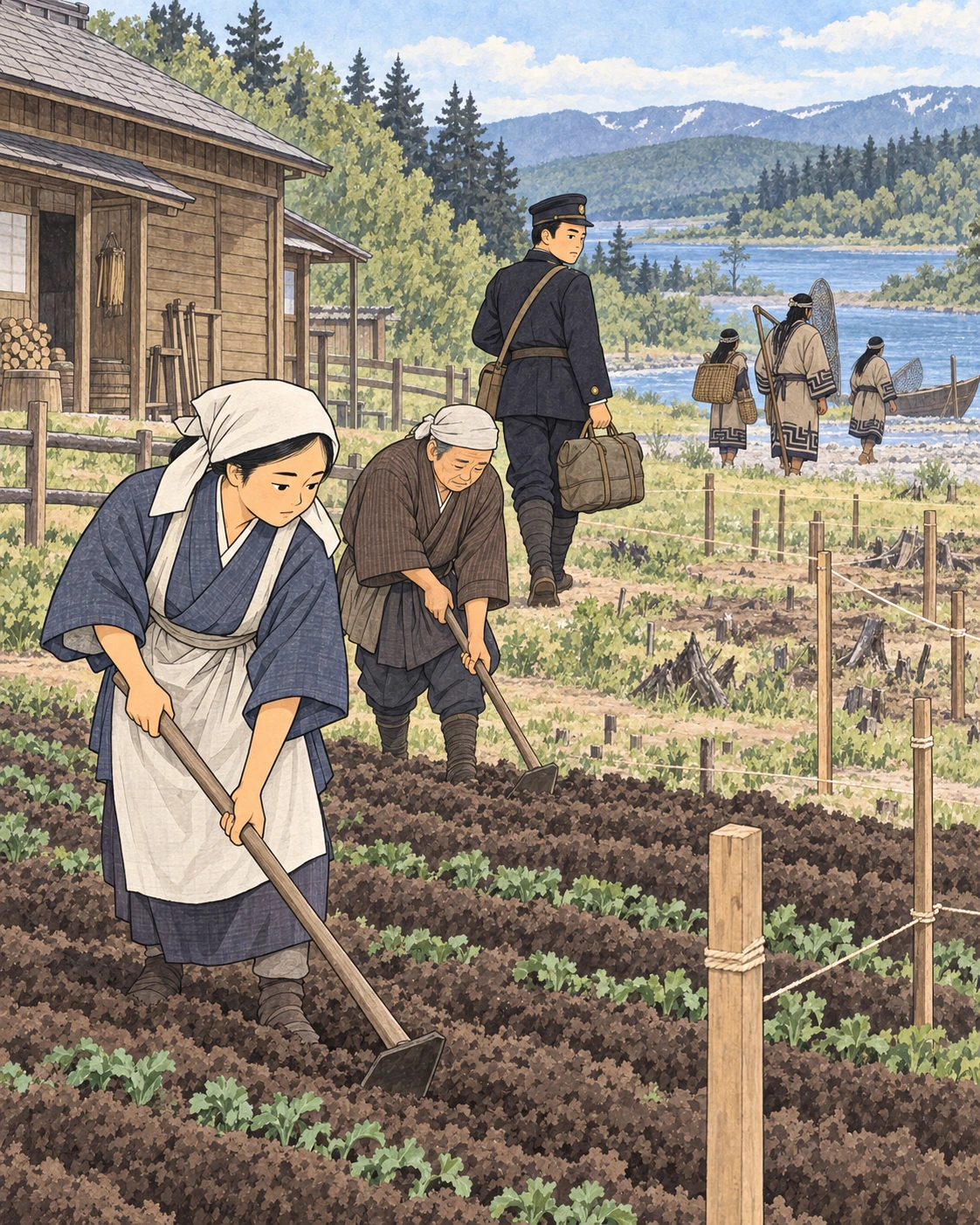
From 1875 tondenhei—soldier households expected to farm and provide an armed reserve—settled under commission support. Selected former samurai gained a new livelihood, while women's labor and children's continuing residence sustained villages. Farming and military duties could compete. Settlement and survey also reduced Ainu access to land and resources; hunting restrictions and schooling altered livelihoods and cultural practice. Communities petitioned, traded and adapted under unequal conditions. Kuroda sponsored the system, while officials implemented particular rules. Later measures such as the 1899 Hokkaidō Former Aborigines Protection Act belonged to successor administration, not his commission years. [1][10]
Alongside settlement, Sapporo Agricultural College opened in 1876. Kuroda supported funding and recruitment. The American educator William Smith Clark taught botany and English; William Wheeler taught mathematics and surveying; David Pearce Penhallow taught chemistry and botany. Clark left in April 1877, and other staff and students continued the work. The farewell saying: “Boys, be ambitious” acquired longer endings. Andō Ikusaburō's 1894–1895 biography added an old-man comparison later questioned by Clark biographer Ōsaka Shingo. Hokkaidō University treats a much longer 1914 exhortation as interpretation rather than a verified continuation. The college's teaching history extends beyond the phrase. [1][5][6]
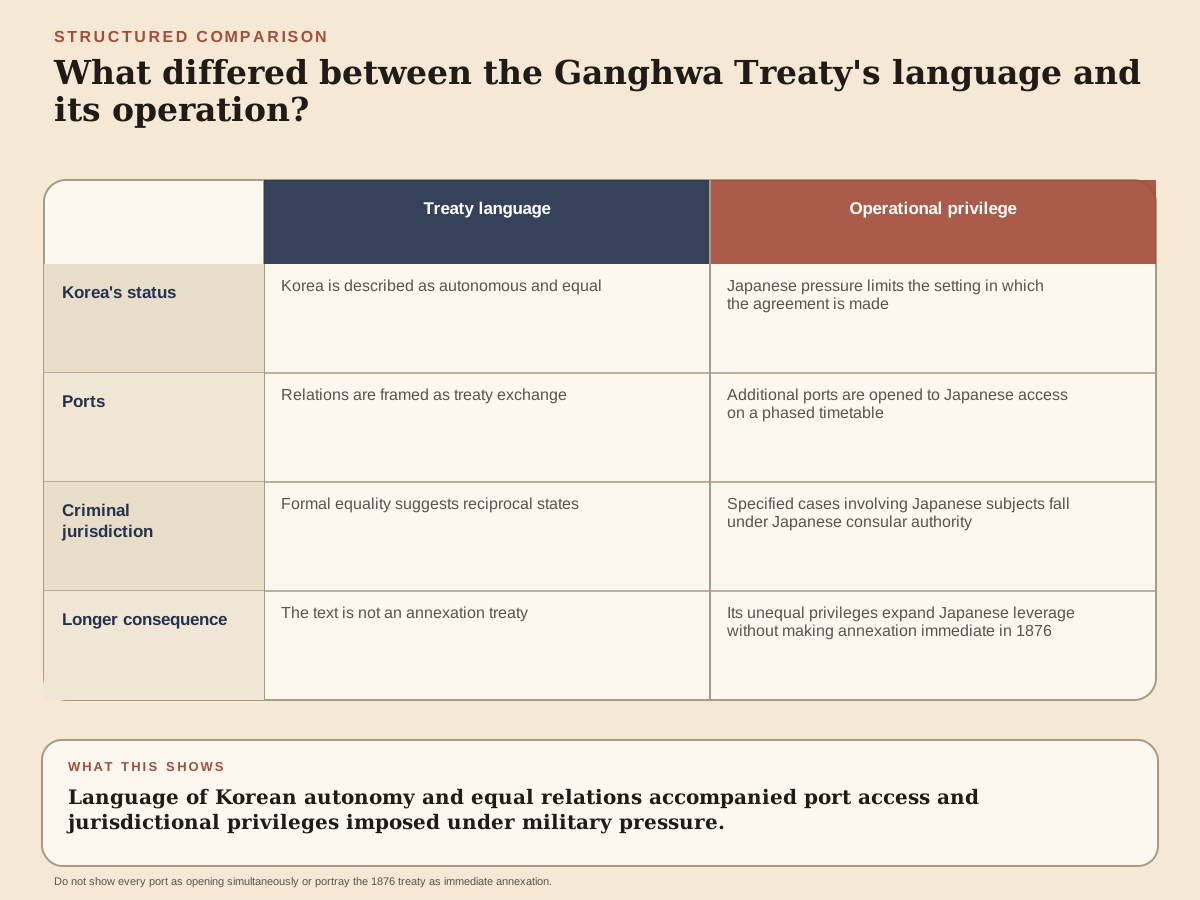
In 1876 Kuroda led Japan's treaty mission to Korea after the Un'yō incident, a clash involving a Japanese warship. Inoue Kaoru served as deputy plenipotentiary, an envoy authorized to negotiate for the government. The Treaty of Ganghwa described Korea as autonomous and equal to Japan. Under military pressure, however, it provided for additional trading ports and Japanese jurisdiction over specified criminal cases involving Japanese residents and Koreans in the designated ports. Its wording challenged the basis of Qing China's relationship with Korea without explicitly abolishing it. These privileges extended Japanese access before any annexation. [7]
In 1877 Kuroda served on the government's campaign staff against the Satsuma Rebellion, the uprising led by Saigō Takamori from his former domain. In 1878 his wife Sei died. Contemporary accusations alleged that Kuroda had killed her while drunk; police chief Kawaji Toshiyoshi investigated, including examination of the exhumed body. An official explanation reportedly attributed the death to illness, while critics suspected protection through Satsuma connections. Evidence limit: an accusation does not establish murder, and an official conclusion alone does not establish an independent inquiry. The allegation remained separate from his documented public appointments. [9][10]
In 1881 the government proposed selling commission assets on favorable terms to a company linked to Satsuma figures. Critics challenged elite control of properties created with public money. Permission was canceled that October, and the transfer did not take place. The crisis also brought the dismissal of Ōkuma Shigenobu, a government councillor advocating an early parliament, and a promise to open a Diet—a national legislature—by 1890. Longer constitutional disputes and popular-rights demands shaped those decisions. Kuroda's political responsibility for the proposal is different from proven criminal theft. [4]
The commission ended in 1882 after its planned term and the asset-sale crisis. Hakodate, Sapporo and Nemuro prefectures took over regional administration until the Hokkaidō Agency restored central coordination in 1886. Facilities and land relations continued across the changes; ending the agency did not restore displaced access to territory. Kuroda moved into national advisory work and became minister of agriculture and commerce in Itō Hirobumi's cabinet in 1887. Itō was Japan's first prime minister under the new cabinet system. Kuroda's next appointment would carry him into the constitutional transition. [1][2][3]
Kuroda became Japan's second prime minister in 1888. His cabinet governed during promulgation of the Meiji Constitution on 11 February 1889. In an address to local governors the following day, he advocated government standing outside parties and acting impartially. This “transcendental” position defended ministers serving the emperor and state above party control; critics saw protection from representative accountability. The Constitution and its political settlement involved Itō, specialists and imperial institutions, not Kuroda alone. Treaty revision provoked controversy, and an 1889 bombing gravely wounded Foreign Minister Ōkuma Shigenobu, the councillor dismissed in 1881. The crisis weakened the cabinet; Kuroda resigned that October. [1][2][3][11][12]
Kuroda remained influential after his premiership. He became a Privy Councillor in 1889, communications minister in 1892 and Privy Council president in 1895. The council advised the emperor; genrō, elder statesmen such as Kuroda, also advised on leadership and policy beyond particular offices. He died on 23 August 1900. Remembrance through the remaining Meiji years to 1912 could emphasize northern institution-building, Enomoto's rescue or the asset-sale scandal. Founder language needs limits: earlier planners, workers and residents built Sapporo, and Ainu communities bore the colonial costs of state-backed settlement alongside its lasting infrastructure. [1][2]
Classic
Kuroda Kiyotaka was born in Kagoshima on 9 November 1840 into a samurai family of relatively modest standing in Satsuma, the domain governing southern Kyushu. Household status offered education and a recognized route into service, while rank restricted appointments and income. The domain's military and commercial institutions gave selected lower retainers opportunities during mounting foreign pressure. Kuroda began within that hierarchy, before the wartime alliances that would carry him into national government. [1][10]
Kagoshima's coastal economy connected service to maritime trade, artillery and manufacturing. Satsuma's unequal control over Ryūkyū, the island kingdom south of Japan, also supported its wider networks. Kuroda entered institutions already developed by earlier officials and specialists. Household teaching and senior patronage prepared young retainers for tasks assigned by domain leaders. As foreign conflict sharpened, those routes could lead to military command and political contacts beyond Satsuma.
Satsuma retainers disagreed over relations with the imperial court and the Tokugawa shogunate, the warrior government headed by the shogun, and over the response to foreign powers. Domain birth supplied a service identity rather than a fixed policy. Later national patronage would grow from changing networks of command and trust. The same institutions that offered advancement remained selective, linking access to leaders who could recognize and employ a lower retainer's work.
The castle town depended on commerce and labor outside warrior households. That support sustained the government through which Kuroda advanced. Regime change would open high office to members of victorious domain networks, without extending the same opportunity to the larger population. His eventual rise would combine service, patronage and the outcome of war.
Kuroda entered Satsuma service while its leaders were reconsidering the domain's place in national politics. The 1863 Anglo-Satsuma conflict brought British warships against Kagoshima. Destruction demonstrated foreign naval power; the trade and technical contacts that followed grew out of that confrontation, not a friendly lesson arranged for Japan's modernization. Domain officials acquired ships and weapons to strengthen Satsuma's position within a changing political order. [8]
In Kyoto, the imperial capital, Satsuma had cooperated with Aizu, another domain, against Chōshū. Chōshū's leaders subsequently became potential partners against Tokugawa dominance. Cooperation required people who could carry messages between former opponents. In 1866 Kuroda invited Kido Takayoshi, a leading Chōshū representative, to travel with him to Kyoto. A letter to the Satsuma leader Saigō Takamori records that request. The invitation placed Kuroda among the intermediaries drawing former opponents toward cooperation. [8]
Historical disagreement · Who initiated Kuroda’s invitation?
Who initiated the invitation? Historian Iechika Yoshiki reads it as Kuroda's independent initiative. Kirino Sakujin interprets Kuroda as conveying Saigō's intention. Machida's 2017 study sets those readings alongside the letter and the divisions within Satsuma.
The invitation is documented; the extent of Kuroda's independence remains disputed. Neither reading makes him sole architect of the alliance.
Sonnō jōi—“revere the emperor, expel the foreigners”—supplied a political rallying cry, but its users differed over what action should follow. Satsuma's foreign purchases and changing alliances did not fit a single uninterrupted program of expulsion. By 1867 cooperation against the bakufu, the shogun's government, had developed through negotiations among leaders who could agree on an immediate opponent without agreeing on every part of a successor regime. Kuroda's contacts placed him within that partnership as it turned toward war.
In 1868 Kuroda served as a staff officer in the new government's northern expedition during the Boshin War, the civil war that displaced the Tokugawa shogunate. In 1869 he became a staff officer in the campaign against the remaining Tokugawa forces at Hakodate, a port in southern Hokkaidō. His assignments carried him from domain service into a coalition claiming authority in the emperor's name. Its troops and supply systems still depended heavily on Satsuma, Chōshū and other allied domains; it was not yet a standardized national conscript army. [1][2][3]
Northern campaigning depended on coastal transport, food supplies and local cooperation, as well as armed force. Staff appointments placed Kuroda within the command network coordinating those operations. Civilians supplied armies and endured requisition and displacement. The north entered his career through war before it became the setting for his better-remembered development work.
At Hakodate, the defeated force was led by Enomoto Takeaki, a former shogunate naval officer who had studied in the Netherlands. Its surrender in 1869 left the new government to decide how to punish or employ its former opponents. Kuroda argued that Enomoto's life should be spared. That intervention connected his wartime role to the personnel choices of the northern administration that followed. [1][3]
Enomoto's naval and linguistic training gave the government a practical reason to consider employing him. Kuroda's advocacy did not produce immediate freedom: imprisonment was followed by pardon in 1872 and entry into new-government service. Sentencing and appointment remained state decisions, and Enomoto had to accept the government he had resisted. Other defeated people lacked comparable skills or sponsorship. The episode preserved expertise across the change of regime while showing how selective that protection could be. [1][2][3][10]
While Enomoto was imprisoned, Kuroda entered the administration of the territory where the war had ended. In 1869 the government renamed Ezo as Hokkaidō and created the Kaitakushi, its Hokkaidō Development Commission. Kuroda became deputy commissioner in 1870 and commissioner in 1874. The agency combined settlement and resource development with northern security, giving its leaders authority over work that elsewhere fell to several departments. [2][3]
The commission inherited a populated territory. Ainu peoples, Indigenous communities whose homelands extended across the northern islands, already lived there, alongside Japanese fishing and trading settlements. Matsumae domain and Hakodate's administration had shaped earlier relations. Matsuura Takeshirō's geographic work and the plans of earlier officials also preceded Kuroda's leadership. Survey and renaming made central-government claims more visible; they did not create an island awaiting inhabitants.
Russian activity in Sakhalin and the North Pacific influenced official planning. Sakhalin, the large island north of Hokkaidō, contained overlapping Japanese and Russian claims. In 1873 Kuroda proposed relinquishing Japan's claim there. Enomoto negotiated the territorial settlement in 1875. The proposal and the treaty were different acts, connected through a policy involving several officials rather than one man's decision. [3][10]
Kuroda secured support for a large ten-year development program and recruited foreign advisers, notably the American Horace Capron. Their recommendations covered agriculture and industrial work, but Japanese officers and specialists selected, translated and adapted them. Engineers, interpreters and local workers turned funded plans into construction and cultivation. Climate, soil and transport costs limited what imported methods could accomplish; some crops and factories failed. [10]
National money funded those experiments. It also paid for the migration and infrastructure intended to strengthen the state's territorial hold. Settler households had to remain, routes had to be usable, and enterprises had to sustain continuing work. Kuroda's budgetary authority made him a powerful sponsor, while decisions passed through officials and contractors. The same concentration of authority that financed ambitious projects left residents and taxpayers with limited means to challenge their costs. [3][10]
Within that program, Sapporo became the inland center of northern administration. Hakodate already had population, shipping and foreign trade; selecting a site in the Ishikari plain shifted the government's attention beyond the older southern gateway. Shima Yoshitake, an early commission official, surveyed the area and advanced a city plan before Kuroda's ascendancy. Higashikuze Michitomi and other early leaders also belonged to this sequence.
A street plan needed drainage, transport and supplies to become an administrative center. Japanese specialists adapted building and engineering work to the climate and available materials, drawing on particular foreign recommendations. Laborers and contractors constructed offices and routes, while migrant households sustained the city's daily economy. Planning concentrated authority at Sapporo, but practical life depended on recurring work outside the map's orderly blocks.
Ainu knowledge and use of the plain's rivers preceded the new capital. State survey translated territory into administrative parcels while subordinating Indigenous claims. Drainage and construction altered the setting, and government facilities linked education and industry to central rule. The city also depended on ports and suppliers outside it, making its growth part of a wider network rather than a self-contained creation.
Kuroda's sustained political support helped make Sapporo a durable administrative center. Plans changed and some early industries failed; the growing city depended on continuing public expenditure and the work of its residents. Its later success was not guaranteed by the original street plan.
From 1875 the tondenhei system settled soldier households in Hokkaidō. Tondenhei were settlers expected to farm while remaining available for military duty. Former samurai who had lost or faced reductions in inherited stipends could gain land, housing and a new service role. Selection was limited: eligibility and household capacity determined who received support. [1][3][10]
Kuroda sponsored the program through the commission. Officials selected sites, recruited families and supervised supplies and training. Farming had to support continuing residence, while military duties could interrupt it. Women's cultivation and domestic work sustained households beyond the male names on military rolls; children entered schools and occupations. Weather, transport and harvests shaped whether a settlement could endure.
That supported settlement also changed Ainu access to territory. Survey made land legible as parcels the government could allocate or reserve. Seasonal and shared uses were harder to defend in those categories. Hunting and fishing restrictions altered subsistence, while officials favored fixed cultivation as a model of improvement. These changes extended beyond soldier villages, through the commission's wider land and resource policies.
Ainu communities differed across Hokkaidō, Sakhalin and the Kurils. Their dealings with merchants, officials and fishery operators had already developed under unequal conditions before the commission existed. During the new administration they petitioned, traded and adapted as access to land and livelihoods changed. Such choices preserved agency without equal bargaining power.
Kuroda carried institutional and budgetary responsibility for the commission's expansion; particular rules and their local enforcement involved other officials. His tenure was not the date of every later assimilation measure. The 1899 Hokkaidō Former Aborigines Protection Act belonged to successor administration, not his commission years. Soldiers' family hardship and Ainu dispossession describe different experiences within the same settlement system, neither canceling the other.
Alongside settlement, the commission funded training for the people expected to sustain its agricultural and technical work. Sapporo Agricultural College opened in 1876 after an earlier preparatory school. Kuroda supported recruitment and funding. William Smith Clark came from Massachusetts Agricultural College with other scientific teachers. Clark taught botany and English; William Wheeler taught mathematics and surveying; David Pearce Penhallow taught chemistry and botany. [1][6]
Clark left Sapporo in April 1877. Wheeler took over teaching leadership, while Japanese staff and students carried the institution forward. Training joined observation and scientific instruction to employment in northern development. The college expanded opportunity for selected students within a state project privileging farming and resource transformation. Environmental knowledge, including Ainu knowledge of seasonal conditions, also existed outside its credential system. [6]
What did Clark say at his farewell? The remembered “Boys, be ambitious” has acquired longer endings. Andō Ikusaburō's 1894–1895 biography added a comparison to Clark himself as an old man; Ōsaka Shingo, a later Clark biographer, questioned that wording. A much longer moral exhortation appeared in a history prepared in 1914, beyond HO's principal chronological boundary. Hokkaidō University's explanation treats it as a later interpretation of the saying, not a verified continuation of the farewell. [5]
The teaching record gives the college a history beyond a celebrated phrase. Its scientific work and continuing institutional life depended on successive teachers and students. Kuroda helped make their appointments possible, but sponsorship was different from carrying out the intellectual work.
The same year that the college opened, Kuroda represented Japan in negotiations with Korea. The immediate crisis followed the Un'yō incident, a clash involving a Japanese warship. In 1876 he led the mission that concluded the Treaty of Ganghwa, accompanied by Inoue Kaoru as deputy plenipotentiary—an envoy authorized to negotiate for his government. Korean officials negotiated under Japanese military pressure. [7]
Japan had faced Western demands for unequal privileges in the 1850s. It now used naval power to obtain advantages from Korea. Article 1 described Korea as an autonomous country with rights equal to Japan's. That wording challenged the political basis of Qing China's relationship with Korea; it did not explicitly declare that relationship abolished. The language of equality sat beside rights that favored Japanese access. [7]
Articles 4–5 provided for two further trading ports in addition to the established Japanese presence at Busan. Article 10 placed specified criminal cases involving Japanese residents and Koreans at the designated ports under the offenders' own national officials. Japanese offenders would therefore be tried by Japanese authorities rather than Korean courts. This was a concrete restriction on Korea's jurisdiction at those ports, not simply a ceremonial recognition of friendship. [7]
The agreement did not yet annex Korea. It extended Japanese access and privileges through negotiations shaped by armed pressure. Kuroda's signatures belonged to a shared diplomatic process, alongside his deputy and the Korean representatives. The mission carried his career outside northern development into a relationship where Japan's growing state capacity could constrain another country's choices.
In 1877 Kuroda served on the government's campaign staff in the Satsuma Rebellion, the uprising led by Saigō Takamori against the Meiji government. He had entered national service through Satsuma's networks; now his military work served the government against forces from his former domain. His northern appointment did not remove him from national campaigns.
The following year his wife, Sei, died. Contemporary accusations alleged that Kuroda had killed her while drunk. Police chief Kawaji Toshiyoshi investigated, including examination of the exhumed body. An official explanation reportedly attributed the death to illness. Critics suspected that Satsuma connections protected Kuroda and questioned whether the inquiry could be trusted. [9][10]
What is established about her death? The death, the accusation and the investigation must be distinguished from a proven homicide. The official illness explanation and the suspicion of protection are competing accounts; neither the allegation nor his reputation for heavy drinking can establish murder. Equally, an official conclusion alone cannot demonstrate the independence of the procedure. [9][10]
The allegation remained part of his public reputation as he continued in high office. It concerned his household and the credibility of an investigation, separate from his documented public appointments.
In 1881 the government authorized a proposed disposal of commission assets to a company connected to Satsuma figures. Public expenditure had created the properties; favorable terms and insider relationships raised doubts over whether the intended purchaser would gain at public expense. Kuroda defended disposal as part of ending a temporary commission. Opponents turned that administrative decision into an argument against domain-connected rule. [4]
Newspapers and political activists carried the controversy beyond Hokkaidō. The government canceled permission that October, so the proposed transfer did not take place. In the same crisis it dismissed Ōkuma Shigenobu, a government councillor advocating an early parliament, and promised a Diet—a national legislature—by 1890. Constitutional planning and longer popular-rights demands shaped those decisions alongside factional conflict; the asset sale did not alone produce the parliamentary promise. [4]
For Kuroda, cancellation was a public reversal of an arrangement he had supported. It connected the commission's farms and factories to a question of who controlled national property. Critics could challenge a development policy through its accounts and proposed beneficiaries, rather than accepting the administrator's claim that closure justified the terms.
Sale or completed theft? Permission was granted and then withdrawn. Political responsibility for the proposal is different from a proven criminal finding that the assets were stolen. The controversy exposed weak public oversight before a national legislature existed, while its cancellation showed that criticism could make an elite decision costly. It did not by itself create transparent procurement or dissolve the networks behind the proposal.
The commission ended in 1882 after its planned term and the asset-sale crisis. Hakodate, Sapporo and Nemuro prefectures took over regional administration. Different populations, industries and transport connections now fell under separate offices. Kuroda no longer directed the whole northern program; successor officials had to determine which facilities and policies to retain. [3]
The Hokkaidō Agency was established in 1886, restoring central coordination after the short-lived prefectural arrangement. Roads and farms could continue to serve households after an agency name disappeared. So could property categories and unequal access created by earlier survey and settlement. Administrative reorganization redistributed responsibility without returning the region to its precommission setting.
The college likewise moved through successor institutions. Teachers and students continued scientific work under changing administration. Retaining useful facilities did not mean that every commission experiment had succeeded. Some enterprises closed or changed ownership, while settlement and resource development remained government priorities.
Kuroda moved into national advisory work after leaving the commission and became minister of agriculture and commerce in Itō Hirobumi's cabinet in 1887. Itō was Japan's first prime minister under the recently created cabinet system. This appointment placed Kuroda within a government preparing constitutional institutions, rather than restoring his old northern command. His experience and Satsuma connections remained valuable in elite politics, but his new office served a broader national administration. [1][2]
His next promotion would make that distinction more visible. Hokkaidō had provided a long setting for concentrated administrative authority; the premiership would require him to defend how executive power should operate as representative institutions approached.
Kuroda became Japan's second prime minister in 1888. Cabinet government was new, and the relation among ministers, imperial authority and the future Diet was still taking shape. His cabinet governed when the Meiji Constitution was promulgated on 11 February 1889. The document provided a representative chamber while grounding sovereignty and executive appointments in the emperor. [1][2][3][11]
In an address to local governors on 12 February 1889, Kuroda stated that government should stand outside political parties and act impartially. This “transcendental” position defended ministers serving the emperor and state rather than a temporary legislative majority. Advocates presented distance from parties as impartiality; critics saw protection for oligarchic executives against electoral accountability. The first national election and Diet still lay ahead, but popular-rights organizations already used newspapers and political networks to demand a greater representative role. [11][12]
Constitutional construction involved Itō, legal specialists and imperial institutions, as well as earlier political commitments and opposition pressure. Kuroda's premiership did not make him the Constitution's sole author. Its promulgation opened a new political framework without settling how much control representative politics would exercise over ministers. [11][12]
Treaty revision put the cabinet under immediate pressure. Negotiations concerned the foreign legal privileges granted under Japan's earlier treaties and concessions proposed to obtain their removal. In 1889 a bombing gravely wounded Foreign Minister Ōkuma Shigenobu, the former councillor dismissed in 1881. The controversy and attack weakened the administration; Kuroda resigned that October.
His cabinet had occupied the threshold between government by the Restoration elite and a constitutional order with a national legislature. Its insistence on executive independence would remain an argument within that order, not a claim that ministers operated outside the Constitution.
After leaving the premiership, Kuroda retained influence through imperial advisory and cabinet offices. He became a Privy Councillor in 1889, minister of communications in 1892 and president of the Privy Council in 1895. The Privy Council advised the emperor on important state matters; it was not an elected chamber. His standing as a genrō, an elder statesman advising on leadership and policy, also gave him access beyond any one appointment. [1][2]
Kuroda died on 23 August 1900. His career had moved from Satsuma service through civil war to northern administration, coercive diplomacy and constitutional government. The institutions associated with him continued under other officials and communities. Sapporo's administrative and educational infrastructure remained visible outcomes of state support, while land relations and assimilation carried colonial costs beyond his life. [1][2]
His advocacy for Enomoto preserved another account of the Restoration generation: a victorious officer had helped a defeated specialist survive and enter new service. The asset-sale controversy recalled the same generation's privileged access to public resources. The Ganghwa treaty connected Japan's administrative strength with armed pressure abroad. These were different public actions, not alternative stories capable of erasing one another.
In the remaining Meiji years to 1912, institutions and survivors continued shaping remembrance of that generation. A founder image concentrated northern achievement in Kuroda's name. It could not account for Sapporo without earlier planners, workers and residents, or for Hokkaidō without Ainu communities. His support helped establish lasting institutions, while the settlement program redistributed land and power against Indigenous peoples. Those joined consequences remain central to the historical meaning of his northern career.