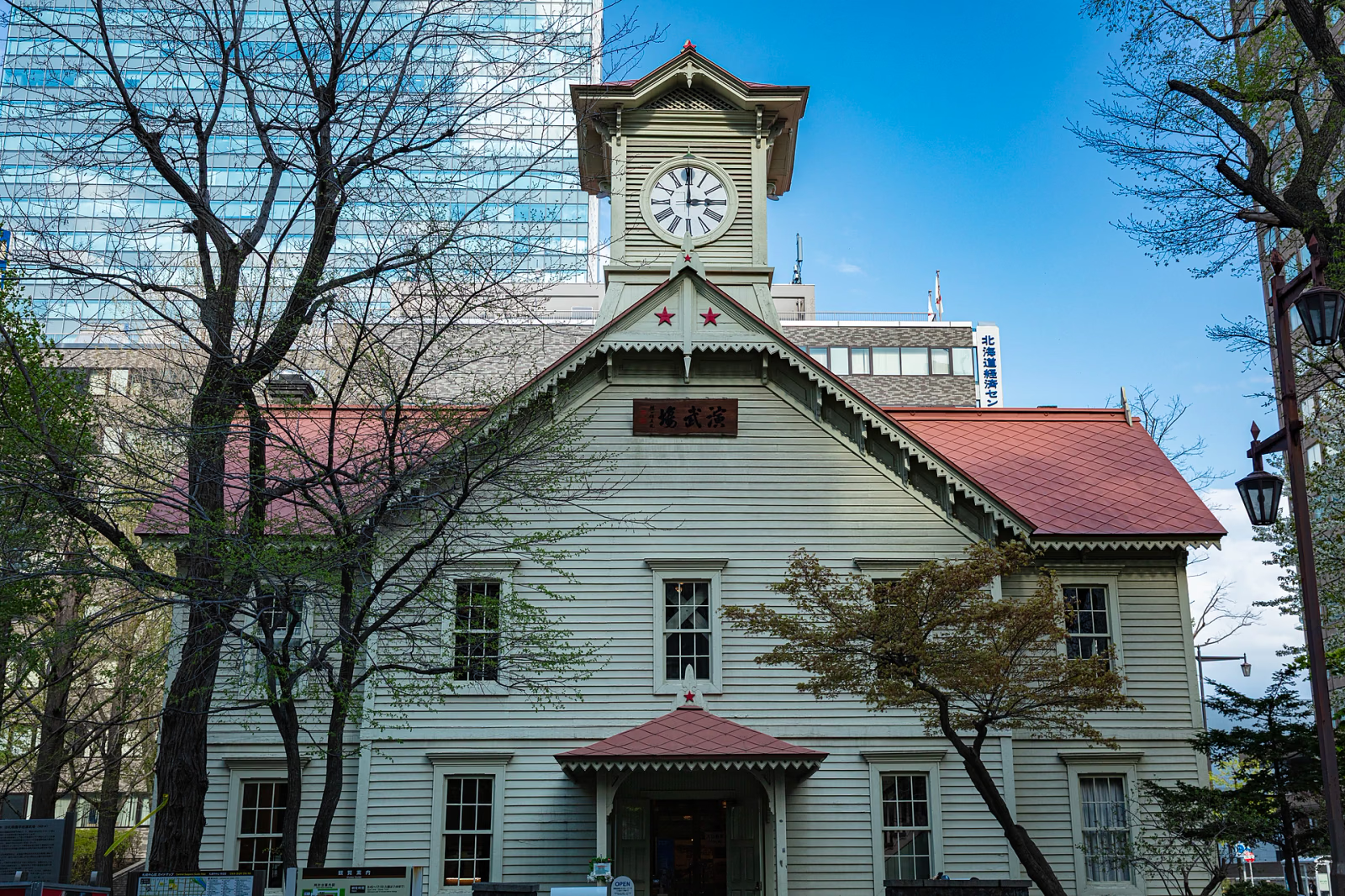
The 1878 Agricultural College Drill Hall
Attraction
The official building name is Former Sapporo Agricultural College Drill Hall. It was completed in 1878 for military-style physical training, ceremonies and teaching. Clark had already returned to the United States, but his educational program included drill, and William Wheeler carried the project forward. The large clock tower did not yet exist. Starting with that chronology prevents the building from being reduced to the picturesque feature added later. The building, formally the Former Sapporo Agricultural College Drill Hall, was designated a National Important Cultural Property in 1970.
Current visibility
The present precinct at Sapporo Clock Tower still carries “The 1878 Agricultural College Drill Hall”; visitors can ground the text in the drill hall, the surviving building, and the ritual setting.
The 1881 Tower Clock and Public Time
Attraction
After the drill hall opened, a large tower clock was ordered from E. Howard in the United States. The mechanism was too large for the original bell structure, forcing a substantial redesign. Official history credits Kuroda Kiyotaka with supporting the installation after Wheeler argued that a public clock could provide standard time for Sapporo. On 12 August 1881 the clock began striking accurate time for residents. The building had become civic infrastructure as well as college property. The clock transformed a campus hall into a citywide time signal.
Current visibility
At Sapporo Clock Tower, “The 1881 Tower Clock and Public Time” remains directly identifiable; the visible reading rests on the tower clock, the drill hall, and the surviving building.
Laboratories, Teaching and Ceremony inside the Hall
Attraction
The official English guide notes that first-floor rooms served as laboratories, lecture rooms and displays for zoological, botanical and mineral specimens, while the second floor supported physical training and ceremonies. That mix is historically useful. The college was not importing one foreign architectural style as decoration; it was building an institution that combined agricultural science, practical education, discipline and public ceremony.
Current visibility
“Laboratories, Teaching and Ceremony inside the Hall” remains part of Sapporo Clock Tower, but interior or path access can vary; verify current official conditions before promising entry to the ritual setting, the interior, and the surviving building.
American influence is structural, not a costume
Attraction
The official site describes the Clock Tower's simple, practical wooden character as resembling American construction associated with the Midwest and West. That does not make the building an imported American object. It was produced in the specific environment of the Sapporo Agricultural College, where foreign advisers, Japanese officials and local builders worked within a new institutional project. The useful category is transfer and adaptation, not imitation.
Current visibility
“American influence is structural, not a costume” can still be read at Sapporo Clock Tower through the bell tower and the surviving building; the visibility claim concerns that setting, not a past moment preserved intact.
A Working Clock within Modern Sapporo
Attraction
The Clock Tower can feel visually small because modern Sapporo has grown around it. That contrast is useful rather than disappointing. The building survives from the city's formative Meiji decades, while the clock still performs the practical act that made it famous: measuring and publicly marking time. The landmark is valuable because a small institutional building was preserved and moved about 100 metres in 1906 while the scale and function of the surrounding city transformed. The mismatch in scale between building and city is itself evidence of Sapporo's growth. The continuing mechanism was also selected for the Soundscapes of Japan 100 in 1996 and designated Mechanical Engineering Heritage in 2009, recognitions that focus attention on the working clock rather than the façade alone.
Current visibility
The working clock and relocated 1878 drill hall remain visible in central Sapporo; the building was moved about 100 metres in 1906, so its present plot is not the original one.