Read the article below. Interactive reading tools are available when scripts load.
Quick
The future Itō Hirobumi was born Hayashi Risuke in Tsukari village, in the eastern part of Chōshū domain, on 16 October 1841. His family cultivated land rather than belonging to the domain's high warrior houses. His father, Jūzō, later entered a low-ranking Itō retainer household; Risuke moved with the family to Hagi and acquired the Itō name.
That transfer mattered. In Tokugawa society, household position helped determine service, education, obligations, and the people who could recommend a young man. Yet the new standing remained modest. It did not place him near the hereditary summit of Chōshū government.
By 1857 he had entered the circle of Yoshida Shōin's Shōka Sonjuku. Later commemoration makes village, household rise, and school look like the first steps of an inevitable prime minister. The evidence supports opportunity, not destiny.
As Itō Shunsuke, the young retainer joined Chōshū's activist world. Yoshida Shōin's execution in 1859 and the treaty crisis sharpened opposition to the bakufu. The slogan sonnō jōi—revere the emperor, expel the foreigners—joined moral claim, political rivalry, and possible violence.
In late 1862, Itō participated with Chōshū associates in setting fire to the unfinished British legation at Gotenyama in Edo. No occupants were killed, but the operation was intended to destroy a diplomatic building and obstruct foreign presence. It cannot be cleaned into harmless youthful enthusiasm.
Nor does it contain his whole later career. Chōshū activism included study of foreign power alongside attacks on foreign institutions. Men could seek Western knowledge while opposing treaties and the authority that accepted them.
Itō's later reputation as an international statesman makes this episode inconvenient. Publication retains it because political learning can include culpable action, reversal, and adaptation without becoming a morality tale of instant enlightenment.
On 27 June 1863, Itō and four Chōshū companions left Yokohama secretly for Shanghai and then Britain. Unauthorized overseas travel exposed them to severe punishment. They cut their hair, adopted unfamiliar clothes, worked aboard ships, and reached London in November.
Alexander Williamson, a chemistry professor associated with University College London, and his wife Emma received the students. Itō encountered railways, factories, finance, naval power, urban poverty, and the administrative infrastructure behind industrial strength. He was not completing a modern degree programme, and the five did not all study identical subjects.
The journey destabilized an easy belief that expulsion by will alone could defeat the powers visible in British ports and streets. Yet observation did not dictate one liberal constitution. Industrial Britain joined representative institutions to empire, class inequality, and coercive global reach.
When news suggested that Chōshū faced foreign attack, Itō and Inoue returned in April 1864. Their overseas study became valuable because they carried warning into a political environment that might punish them for having left.
Itō and Inoue returned to Japan in 1864 because Chōshū's attacks on foreign shipping had invited a combined response. They warned domain leaders that its batteries could not defeat the industrial naval powers they had seen. Their advice did not immediately reverse policy.
In August, British, French, Dutch, and United States vessels attacked Shimonoseki. Allied forces destroyed or captured batteries, landed troops, and reopened the strait on terms backed by force. Itō and Inoue served as intermediaries in the negotiations that followed.
This was not a clean scene in which enlightened travelers saved irrational countrymen. Chōshū contained competing authorities; foreign governments defended shipping and treaty access through disproportionate power; interpreters carried meanings across dangerous gaps; coastal workers and residents bore consequences they had not designed.
Military defeat accelerated Chōshū's strategic change, but surrender at the strait did not end its domestic war. The same year brought conflict around Kyoto and a bakufu punitive expedition. Adaptation required survival inside several overlapping struggles.
After the Restoration, Itō moved from domain activism into offices of the new government. He served in Hyōgo, a port region where foreign trade, customs, local administration, and treaty obligations met. He then held posts in finance, civil affairs, taxation, and the new Industry Ministry.
The change demanded more than revolutionary loyalty. Officials had to inventory revenue, standardize paperwork, staff prefectures, manage ports, and turn former domain resources into central institutions. In 1869 lords returned their registers to the emperor; in 1871 the government abolished the domains and replaced them with prefectures.
Itō participated in that centralizing project alongside Ōkubo, Kido, Ōkuma, Inoue, officials from many domains, and foreign advisers. Farmers supplied land tax; merchants supplied credit and information; clerks made decrees operational.
His rapid rise shows the value of mobility and overseas knowledge. It also shows how a revolutionary coalition converted victory into an administrative hierarchy that excluded most subjects from deciding its design.
Itō left Japan in December 1871 as a vice ambassador on the Iwakura Mission. The delegation crossed the United States and Europe with diplomats, officials, specialists, and students. It hoped to examine institutions and prepare treaty revision while representing a government whose international standing remained unequal.
In Washington, the leaders discovered that their credentials did not authorize the negotiations they had begun to contemplate. Itō and Ōkubo returned to Japan to obtain fuller powers. Even then, early treaty revision was not achieved. The episode exposed the difference between ceremonial reception, legal competence, and bargaining strength.
The mission studied factories, schools, courts, parliaments, ministries, militaries, and municipal services. Itō saw no single “Western system.” Britain, the United States, France, Germany, and other states joined different institutions to industrial and imperial power.
Comparison enlarged his repertoire, but selection remained political. The travelers returned to disputes over Korea, revenue, representation, and the speed of reform. Observation abroad could inform those choices; it could not make them uncontested.
After returning, Itō joined the coalition that rejected an immediate Korean mission and kept priority on domestic consolidation during the 1873 political crisis. He became councillor and Industry minister. Railways, telegraphs, mines, shipyards, and technical schools expanded under a state that borrowed expertise and concentrated revenue.
These projects were not Itō's personal inventions. Engineers, foreign employees, workers, contractors, and taxpayers made them function. State plants could discipline labor and expose communities to danger even while creating new transport and production.
Itō also helped mediate the 1875 Osaka Conference, which brought Kido and Itagaki back into government around promises of gradual representative institutions. The settlement proved temporary. Political societies and newspapers continued to demand assemblies and rights.
After Ōkubo's assassination in 1878, Itō served as Home Minister. The office joined policing, prefectures, public works, and economic promotion. Building capacity and controlling dissent were not separate careers; they were two uses of the same central apparatus.
In 1881 Ōkuma Shigenobu proposed an early constitution and parliament modeled substantially on British cabinet practice. Itō and other leaders opposed the timetable and feared an executive dependent on party majorities. At the same time, public outrage grew over a plan to sell Hokkaidō Development Commission assets to connected buyers.
In October the government canceled the sale, forced Ōkuma from office, and issued an imperial promise to open a national assembly in 1890. The settlement accepted constitutional government while allowing the dominant coalition to control its design and schedule.
Itō emerged as the central investigator of the official route. This was not a debate he won through abstract theory alone. Factional distrust, regional alliances, patronage, the scandal, and control of imperial procedure shaped the outcome.
The crisis fixed a productive contradiction. Public pressure made indefinite delay impossible; executive leaders used the promise of a future Diet to contain immediate demands. A constitution would come, but its authors intended it to preserve administrative initiative.
Itō left Yokohama on 14 March 1882 with an official mandate to investigate constitutional government. The accompanying instructions listed thirty-one subjects, including monarchy, upper and lower chambers, ministries, courts, local administration, and the imperial house.
He and his staff traveled through Germany, Austria, Britain, Belgium, and other states. Rudolf von Gneist, Albert Mosse, and Lorenz von Stein were among the jurists who instructed them. German and Austrian state law offered language for a strong monarchy and professional administration, but the investigators also compared parliamentary and local institutions.
Itō returned after roughly fourteen months abroad. He did not carry home one ready-made constitution. Translation altered concepts; advisers disagreed; Japanese drafters would have to connect foreign categories to the emperor, existing ministries, peerage, military command, and promised Diet.
The mission narrowed official choice while expanding technical knowledge. It made an executive-centered constitutional monarchy easier to formulate, not historically inevitable or politically neutral.
On 22 December 1885, the government abolished the old Dajōkan ministerial structure and established a cabinet of a prime minister and departmental ministers. Itō became Japan's first prime minister. The change clarified administrative portfolios and supplied a recognizable center for coordination.
It did not make the prime minister the leader of an elected parliamentary majority. Ministers were appointed within an imperial state, and the Diet did not yet exist. The army, navy, imperial household, elder statesmen, and later Privy Council formed authority that no single cabinet fully controlled.
The new system followed other preparations: a peerage had been created in 1884, ministries revised, and the imperial household placed on a distinct institutional track. In 1888 Itō left the premiership to chair the new Privy Council, where constitutional drafts received secret deliberation.
His title was a major innovation, but “first prime minister” can mislead if modern assumptions are imported backward. Itō headed an executive designed before representative government and intended to remain protected from direct parliamentary selection.
The constitution was drafted by a working group, not written by Itō alone. Inoue Kowashi prepared major texts; Itō Miyoji and Kaneko Kentarō contributed research and drafting; the German adviser Hermann Roesler answered legal questions. Itō directed political choices and defended them in the Privy Council.
Promulgated on 11 February 1889, the Constitution located sovereignty in the emperor, established a bicameral Diet, and recognized rights of subjects within limits set by law. Ministers advised the emperor rather than deriving office from the elected chamber. Military command and ordinance powers retained important independence from parliamentary control.
This was a real constitutional order, not decorative paper. Laws and new taxes required Diet consent, budgets could provoke negotiation, and rights language supplied legal claims. It was also not parliamentary sovereignty or universal citizenship.
The separate Imperial House Law and confidential drafting process protected dynastic design from popular deliberation. Itō's leadership joined institutional restraint to preservation of an imperial executive.
The Imperial Diet first met in November 1890. Fewer than half a million tax-qualified men could vote for the House of Representatives; women and most men were excluded. The House of Peers combined hereditary and appointed privilege.
Even this restricted lower house mattered. Opposition members cut budgets, challenged officials, and forced cabinets to negotiate. Governments sometimes dissolved the chamber, used police pressure and election interference, or traded concessions for support. Constitutional politics became behavior, not text alone.
Itō served four times as prime minister and repeatedly worked outside office as a genrō, one of the elder statesmen who advised on cabinets without a clear constitutional basis. His hope that administration could stand above parties weakened as parties proved durable.
In 1900 he organized the Rikken Seiyūkai and used it as a governing base. The move was adaptation, not full acceptance of parliamentary supremacy. It linked bureaucratic leadership, local political networks, patronage, and legislative votes inside the imperial constitution.
War between Japan and Qing China began in 1894 amid rival intervention in Korea. As prime minister, Itō headed a government that mobilized soldiers, finance, transport, diplomacy, and censorship. Japanese victories demonstrated new state capacity while exposing Korean and Chinese populations to war on their land.
At Shimonoseki on 17 April 1895, Itō and Foreign Minister Mutsu Munemitsu signed the peace treaty for Japan with Li Hongzhang's Qing delegation. Qing recognized Korea's “independence,” ceded Taiwan, Penghu, and Liaodong, opened commercial privileges, and promised a large indemnity.
The terms were not chosen by Koreans or Taiwanese. Japan's occupation of Taiwan encountered armed resistance. Russia, Germany, and France then compelled Japan to return Liaodong in the Triple Intervention, demonstrating that victory over Qing did not equal parity with all empires.
Itō's diplomacy joined constitutional state power to imperial acquisition. Administrative achievement and colonial violence belonged to the same government.
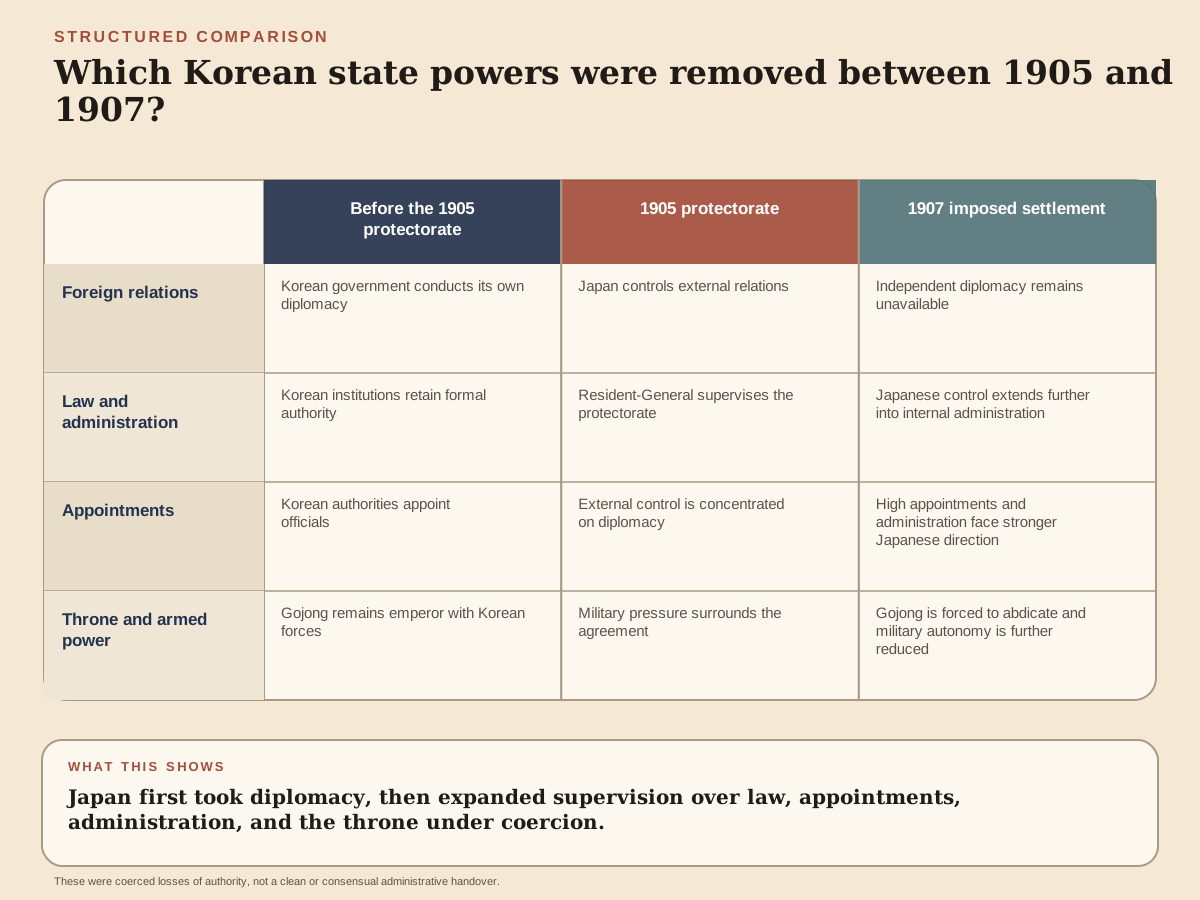
After victory over Russia, Japan moved to take Korea's foreign relations. Itō went to Seoul as special envoy in November 1905. Emperor Gojong refused approval, while Japanese troops and officials exerted pressure on Korean ministers. The resulting Eulsa Agreement removed Korean diplomatic autonomy and established a Resident-General.
Itō became the first officeholder. In 1907, after Gojong sent envoys to the Hague, Japan forced his abdication. A new agreement gave the Resident-General supervision over important laws and administration and power over senior appointments; the Korean army was disbanded. Armed resistance expanded.
Itō sometimes differed from advocates of immediate annexation and promoted staged protectorate rule. That was a dispute over the form and timing of domination. His office curtailed sovereignty, inserted Japanese officials, and governed against sustained Korean opposition.
By 1909 he accepted the government's annexation course and resigned the Residency-General. The claim that he “opposed annexation” cannot erase his central role in making annexation possible.
After leaving the Residency-General, Itō again chaired the Privy Council. On 26 October 1909 he arrived at Harbin station for a meeting involving Russian finance minister Vladimir Kokovtsov. Korean independence activist An Jung-geun shot him on the platform. Itō died; An was arrested.
An presented the act as part of Korean independence struggle and a defense of peace in East Asia. Japanese authorities tried him in the colonial legal environment at Lüshun and executed him on 26 March 1910. His political claims belong to his evidenced perspective; they are not neutral descriptions of every disputed fact.
Japan gave Itō a state funeral. In August 1910 it annexed Korea. His death did not create the policy, which had already been accepted, but it removed a senior actor before its completion.
Japanese commemoration long centered prime minister, constitution, and modernization. Korean memory centered coercion and resistance. A responsible biography holds those classifications against the same documented career.
Classic
Tsukari belonged to the productive countryside on which the stipends and institutions of Chōshū depended. The Hayashi family worked within that rural order. Calling Risuke simply “of samurai birth” would project the household's later status backward; calling him a solitary peasant genius would hide the transfer that made retainer service possible.
His father Jūzō did not rise into the domain's governing aristocracy. He entered the Itō house as a dependent of low status, often described by the term chūgen. The category sat below full-ranking retainers and carried practical service obligations. When the family took the Itō name, the boy acquired a new institutional relationship, not wealth equal to senior Chōshū lineages.
The move to Hagi changed geography as well as status. Castle towns concentrated offices, schools, military instructors, paper traffic, patrons, and information from Edo or the coast. A family without high rank could still encounter routes that did not exist in a farming village. Those routes were narrow, competitive, and controlled by the domain.
Household mobility depended on labor rarely centered in political biography. Rural kin remained attached to land and local obligations. Women managed food, clothing, illness, and relations while names and service positions changed. Retainer households needed dependants precisely because official life rested on work below the rank recorded in appointment lists.
The Shōka Sonjuku was another opening, but it should not be treated as a machine that manufactured Restoration leaders. Yoshida Shōin taught a shifting population of young men through texts, discussion, geography, military questions, and urgent responses to foreign pressure. Students differed in age, duration of attendance, position, and later choice. The school's retrospective fame collects their divergent careers under one roof.
Risuke entered that circle in 1857, after Perry's expeditions and the intensifying treaty crisis. He could hear questions about coastal defense, imperial authority, the bakufu, and foreign knowledge. Nothing in the surviving institutional record recovers a sixteen-year-old's complete inner response. Later titles—prince, prime minister, constitutional statesman—cannot supply it.
The household change nevertheless helps explain a genuine historical possibility. Chōshū's crisis created demand for mobile, literate, politically committed men who could move between village, castle town, port, and eventually foreign country. Rank remained powerful, but emergency allowed performance and patronage to matter more than in quieter decades.
That opportunity was unequal. Most rural children did not enter a celebrated teacher's network, leave the domain, or acquire patrons who could protect an illegal overseas journey. Itō's later ascent illustrates a partial opening within hierarchy, not the disappearance of hierarchy.
Calendar and name require equal care. The traditional date belongs to Tenpō 12; 16 October is the converted Gregorian date. “Itō Hirobumi” is the stable article label, but the child at Tsukari was Hayashi Risuke. Writing the final name at every stage makes public office appear present in infancy.
The strongest conclusion is structural rather than prophetic. A farming household entered a low retainer line; a village child reached Hagi; a domain in crisis made new networks politically valuable. These transitions expanded what Risuke could attempt. They did not tell him what he would become, whom his policies would later govern, or whose sovereignty those policies would restrict.
The apparent contradiction weakens only when “foreign” is treated as one undivided idea. Chōshū activists could desire military, navigational, and industrial knowledge while rejecting treaty ports, extraterritorial privilege, and bakufu diplomacy. They could believe that learning strengthened Japan and that destroying a legation resisted subordination. The combination was dangerous rather than incoherent.
Shōin's school encouraged attention to the outside world, but his execution after the Ansei Purge also supplied a martyr around whom grievances gathered. Former pupils and younger associates did not inherit one fixed programme. Some emphasized direct action, some domain reform, some court politics, and many shifted as coalitions and military facts changed.
Itō's low rank shaped his place inside this movement. He did not possess a senior councillor's formal authority. Activist networks offered another currency: willingness to travel, carry messages, accept danger, and join collective operations. Such conduct could win trust from men like Takasugi Shinsaku or connect him with Inoue Kaoru.
The Gotenyama target was the new British legation still under construction. Burning it made diplomatic infrastructure vulnerable and signaled that the bakufu could not guarantee foreign security even in Edo. The operation involved planning, materials, movement through guarded space, and a group prepared to use fire for political ends.
Absence of fatalities does not make arson symbolic in a harmless sense. Workers had built the compound; guards and residents faced risk; diplomacy after the attack had to absorb the threat. Political biography often narrates the flames as picturesque prelude because the perpetrators later became officials. That outcome should not retroactively lower the act's seriousness.
At the same time, responsibility must remain specific. Participation is well established. Evidence does not justify assigning Itō sole design of the operation or every violent act conducted by Chōshū militants. Collective culpability and individual limits can be stated together.
The wider movement also contested domestic authority. Activists condemned foreign agreements partly because the bakufu had signed them without the form of imperial approval they demanded. “Expulsion” therefore operated as a challenge to who could bind the polity. A legation became a physical point where external relations and internal sovereignty met.
Merchants, interpreters, sailors, laborers, and port residents experienced that struggle without choosing its slogans. Violence against diplomatic property could invite retaliation that reached coastal communities and commerce. The costs of dramatic action were distributed more widely than the honor claimed by conspirators.
Itō did not convert from ignorance to knowledge in one clean moment after this attack. He already belonged to a milieu collecting intelligence about foreign strength. The journey to Britain in 1863 would intensify comparison and accelerate tactical reversal, but it would not erase Gotenyama.
Later constitutional office makes a second distortion tempting: the claim that the young radical secretly possessed his mature institutional plan. No evidence supports it. The man who would help build diplomatic and constitutional machinery first helped burn a diplomatic building. Historical development lies in that distance.
This episode is therefore neither a disqualifying essence nor a romantic initiation. It is a bounded act of political violence committed inside a movement whose members combined study, resentment, courage, hierarchy, and coercion. Retaining all of those elements makes later adaptation intelligible without granting absolution through success.
The departure itself required an institution before it escaped one. Chōshū funds, approval within a limited circle, commercial intermediaries, foreign ships, and Shanghai arrangements made the illegal journey possible. The five were not unaffiliated adventurers crossing borders by private means. A domain seeking useful knowledge accepted the legal danger.
Itō traveled with Inoue Kaoru, Inoue Masaru, Yamao Yōzō, and Endō Kinsuke. Their later careers—in diplomacy, railways, engineering, finance, and high politics—encourage retrospective division of the trip into assigned destinies. In 1863 they were young retainers with overlapping instructions and uneven language, not completed national specialists.
The route exposed unequal mobility. Foreign merchants and crews moved through treaty ports protected by extraterritorial arrangements, while Japanese law prohibited the students' departure. They depended on sailors, brokers, shipboard labor, money, and concealment. The celebrated courage of the five should not erase those logistical hands.
London supplied scale. Rail systems coordinated time and freight; factories concentrated machines and disciplined labor; docks connected manufacturing to colonies and markets; banks and public credit could sustain states over distances unimaginable to one domain. Naval power appeared as the product of institutions, taxation, industry, and training rather than superior courage alone.
Williamson's household mattered as much as a lecture room. Alexander taught chemistry; Emma helped receive and support foreign students living through linguistic and social dislocation. University College's comparatively open admissions environment offered contact unavailable in more restrictive institutions. Still, “studied at UCL” should not be inflated into a completed standardized degree.
Industrial modernity also carried costs. Smoke, dangerous work, crowded housing, class division, imperial commerce, and the power to impose treaties belonged to the same order as laboratories and railways. The lesson was not simply that Britain had discovered freedom. It was that organized wealth and force reinforced one another.
Itō's change is best stated as strategic correction. An exclusionary movement could not drive away industrial empires through isolated coastal batteries. Japan would need knowledge, coordinated government, revenue, and international negotiation. That conclusion left open who would command the state, whose taxes would pay, and how new power would be used abroad.
News from Japan made study urgent in another direction. Chōshū's attacks at Shimonoseki risked retaliation by several powers. Itō and Inoue chose to return before the other three. Their departure in April 1864 divided the group's response without proving that those who remained cared less about the domain.
Return was not triumphal. They had to communicate military imbalance to men who had authorized or defended expulsion. Foreign language and firsthand observation could make them useful intermediaries while their unlawful travel and revised advice exposed them to suspicion.
The Chōshū Five later became a compact founding legend. The legend is helpful when it preserves the shared journey; it misleads when five famous men seem to modernize a country alone. Engineers, workers, taxpayers, teachers, foreign employees, merchants, and political opponents made or contested every institution associated with their careers.
Britain therefore changed the evidence available to Itō, not the moral content of every later policy. The same institutional realism could support constitutional government at home and coercive empire in Korea. Overseas learning did not contain one inevitable future. It expanded the means by which he would choose among futures.
Information has political weight only when institutions accept the messenger and the cost of changing course. Itō and Inoue returned with firsthand knowledge, but they were junior men carrying advice that threatened reputations, commitments, and the credibility of Chōshū's expulsion policy. Correct calculation did not automatically produce command.
They also returned through networks of foreign shipping and diplomacy that militants distrusted. Their language skills and new relationships made mediation possible while inviting the suspicion that exposure abroad had weakened loyalty. A domain at war with outside powers could value and fear the same intermediaries.
Shimonoseki was a strategic channel. Chōshū's earlier fire on foreign vessels had challenged passage through it; foreign governments treated reopening as a material test of treaty order. Merchants, insurers, naval officers, diplomats, and crews translated obstruction into pressure for joint action.
The allied fleet joined four flags but not one motive. Britain, France, the Netherlands, and the United States defended shipping, prestige, and existing agreements through coordinated violence. Their technological advantage did not make the treaty system consensual or the bombardment morally neutral.
Coastal batteries depended on more than named samurai commanders. Gunners, laborers, boatmen, builders, suppliers, and villagers maintained sites that became targets. When shells struck and landing parties seized guns, risk spread through the locality. Political narratives centered on elite conversion often leave those bodies at the edge.
The result confirmed the visitors' military judgment. Isolated batteries could be silenced; determination could not substitute for range, ships, logistics, and combined command. Chōshū accepted terms, and Itō and Inoue helped communicate across the settlement. They did not personally create the coalition or control every negotiation.
Indemnity further complicated responsibility. The foreign powers demanded payment from the bakufu, whose inability to control Chōshū was itself part of the crisis. Money extracted through gunboat power circulated the cost from domain action into national diplomacy and public finance.
Defeat did not produce an immediate embrace of everything Western. It weakened one strategy and strengthened men arguing that knowledge and state capacity must precede confrontation. Chōshū could retain hostility toward bakufu authority while abandoning a literal attempt to expel foreign shipping.
The sequence also resists a conversion legend. Itō had revised his estimate in Britain before the battle; others changed after material defeat; still others adapted because the domain needed weapons from foreign traders for civil conflict. Strategic openness emerged through different motives.
Meanwhile, Chōshū was losing position at the imperial court and confronting punitive pressure from the bakufu. The domain could not separate external diplomacy from domestic survival. Men who mediated at Shimonoseki soon operated inside a movement seeking military and governmental transformation.
The human skill involved was real. Interpretation required more than matching words. It meant explaining intention, rank, ultimatum, and possible concession to parties whose mistakes could renew fire. Yet celebrating the interpreter should not turn coercive negotiation into equal conversation.
Shimonoseki therefore taught two lessons at once. The domain learned that foreign naval power had to be studied and negotiated; the foreign powers demonstrated that access could be imposed by arms. Itō would later build institutions meant to escape unequal vulnerability. He would also participate in a Japanese state that used unequal power against others.
That later reversal does not cancel the 1864 asymmetry. It makes the event more important. A man who experienced coercive international order from the weaker side could learn to oppose coercion—or learn how a stronger state applies it. His career would contain both constitutional restraint and imperial domination.
Restoration decrees could announce new authority, but ports still needed customs procedures, roads required maintenance, taxes arrived in different forms, and former domains retained records, officials, debts, and armed followings. Administration was the work of converting political victory into repeated transactions.
Hyōgo placed Itō at a revealing boundary. Opened to foreign commerce under treaty arrangements, the port connected consuls, merchants, shipping, customs revenue, interpreters, local producers, and residents. A governor could not treat international affairs as distant diplomacy. Dispute, sanitation, policing, prices, and jurisdiction entered ordinary office.
Itō's assignments then crossed ministries because the ministries themselves were unsettled. Finance and civil affairs overlapped in the attempt to gather revenue and direct local government. Titles changed while officials tested which bureau controlled tax, currency, industry, and prefectural reporting.
The return of domain registers in 1869 did not instantly remove domain power. Lords became governors of their former territories; local staffs continued much work; compensation and hereditary obligation remained unresolved. The measure created a language of imperial ownership before the center possessed complete control.
Abolition of the domains in 1871 was more decisive. Former governors were summoned, prefectures were reorganized, and central appointees replaced hereditary territorial rule. The government relied on a loyal military presence and elite coordination to carry out a transformation for which there was no national electoral mandate.
Itō belonged to the younger administrative stratum serving leaders such as Ōkubo Toshimichi and Kido Takayoshi. His foreign travel and ability to prepare memoranda made him useful, but “useful” did not mean sovereign. Major decisions emerged through councils, domain bargains, imperial authorization, and the pressure of fiscal necessity.
Tax work exposed the foundation of reform. Stipends, armies, schools, missions, and imported machines required revenue. Farmers and villages supplied much of it under changing assessments. Modernization narratives that move from one ministry to the next without naming taxpayers turn state capacity into an elite personal possession.
Merchants and former domain accountants also mattered. The center needed credit, prices, trained hands, and records. Standardization could reduce local arbitrariness while enabling deeper extraction. A uniform form is both an administrative achievement and a means of seeing subjects from the capital.
The Industry Ministry, created in 1870, gathered projects involving railways, mines, telegraphs, shipyards, and technical training. Itō became a vice-minister in 1871, but engineers such as Yamao Yōzō and Inoue Masaru, foreign employees, artisans, and workers carried specialized responsibility. Later honorifics that name one “father” of an institution obscure this collective construction.
Centralization also displaced people. Former retainers lost offices or saw stipends transformed; local leaders negotiated new prefectural borders; residents encountered unfamiliar officials. The government's promise of national unity did not make every transition voluntary or evenly beneficial.
Itō's career accelerated because he could move between political trust and administrative detail. That combination distinguished him from activists whose legitimacy rested primarily on armed sacrifice. It also attached him to a state whose authority grew faster than popular participation.
By 1871 he had not yet designed the mature cabinet or constitution. He had learned a prior lesson: institutions survive only when offices, budgets, personnel, and chains of responsibility are specified. That lesson would inform later constitutional work, though administrative clarity alone would not decide where sovereignty or rights should reside.
The revolutionary becoming a bureaucrat was not a retreat from politics. It was politics relocated into appointment, revenue, and rule. Decisions made in those forms reached more people, more often, than the conspiratorial acts that had helped overthrow the old order.
Diplomatic ceremony and legal leverage are different resources. Hosts could honor Iwakura Tomomi's party, show public institutions, and celebrate Japanese curiosity while refusing to surrender extraterritorial privileges or tariff advantages. Hospitality did not dissolve the unequal structure of the treaties.
The delegation was unusually large and internally differentiated. Iwakura led it; Ōkubo, Kido, Itō, and Yamaguchi Naoyoshi served as vice ambassadors. Ōkuma Shigenobu and other officials held government responsibilities at home. Secretaries, translators, technical officials, and students gathered information that no small group of famous men could master alone.
In Washington the embassy's ambitions exceeded its credentials. When negotiations appeared possible, the absence of formal full powers became decisive. Itō and Ōkubo crossed the Pacific again to secure authorization, then returned. The delay consumed time and exposed inexperience; the United States still did not grant the desired revision.
The failure matters because later narratives can turn the mission into an uninterrupted school tour. It was an exercise in sovereignty conducted under constraint. The Japanese government learned that being recognized as a state did not mean being treated as an equal contracting power.
Investigation continued across different regimes. The United States displayed a federal republic, elected institutions, territorial expansion, and racial exclusion. Britain joined cabinet-parliament practice to monarchy and empire. France had passed through revolution and war. German states demonstrated organized administration and military power. No common blueprint waited to be copied.
Industrial tours likewise depended on unseen structures. Factories drew on workers, coal, finance, patents, colonial materials, and disciplined time. Schools required local taxation and trained teachers. Railways required law, land, maintenance, and standardized schedules. The travelers could inspect installations more quickly than they could learn the conflicts that had produced them.
Women and students made another layer of the mission. Young people sent abroad faced language, isolation, and expectations to carry expertise home. Some women students would contribute to education after return. Their experiences were not accessories to the senior ambassadors' itinerary; they tested who modernization allowed to learn.
Itō's public adaptability made him prominent during receptions and explanations, but the mission's knowledge was collective. Reports, translations, notebooks, and conversations passed through many hands. Later offices gave him greater power to select from that archive than most participants possessed.
Treaty inequality sharpened the appeal of a state able to demonstrate “civilization” in terms recognized by foreign powers: codified law, courts, finance, and constitutional form. That external test could overlap with domestic reform while narrowing it. Institutions might be built partly to satisfy imperial observers rather than chiefly to empower Japanese subjects.
The mission also missed domestic costs while abroad. Policies continued, budgets tightened, and disagreement about Korea and internal priorities grew. Returning travelers carried high expectations into a government whose resident leaders had developed their own authority.
For Itō, comparison encouraged institutional pluralism without democratic inevitability. He learned that representative bodies could coexist with strong executives and empires, and that constitutional appearance depended on administrative foundations. Those observations later supported a monarchy-centered constitution rather than parliamentary sovereignty.
The useful verdict is therefore double. The embassy did not revise the treaties and should not be credited with doing so. It built a comparative archive and a network of officials who could argue more precisely about the state they intended to make. Failure in one objective increased the urgency of another.
The 1873 crisis forced the leadership to allocate scarce authority and money. Saigō Takamori and allies supported a mission to Korea whose risks remain debated; Ōkubo, Kido, Itō, and other returnees argued that internal reforms and fiscal recovery should take priority. The outcome removed major leaders from office and narrowed the ruling coalition.
Calling the victors the “peace faction” would be misleading. They rejected one immediate course while continuing military preparation, intervention abroad, and a centralized programme enforced within Japan. Itō's choice was about timing, procedure, and state capacity, not a permanent renunciation of expansion.
As Industry minister, he occupied a portfolio that symbolized practical modernization. Rail construction linked ports and cities; telegraph lines compressed official time; mines supplied fuel and metal; shipyards and technical schools transferred specialized skills. Ministries had to contract, budget, recruit, translate, and inspect.
Named engineers carried independent responsibility. Inoue Masaru developed railway administration; Yamao Yōzō promoted engineering education and industrial organization. Foreign employees supplied expertise under expensive contracts. Japanese artisans adapted machinery. Workers blasted tunnels, laid track, mined coal, and suffered accidents that official progress accounts often reduced to totals.
Projects redistributed land and risk. A railway required surveys and acquisition; a mine altered water, health, and local authority; a model factory regulated women's and men's labor. Tax revenue from households far from a line could finance it. Public capacity should be evaluated through these relationships, not only opening ceremonies.
The Osaka Conference of 1875 addressed a political capacity problem. Kido had left government; Itagaki Taisuke was organizing demands for elected representation; Ōkubo needed broader cooperation. Itō acted as a connector in discussions that produced a Senate, a court of cassation, and a conference of local governors.
Those institutions did not create national parliamentary government. The Senate was appointed, executive leaders retained initiative, and the promise of gradual development deferred the central demand. Itagaki again withdrew. Mediation succeeded in producing an arrangement and failed to settle the conflict that required it.
The Freedom and People's Rights movement expanded through petitions, associations, speeches, and newspapers. Participants included former samurai, rural notables, teachers, merchants, and women in political networks, though formal leadership and later suffrage remained male dominated. Their constitutional proposals were not gifts from the government.
Ōkubo's assassination in May 1878 altered the balance. Itō succeeded him as Home Minister for a substantial period. The ministry supervised prefectures, police, public works, hygiene, and economic promotion. It could coordinate vaccination or roads and restrict assembly or print through connected chains of command.
Itō's reputation as a flexible broker grew from this environment. He could translate between elder leaders, younger officials, and foreign institutional language. Flexibility made agreement possible; it could also make principle subordinate to maintaining the governing center.
Administrative capacity was therefore not politically neutral. A stronger ministry could deliver infrastructure more consistently and monitor opponents more closely. A prefectural report that identified crop conditions could also identify meetings and organizers. The same railway carried goods, officials, troops, and political newspapers.
By 1881 constitutional debate could no longer be treated as a distant ornament. The government needed legitimacy, fiscal consent, and a controlled answer to organized demands. Itō approached that problem with a decade of experience in offices designed to act before broad representation existed.
His emerging constitutional preference followed from this institutional history without being dictated by it. He valued coordination, professional administration, and an executive protected from sudden parliamentary control. The question was whether a constitution would limit that apparatus or legalize its priority.
Both processes occurred. The Freedom and People's Rights movement had made national representation politically unavoidable through petitions, associations, local assemblies, and proposed constitutions. Government leaders could no longer assume that administrative performance alone would secure obedience.
Ōkuma's memorial accelerated the conflict inside government. He favored a rapid timetable and a cabinet system closer to British parliamentary responsibility. Such an arrangement could turn an elected lower house and political parties into decisive makers of ministries. To Itō, that risked surrendering executive continuity before parties or the state were ready.
Their disagreement was institutional and factional. Ōkuma came from Hizen rather than the dominant Satsuma-Chōshū alignment and had built influence through finance. Itō reportedly secured a copy of the memorial and coordinated opposition. Personal trust, regional network, and constitutional preference reinforced one another.
The Hokkaidō sale provided the public scandal through which the dispute broke. Kuroda Kiyotaka's Development Commission proposed disposing of state assets on terms widely attacked as favoring associates. Newspapers and activists connected fiscal privilege to the absence of accountable government.
The cabinet canceled the sale, but Ōkuma was removed along with officials close to him. Presenting that outcome as purification would miss who retained power. One disputed transaction ended while the coalition able to decide appointments consolidated itself.
The imperial rescript promising a national assembly in 1890 made a major commitment. It established a date against which the government could be judged and acknowledged that constitutional institutions were coming. It also gave the state nearly nine years to investigate, draft, create a peerage, reorganize ministries, and train officials on its own terms.
Itō's route thus joined concession to delay. The promise could reduce agitation by making immediate confrontation seem unnecessary. It could also organize real preparation. Containment and construction are not mutually exclusive descriptions.
The emperor's name helped transform a factional outcome into public authority. Yet the young Meiji emperor did not privately invent the settlement. Councillors prepared advice and documents; imperial sanction gave their choice a higher institutional form. Biography must not hide collective responsibility behind either monarch or minister.
Popular constitutionalism remained plural. Some activists preferred natural-rights arguments, some local autonomy, some strong national institutions, and some futures that kept significant imperial authority. There was no single democratic model for Itō to accept or reject.
Nor was the British model merely “foreign” while Itō's later design was “Japanese.” Every proposal selected from imported, translated, historical, and domestic materials. The meaningful distinction concerned cabinet responsibility, sovereign location, administrative independence, and the pace at which voters would gain leverage.
The losers faced more than intellectual disagreement. Press restrictions, policing, and appointment power favored the state. Ōkuma's expulsion changed the personnel who would write the constitution. A controlled process can produce durable institutions while remaining controlled.
Itō accepted personal responsibility for investigating European systems. That opportunity arose from victory in the crisis. Later praise of his constitutional expertise should therefore remember the political removal that made him the official center.
The 1881 settlement was neither fraudulent nothing nor democratic fulfillment. It bound the government to a Diet, prevented Ōkuma's immediate parliamentary route, and defined the next decade as a race between state-led design and popular political organization.
The mandate was broader than reading constitutional texts. Thirty-one specified topics directed attention to chambers, cabinet, judiciary, finance, local government, royal household, and relations among them. A constitution was being treated as an operating system of offices, not a declaration alone.
Itō traveled with officials who would become participants in drafting and explanation. Itō Miyoji and Kaneko Kentarō gathered material, translated, and prepared records. Their labor complicates the familiar portrait of one statesman returning from Europe with a finished answer.
In Berlin, Rudolf von Gneist and Albert Mosse represented important but not identical strands of German public law. In Vienna, Lorenz von Stein emphasized administration and the relationship between social development and state form. The Japanese delegation encountered lectures, conversations, documents, and living political disputes rather than a single “German lesson.”
Prussian experience appealed because it joined a powerful monarchy and bureaucracy to representative institutions without making ministers simply agents of a parliamentary majority. That arrangement addressed Itō's concern after 1881. Appeal is not proof of exact replication.
Austria-Hungary displayed another composite monarchy, while Britain demonstrated cabinet-parliament conventions that could not be understood from statute alone. Belgium supplied a written constitutional reference with its own allocation of powers. Comparison showed that similar words—minister, responsibility, parliament, crown—could operate differently.
Translation created choices. Japanese terms for sovereignty, subject, right, ordinance, and responsibility carried histories not identical to European legal vocabulary. Selecting a term could make an unfamiliar concept appear continuous with imperial tradition or expose its novelty.
The investigators also saw institutions shaped by conflict. European constitutions had emerged from revolution, compromise, war, class struggle, and religious division. Treating them as neutral technical packages would erase the political conditions that gave clauses meaning.
Itō's team sought a source of unity above parties in the emperor. That choice connected ancient dynastic continuity to a newly specified constitutional office. It was both an appeal to history and an act of modern construction. The emperor's legal powers would be written through recently imported categories.
Professional administration appeared as protection against unstable party rule. Yet bureaucracy was not socially neutral. It recruited through education, rank, and appointment; it could defend continuity and shield government from voters. The constitutional question was whose accountability accompanied expertise.
Foreign jurists spoke from their own assumptions about monarchy, society, and law. Japanese officials selected what served domestic purposes. Advisers influenced the design, but responsibility remained with the government that commissioned, translated, and enacted it.
The trip's duration also imposed limits. Fourteen months across several countries could build a directed comparative understanding, not comprehensive mastery of every convention. Itō's confidence afterward was political capacity to lead a drafting process, not proof of solitary scholarly completeness.
When he returned in 1883, major design work remained. Ministries would be reorganized, a peerage established, the Imperial Household framework separated, and a drafting group assembled. The European investigation was one stage within that institution-building sequence.
“Not a copy” must not become a claim of pure indigenous origin. German and Austrian public law materially shaped the official route. The accurate formulation preserves both facts: external models were decisive resources, and Japanese actors recombined them for a monarchy, bureaucracy, and empire with distinct political purposes.
The cabinet system answered an administrative problem first. The Dajōkan order used titles inherited or adapted from earlier court government, with overlapping authority among great ministers, councillors, and ministry heads. A modernizing state needed clearer responsibility for departments and coordination among them.
The 22 December 1885 ordinance replaced the old apex with a prime minister and ministers for foreign affairs, home affairs, finance, army, navy, justice, education, agriculture and commerce, communications, and the imperial household. Itō's appointment made one official the visible coordinator.
Visibility did not equal parliamentary sovereignty. No electorate had chosen him; no elected chamber could yet determine the cabinet. Appointment and responsibility operated within imperial authority. Later constitutional rules would describe ministers as advising the emperor rather than collectively depending on lower-house confidence.
The cabinet also did not absorb every power. Army and navy institutions developed direct relationships to imperial command. The Imperial Household Ministry stood partly apart from ordinary cabinet politics. Elder leaders without a formal constitutional office continued to advise on appointments and major decisions.
Itō's personal skill mattered because the new prime minister had to negotiate rather than simply command. Colleagues such as Inoue Kaoru, Matsukata Masayoshi, Yamagata Aritomo, and Yamada Akiyoshi possessed their own networks and portfolios. Coordination among powerful ministers could not be guaranteed by the novelty of a title.
Administrative professionalization deepened beneath them. Recruitment, examinations, legal training, budget procedure, and official ranks helped create a career bureaucracy. Such officials could preserve policy across cabinet changes. They also insulated government knowledge from subjects who lacked access to education or appointment.
The peerage established in 1884 prepared another constitutional component. New titles joined former court nobles, domain lords, and Restoration leaders in a hierarchy from which an upper chamber could be formed. Reward, social order, and institutional design converged.
The imperial household required its own legal and financial settlement. Keeping the Imperial House Law separate from the public constitution protected dynastic matters from ordinary Diet amendment. The separation was itself a political decision about what representative institutions could not reach.
Itō's first cabinet pursued legal, diplomatic, military, educational, and fiscal reforms while constitutional drafting continued outside public view. Ordinary residents encountered the new order through police, schools, conscription, taxation, and courts before they could vote for a national representative.
Women remained excluded from the future franchise and from national office. Most men also lacked the tax qualification that would later permit voting. The cabinet's “national” scope described the reach of administration, not equal participation in its formation.
In 1888 Itō moved to the presidency of the newly established Privy Council. The council gave senior appointees a confidential forum to examine the constitution and advise the emperor. This change did not reduce his influence; it relocated him to the institution closest to the final legal design.
The label “father of the cabinet” can identify leadership if it does not erase collaborators or the political purpose of the design. The system made executive work more legible and effective while deliberately avoiding dependence on parties not yet admitted to the national chamber.
Itō's achievement was thus neither empty title nor modern premiership. He helped create a durable executive form whose ambiguities would shape later conflict: a prime minister expected to coordinate ministers, but not always empowered to compel them; a cabinet governing nationally, but not selected by the elected house.
The drafting process began with deliberate secrecy. At Natsushima and in official offices, a small group converted comparative research into Japanese articles. Limited participation allowed coherence and protected the project from immediate party pressure; it also denied the future subjects of the constitution a direct role in framing it.
Inoue Kowashi was the central legal drafter. His command of classical sources, Japanese institutions, and translated public law enabled precise formulations. Itō Miyoji and Kaneko Kentarō prepared texts and explanations. Roesler, a German legal adviser in government service, responded to questions and influenced clauses. Itō supplied leadership, arbitration, and access to imperial decision.
Calling Itō “the author” is acceptable only as compressed political attribution. Literal sole authorship is false. The distinction matters because different hands carried different arguments, and constitutional meaning emerged through revisions rather than one mind dictating a complete design.
Article 1 declared rule by an unbroken imperial line; Article 4 joined sovereignty to the emperor acting according to the constitution. This simultaneously invoked ancient continuity and subjected imperial action to newly written forms. Tradition did not simply speak for itself; modern jurists specified it.
The Diet contained a House of Peers and an elected House of Representatives. Its consent was required for laws and new taxes, and it considered budgets. These powers created future sites of bargaining that the executive could not treat as ceremonial whenever consent was legally necessary.
Rights of subjects included speech, publication, assembly, religion, property, and due process in formulations conditioned by law. Such clauses could restrain arbitrary action and support legal argument. Because ordinary statutes defined their exercise, a government-supported majority or existing police law could narrow them.
Ministerial responsibility remained ambiguous by parliamentary standards. Ministers advised the emperor and bore responsibility for that advice, but the constitution did not state that a cabinet must hold lower-house confidence. Governments could claim a “transcendental” standing above parties while still needing legislative cooperation.
Military authority created a further separation. Supreme command belonged to the emperor, and army and navy institutions developed claims to direct access not reducible to cabinet or Diet control. Itō sought coordination, but the text left spaces that later actors would use in conflicts he could not settle permanently.
Emergency and ordinance powers also protected the executive. When the Diet was not sitting, imperial ordinances could address urgent matters subject to later conditions. Existing taxes could continue if a budget failed. These devices reduced the elected chamber's ability to stop the state completely.
The Imperial House Law was promulgated separately. Succession, regency, and dynastic governance were treated as household-constitutional matters outside ordinary Diet amendment. The arrangement drew a protected boundary around the institution from which public sovereignty was said to flow.
The Privy Council reviewed drafts article by article under Itō's presidency. Its appointed elder members advised the emperor in confidential session. The process could improve technical consistency while concentrating interpretive authority among the same elite that designed the state.
Promulgation on the anniversary associated with the mythical accession of Emperor Jimmu connected modern legal form to national antiquity. Public ceremony made the constitution appear as an imperial grant. Popular activists who had demanded representation were acknowledged through the Diet but not recognized as co-authors of sovereignty.
The document should neither be dismissed for failing a later democratic standard nor celebrated without its limits. It created enforceable procedures, a legislature, and a language of rights. It also placed those mechanisms within emperor-centered sovereignty, restricted participation, and a strong administrative-military order.
Itō's constitutional achievement was therefore a structured compromise on unequal terms. Government would be ruled through law and required to meet a Diet; it would not be made by the elected house. The durability and later dangers of the settlement arose from the same distribution of powers.
The franchise set the social boundary. Voting required male status, minimum age, residence, and a high direct-tax payment. Roughly one percent of the total population participated. Landowners and other affluent taxpayers were overrepresented; women, laborers, most tenants, and most urban residents had no national vote.
Restriction did not make the chamber inert. Representatives arrived with party alignments, constituency promises, and experience in the Freedom and People's Rights movement. They treated budget approval as leverage over a government that claimed to stand above parties.
The constitution allowed existing expenditures to continue if a new budget failed, limiting the lower house's power of the purse. Yet new programmes and contested increases required political work. Opposition cuts could embarrass ministers and slow military or administrative plans.
Cabinets responded through several instruments. They negotiated, offered local projects, appealed to imperial authority, dissolved the House, restricted meetings, and intervened in elections. The violent interference surrounding the 1892 election demonstrated that constitutional procedure could coexist with coercion.
Itō was not always prime minister during these confrontations, but he remained central to cabinet formation and constitutional interpretation. He served as first, fifth, seventh, and tenth prime minister. Between ministries he chaired the Privy Council or advised as an elder statesman.
The genrō role reveals a gap between text and practice. No constitutional article created a council of Restoration elders. Their prestige, imperial access, and network allowed them to recommend prime ministers and shape high policy. Informal authority stabilized succession while weakening the transparency the cabinet title seemed to promise.
Parties also changed. Leaders could oppose one cabinet and cooperate with another; factions merged or split; local brokers connected national votes to roads, schools, and appointments. It would be mistaken to treat all bargaining as corruption or all principle as pure. Representative government operated through both.
Itō initially preferred a state administration not captured by party competition. Repeated Diet sessions showed that legislation and budgets required organized support. A chamber could be dissolved, but elections returned members and issues. Management became more expensive than durable alliance.
The Sino-Japanese War temporarily produced patriotic cooperation and expanded resources, but postwar budgets revived conflict. Military growth, industrial spending, and colonial administration created demands that required revenue. Parties understood that state ambition increased their leverage.
In 1900 Itō formed the Rikken Seiyūkai with former Jiyūtō politicians and administrative allies. The organization offered a parliamentary base to a statesman rooted in bureaucracy. It was not a mass democratic party in the later universal-suffrage sense; it connected elite leadership to constituency machines under a narrow franchise.
This move can be called constitutional learning. Itō accepted that parties were not temporary disorder and that executive programmes needed legislative organization. It can also be called co-optation: government resources and prestige helped bring party networks under elder leadership.
The House of Peers, Privy Council, military, bureaucracy, and imperial advisers continued to constrain the elected chamber. No single line of accountability ran from voters to cabinet. That fragmentation was partly designed and partly produced by practice.
Ordinary subjects nevertheless used the new public arena. Newspapers reported debates, associations petitioned, and local politics interpreted national conflict. People without votes could speak, organize within restrictions, or suffer police repression. Constitutional life exceeded the electorate.
Itō's repeated movement between office, council, and party illustrates the system he helped create: lawful, competitive, and adaptive, yet governed through overlapping unelected powers. The Diet did not replace oligarchic rule. It made that rule negotiate in public and taught it new methods of survival.
The conflict grew from competing claims in Korea, where the Donghak uprising, Korean requests and internal factions, Qing intervention, Japanese troop deployment, and demands for reform intersected. Describing war as a simple bilateral contest erases the country in which the immediate crisis unfolded.
Itō's cabinet made decisions within an imperial constitutional system. Military command formally belonged to the emperor, while ministers coordinated finance, diplomacy, transport, information, and occupation. Constitutional form did not prevent expansion; it organized responsibility across institutions.
Conscripts and reservists fought under conditions made possible by railways, shipping, arsenals, taxes, and medical services. Families supplied soldiers and absorbed death or disability. Workers and merchants moved supplies. State capacity celebrated after victory rested on this distributed labor.
Japanese forces won major engagements in Korea, Manchuria, and at sea. Victory encouraged claims that national reform had been vindicated. It also produced atrocities, most notoriously the killing of civilians and prisoners at Port Arthur, whose scale and interpretation generated international dispute. The event cannot be excluded because it disrupts a success narrative.
Peace negotiations at Shimonoseki were coercive by definition: the defeated Qing government bargained under military loss. Li Hongzhang's wounding by a Japanese attacker during the conference altered the diplomatic atmosphere and led Japan to agree to an armistice. The attack was not Itō's order, but security and political consequence belonged to the setting he led.
The treaty's first article declared Korea independent from Qing. In Japanese official language this could appear as liberation from tributary relations. Korea did not thereby gain freedom from Japanese pressure. Removing Qing influence increased Japan's capacity to dominate Korean policy.
Territorial cession transferred Taiwan and Penghu as objects of agreement between empires. Residents were not represented at the table. Local officials, gentry, militia, Indigenous communities, and ordinary households faced occupation, flight, negotiation, or resistance. Japanese forces fought a campaign to impose the new rule.
Itō briefly headed the Taiwan Affairs Bureau, connecting the peace settlement to early colonial administration. Administration after cession involved law, policing, health, land, communication, and military force. Calling Taiwan a prize converts governed people into geography.
The indemnity transformed Japan's finances. It supported military expansion, industrial projects, and monetary reform. Resources extracted from defeated Qing taxpayers became capital for the victorious state's next stage. The material afterlife of the treaty reached far beyond the conference room.
Liaodong revealed the hierarchy among imperial powers. Russia, Germany, and France advised—under threat—that Japan return the peninsula. Japan accepted in exchange for additional compensation because it could not risk war against the three. Public anger converted imposed restraint into pressure for future military strength.
This humiliation did not negate Japan's new imperial position. It showed that a state could be stronger than Qing and weaker than a European coalition at once. Itō's realism operated inside that ladder rather than challenging the ladder itself.
Domestic parties largely supported war appropriations, and victory increased government prestige. Constitutional contest did not disappear, but external war enabled a wider governing coalition. National inclusion at home could be energized by exclusion and conquest abroad.
Mutsu was not merely Itō's subordinate at the treaty table; diplomats, military leaders, interpreters, clerks, and the cabinet shaped the terms. Itō bears leadership responsibility without becoming sole author of war or settlement.
The episode is central to his biography because it prevents “constitutional statesman” and “imperial actor” from being placed in separate compartments. The institutions he helped make were capable of lawful deliberation among Japanese elites and coercive transfer of other peoples. Both capacities defined the modern state.
Only if the object of analysis is reduced to disagreement among Japanese leaders. From the standpoint of Korean sovereignty, both policies denied equal authority. The difference affected institutions and timing; it did not restore Korea's right to decide its foreign or domestic government.
Japan entered the Russo-Japanese War claiming decisive interests in Korea. Military occupation and international agreements with other powers narrowed the space in which the Korean Empire could act. The Portsmouth Treaty recorded Russian acceptance of Japanese direction, protection, and supervision in Korea. Great-power recognition did not constitute Korean consent.
In November 1905 Itō arrived as an imperial special envoy. Gojong opposed transferring foreign affairs. Korean ministers also resisted before pressure, palace encirclement, and divided decisions produced signatures from five ministers. Gojong neither signed nor sealed the agreement. Korean historical institutions therefore describe it as coerced and invalid.
The text assigned Korea's external relations to Japan and created a Resident-General with access to the emperor. Korean legations abroad were closed. A state deprived of its own diplomacy lost the ability to appeal or contract in its own name precisely when it most needed international support.
Itō took office as first Resident-General, formally appointed by the Japanese emperor. He presented control as reform, protection, fiscal improvement, and preparation for stronger institutions. Colonial administrations often describe their authority through promised competence. The relevant test includes who could refuse the programme.
Japanese advisers and officials entered finance, communication, policing, education, and administration. Infrastructure and fiscal changes could create services while redirecting decision and resources toward Japanese purposes. Korean officials worked within institutions whose senior choices were increasingly supervised from outside.
Korean resistance took diplomatic, journalistic, educational, religious, and armed forms. Gojong sent secret envoys to the 1907 Hague Peace Conference to challenge the loss of sovereignty. Their exclusion from official participation demonstrated the international isolation that the protectorate had produced.
Itō and Japanese authorities treated the mission as grounds for Gojong's responsibility. The emperor was forced to abdicate in favor of Sunjong. The Third Japan–Korea Agreement then required prior Resident-General approval for important laws and administrative measures and allowed Japanese control over appointment or dismissal of senior Korean officials.
The Korean army was disbanded. Soldiers resisted at Seoul's Namdaemun and joined wider Righteous Army formations. Japanese suppression brought combat and collective punishment to local communities. Reducing these actors to “disorder” would adopt the vocabulary of the occupying administration.
Press controls, school policy, courts, police, and land or financial measures extended the protectorate into daily life. Every reform had an authority question attached: Korean subjects were governed through measures shaped by an official accountable to Japan, not to a Korean representative institution.
Itō did disagree with some immediate annexation advocates. He could argue that protectorate administration, education, or gradual assimilation better served Japanese interests and international appearances. Such differences affected tactics and may have restrained or redirected particular proposals.
They did not make his programme anti-imperial. He personally helped coerce the 1905 transfer, directed the office that deepened control, participated in the response that removed Gojong, and supported the institutional instruments through which Japanese authority displaced Korean authority.
In April 1909 Japanese leaders settled on annexation as policy. Evidence indicates that Itō accepted the decision rather than leading principled resistance. He resigned as Resident-General in June and returned to the Privy Council presidency. The protectorate he had administered remained the platform from which annexation proceeded.
Historical responsibility should therefore avoid two simplifications. Itō was not sole author of Japanese colonial policy; cabinets, military forces, diplomats, officials, Korean collaborators, and foreign powers all shaped its operation. Nor was he a moderating outsider innocent of the system. He was one of its most authoritative designers and agents.
The physical sequence is comparatively firm. Itō had resigned as Resident-General in June 1909 and was president of the Japanese Privy Council. He traveled to Harbin, a railway city in a Russian-administered zone of Manchuria, for high-level contact involving Vladimir Kokovtsov. On the morning of 26 October, An Jung-geun fired at him on the station platform. Itō died and An was detained.
Classification begins immediately around those facts. Japanese state records treated the killing of a senior statesman as assassination and organized a state funeral. Korean independence memory identifies An's act as a righteous deed against a leading agent of imperial dispossession. Legal and moral labels express relations to sovereignty, not merely different emotional reactions.
An was not an abstract symbol. He had participated in armed resistance networks and planned the attack with associates. After arrest he articulated reasons for targeting Itō and worked on an argument for peace in East Asia. Those claims can be attributed to him without converting every charge he listed into independently verified fact.
The trial occurred under Japanese authority at Lüshun after a killing in a Russian railway setting by a Korean subject directed against a Japanese official whose policies had helped remove Korean sovereignty. Jurisdiction itself therefore carried the imperial relationships at issue. A verdict cannot be treated as politically contextless merely because procedure existed.
An was sentenced to death and executed on 26 March 1910. His writings, calligraphy, Catholic identity, armed activity, and unfinished peace project later supported several forms of remembrance. This biography does not use his voice as scenery for Itō; it recognizes a separate actor with his own evidentiary corpus.
No final Itō thought can be responsibly supplied. Accounts of shots, wounds, attendants, and reported last words vary in reliability and have been shaped by commemoration.
Japanese funeral honors selected another resolution. They presented an elder architect of cabinet government and the constitution, four-time prime minister, diplomat, and imperial servant. Such offices are factual. State mourning also organized public memory around service to Japan rather than the sovereignty lost under his Korean policy.
Annexation followed in August 1910. The cabinet's course predated Harbin; Itō had accepted it before resigning. It is therefore inaccurate to say his death caused annexation or that his survival certainly would have prevented it. Counterfactual timing remains uncertain.
The annexation treaty transferred governing authority under conditions Koreans could not freely determine. Colonial rule then reclassified the protectorate's institutions as foundations of a formal empire. Itō belongs to that sequence even though he did not live to administer the annexed colony.
Within Japan, later democratic and constitutional narratives could detach his domestic institution-building from his imperial role. Within Korea, constitutional authorship could appear secondary to the coercion of 1905 and control after it. Neither emphasis requires invented facts; each selects which documented relationships define the person.
The archive itself is unequal. Japanese ministries preserved immense official paper from positions able to command clerks and publication. Korean protest, secret diplomacy, local resistance, and loss often survive through records created by those suppressing them or through later recovery. Provenance must be read as a power relation.
Itō's career also resists a simple arc from radical to liberal. He moved from legation arson to international negotiation, from low household rank to elite office, and from constitutional limitation at home to colonial domination abroad. Adaptability was a political talent without a fixed moral direction.
The end date of this reception unit remains within the project's 1912 narrative boundary. It includes annexation and An's execution because they determine the immediate meaning of the 1909 event. It does not import later film, manga, television, or nationalist screen characterizations into historical evidence.
The responsible final classification is plural but not evasive. Itō was a principal designer of durable constitutional and cabinet institutions. He was also a principal agent in depriving Korea of sovereign authority. An killed him as a conscious anti-colonial political act. Holding these propositions together is more rigorous than asking one honorific or condemnation to erase the others.