From a Medical Retreat to Itō Hirobumi's Chosen Conference Site
Attraction
The property began with physician Fujino Genyō, whose clinic and therapeutic facilities occupied part of the former Amidaji precinct. After his death, Fujino Michi developed the establishment into an inn and restaurant in the early 1880s, with encouragement from Itō Hirobumi. In March 1895 Itō selected Shunpūrō for negotiations with Qing representatives. Its controlled private rooms, position above the strait, and proximity to shipping made the inn more than neutral accommodation. The present business continues the name and location, but the building in which the diplomats met no longer survives. That distinction keeps institutional continuity from becoming false architectural continuity.
Current visibility
Shunpūrō operates on the historic property, but its current principal building dates from a full 1985 rebuilding after the 1895 structure was lost in 1945.
Seven Meetings under the Pressure of Japanese Victory
Attraction
Qing plenipotentiary Li Hongzhang arrived in Shimonoseki with the delegation on 19 March 1895, and formal meetings began the next day. Across seven sessions, he and Li Jingfang faced Japanese plenipotentiaries Itō Hirobumi and Mutsu Munemitsu after Japanese forces had won major campaigns and occupied territory. The conference room overlooked a strategic strait through which naval movement could be seen. Diplomacy occurred here, but it did not erase military inequality; the talks were conditioned by war, continuing operational capacity, and the threat of further loss. The room's location makes that relationship between negotiation and force unusually concrete.
Current visibility
The strait and site relationship remain visible, but the original second-floor conference room was destroyed in 1945.
The Attack on Li Hongzhang and the Lane That Bears His Name
Attraction
On 24 March, after the third conference, a Japanese assailant shot and wounded Li Hongzhang as he returned toward his lodging at Injōji. The attack interrupted the negotiations and created an international crisis. Once talks resumed, Li avoided the main road and used a narrower lane between the lodging and Shunpūrō. The route later became known as Li Hongzhang Road. Unlike the rebuilt inn, this modest urban connection preserves the geography of a delegate's vulnerability outside the conference chamber. Its name also shifts attention from state representatives seated at a table to the insecurity and hostility that surrounded the Qing mission in the host city.
Current visibility
The named lane remains part of the local street landscape; it is a commemorated route rather than a preserved 1895 interior.
The Treaty of Shimonoseki and Its Unequal Settlement
Attraction
The treaty signed on 17 April ended the Sino-Japanese War on terms favorable to Japan. Qing China recognized Korean independence, ceded territory, agreed to a large indemnity, and opened further commercial privileges. Some territorial provisions were soon altered under pressure from Russia, Germany and France, but the settlement marked Japan's emergence as an imperial power and intensified colonial expansion. The site should not reduce this transformation to a successful peace ceremony. The signatures concluded active warfare between the states while redistributing sovereignty, money and strategic position under coercive conditions. The memorial hall's documents and furnishings help locate that settlement in a specific room and process.
Current visibility
No treaty text remains in situ as an architectural feature; the event is interpreted through documents, objects and the memorial setting.
A 1937 Memorial Hall Preserves Objects, Not the Original Room
Attraction
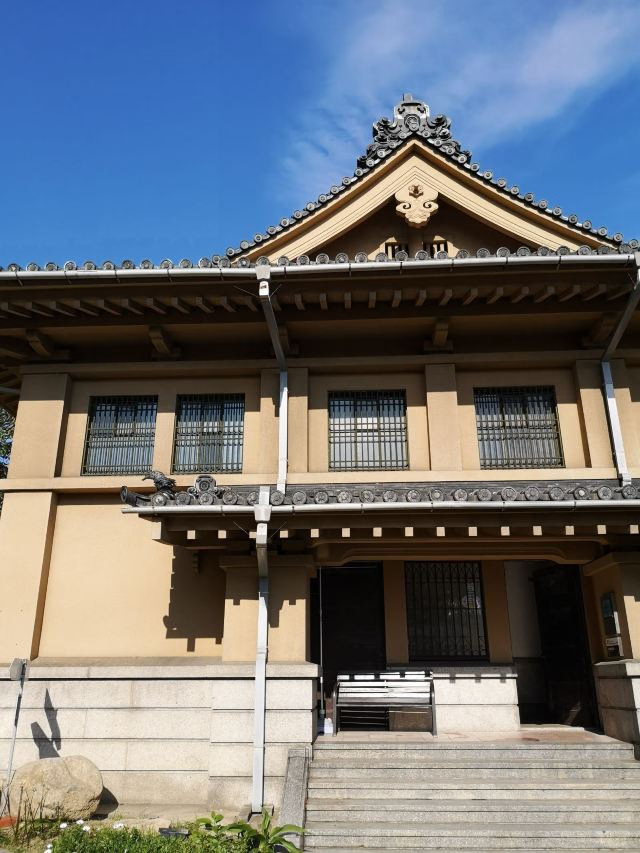
Shimonoseki City opened the Sino-Japanese Peace Memorial Hall beside Shunpūrō in 1937. Its reinforced-concrete structure survived the 1945 air raid that destroyed the inn. Inside, actual chairs and furnishings used during the conference are arranged to reconstruct the meeting scene, accompanied by writings and other materials associated with Itō Hirobumi and Li Hongzhang. The distinction is exact: important original objects survive, while the displayed chamber is a later museum reconstruction in a separate building. The hall remains a municipal museum branch and is normally free to enter, but current hours should be checked because an unstaffed historic facility can close temporarily for conservation or emergencies.
Current visibility
The 1937 memorial hall survives and normally opens daily under the museum's published schedule; the room is a recreation using surviving conference furnishings.