Read the article below. Interactive reading tools are available when scripts load.
Quick
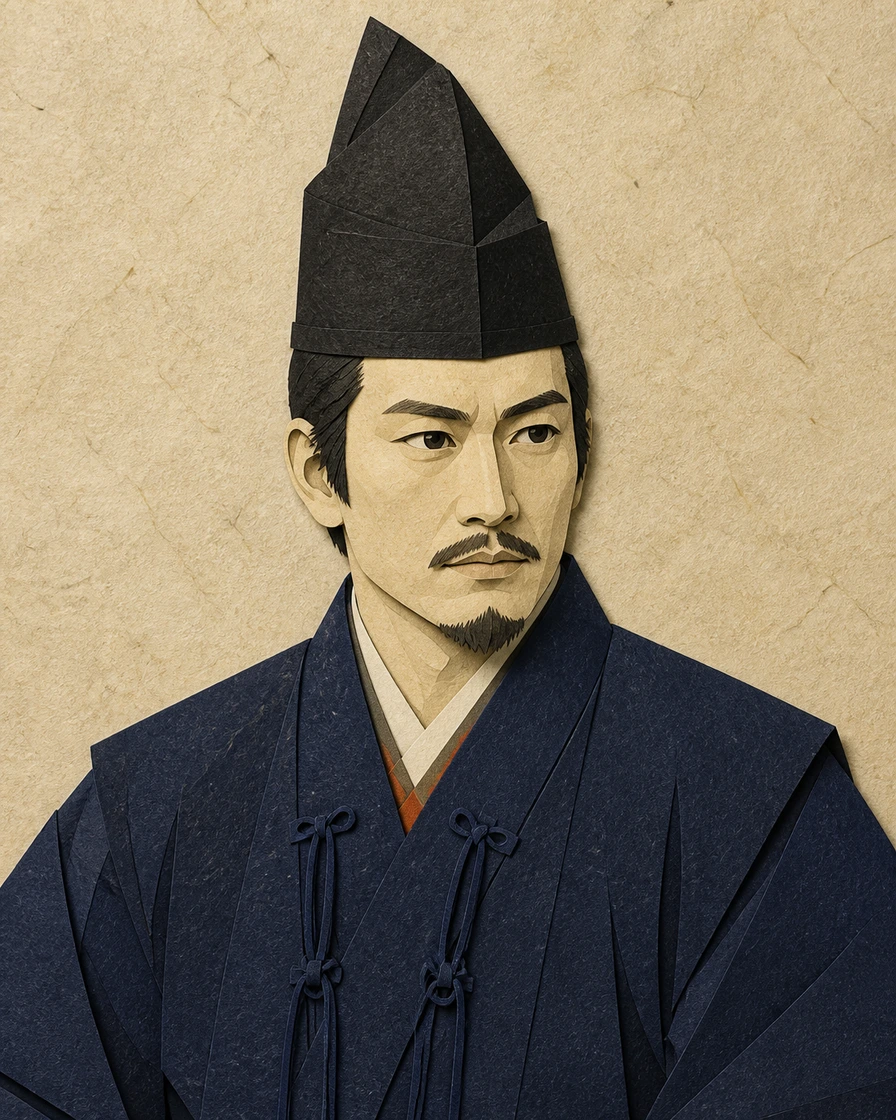
Hosokawa Katsumoto was born in 1430 into the Keichō branch of a powerful warrior family. Japan had an emperor in Kyoto, but its military government was headed by an Ashikaga shogun. The Hosokawa held provincial governorships called shugo appointments and repeatedly supplied the kanrei, the shogun’s chief deputy. These connections gave the young Katsumoto a place near government before he could exercise authority himself. Katsumoto inherited the family leadership after his father died in 1442. His uncle Mochikata assisted him while he was young. Provincial deputies and retainers continued administering the house’s resources. Inheritance preserved Katsumoto’s position, but the people sustaining it also had interests and followers that an adult house head would still need to accommodate. [1]
Katsumoto served as kanrei in 1445–1449 and 1452–1464; he returned to the office in 1468. His provincial governorships, including Sanuki on Shikoku and Settsu around Osaka, supported this central role. As kanrei, Katsumoto helped mediate between the shogun and major warrior houses. Shogunal recognition could determine which heir had the right to represent a house or hold a provincial appointment. Yet a rejected claimant might still possess castles and supporters. Katsumoto’s office gave a judgment authority at the center; enforcement depended on warriors beyond Kyoto.
In 1450 Katsumoto founded Ryōan-ji, a Zen Buddhist temple in Kyoto, on property associated with the aristocratic Tokudaiji family. The foundation connected his household to religious communities and family remembrance. It predates the Ōnin War. The surviving buildings and stone garden have a later, more complicated history.
Katsumoto backed Shiba Yoshitoshi in a disputed inheritance; the provincial lord Yamana Sōzen backed Yoshikado. In 1466 the government restored Yoshitoshi’s governorships, provoking resistance. That year Shogun Ashikaga Yoshimasa’s adviser Ise Sadachika urged punishment of the shogun’s brother Yoshimi. Leading lords opposed him and brought his downfall. Court decisions were still being contested across changing alliances.
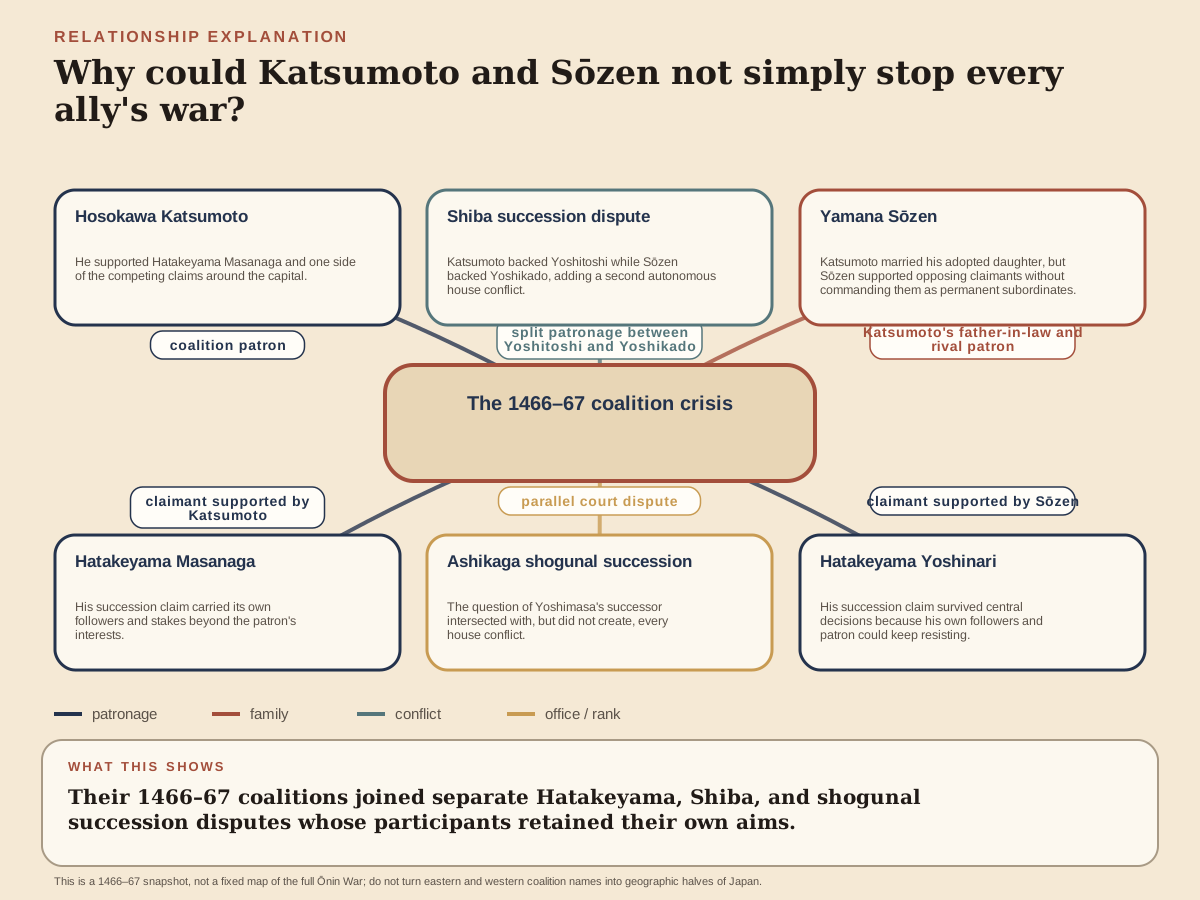
Yamana Sōzen was another powerful provincial lord. Katsumoto married Sōzen’s adopted daughter; the two lords sometimes cooperated. Their rivalry sharpened as they backed competing heirs elsewhere: Katsumoto supported Hatakeyama Masanaga, while Sōzen supported Yoshinari. Each patron had committed his resources to a claimant whose defeat would weaken his own network. The Hatakeyama were a major house eligible to supply the kanrei. Yoshinari and Masanaga competed for its leadership and the offices and benefits attached to it. Katsumoto’s backing gave Masanaga a powerful protector; Sōzen did the same for Yoshinari. A ruling by Yoshimasa could recognize one claimant without disarming the other’s supporters. Their conflict eventually brought armed confrontation into Kyoto.
Yoshimasa had looked to his brother Yoshimi as successor before his wife, Hino Tomiko, bore their son Yoshihisa. A familiar account makes Tomiko recruit Sōzen to protect the child’s succession. Historian Ienaga Junji challenges that plot through diary evidence and the 1466 crisis, emphasizing struggles within shogunal government and the great houses. The birth raised the stakes, but the army alignments do not fit a simple brother-versus-son explanation throughout the war.
In early 1467, Hatakeyama Yoshinari attacked Masanaga’s forces in the grove of Goryō Shrine in Kyoto. Sōzen supported Yoshinari; Katsumoto withheld direct help for Masanaga, who lost and retreated. This is conventionally the opening battle of the Ōnin War. Fighting expanded between larger coalitions over the following months.
Katsumoto led the Eastern coalition, named for its position in Kyoto rather than a division of Japan into two halves. The shogunal center gave his side political weight, but allied lords retained provincial interests and followers of their own. A settlement acceptable to Katsumoto might still threaten an ally’s inheritance or lands. Coalition members carried succession and territorial disputes into their provinces. Local rivals used the larger alignment to pursue conflicts that predated 1467. Even if leaders in Kyoto negotiated, they could not instantly reverse occupations, deaths, and new bargains across the country. The war became a network of connected struggles rather than one continuous front.
Eastern and Western forces fortified residences, temples, and streets around the court city. Fire, combat, requisition, and displacement damaged institutions and civilian life. Kyoto was not an empty board for elite strategy. Its density made military positions valuable and ensured that coalition failure became urban catastrophe remembered in place names and rebuilt landscapes.
Sōzen and Katsumoto both died in 1473, but their coalitions and the provincial disputes continued. The sustained conflict in Kyoto ended conventionally in 1477. That endpoint did not settle every local struggle or immediately restore the devastated city. Katsumoto died without securing an end to the war he had helped lead. Katsumoto’s son Masamoto inherited the Hosokawa leadership in 1473; household succession did not end the allies’ separate disputes.
Ryōan-ji’s abbot’s hall was restored in 1488 and replaced after a 1797 fire with a hall moved from another temple. The garden’s history is less certain: institutional accounts place its origins in different periods, sometimes distinguishing creation from its present form. Katsumoto founded the temple, but personal authorship of the surviving garden is not established.
Classic
Hosokawa Katsumoto was born in 1430 into the Keichō branch of one of the most powerful warrior families in Japan. The country had an emperor in Kyoto, but its military government was headed by an Ashikaga shogun. The Hosokawa belonged to the small group of families whose provincial resources gave them a regular voice in that government. [1]
Their appointments as shugo, provincial military governors, connected the family to warriors and landholders outside the capital. In Kyoto, members of the house also served as kanrei, the shogun’s chief deputy. These were different sources of influence. A provincial appointment supplied claims on service and revenue; the central office brought access to the shogun and a role in settling disputes among great houses.
Katsumoto inherited the leading Hosokawa branch after his father died in 1442. His uncle Mochikata assisted the young house head. The succession preserved the family’s position, but Katsumoto could not yet personally manage provincial deputies, negotiate at the shogun’s court or command experienced warriors. Senior relatives and house officials supplied that capacity. [1]
Their work kept the household’s income and service relationships from breaking apart during his minority. It also placed Katsumoto inside an organization with established expectations. A retainer who had protected the succession could later claim recognition; a deputy who maintained a province had local followers of his own. Becoming an adult did not make these people disappear from the exercise of power.
The family’s possessions were not a compact kingdom under a single administration. Deputies and local retainers carried out much of its work. Katsumoto’s future position therefore depended on people whom he could not watch or direct every day.
Katsumoto first became kanrei in 1445, serving until 1449 and again from 1452 to 1464. His governorships included Sanuki, on Shikoku, and Settsu, around present-day Osaka. These appointments supplied a provincial base for his work at the shogunal center. As kanrei, Katsumoto worked between the Ashikaga shogun and the leading warrior houses. A dispute over a provincial governorship or an heir could arrive in Kyoto because shogunal recognition affected which claimant local warriors were expected to obey. The deputy helped turn petitions and negotiations into decisions issued at the center. [1]
Such recognition could be decisive without being final. The claimant who lost might still possess castles, relatives, and armed supporters. A shogunal order required people in the province to enforce it, and those people could have reasons to resist. Katsumoto’s own provincial connections gave weight to his mediation; rival governors arrived with comparable resources.
Repeated service in the office made him an experienced participant in government. It also tied his standing to settlements that other houses might refuse to accept. Supporting an heir was no longer a detached judgment once Katsumoto had lent that heir his protection. A reversal by the shogun could damage the deputy’s allies and expose the limits of his influence. This tension between the authority of a decision and the means of enforcing it became increasingly dangerous in the 1460s.
Between his first and second terms as kanrei, Katsumoto established Ryōan-ji, a Zen Buddhist temple in Kyoto. Institutional histories date its foundation to 1450 on property associated with the Tokudaiji family. Supporting a temple connected his household to clerics, ritual services, and a durable place of family memory. [4]
Zen Buddhist communities maintained institutions for worship, training and family remembrance. Patronage linked a warrior household to such communities as well as to other landholding elites. Katsumoto’s foundation gives his career a religious setting alongside its better-known contests over office.
The property’s association with the aristocratic Tokudaiji family also places the temple within Kyoto’s existing elite landscape. Founding an institution involved a site and a continuing community; it was more than attaching a benefactor’s name to a building. The history of the surviving garden belongs to later chapters of the temple’s life.
The Shiba house supplied another succession struggle. Like the Hosokawa and Hatakeyama, it held provincial appointments and belonged to the families eligible for the shogun’s chief deputyship. Katsumoto supported Shiba Yoshitoshi, while Yamana Sōzen, another powerful provincial lord, supported Yoshikado. The rival claimants brought the interests of provincial followers into Kyoto’s political negotiations.
In 1466 the government restored Yoshitoshi’s provincial governorships, but Yoshikado resisted with Sōzen’s support. A title issued in Kyoto could therefore provoke another contest over who would actually hold authority. This dispute was active when Ise Sadachika, Shogun Ashikaga Yoshimasa’s close adviser, urged the punishment of Yoshimasa’s brother Yoshimi. [1][3]
Opposition among leading lords brought Sadachika’s fall. Historian Ienaga Junji’s study of the episode shows a political field more fluid than the two fixed armies familiar from accounts of the later war. Katsumoto and his future enemies were still bargaining over authority within the same government. By early 1467, several unresolved inheritances had made those bargains much harder to sustain.
Katsumoto was close to the center of these decisions, but Yoshimasa maintained advisers and interests of his own. The deputy’s backing did not guarantee that a judgment would stand. Reversals encouraged disappointed parties to remain in the political contest rather than accept a permanent defeat. They also made patrons anxious that today’s ally might lose recognition tomorrow. [3]
Yamana Sōzen was another provincial magnate with a substantial presence in Kyoto. Katsumoto married Sōzen’s adopted daughter, making the older lord his father-in-law, and the two men sometimes cooperated. Their households belonged to an elite world in which a marriage could bind political partners as well as produce family obligations. [1][6]
The Hatakeyama were a major warrior house, with provincial appointments and their own claim to serve as kanrei. Their succession dispute concerned Yoshinari and Masanaga. Recognition of either man would determine who could speak for the house and distribute its offices and benefits. Followers of the rejected candidate therefore had much more to lose than a change of family head.
Katsumoto backed Masanaga. Sōzen supported Yoshinari. Once these patrons became involved, an internal inheritance quarrel acquired the resources and prestige of two larger households. A decision by Yoshimasa could favor one claimant, but it could not automatically disarm the other’s supporters. [1][3]
The dispute also concerned residence and access in Kyoto. A claimant excluded from the political center could attempt to recover his position with armed help. Masanaga and Yoshinari were thus participants with their own followers, not merely substitutes fighting on behalf of Katsumoto and Sōzen.
The relationship did not prevent them from supporting different heirs in other great houses. An inheritance dispute might affect the security of an ally’s province or the distribution of offices at the shogun’s court. As Katsumoto and Sōzen accumulated commitments, concessions to one claimant could become losses for someone else in their respective networks.
Yoshimasa had looked to his brother Yoshimi as a possible successor before his wife, Hino Tomiko, gave birth to a son, Yoshihisa. The arrival of a child changed the family’s succession prospects. It became a powerful way for later narrators to explain a complicated war: Katsumoto would stand behind the brother, Sōzen behind the son, and Tomiko would set the struggle in motion. [3]
That familiar account assigns the future armies a simple purpose, but their early alignments do not fit it consistently. The Hatakeyama and Shiba disputes had already drawn the patrons into competing commitments. Yoshimi’s political relationships also changed during the war.
Historical disagreement · Did Tomiko recruit Sōzen for her son?
Ienaga Junji, examining the 1466 crisis and contemporary diary evidence, challenges the story of Tomiko recruiting Sōzen to secure Yoshihisa’s succession. Different transmissions of the war chronicle itself place emphasis on different conflicts. His reading shifts attention toward struggles inside the shogunal government and among the great houses.
It is a specific scholarly interpretation, not grounds for claiming that the child’s birth had no importance.
Ienaga’s argument gives the diary testimony more weight than the domestic plot. It does not establish a single explanation accepted by all Japanese historians.
In early 1467, the Hatakeyama conflict erupted in the grove of Goryō Shrine in Kyoto. Masanaga’s position came under attack from Yoshinari and his supporters. Sōzen supported Yoshinari; Katsumoto initially withheld direct intervention on Masanaga’s behalf. Masanaga’s men lost the encounter and retreated. The ally whom Katsumoto had declined to assist was left defeated.
This hesitation matters because the later division into Eastern and Western armies was still taking shape. Katsumoto’s commitment to Masanaga did not make every tactical decision automatic. A direct intervention risked widening the fighting, while holding back could leave his ally defeated.
The encounter is conventionally treated as the opening battle of the Ōnin War, named for the era that began in 1467. It did not immediately explain every participant’s alignment. By the fifth month of the Japanese calendar, the opposing coalitions were fighting on a much larger scale. Greater forces assembled and the struggle spread through the city. A confrontation between two branches of a warrior house became a sustained war among coalitions. [2]
Kyoto’s political geography made this escalation especially serious. The shogun and imperial court were there, alongside the residences of men disputing provincial power. Moving troops near a rival’s residence could also threaten access to the government. Once armed protection became necessary for political survival, the same proximity that had allowed negotiation made separation from the conflict increasingly difficult.
As the fighting expanded, Katsumoto became the principal leader of the Eastern army. Sōzen headed the opposing Western coalition. The names described their positions in Kyoto, not two neatly divided halves of Japan. Houses with widely separated provincial interests gathered around headquarters in the capital. [1][3]
Katsumoto resumed the kanrei office in 1468, retaining it until his death in 1473. Katsumoto’s position near the shogunal center gave his coalition political as well as military weight. Recognition, appointments, and the protection of claimants remained reasons for allies to join him. He could coordinate action and speak for the alignment, but allied houses supplied their own followers and retained interests outside Kyoto.
A lord might support Katsumoto in the capital while facing a rival in his province. The contribution he could make to the Eastern army depended on that local situation. Negotiations could therefore concern several struggles at once: the position of an heir, possession of land at home, and the security of a residence in Kyoto.
The armies in Kyoto drew on provincial households, and their local disputes did not stop when forces gathered in the capital. An appointment supported by Katsumoto might be resisted by followers of the opposing claimant in the province concerned. Occupying land or defeating a local rival could change what a lord was willing to concede in Kyoto.
The fighting consequently spread through connections that had helped bring the coalitions together. Provincial interests gave the war new reasons to continue. Once followers had been killed or possessions seized, restoring a claimant’s title at the center could not by itself undo what had happened locally.
Distance also limited Katsumoto’s ability to control the consequences of his commitments. Allies made decisions amid circumstances that could change before a message reached Kyoto. Some needed protection for inherited claims; others could use the larger war to improve a position they had contested long before 1467.
The war unfolded in a city of temples, court residences, workshops, and ordinary homes. Warrior compounds became fortified positions. Fighting and fire damaged the neighborhoods between them, and people without a place in the succession disputes had to flee or live around armed forces.
Katsumoto’s Eastern coalition could defend a position and still contribute to the destruction of the city in which it stood. The proximity of military headquarters to religious and residential properties made it difficult to confine violence to the houses that had chosen to fight. Buildings could provide cover, block a route, or become obstacles to an attack.
The resulting damage changed political life as well as the physical city. Court and temple institutions lost buildings and income, while disruption made their recovery dependent on resources outside the devastated areas. Kyoto remained an important center, but the war weakened the conditions that had allowed it to gather and govern competing elites.
This is part of Katsumoto’s responsibility as a leader. His provincial holdings and central office had given him a role in government; the coalition he led fought within the same urban society that supported that government. The experience of its inhabitants belongs alongside the choices made in elite households.
Sōzen and Katsumoto both died in 1473, after years of war in Kyoto. Their deaths removed the two men most closely identified with the opposing armies. They did not resolve the Hatakeyama and Shiba inheritances or the provincial conflicts attached to them. [1]
Katsumoto’s son Masamoto inherited the Hosokawa leadership in 1473. Passing on the household preserved a political actor; it did not settle the interests of every allied house. The Hatakeyama claimants and provincial followers still had positions to defend.
The conflict conventionally called the Ōnin War continued until 1477. Even that endpoint did not mean that every provincial struggle ended or that Kyoto immediately recovered. It marked the dissolution of the sustained confrontation in the capital rather than the restoration of the political world that had existed before it.
Katsumoto therefore died without securing a conclusion to the war he had helped lead. Its continuation is a concrete measure of how far power had dispersed among the participants. The coalition depended on his coordination, yet it had acquired commitments and consequences that could survive him.
Ryōan-ji’s buildings have their own history after Katsumoto’s death. Kyoto City dates restoration of its hōjō, the abbot’s residential hall, to 1488. Following a fire in 1797, a hall built at Seigen-in in 1606 was transferred to the temple. The present building therefore cannot be treated as an untouched setting from the founder’s lifetime.
Historical disagreement · When was Ryōan-ji’s stone garden made?
Dating the stone garden raises a separate problem. Kyoto City assigns its origins approximately to the mid-fifteenth century. The Nara National Research Institute for Cultural Properties’ garden dictionary records a tradition of creation in 1499 and another interpretation placing the present form in the early Edo period.
These descriptions may concern different phases rather than an identical object at a single moment.
Katsumoto’s foundation is secure; designing the surviving stone arrangement is not an achievement that can securely be assigned to him. The later rebuilding shows how an institution associated with a medieval patron could survive through substantial material change. [4][5]