Map: GSI Japan Ryōan-ji is a Rinzai Zen temple whose fame rests on a small dry garden of fifteen stones and white gravel, but its history is broader and less certain than the familiar image suggests. Hosokawa Katsumoto acquired a former Tokudaiji villa in 1450 and established a temple there. Fire in the Ōnin War destroyed the first complex; later rebuilding and a major fire in 1797 repeatedly changed the buildings around the garden. The present abbot's quarters came from a subtemple, while Kyōyōchi pond preserves a landscape history older than the Zen foundation. Ryōan-ji is therefore not an untouched fifteenth-century tableau. It is a layered precinct in which survival, relocation, maintenance, disputed authorship, and generations of interpretation are inseparable from the experience of the stones.
Katsumoto's 1450 foundation on a former villa
Attraction
Hosokawa Katsumoto acquired the former Tokudaiji villa in 1450 and invited Giten Genshō to establish a Zen temple. Genshō named his own teacher, Nippō Sōshun, as the formal founding abbot, a distinction that separates institutional lineage from the person who carried out the foundation. The first complex was destroyed during the Ōnin War, in which Katsumoto himself was a leading participant, and was rebuilt under his son Masamoto. No intact 1450 building can therefore be pointed out. The surviving precinct marks a political and religious foundation repeatedly remade by the same conflicts and patronage networks that gave it importance.
Current visibility
The temple precinct occupies the historic site, but no standing building is presented as an untouched survival from the 1450 foundation.
The relocated Hōjō after the 1797 fire
方丈
Attraction
A major fire in 1797 destroyed the abbot's quarters, founder's hall, and Buddha hall. The present Hōjō was transferred from Seigen-in, a subtemple, to replace the lost building. That relocation is essential to an honest reading of the famous view: the veranda and room from which the garden is now encountered are historic architecture, but not the original Hōjō in its original construction history. The garden, wall, building, and visitor viewpoint have also been maintained across time. Ryōan-ji's power does not depend on pretending otherwise. Relocation shows how a temple preserved function and spatial relationship after disaster by adapting existing monastic fabric.
Current visibility
The present Hōjō is historic but was moved from Seigen-in after the 1797 fire; ordinary visitor access is limited to the temple's designated public area.
The fifteen-stone Hōjō garden
龍安寺方丈庭園
Attraction
The Hōjō garden is a shallow rectangle of raked white gravel, bounded by earthen walls and arranged with fifteen stones in five groups. It contains no pond or planted tree within the gravel field, yet the stone groups and empty intervals produce changing relations from the veranda. National designation recognizes it as both a Historic Site and a Special Place of Scenic Beauty. The compact scale is important: this is not a miniature tour through many scenes but a fixed field studied from one side. Maintenance of gravel, walls, drainage, moss, and viewing space is part of its continued existence. The garden is currently visible, while entry onto the composition itself is neither intended nor permitted.
Current visibility
The garden is viewed from the Hōjō side; visitors do not enter the protected gravel-and-stone composition.
Unknown maker, uncertain date, open meaning
Attraction
The garden's maker and exact date remain unknown. Kyoto City presents it broadly as a late Muromachi work, while other interpretive accounts connect it to rebuilding after the Ōnin War. Traditional readings include a tigress carrying cubs across water, but no single symbolic program has authoritative proof. This uncertainty is not a gap to be filled with a confident slogan. It is one of the site's central historical facts, revealing how an austere material arrangement accumulated Zen, pictorial, mathematical, and popular explanations over centuries. A good reading begins with what is present—stones, gravel, wall, viewpoint, asymmetry—and then labels symbolic interpretations as interpretations rather than the designer's recovered instructions.
Current visibility
The physical composition is visible; claims about designer, exact date, and intended symbolism remain interpretive rather than directly observable.
Kyōyōchi, the older pond landscape
鏡容池
Attraction
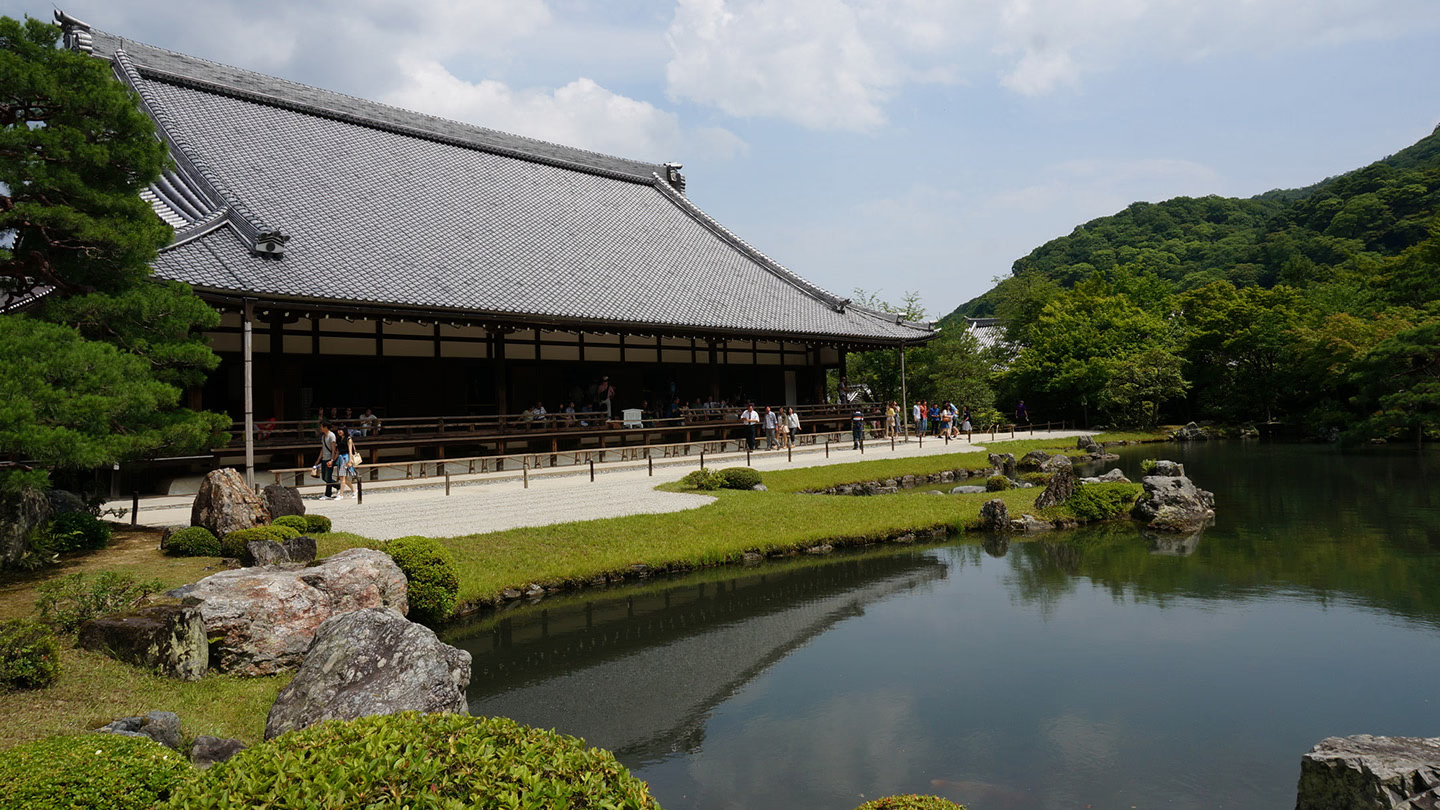
Kyōyōchi predates the Zen temple and is identified as a twelfth-century pond landscape associated with the earlier villa. Its water, islands, vegetation, and wider movement around the grounds provide a deliberate counterweight to the dry, compressed Hōjō garden. The pond proves that Ryōan-ji's history did not begin with Katsumoto and that the precinct contains more than one garden tradition. It also clarifies how selective the famous image is: the stone garden removes water and planting from its field, while an older aquatic landscape survives nearby. The pond is presently visible in the public grounds, though seasonal growth and routine landscape care naturally change its appearance.
Current visibility
The pond and surrounding landscape are visible within the public precinct; their appearance varies seasonally and through maintenance.
The stone basin and the language of sufficiency
蹲踞
Attraction
North of the Hōjō is a stone water basin whose square central opening completes four surrounding characters commonly read as ‘I know only sufficiency.’ Tradition associates the gift with Tokugawa Mitsukuni. The phrase has become a compact ethical gloss on Ryōan-ji, but the attribution and relationship to the fifteenth-century garden should not be made stronger than the source allows. The basin belongs to the practical and ritual world of washing as well as to later interpretation. Its position and viewing conditions differ from those of the main stone garden, and close access is controlled by the temple's visitor arrangement. It is best understood as an associated object with its own transmission, not the key that decodes every stone.
Current visibility
The basin is associated with the Hōjō precinct and is viewed under the temple's controlled visitor arrangement; unrestricted close handling is not implied.