Read the article below. Interactive reading tools are available when scripts load.
Quick
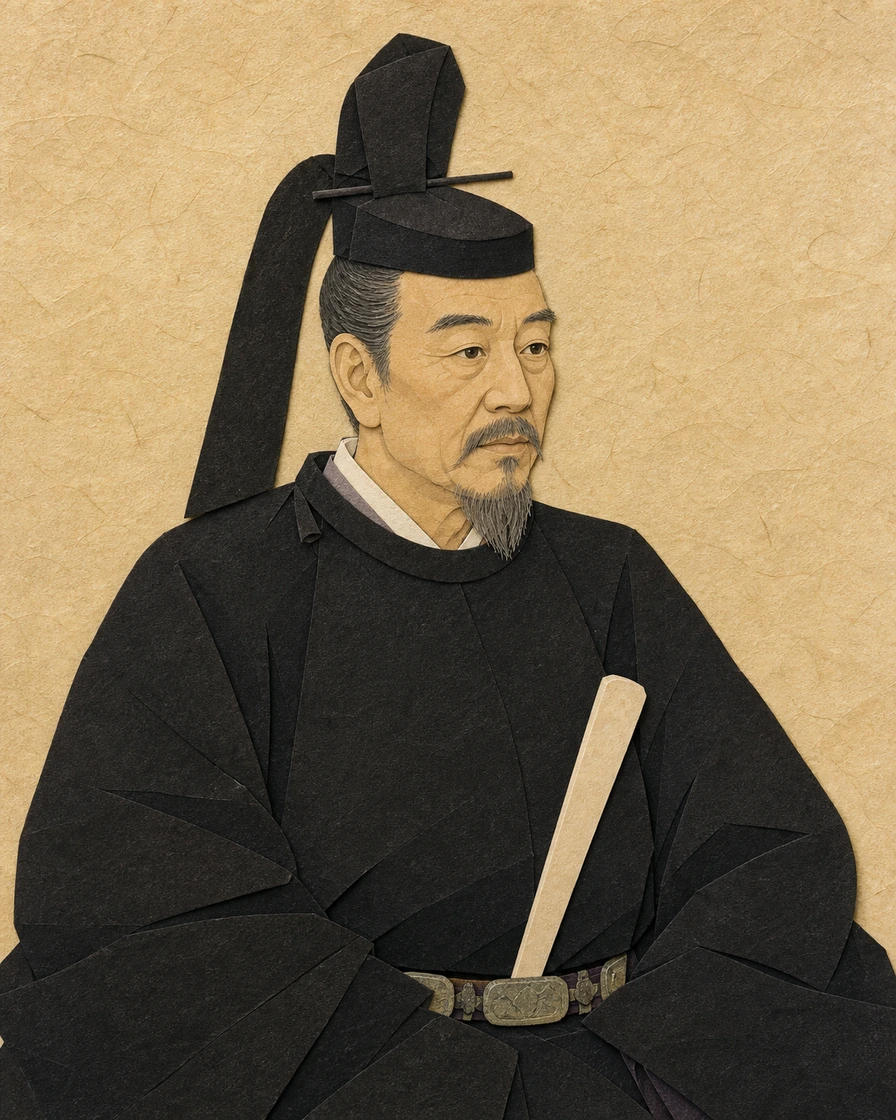
Fujiwara no Yorimichi was born in 992 to Fujiwara no Michinaga and Minamoto no Rinshi. His parents' household stood close to the imperial court in Kyoto, supplying education and access unavailable to most people. Michinaga's later concentration of power was still developing. Yorimichi grew among siblings whose marriages and careers would extend the family network. Early advancement made him a plausible future leader, while appointments and imperial relationships would determine the position he eventually received. [2]
Yorimichi advanced toward leadership of Michinaga's house. His elder sister Shōshi was the mother of Go-Ichijō, who became emperor in 1016 while still a child. Michinaga first served as regent, governing on the young sovereign's behalf, then transferred that office to Yorimichi in 1017. The son began formal leadership while his father remained alive. In 1019 he became kanpaku, the chief intermediary advising an adult emperor and handling government business. Ministers and other households retained authority alongside him. [1][2][4]
Yorimichi led the regent house through the reigns of Go-Ichijō, Go-Suzaku and Go-Reizei. He also handled provincial grievances. In 1025 he accepted a governor's complaint that his estates obstructed administration in Wakasa, a province on the Sea of Japan coast. Michinaga died in 1027, but Yorimichi's tenure continued. In 1031 he ordered an official envoy after another estate-related complaint. These records show particular responses, not proof of a uniform policy. New imperial marriages would matter to the house's future influence. [2]
Yorimichi inherited Michinaga's villa at Uji, south of Kyoto on routes toward Nara. In 1052 he converted it into Byōdō-in. Buddhist calculations associated that year with mappō, an age when effective practice of the Buddha's teaching was believed to decline. Pure Land devotion offered hope of rebirth with Amida Buddha. Monks, builders and continuing revenue turned the inherited residence into a religious institution; the celebrated Amida Hall followed in 1053. [5]
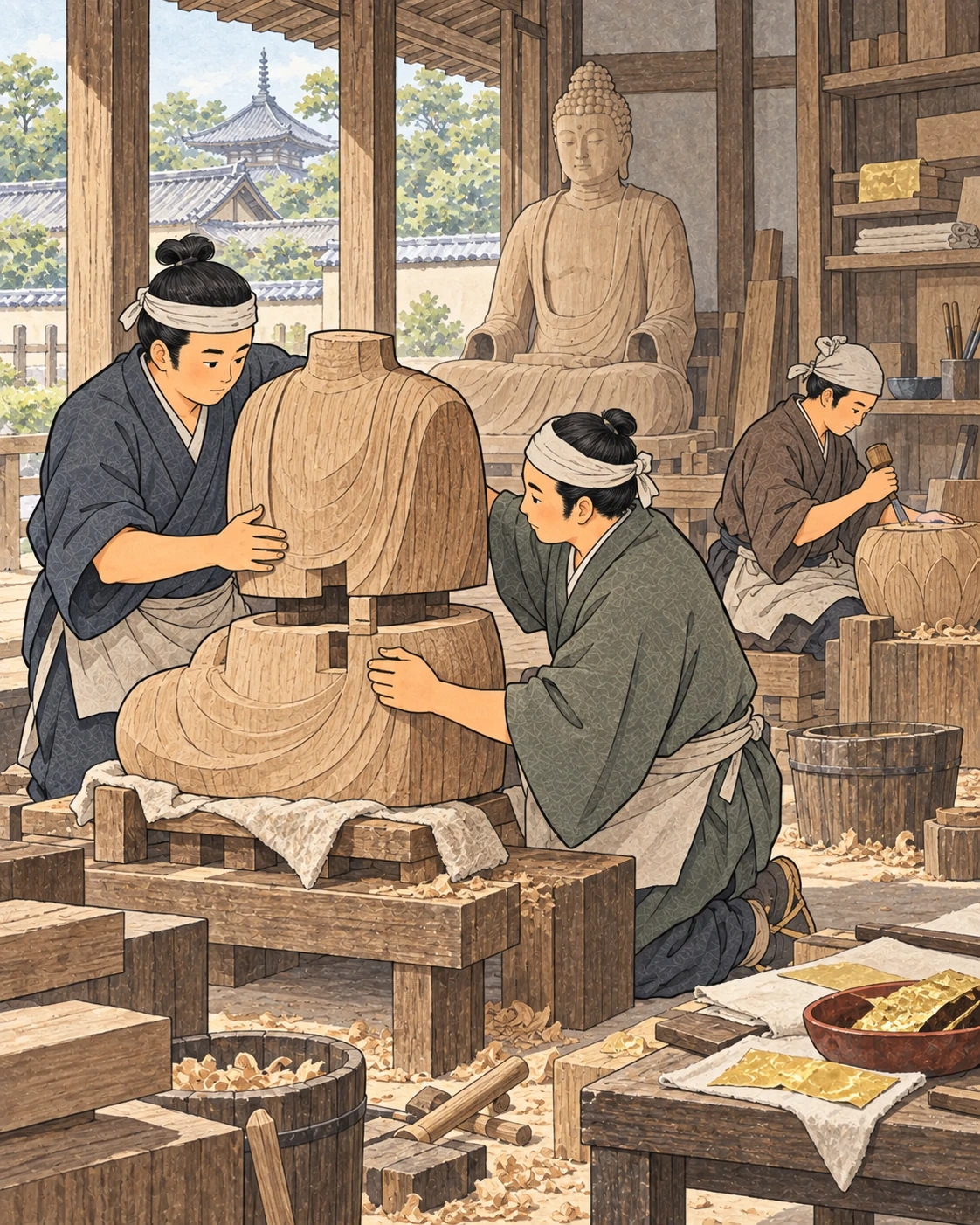
The Amida Hall was completed in 1053. Its central image is the only surviving work securely confirmed as Jōchō's, while the attendant figures belonged to his workshop. The sculptors used yosegi-zukuri, joining smaller wooden blocks to make the larger image and finishing its surface with lacquer and gold leaf. Yorimichi was the patron, not the statue's designer. “Phoenix Hall” became established as a name centuries later, and repairs changed parts of the surviving ensemble. [5][6][7]
The Amida Hall gave worshippers a setting for Pure Land devotion, the hope of rebirth with Amida Buddha. Its east-facing entrance directed them toward the western paradise represented by the image. The pond, paintings and attendant figures worked with architecture and ritual. Monks activated the setting through repeated worship, while maintenance kept its material conditions usable. The ensemble gave form to a religious promise within the everyday operation of an aristocratic foundation. [6][7][8]
The story now looks back at the estate economy behind the temple. Shōen were lands from which aristocratic or religious institutions claimed income and privileges. Cultivators, managers, provincial officials and patrons could hold different rights over the same land. Rural production and transport helped sustain Yorimichi's household and Byōdō-in's worship and repairs. Provincial government continued alongside these claims, producing disputes like those from Wakasa. This layered system would become the subject of documentary review.
Returning to imperial marriage policy, Yorimichi's adopted daughter Genshi entered Go-Suzaku's household in 1037; his daughter Kanshi became empress to Go-Reizei in 1051. Neither marriage produced a son who fulfilled the intended imperial succession. Go-Reizei left no surviving son, and Prince Takahito, later Go-Sanjō, remained the alternative. Takahito's mother lay outside Yorimichi's immediate regent-house branch. Rank and estates remained, but the direct maternal relationship that had reinforced earlier authority could not be reproduced.
Takahito became Emperor Go-Sanjō in 1068. That year Yorimichi's younger brother Norimichi became kanpaku, showing that Fujiwara officeholding continued. In 1069 a new office reviewed estate deeds and exemptions; it did not abolish every estate. Earlier regent-led government had also addressed estate disputes. Imperial advisers now had greater scope for initiative beyond Yorimichi's household. Go-Sanjō abdicated in 1072 and Shirakawa succeeded; the fuller development of retired-emperor government followed Yorimichi's lifetime. [2][9]
Yorimichi increasingly resided at Uji after Norimichi held formal office. Byōdō-in sustained religious practice and family standing outside daily court competition. Monks, managers and messengers kept the foundation operating and connected to Kyoto. In 1072 Yorimichi took Buddhist vows. This was a specific religious turn, not proof that every household interest ended. His later patronage continued to support an institution that had already operated for twenty years.
Yorimichi died in 1074, aged eighty-three by traditional Japanese reckoning, which counted a child as one at birth and added an age at the new year. Shirakawa was emperor. Relatives continued in government, while monks and managers sustained Byōdō-in. Death ended Yorimichi's personal decisions without ending the Fujiwara house, kanpaku office or estate system. The foundation's future depended on people who outlived him. [2]
After 1074 most early Byōdō-in buildings disappeared, while the Amida Hall and Jōchō's image survived through repeated care. “Phoenix Hall” became established as a name centuries after construction. Repairs changed the fabric; an imperial visit in 1877 and restoration from 1902 to 1907 added Meiji-era layers. These were later communities' actions, not Yorimichi's. The surviving ensemble preserves an exceptional portion of his world rather than the whole foundation or age. [5][10]
Classic
Fujiwara no Yorimichi was born in 992, the son of Fujiwara no Michinaga and Minamoto no Rinshi. His parents' household stood close to the imperial court in Kyoto. Michinaga's rank and connections offered early advancement, while Rinshi's lineage, residence and authority helped sustain the family. Michinaga had not yet reached the concentration of power later associated with his name. Senior relatives still competed for office, and the future standing of his children depended on appointments and imperial relationships. [2]
Yorimichi grew among siblings whose marriages and careers would extend the household in different directions. Education and attendants prepared a noble child for court service; estate revenue supported the time, clothing and personnel that service required. Early preferment made Yorimichi a plausible future leader, but competition within the wider Fujiwara family remained. Paternal support had to become public appointments before it could give him a recognized place in government.
Michinaga's daughters were entering imperial households. Their standing there mattered to their brothers as well as to their father. A son born to one of these women might become emperor, making Yorimichi the sovereign's maternal uncle. The prospect depended on the survival of mothers and children and on acceptance within the dynasty. The sisters' households also had their own attendants, property and religious interests.
Yorimichi's upbringing thus joined an unusually favorable starting position to relationships whose outcomes remained unsettled. Land and rank could be passed on; an imperial birth or accession could not be arranged with the same certainty. His own advancement would become inseparable from the changing fortunes of this larger family.
As Michinaga's power grew, Yorimichi advanced through court appointments toward leadership of his father's house. Promotion placed him before the officials with whom he would eventually work. Rank established precedence at ceremonies; office gave him a place in the handling of government business. Other Fujiwara branches retained their own resources and ambitions, so being Michinaga's preferred son did not put every noble at his command.
The decisive opening came through Yorimichi's elder sister Shōshi, an imperial consort and the mother of Go-Ichijō. When her young son became emperor in 1016, Michinaga took the regency. A regent, or sesshō, conducted government on behalf of a child sovereign. The family relationship made Michinaga especially well placed to perform that role, while Shōshi's own position as emperor's mother gave her household continuing importance at court. [2][4]
In 1017 Michinaga transferred the regency to Yorimichi. The new officeholder was the emperor's maternal uncle. His father remained alive, allowing the son's formal authority to overlap with the standing Michinaga had accumulated. Officials could begin dealing with Yorimichi without the uncertainty of a succession first announced after his father's death. [1][2]
The distinction between appointment and personal control remained substantial. Ministers retained offices, scribes prepared documents and ritual specialists guarded precedent. These were the people through whom a regent's decisions became government. Michinaga's support helped Yorimichi enter that field; it did not turn its institutions into departments of his residence. [1][2]
In 1019 Yorimichi became kanpaku, the chief intermediary advising an adult emperor and handling the passage of business to him. Go-Ichijō's stage of rule had changed, and the office changed with it. Shōshi remained the sovereign's mother. Yorimichi began a long tenure with both a recognized institutional position and the maternal connection that had made the regency possible. [1][2]
Yorimichi continued as the leading regent-house figure through Go-Ichijō's reign and those of Go-Suzaku and Go-Reizei. Go-Ichijō and Go-Suzaku were sons of his sister Shōshi; Go-Reizei belonged to the following imperial generation. The same officeholder remained near the center of government while the people around the throne changed. His long tenure required work with reigning emperors and senior nobles, not simply possession of an inherited title. [2]
Provincial complaints show that work at a smaller, more concrete scale. In 1025 Nakahara no Moromitsu, governor of Wakasa, complained that Yorimichi's estates were obstructing provincial administration. Wakasa was a province on the Sea of Japan coast. A report conveyed to the senior minister Fujiwara no Sanesuke stated that Yorimichi had accepted the governor's petition. The surviving chronological summary establishes that response; it does not tell us how completely the obstruction was removed.
Another Wakasa complaint in 1031 concerned abuses by people attached to other senior officials' estates. Yorimichi instructed that an official envoy be sent. Selecting and dispatching the representative involved other court officers as well. The episode shows provincial grievances entering government through petitions and intermediaries, with the kanpaku taking a specific action rather than merely presiding over ceremony.
Michinaga died in 1027, between these two episodes. Yorimichi's tenure continued without his father's living presence. The inherited connections still mattered, but complaints about estates could place the interests of powerful households against the responsibilities of provincial government. Influence brought disputes as well as income.
Decades of service preserved the house's position through successive reigns. Its future, however, depended partly on new marriages producing a prince who could become emperor. Yorimichi's later patronage at Uji would create a durable institution while that route to continued maternal influence remained uncertain.
South of Kyoto, the Uji villa stood beside a river and on routes toward Nara. Yorimichi received it from his father Michinaga. It offered a residence away from the immediate traffic of the palace without severing connections to the capital. Buildings, gardens and managed water already formed a site that could be adapted to a new purpose. [5]
Residence there depended on continuing work. Food and materials had to arrive; buildings and gardens needed care. The river belonged to that practical geography as well as to the view. The later temple would occupy an inherited, maintained landscape rather than begin on an empty stretch of scenery.
In 1052 Yorimichi converted the villa into Byōdō-in. Buddhist calculations associated that year with the beginning of mappō, the Final Age of the Dharma, when the effective practice of the Buddha's teaching was believed to decline. Pure Land devotion offered the hope of rebirth with Amida Buddha despite that decline. This was a historical religious belief, not a date for an independently established cosmic event. Its association with the foundation does not reveal Yorimichi's exact private motive. [5]
Conversion brought worship and commemoration into the inherited residence. Monks, builders and administrators gave the new foundation its institutional life, while recurring revenue supported rites and care of the buildings. Family memory and public standing continued to matter alongside religious service. The same foundation could preserve a lineage and give material form to a hope of salvation.
The conversion preceded the celebrated Amida Hall. Construction continued into 1053, when the hall and its central image were completed for worship. Yorimichi authorized and supported the work; specialists supplied the architecture, sculpture and painting. The building campaign began a longer obligation to maintain the institution.
In 1053 the Amida Hall at Byōdō-in was completed. At its center stood a seated Amida made by Jōchō, a Buddhist sculptor. It is the only surviving image securely confirmed as his work, giving the hall exceptional importance in the history of Japanese sculpture. Yorimichi supplied patronage; the sculptor and his workshop supplied knowledge that a wealthy commission alone could not provide. [5][6]
The image used yosegi-zukuri, a joined-wood construction technique. Smaller pieces of cypress were assembled to make the larger figure, then carved and shaped. Cloth, lacquer and gold leaf covered the joints and finished its surface. This concrete sequence helps explain how a large, gilded image emerged from the work of a studio. It was a sculptural achievement, not evidence that Yorimichi personally designed the statue or invented the method.
Fifty-two small attendant figures also belonged to Jōchō's workshop. These bodhisattvas—Buddhist beings associated with the path toward awakening—appear on clouds around Amida, some playing instruments and others dancing or holding objects. The attribution to a workshop leaves room for several makers within the ensemble. Most of their individual names do not survive. [5][6][7]
Carpenters and painters made the hall around the images, and monks gave it a continuing ritual use. The formal name was Amida Hall. “Phoenix Hall,” familiar today, became established centuries later, associated with the building's birdlike appearance and roof ornaments. [5][6][7]
The object has also changed. Byōdō-in's architectural account associates the change to a fully tiled roof with a repair in 1101, presenting that dating as an interpretation rather than certainty about every original roof element. Most early temple buildings were subsequently lost. The hall and Jōchō's image preserve an exceptional ensemble within that larger, altered foundation.
The Amida Hall faces east across its pond. A worshipper looking toward the hall thus faces west, the direction of Amida's Pure Land, the realm in which devotees hoped to be reborn. The orientation connects a physical approach at Uji to a religious destination. The pond separates the hall from the viewer while reflecting its form, making water part of the setting rather than incidental scenery. [7]
The central image supplies a stable focus. Wall and door paintings extend the religious scene around it, while the cloud-borne attendants suggest Amida's company. The attendant figures include musicians, presenting that company through sculptural form. Monks added actual sound through chanting and liturgy. Incense, offerings and changing light made worship a recurring experience rather than a fixed view. [6][7][8]
Built space and ritual worked together. Timber framed sight, pigments generated landscape, gilding caught light and water altered reflection. Priests interpreted the teaching, artisans made its visible forms, attendants prepared the setting and visitors responded. Access remained shaped by the institution and by visitors' standing. The promise of rebirth existed within an aristocratic foundation supported by unequal estate relationships. [6][7][8]
Parts of the ensemble survive unusually well, but the present setting is not an untouched eleventh-century moment. Surfaces have been repaired and objects replaced or moved; the garden has undergone archaeological recovery. Historical paths and approaches cannot all be reconstructed from a modern visit. What survives nevertheless shows a coordinated religious setting in which the image, its attendants, paintings and pond helped give form to a hoped-for realm. That realm was an object of devotion, not a place whose literal reproduction could be verified.
The temple's materials, food and continuing rites had costs. To understand their support, the story returns to the estate economy behind Yorimichi's household. Shōen, often translated as estates, were lands from which aristocratic or religious institutions claimed income and privileges. The term does not imply one owner holding every right over a single bounded property.
Rights could be layered. A cultivator worked land; a local manager collected dues; a provincial official claimed public revenue; an elite patron or temple held exemptions or beneficial interests. Documents attempted to stabilize these relations, but boundaries, obligations and exemptions remained open to dispute. Regent-house influence could help protect a claim because local rights were not self-enforcing.
An estate supporting Byōdō-in could provide resources for monks, offerings and repairs. Cultivators supplied much of the productive burden, while managers translated local circumstances into what reached the institution. Carriers and boatmen connected production to consumption. Nominal income still had to become food, materials or usable revenue at Uji.
The record preserves elite claims more readily than individual laboring lives. Conditions varied with location, tenure and bargaining capacity; a single account of how every cultivator experienced the system would conceal those differences. The imbalance in what survives nevertheless makes the household's resources much easier to trace than the people whose work sustained them.
Provincial government continued alongside estate privileges. Public and private claims could overlap, as the Wakasa complaints had shown. This background matters for the documentary review begun under Go-Sanjō in 1069. Regulation examined a field of different rights and records, not a uniform category of modern private property.
The surviving hall makes one result of this economic chain visible. Rural production sustained skilled making and recurring worship. Religious purpose and material dependence operated together through an institution whose care continued after its first building campaign.
The next part of the story returns to the imperial marriages pursued during Yorimichi's long tenure. In 1037 his adopted daughter Genshi entered Emperor Go-Suzaku's household. In 1051 his daughter Kanshi became empress to Go-Reizei. These were specific attempts to renew the maternal connection that had strengthened Michinaga's house. A son who became emperor could give Yorimichi the position of imperial grandfather.
Entering an imperial household brought a woman into a residence with its own attendants, resources and religious obligations. The political design depended on a surviving prince and on his acceptance in the succession. No son from these marriages fulfilled it. That outcome limited Yorimichi's future influence; it does not establish a private motive or a personal failure on the part of either woman.
Go-Reizei left no surviving son to continue that route. Prince Takahito, the future Go-Sanjō, remained the alternative successor. His mother, Princess Teishi, descended from the imperial line rather than Yorimichi's immediate regent-house branch. Yorimichi would therefore lack the direct maternal relationship that had reinforced his place under earlier emperors.
Takahito still belonged to a court populated by aristocratic relatives and officeholders. Maternal distance from Yorimichi did not make him free of those relationships or able to govern alone. It changed one particularly valuable route of access to the sovereign.
The house retained rank, estates and connections even as its marriage strategy failed to produce the intended heir. Its resources could continue without reproducing Michinaga's exceptional combination of daughters, imperial grandsons and office. The approaching accession exposed that distinction: decades of leadership gave Yorimichi considerable standing, but neither family policy nor a long tenure could secure the birth on which the next concentration of influence depended.
Prince Takahito became Emperor Go-Sanjō in 1068. The absence of a direct maternal connection to Yorimichi altered the balance of access at court. That same year Yorimichi's younger brother Fujiwara no Norimichi became kanpaku. The office and Fujiwara participation in government continued even as initiative shifted away from the household that had dominated earlier reigns. [2]
Go-Sanjō's estate policy made the change visible. In 1069 a new office reviewed estate title deeds and claims to exemptions. Such documentary examination could reject an encroachment or recognize an established claim. Its immediate task was to distinguish rights through records, not to abolish every estate. [9]
The privileges themselves continued to exist. A government document from 1068 granted two Byōdō-in estates exemption from taxes and official entry. The later review operated in a world where temple and aristocratic claims still had institutional recognition. Its effects cannot be reduced to one uniform reversal of privilege. [9]
Earlier regent-led government had also addressed estate disputes, including the Wakasa petitions considered by Yorimichi. Go-Sanjō's review therefore belongs to a longer history of tension between provincial administration and privileged claims. His greater scope for choosing advisers mattered, but a contrast between an entirely inactive regent and an emperor who invented regulation would erase those earlier actions.
Norimichi's appointment likewise distinguishes the loss of one man's dominance from the end of a family or office. Other Fujiwara nobles retained high rank and administrative experience. Yorimichi remained a senior family figure with estates, prestige and his religious foundation.
Go-Sanjō abdicated in 1072 and Shirakawa succeeded. The fuller development of retired-emperor government, in which an abdicated sovereign exercised political authority through a separate household, followed Yorimichi's lifetime. The changes he lived through widened the routes by which emperors and advisers could act while leaving much of the older aristocratic structure in place. [9]
In later life Yorimichi increasingly directed residence and patronage toward Uji. After Norimichi held formal office, the elder brother still had a foundation, household interests and family standing. Byōdō-in offered worship outside the court's daily competition, while its endowment and buildings preserved a visible connection to his earlier resources.
Residence changed access. Courtiers seeking Yorimichi had farther to travel, and routine palace traffic no longer passed as directly through his rooms. Uji nevertheless remained connected to Kyoto by routes and messengers. Physical distance narrowed some forms of intervention without making the household or its claims disappear.
Monks performed rites and estate managers sustained the revenue on which the foundation depended. Those responsibilities belonged to people with their own knowledge and authority. The institution's continuing operation required them to turn patronage into service and care of its material fabric. Yorimichi's standing could support that work without giving him direct control of every local transaction.
In 1072 he took Buddhist vows. This gives the later religious orientation a specific point in his life rather than treating all residence away from Kyoto as modern retirement. Ordination does not establish that he ceased to care about his family or the foundation's resources, and the record does not disclose a complete account of his private spiritual experience.
Byōdō-in had already existed for twenty years. Supporting it was continuing work within Yorimichi's lifetime, not simply an act designed for a future memorial. The religious institution would later depend on communities that outlived him, but his last years still belonged to the history of a living patron and an operating foundation.
Yorimichi died in 1074, aged eighty-three by traditional Japanese reckoning. That system counted a child as one at birth and increased the age at the new year. Go-Sanjō had abdicated and Shirakawa was emperor. Maternal relationships and court leadership had changed greatly since Yorimichi received the regency in 1017. [2]
Byōdō-in had operated for more than two decades. Its creation preceded the final changes in court leverage, giving religious patronage a course related to, but not identical with, Yorimichi's political career. His death ended his personal decisions about the house and foundation.
Fujiwara relatives continued to hold office and manage family interests. Monks maintained rites while managers dealt with the revenue supporting them. The temple's survival required these survivors to organize worship and material care under new leadership. Buildings and images could not preserve themselves, even when associated with a patron of extraordinary standing.
The inherited resources also remained part of a larger system of estates and government. Yorimichi's death did not end either the kanpaku office or aristocratic claims to income. It changed the people responsible for particular obligations.
The record establishes the year and the institutional setting more securely than it reveals his final thoughts. A career that crossed several reigns had made Yorimichi's house a center of lasting relationships. His personal agency ended in 1074; relatives and religious communities carried the foundation into political conditions different from those of its founder.
After Yorimichi's death, Byōdō-in followed a history of its own. Most of the early complex was lost, while the Amida Hall and Jōchō's image survived through repeated care. The remaining ensemble gives rare material contact with eleventh-century aristocratic religion, but its survival makes one portion of the foundation much more visible than the buildings and relationships that disappeared. [5]
“Phoenix Hall” became established as a name centuries after construction. Byōdō-in's institutional history associates its adoption with the period of a major repair around 1670. The name draws attention to the building's birdlike form and roof ornaments. It belongs to the hall's reception rather than to an unchanged identity transmitted from 1053. [5][10]
Repair also altered physical fabric. Roofs, surfaces and fittings required work; preservation involved decisions about what to replace and what to maintain. Monks and sub-temples cooperated in early modern care. The building's durability was an institutional achievement, not passive endurance after a wealthy patron's donation. [5]
An imperial visit in 1877 placed the hall within Meiji-era cultural attention. Restoration from 1902 to 1907 repaired the building and its attendant figures. Those events fall within HO's principal chronological boundary; later designations and repair campaigns belong outside this account of its history through 1912. [5][10]
The surviving work preserves Yorimichi's patronage alongside Jōchō's secure attribution and contributions by makers whose names are less recoverable. Its care belongs to later communities acting for their own religious and cultural purposes. The hall outlasted the maternal relationships that had helped finance it. Its material history can illuminate that earlier world without standing in for the whole of it.