Read the article below. Interactive reading tools are available when scripts load.
Quick
Kōmyō was born in 701 to Fujiwara no Fuhito and Agata Inukai no Michiyo. Records later identify her by names including Asukabe-hime and Kōmyōshi. From birth, she stood at the meeting point of several powerful worlds: the Fujiwara kinship network, the imperial court, and the developing political order of Nara Japan. That position would matter throughout her life, but it should not be mistaken for a complete explanation of her choices.
Her father’s identity gave Kōmyō an unusually important aristocratic location. It did not make her a simple instrument of the Fujiwara family, nor does kinship allow us to reconstruct private motives that the evidence does not preserve. The safest beginning to her biography is therefore structural. She entered history with access, relationships, and expectations created by family, but her later significance would depend on the offices she occupied, the religious and charitable projects associated with her, her marriage to Shōmu, and her place in the succession that followed. Family opened political possibilities; it did not predetermine the life that followed.
Kōmyō married Shōmu while he was still crown prince. The marriage joined a woman from one of the court’s most powerful aristocratic families to the household of a future sovereign. That shift mattered because marriage at the Nara court was not merely a private relationship. It changed Kōmyō’s institutional position, connected her more directly to the succession, and placed her life inside the political household that would later become the center of Shōmu’s reign.
The surviving material does not justify turning this marriage into either a love story or a cold political bargain. Both would claim knowledge of a private relationship that the record does not securely provide. What can be said is more important historically: Kōmyō moved from being the daughter of Fujiwara no Fuhito to being the consort of the crown prince, and those two identities overlapped rather than replacing one another. Her later religious patronage, elevation to empress, and role as mother of Princess Abe would all develop from this new position within the imperial family.
In 718 Kōmyō gave birth to Princess Abe. The child would later reign as Empress Kōken and, after an abdication, return to the throne as Empress Shōtoku. Those later reigns make Abe’s birth a major point in Kōmyō’s biography, but they must not be treated as if the future were visible in 718. At the moment of birth, Kōmyō had a daughter within the imperial family, not a sovereign whose later career was already fixed.
Abe’s eventual accession also reminds us that female sovereignty in Nara Japan was historically intelligible within the imperial system. It should neither be converted into a modern story of gender equality nor described as something institutionally unimaginable. For Kōmyō, motherhood became a political relationship because her daughter belonged to the succession. In 749 that relationship would change again when Abe ascended as Kōken and Kōmyō became empress dowager. The importance of 718 lies in opening that possibility, not in making the later outcome inevitable.
In 729 Kōmyō was elevated to empress. The Nara National Museum describes her as the first empress of non-imperial birth, making the appointment significant beyond a change of title. A woman born into the Fujiwara aristocracy had entered an office previously associated with imperial lineage, and her new status altered the relationship between court kinship and the formal position of empress.
The elevation should not be reduced to a simple statement that the Fujiwara had “captured” the imperial household. Kōmyō’s family background was politically important, but the office itself gave her a new public and institutional identity. From this point, her religious patronage and charitable associations carried the status of an empress behind them. The timing also places the elevation beside one of the year’s most controversial political events, the fall of Prince Nagaya. That proximity demands caution rather than a dramatic conclusion: Kōmyō’s elevation is established; the full causal relationship between the two events is not.
The same year that Kōmyō became empress, Prince Nagaya fell in a political crisis that ended in his death. The chronological proximity of the two events makes them difficult to discuss separately. It is easy to build a compelling story in which one event directly clears the way for the other, especially because Kōmyō’s elevation strengthened the position of a Fujiwara daughter at the center of the imperial household.
But a compelling sequence is not automatically a proven chain of responsibility. The existing material supports the importance of the political connection and the long-standing tendency to read the events together; it does not establish Kōmyō’s personal direction of the affair. Her biography therefore has to preserve two facts at once. Nagaya’s fall belongs to the political environment of her elevation, and the precise degree of her own involvement remains uncertain. That uncertainty is not a gap to be filled with drama. It is part of what a responsible account of 729 must retain.
Kōmyō became closely associated with Buddhist patronage: support for temples, sutra-copying projects, and activities of relief. These were not merely private devotional gestures hidden inside the palace. As empress, she could direct resources and attach the prestige of her position to religious institutions and projects that entered public life. Patronage gave her a field of action distinct from the formal issuance of imperial policy.
That distinction is essential. Kōmyō’s religious activity should not be merged automatically with every Buddhist policy of Shōmu’s reign, and the existing material does not support assigning her the same degree of control over every project associated with her name. Her significance lies precisely in the space between private piety and sovereign command. Through sponsorship, resources, institutions, and court networks, an empress could shape religious and social activity without becoming the author of all state Buddhism. This public role prepares the ground for the May First Sutras, Hiden-in and Seyaku-in, and her later connection to Tōdai-ji and the Shōsō-in treasures.
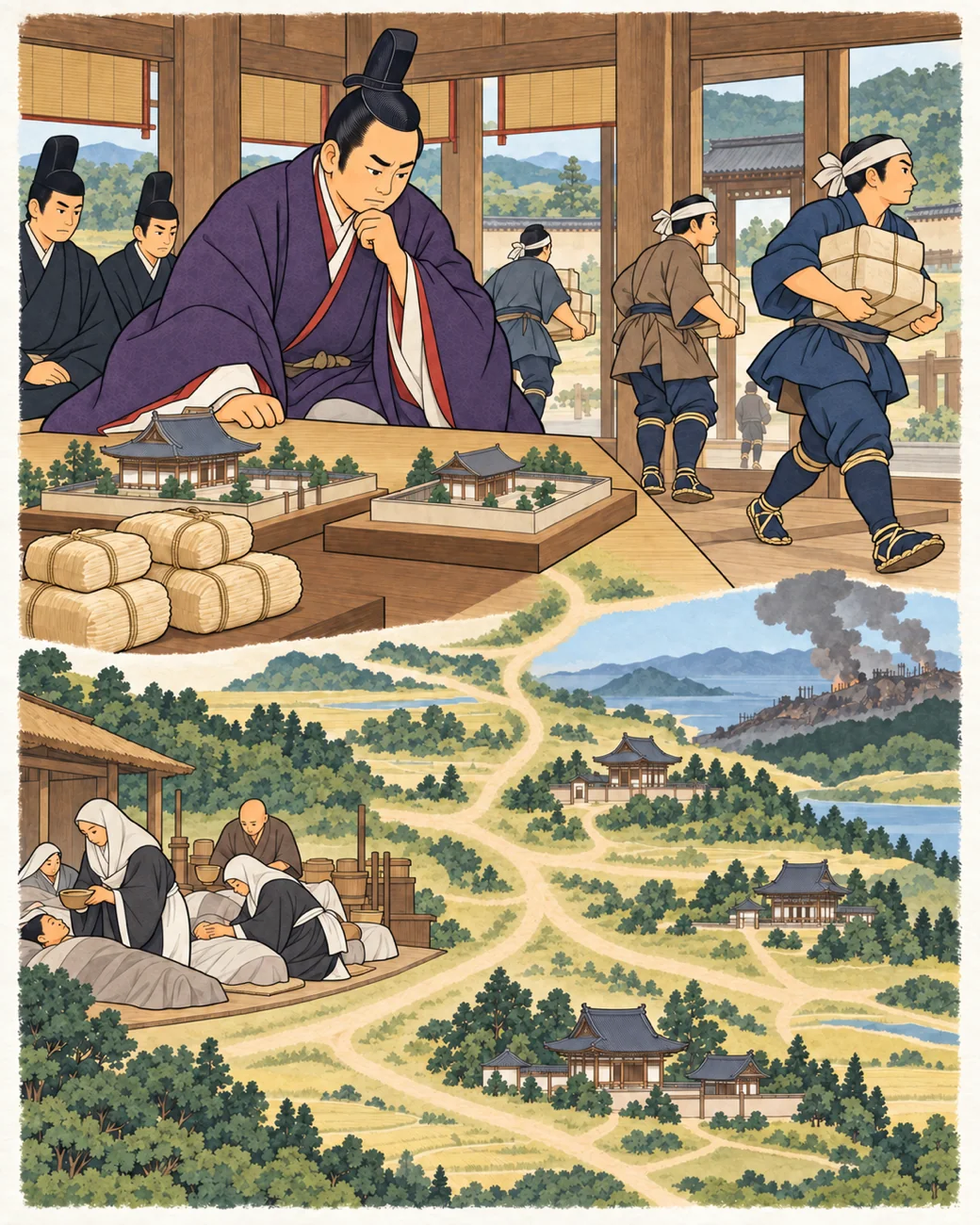
Hiden-in and Seyaku-in became the institutions most strongly associated with Kōmyō’s reputation for compassion. The names are often rendered through modern analogies—a refuge for the poor and a medical or pharmaceutical institution—but those comparisons can mislead if they imply a modern hospital or welfare state. What matters is that relief was connected to named institutions and to the movement of material resources rather than surviving only as moral legend.
Official museum accounts associate Hiden-in with aid for vulnerable people and Seyaku-in with medicinal relief. A surviving catalogue supplies a later, concrete extension of that activity: in 756 Kōmyō offered sixty medicinal substances to the Great Buddha, and the inventory preserves their transfer. This does not prove that the institutions served every person continuously. It shows that charity could be organized through named facilities, stored substances, written records, and court patronage.
The existing Shōsō-in record strengthens that point by showing medicines leaving the treasury for Seyaku-in. It gives concrete evidence that medicinal resources were connected to the institution. At the same time, the surviving material does not justify confident claims about the full scale, exact beneficiary population, or continuity of these institutions across time. Kōmyō’s charitable reputation therefore rests on a genuine institutional core, but the core must be described in eighth-century terms. Her importance is not that she created a modern social service system centuries early; it is that court patronage could be organized into structures of relief.
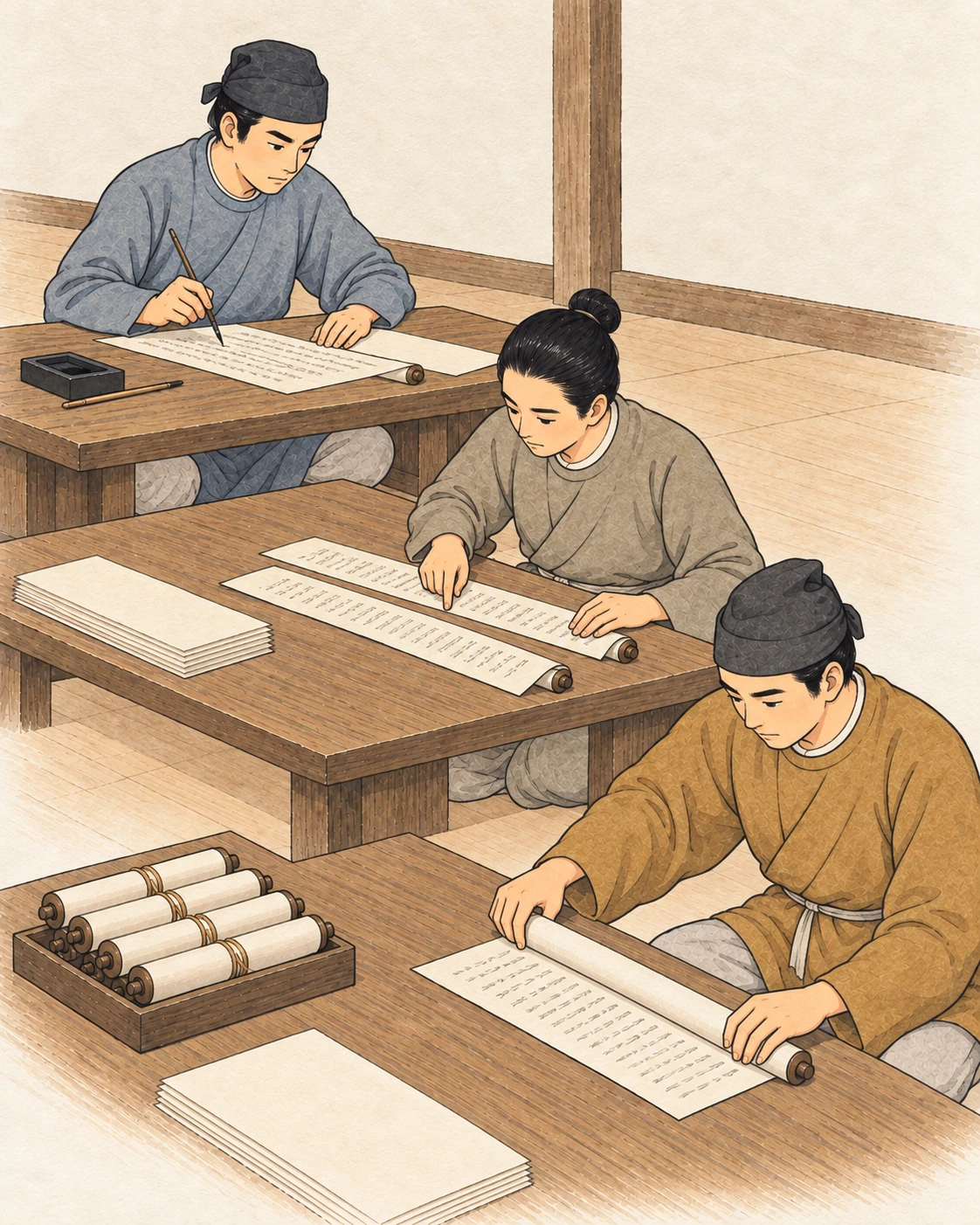
Among Kōmyō’s most tangible religious projects was the copying of a complete Buddhist canon in memory of her deceased parents. Full-scale work began in 736 in the copying office attached to her household, using scriptures brought from Tang China by Genbō as important exemplars. A vow dated May 1, 740 gave the surviving corpus its name. Work continued, with interruptions and changes of scope, until 756 and is estimated to have produced between 6,500 and 7,000 scrolls.
That scale changes how the episode should be imagined. Sutra copying required more than a patron’s pious intention. It depended on scribes, paper, ink, supervision, working time, and the organization needed to produce and preserve an enormous body of text. Kōmyō’s patronage therefore links religious belief to the material history of writing. The scrolls are both Buddhist objects and evidence of coordinated labor. In her biography, the May First Sutras show how an empress’s devotion could become an institutionally organized project whose physical products survived long after the moment of the original vow.
Between 740 and 745, Shōmu repeatedly shifted the political center of the court. Kōmyō lived through this mobile phase of imperial government, moving within a royal world whose places changed in quick succession. The relocations affected the setting in which court politics, ritual, administration, and Buddhist patronage operated, and they form an unavoidable part of her life beside Shōmu.
What the existing material does not preserve is a secure account of Kōmyō’s private opinion about each move. It would be easy to make her either the emperor’s enthusiastic partner or a skeptical observer, but either portrait would exceed the record. Her historical importance here lies in position rather than invented commentary. As empress, she remained inside the moving center of power while her own religious and institutional networks continued to matter. The years of relocation show how biography can follow a person through changing political space even when the person’s private interpretation of those changes remains unknown.
The creation of the provincial temple system and the proclamation of the Great Buddha project transformed the Buddhist landscape of Shōmu’s reign. These undertakings connected imperial religion to a nationwide network and to monumental construction at a scale far beyond private devotion. Kōmyō was closely associated with the Buddhist world in which they developed, and her own patronage makes her impossible to exclude from the wider story.
Yet closeness is not the same as identical authority. The provincial temple policy and the Great Buddha proclamation belonged to imperial and state action; implementation also depended on officials, temples, monks, donors, and laborers. Kōmyō’s patronage formed another layer within that system. Treating Shōmu and Kōmyō as a single decision-making unit would erase the difference between an emperor’s edict and an empress’s resources. Her role is best understood as part of a shared religious-political environment in which different actors contributed through different institutions and powers.
In 749 Shōmu abdicated and Princess Abe ascended the throne as Empress Kōken. Kōmyō’s title and political location changed with the succession: she moved from empress to empress dowager while her daughter became the reigning sovereign. The transition did not remove Kōmyō from the court. Instead, it created a new configuration in which mother, daughter, retired emperor, and powerful aristocrats such as Fujiwara no Nakamaro occupied distinct but interacting positions.
This is the beginning of a later phase of Nara politics, and Kōmyō’s exact intervention in every decision cannot be assumed simply from her status. What can be said is that she remained embedded in the networks surrounding the throne. Her Fujiwara connections, her maternal relationship to Kōken, and her established religious prestige all continued to matter. The succession therefore changed the form of her position rather than making her politically invisible. To understand what followed, one must track relationships rather than assume that loss of the title “empress” meant withdrawal from public life.
In 752 Tōdai-ji held the consecration of the Great Buddha. By then the political arrangement of the imperial family had changed: Kōken was the reigning sovereign, Shōmu was retired emperor, and Kōmyō was empress dowager. Kōmyō belonged to the ritual and patronage world surrounding the achievement, but the ceremony should not turn her retrospectively into a second founder of the entire project.
The event is best understood as the culmination of a vast network. Shōmu’s earlier proclamation was crucial, yet implementation depended on temple organization, religious specialists, mobilizers, craftspeople, donors, and laborers. Kōmyō’s own Buddhist patronage placed her within that network as an important imperial participant. Her role matters precisely because it was one role among many. The consecration made monumental Buddhism visible in ceremonial form and brought together the imperial household, the temple, and the accumulated work of years.
Shōmu died in 756. For Kōmyō, the loss ended a marriage that had also been one of the central political relationships of her life. The archive does not give us permission to invent the private words of her mourning. Instead, it preserves something unusually concrete: the actions she took afterward, including the dedication of Shōmu’s treasured possessions and medicines to the Great Buddha at Tōdai-ji.
On the twenty-first day of the sixth month, the major memorial offering was recorded through distinct catalogues. The Shujuyakuchō alone lists sixty medicinal substances, while the treasured-property inventory organizes another class of objects associated with Shōmu. Keeping those records separate prevents “the donation” from becoming an undifferentiated legendary hoard.
This changes the way the episode can be told. Objects, dates, lists, and dedicatory purposes provide a documentary path through bereavement without pretending to know emotions that were not recorded in recoverable form. The offerings also transformed personal and imperial possessions into religious gifts, attaching Shōmu’s memory to Tōdai-ji and to the collection later preserved at the Shōsō-in. Kōmyō’s grief need not be denied simply because it cannot be quoted. It can be approached through what she demonstrably did: organize acts of dedication whose material traces still define this part of her historical record.
Beginning with the memorial period after Shōmu’s death, Kōmyō made repeated dedications to the Great Buddha at Tōdai-ji. Five surviving dedicatory records document offerings made between 756 and 758, including treasured possessions and medicines associated with the retired emperor. The sequence matters because it replaces the image of a single legendary donation with a documented process of repeated transfer.
Even the first major date contained more than one documentary object: the treasured-property catalogue and the inventory of sixty medicines classified different materials and purposes. The later records extended the chain. “Five offerings” therefore describes a documentary sequence, not five identical batches.
These records form one of the strongest provenance chains behind the Shōsō-in collection. They connect donor, objects, dates, and recipient institution in a way that allows later study to reconstruct how part of the treasury was formed. The medicines also belong to a history of use rather than simple preservation: the wider Kōmyō record includes medicinal resources connected to Seyaku-in. Her acts after Shōmu’s death therefore joined commemoration, Buddhist dedication, and the management of material goods. The surviving collection is not just a treasure house of beautiful objects; it is evidence of decisions made across time.
Kōmyō died on June 7, 760. Her death closes the period in which a first-person perspective can responsibly be reconstructed. What remains is a historical legacy built from several different kinds of material: the May First Sutras, records connected to relief institutions, dedicatory inventories, medicines, and objects preserved through the Shōsō-in tradition.
Those materials help separate the historical Kōmyō from the later idealized image of a uniquely compassionate empress. The image was not created from nothing; her documented patronage and relief associations gave it a real foundation. But later reputation should not be used as evidence for every story told about her. The strongest account works in the opposite direction, beginning with texts, institutions, inventories, and surviving objects and then asking how memory grew around them. Kōmyō’s importance lies not only in the virtues later generations attributed to her, but in the unusually material record through which her actions can still be examined.
Classic
Kōmyō’s birth into the family of Fujiwara no Fuhito is one of the clearest facts about her political location and one of the easiest facts to misuse. Because the Fujiwara became so important in later Japanese history, it is tempting to treat “Fujiwara” as a complete explanation: she was Fuhito’s daughter, therefore every later act must have expressed Fujiwara family strategy. That reasoning turns a real kinship structure into an all-purpose theory of motive.
Kinship nevertheless mattered profoundly. The Nara court was not a political world of isolated individuals. Marriage, descent, household ties, and aristocratic rank shaped access to rulers, offices, patronage, and succession. Being Fuhito’s daughter placed Kōmyō within a network able to operate close to the throne. Her mother, Agata Inukai no Michiyo, also connected her to the courtly world in which family and service overlapped. These relationships help explain why Kōmyō could become a consort of the future Emperor Shōmu and, eventually, occupy an unprecedented position as empress.
But access is not agency, and agency is not motive. A useful biography has to keep those categories separate. Family background can tell us which relationships surrounded Kōmyō, which institutional doors were open to her, and why her elevation carried political significance. It cannot tell us what she privately thought about every court conflict, whether she embraced each Fujiwara interest, or whether later projects were designed primarily for clan advantage. Those questions require event-specific evidence. Where that evidence is absent, the uncertainty is part of the history.
This distinction becomes especially important in 729, when the fall of Prince Nagaya and Kōmyō’s elevation to empress occurred in the same year. A family-centered narrative can easily turn chronology into conspiracy: the Fujiwara wanted their daughter elevated, an obstacle fell, and the outcome followed. Yet a sequence of politically connected events does not by itself establish Kōmyō’s personal responsibility or knowledge. Her kinship made the political stakes legible; it does not supply missing evidence about individual action.
The same caution applies in the opposite direction. Rejecting a crude “Fujiwara agent” label does not mean family politics were irrelevant. Kōmyō’s life cannot be detached from the network that made her position possible. The historical task is to hold both truths at once: aristocratic kinship was a form of political structure, and people within that structure were not interchangeable parts. Seen this way, Kōmyō’s birth establishes a recurring problem for her entire biography. We can map the network with confidence, but we must explain her actions one event at a time rather than allowing ancestry to become a substitute for evidence.
A final advantage of this approach is that it keeps Kōmyō from being swallowed by the later history of her clan. The Fujiwara name can make the eighth century look like a prelude to political arrangements that became more familiar in later periods, but Kōmyō lived in her own Nara-era configuration of court institutions and kinship. Her father’s family mattered in that present. We should not make it matter only because we know what the Fujiwara would later become. Reading her network at the scale of her own lifetime preserves contingency: aristocratic family strategy was powerful, but the precise relationship between clan interest, imperial household, religious patronage, and individual action was still being worked out through particular events.
Marriage altered Kōmyō’s political location because elite marriage in the Nara court joined households, succession, and status. It is misleading to imagine a sharp modern division between a private marriage and a public career. For an aristocratic woman who married the crown prince, family life took place inside the institutional world of the court. The relationship did not automatically grant her the emperor’s authority, but it placed her where dynastic continuity, household management, ritual status, and aristocratic networks met.
Kōmyō entered the marriage as Fujiwara no Fuhito’s daughter. She did not cease to possess that family identity when she joined Shōmu’s household. Instead, the marriage created an overlap between an aristocratic kin group and the future emperor’s family. Such overlaps were politically consequential precisely because the early Japanese state depended on people whose identities were simultaneously familial and institutional. A consort could be daughter, wife, mother, patron, and court figure at the same time, with each role carrying different forms of access and expectation.
The next distinction is between position and power. “Consort of the crown prince” should not be translated into an assumption that Kōmyō jointly governed with Shōmu. Nor should the absence of formal sovereign authority be mistaken for political irrelevance. Her position gave her proximity to the future emperor, placed her children within the succession, and helped create the conditions under which her own patronage could later become publicly important. This was influence through institutional location rather than a duplicate version of the crown prince’s office.
The private marriage itself remains difficult to reconstruct. The archive supports the relationship and its public consequences, not a detailed emotional biography. That is why romance and cynicism are equally hazardous. A sentimental narrative might invent affection; a purely strategic narrative might reduce Kōmyō to a family asset moved into place by the Fujiwara. Both erase the difference between what happened and what we wish to know about why it felt meaningful to the people involved.
The marriage therefore matters less as a hidden psychological story than as a transformation of social position. It moved Kōmyō into the household from which Shōmu would rule and made her future motherhood politically consequential. When she later became empress in 729, that elevation did not appear from nowhere. It was another institutional change built upon the earlier marriage. Understanding the sequence—aristocratic daughter, crown-prince consort, imperial consort, empress—shows how status could accumulate through relationships without making every relationship equivalent to sovereign power.
This institutional reading also clarifies why changes of title matter so much later in Kōmyō’s life. Marriage was not the end of her political transformation; it was the beginning of a sequence. As Shōmu moved from crown prince to emperor, Kōmyō’s own position could be redefined, eventually culminating in her elevation as empress and later her status as empress dowager. Each change altered expectations and access without turning her into a different person or severing older family connections. Marriage thus supplied continuity across changing offices. It joined biography to constitutional history in the broad sense: not a written constitution, but the rules, precedents, ranks, and relationships through which the court made a dynastic household politically meaningful.
Princess Abe’s birth raises a succession question that is easy to distort with modern assumptions. Because she later ruled as Empress Kōken and again as Empress Shōtoku, readers may be tempted either to celebrate her career as evidence of straightforward female equality or to treat it as a bizarre exception to an otherwise exclusively male institution. Neither approach captures the political world into which she was born.
The imperial tradition already made female sovereigns conceivable. A woman on the throne was therefore not an institutional impossibility. At the same time, that fact does not mean the court operated according to a modern principle that men and women had identical political opportunities. Succession belonged to a dynastic system shaped by lineage, availability of candidates, court politics, and the need to preserve the imperial line. Gender mattered, but it operated within a succession structure more complex than a simple rule of male-only inheritance.
This matters for Kōmyō because motherhood connected her directly to the future of the dynasty. Yet “mother of a future emperor” is a retrospective description. In 718, Princess Abe’s later reigns were unknown. To write as though Kōmyō already understood the child’s future would smuggle later history backward into the scene. Historical narrative has to respect the difference between possibility and outcome. Abe was born into a position from which succession could become relevant; she was not born with a guaranteed political script.
The later accession in 749 would also change the meaning of Kōmyō’s own position. She would become empress dowager while her daughter occupied the throne, creating a court in which female dynastic roles were not marginal decorations but part of the structure of government and succession. That later configuration helps explain why the 718 birth matters, but it should not erase the contingency between the two dates.
There is a broader methodological point here. Biography often becomes deterministic when the subject’s later importance is known. Every childhood event is made to foreshadow the adult, every birth to predict a throne, every family tie to announce a future alliance. Kōmyō’s life is better served by resisting that pattern. Princess Abe’s birth should be understood as a new dynastic relationship whose later significance emerged over time. Female succession was a real possibility within the Nara imperial order, but possibility is not prophecy. That distinction allows us to understand both the institutional openness of the succession and the political contingency that eventually placed Kōmyō’s daughter on the throne.
Kōmyō’s motherhood also helps separate dynastic succession from biological reproduction alone. Giving birth to an imperial child mattered because the child entered a political genealogy, not simply because she was a daughter in a private household. That genealogy connected family life to court stability. Yet the path from child to sovereign required later circumstances that 718 did not settle. This is why the most accurate historical language is conditional rather than prophetic. Abe’s birth expanded the field of possible succession and gave Kōmyō a maternal stake inside it. Only later events converted that possibility into accession. Holding those stages apart lets the reader understand how dynasties work without making dynastic history look predetermined.
Kōmyō’s elevation in 729 matters because titles in a court monarchy were not merely ceremonial labels. They defined rank, ritual position, household standing, and the political meaning of relationships around the sovereign. Describing Kōmyō as the first empress of non-imperial birth therefore points to a change in who could occupy one of the court’s highest female positions and to the growing importance of aristocratic kinship within the imperial household.
Her Fujiwara birth is central to that significance. The family already stood close to power, and Kōmyō’s marriage to Shōmu had placed a daughter of Fujiwara no Fuhito inside the future emperor’s household. Elevation to empress took that relationship further. A consort from an aristocratic family was no longer simply close to the throne through marriage; she now held the formal status of empress. This gave her position a public institutional weight that cannot be captured by calling her merely “the emperor’s wife.”
Yet the change should not be exaggerated into a transfer of sovereignty. Kōmyō did not become a co-emperor, and an empress’s authority was not identical to the emperor’s. One of the most important distinctions in her biography is precisely the ability to recognize meaningful public agency without making every form of agency sovereign. Her later support for Buddhist institutions, sutra copying, and relief activities can be understood as actions made possible and magnified by her status, while imperial edicts and state administration remain separately attributable.
The political environment of 729 makes the elevation especially difficult to discuss cleanly. Prince Nagaya fell in the same year, and the proximity has long encouraged a combined story in which his removal clears the way for Kōmyō. The sequence is politically suggestive, and the Fujiwara interest in her position is a legitimate part of the context. But suggestive context is not the same as proof of Kōmyō’s personal role in a plot. The office of empress can be analyzed without solving that unresolved question by assertion.
The deeper significance of 729 therefore lies in institutional boundary change. Kōmyō’s elevation shows that the political architecture of the Nara court could absorb an aristocratic woman into an office of exceptional dynastic prestige. It strengthened the overlap between imperial and Fujiwara networks while also creating a platform from which Kōmyō’s own public identity could develop. The event is important not because it gives us a license to explain every later action through clan strategy, but because it changed the position from which she acted.
The elevation also gives Kōmyō’s later projects a different institutional background. A sutra-copying project or charitable foundation supported by a high aristocratic woman already carried prestige; the same kind of activity associated with an empress operated from a position embedded in imperial ritual and dynastic representation. That does not tell us that every later project was created because of the 729 elevation, but it changes the scale at which patronage could be perceived. Kōmyō’s religious public identity was not separate from court rank. Rank supplied visibility, resources, and symbolic force, while the projects themselves supplied content to the office she inhabited. The relationship ran in both directions: title enabled action, and action helped define what the title meant in practice.
The Nagaya incident is a useful test of historical causation because it offers almost everything a dramatic narrative wants: a prominent political figure falls, a powerful family benefits, and Kōmyō is elevated to empress in the same year. The temptation is to convert sequence, interest, and outcome into a single intentional plan. Doing so would make the story cleaner. It would also claim more than the existing evidence securely establishes about Kōmyō’s personal role.
Chronology is the first layer. Nagaya’s fall and Kōmyō’s elevation belong to the same political moment, so it is not artificial to consider them together. The second layer is interest. Kōmyō’s status mattered to the Fujiwara network, and Nagaya’s position belonged to the balance of power at court. The third layer is responsibility: who knew what, who initiated what, and how directly Kōmyō herself participated. It is at this third layer that historical confidence must narrow.
This distinction matters because political history often slides from structural explanation into personal accusation. A family may benefit from an event without every member having planned it. A later outcome may become possible after a rival falls without proving that the beneficiary caused the fall. Conversely, uncertainty about individual responsibility does not require pretending that there was no political relationship between the events. The task is to describe the political stakes without turning inference into fact.
Excavated documents add a material succession without resolving personal guilt. The large residence associated with Nagaya’s household was confiscated after his fall, and documentary archaeology has been used to identify later activity there connected with Kōmyō’s household. Property, staff routes, and administrative space could therefore pass into the victorious order. That reuse is an outcome of 729, not proof that Kōmyō planned the accusation. It makes the redistribution of power visible while leaving the initiating agency unresolved.
Kōmyō’s position makes the problem even sharper. She was simultaneously a Fujiwara daughter and Shōmu’s consort, and in 729 she became empress. A narrative that treats her only as a passive wife erases the political meaning of that position. A narrative that turns her into the hidden author of the entire crisis overstates what the material can support. The responsible middle is not evasive. It is analytically precise: her elevation was significant; the Fujiwara context mattered; Nagaya’s downfall changed the political environment; Kōmyō’s exact agency in the incident remains unresolved.
Why, then, have the events so often been joined? Because historical storytelling prefers motive and consequence to coincidence and uncertainty. A causal chain is easier to remember than a contested political environment. But the purpose of deeper historical writing is not to maximize narrative satisfaction. It is to distinguish what the structure makes plausible from what the record can actually sustain. In Kōmyō’s life, 729 should remain a year of connected political transformations without becoming a confession written on her behalf.
This method also preserves the difference between political explanation and judicial proof. Historians often have enough evidence to identify beneficiaries, tensions, and plausible interests without having enough to convict a named person of planning an event. The Nagaya incident belongs to that uncomfortable middle ground in Kōmyō’s biography. Its proximity to her elevation makes it historically relevant; the absence of decisive evidence for her personal responsibility makes categorical accusation unsafe. Rather than treating uncertainty as a failure, the account can use it to teach how court politics is reconstructed. We can state what changed, who stood to gain, and why contemporaries or later writers might connect the events, while keeping the final step—personal culpability—at the confidence level the material allows.
Kōmyō’s Buddhist patronage reveals a form of power that disappears if political history looks only for edicts, offices, and sovereign commands. An empress did not need to issue the same orders as the emperor in order to act publicly. Patronage could mobilize resources, sustain religious production, support institutions, and connect court status to temples and charitable activity. That made it politically meaningful even when it was not identical to government administration.
The first distinction is between devotion and institution. Personal Buddhist commitment may have motivated patronage, but the historical effects of patronage were material. Sutras had to be copied. Temples required resources. Relief activities required medicines, administrators, or organized channels through which goods could move. Once devotion generated durable projects, it entered a world of labor, property, institutional relationships, and public reputation. Kōmyō’s significance lies partly in the ability of an empress’s religious role to operate within that world.
The second distinction is between patronage and sovereignty. Shōmu’s reign saw major projects of state Buddhism, including the provincial temple system and the Great Buddha. Because Kōmyō stood beside him and had her own strong Buddhist profile, later narratives can merge the pair into a single religious will. That is too simple. Imperial proclamations, state offices, temple organizations, monks, and an empress’s resources were different components of the same religious-political environment. Shared commitment does not erase differences in authority.
The third distinction concerns attribution. Kōmyō is associated with several projects and institutions, but association does not always tell us the exact degree of management she exercised at every stage. A responsible account can say that her position, resources, and patronage were important without manufacturing a modern executive chart in which every project has a single founder controlling every detail. Ancient institutions often survive in the record through uneven evidence, and the language of “founded,” “ran,” or “created” can become more definite than the underlying material warrants.
Seen structurally, patronage was one way elite women could act in a public sphere not reducible to formal office. Kōmyō’s Buddhist identity was therefore neither merely private nor a disguised version of imperial sovereignty. It was a distinct political-religious capacity: the ability to connect status, wealth, ritual legitimacy, institutions, and social action. That capacity helps explain why her memory became so closely tied to sutra copying and relief. It also provides a better language for her power than either of two extremes—“only a pious consort” or “co-ruler of Shōmu’s Buddhist state.”
Patronage also created a relationship between reputation and infrastructure. A ruler or consort could be remembered for piety because buildings, texts, institutions, and endowed activities made that piety visible. In Kōmyō’s case, the material forms matter more than a generalized claim that she was devout. They allow us to ask where resources went and what kinds of work they enabled. This makes her religious life historically analyzable without pretending to know the full texture of her inner faith. Public Buddhism was simultaneously belief, social prestige, economic allocation, textual production, and institutional maintenance. Kōmyō’s career demonstrates how one person could operate across those dimensions through patronage while remaining distinct from the bureaucratic machinery of the state.
Calling Hiden-in an “orphanage” or “poorhouse” and Seyaku-in a “hospital” makes them instantly legible to modern readers. It also risks importing institutions that did not exist in eighth-century Japan in the same form. The deeper question is not which modern label fits best, but what kind of organized relief these names and surviving records allow us to reconstruct.
Kōmyō’s reputation is closely tied to care for people in need, and Hiden-in and Seyaku-in sit at the center of that memory. The most useful evidence is material rather than purely celebratory. Medicines are recorded as moving from the Shōsō-in treasury to Seyaku-in. That does not answer every question about the institution, but it demonstrates that the name was connected to real resources and activity. Relief was not only an abstract virtue attached to the empress after the fact.
What remains uncertain is equally important. The archive does not support a complete census of beneficiaries, a stable annual budget, a modern professional staff structure, or a continuous institutional history comparable to a contemporary public-health agency. Terms such as “hospital” carry expectations of diagnosis, inpatient care, professional medicine, and bureaucratic continuity that may exceed what the surviving material establishes. “Welfare office” similarly suggests a state system of entitlement and regular administration. Those analogies can be used only with caution, if at all.
A better approach is to think about organized charity within the political and religious world of the Nara court. Elite Buddhist patronage could direct goods, medicines, and institutional attention toward relief. The empress’s status gave such activity prestige and resources. The institution, in turn, made compassion visible as something more than personal generosity: it could be named, administered in some form, and linked to stores of material goods. That is already a substantial historical development without requiring modern vocabulary.
The Shujuyakuchō demonstrates why documentary precision matters. Dated to the twenty-first day of the sixth month of 756, it inventories sixty medicinal substances offered by Kōmyō. An inventory cannot reconstruct diagnoses, staffing, or the social profile of recipients, but it establishes classification, custody, and intended availability more securely than a general story of benevolence. Relief history here rests on the meeting of moral purpose and administrative record.
This approach also changes how Kōmyō’s later image should be judged. The “compassionate empress” is not simply accepted as legend, nor is it dismissed because later memory became idealized. Instead, the image is disassembled. Some elements rest on concrete records—institutions, medicines, sutras, offerings. Other details may belong to later storytelling. By separating those layers, Hiden-in and Seyaku-in become more historically interesting. They show how moral reputation can grow from real institutional actions while still accumulating meanings that exceed what the surviving eighth-century record can prove.
The vocabulary problem is more than a matter of translation. Modern institutional words carry hidden assumptions about who has rights, who pays, how services are administered, and what continuity a public body is expected to possess. If those assumptions are silently imported, Kōmyō can be turned into the founder of institutions that resemble twentieth- or twenty-first-century services more than eighth-century relief. Keeping the Japanese names visible—Hiden-in and Seyaku-in—helps preserve the conceptual distance. We can then explain their charitable and medicinal associations positively, from the surviving record, rather than defining them by a modern category. This gives the reader something more useful than a catchy equivalence: a picture of how care could be organized within the religious and aristocratic resources of the Nara court.
The May First Sutras make visible something that religious history can easily hide: devotion had to be manufactured in the literal sense of being made by human hands. A vow to copy the Buddhist canon was an act of faith, but thousands of scrolls could not appear through faith alone. They required a production system. Once the project is viewed that way, Kōmyō’s patronage becomes a history of labor, materials, coordination, and time as well as piety.
The project was connected to prayers for her deceased parents, and the vow of May 1, 740 gave the corpus its later name. The memorial purpose is essential because it explains why religious merit, family memory, and textual production came together. Copying scripture could be devotional action directed toward the dead, while at the same time creating physical Buddhist texts for ritual and institutional use. The project thus joined private kinship obligations to a public religious economy.
Scale is what transforms the meaning of the undertaking. A single hand-copied text can be imagined as an individual devotional act. A corpus approaching seven thousand scrolls required scribes and supervision, supplies of paper and ink, exemplars, systems for checking and handling the work, and sustained resources over two decades. The project also changed scope: it moved beyond a single Chinese catalogue toward copying additional scriptures and commentaries available in Japan.
Documents from the later collation stage show finished scrolls being distributed among Tōdai-ji, Kōfuku-ji, Daian-ji, Yakushi-ji, and Gangō-ji for textual checking. Manufacture therefore did not end when a scribe put down the brush. Quality control required inter-temple document exchange, named offices, transport, comparison, and return. The surviving scroll is both a devotional object and the output of a networked editorial system.
This also complicates the idea of authorship. Kōmyō was the patron associated with the vow, but she did not personally write every character. The surviving objects are products of a network: patron, scribes, material suppliers, supervisors, and religious institutions. Giving the empress proper credit therefore does not require erasing the many people whose work made her vow durable. Patronage and collective production are complementary explanations, not rivals.
The May First Sutras also provide a model for understanding Kōmyō’s broader public role. Her influence often appears through resources directed into institutions rather than through sovereign proclamations. Here, the result is unusually concrete. A religious intention leaves an archive of physical texts. That survival allows historians to move from the language of piety to the infrastructure that made piety visible. In that sense, the project is not merely an illustration of Kōmyō’s faith. It is evidence that elite Buddhist devotion in Nara Japan could mobilize a substantial production apparatus and leave behind objects through which that apparatus can still be studied.
Textual scale also makes the May First Sutras a window into state-era literacy without requiring us to imagine a mass-literate society. A large copying project concentrated specialist literacy and material resources in organized settings. The value of the scrolls therefore lies not only in what their Buddhist texts say but in what their existence implies about scribal capacity. Repetition, consistency, and sheer volume require systems. In Kōmyō’s biography, this is especially important because it turns “patron of Buddhism” from an honorific into a traceable relationship between elite sponsorship and skilled work. The project survives as proof that religious merit could be pursued through coordinated production, making the history of belief inseparable from the history of people who physically manufactured written culture.
The repeated movement of Shōmu’s political center between 740 and 745 creates a difficult biographical problem for Kōmyō. She was empress and therefore lived within the mobile imperial world, but the fact that we can trace where the court moved does not mean we can recover what she thought about every relocation. Space is documented more securely than opinion.
That distinction is historically valuable. Court politics is often written as a sequence of decisions made by named rulers, yet each decision displaced or reoriented an entire social and institutional environment. An imperial move affected aristocrats, officials, religious establishments, households, transport, ritual practice, and the logistical center of government. Kōmyō’s life belonged to that environment. Even if her individual position on a particular move is unknown, her experience was shaped by the fact that the court itself was not stationary.
The temptation is to fill the silence through relationship. Because she was Shōmu’s empress, one might assume she supported his decisions. Or, because repeated moves can be presented as disruptive, one might imagine private disagreement. Both are projections. Marriage gives us proximity, not automatic agreement or opposition. The same rule used elsewhere in her biography applies here: shared location does not prove shared intention.
What can be reconstructed instead is a moving network. Kōmyō’s religious interests, family ties, and court status did not disappear each time the political center shifted. A person at the top of the Nara court occupied a web of relationships that traveled, adapted, and remained connected to temples and aristocratic families across places. This helps us see capital relocation as more than a dot moving on a map. It was a reconfiguration of where authority was physically concentrated and where the people surrounding that authority had to operate.
For Kōmyō, therefore, the capital moves matter without needing a lost diary. They place her patronage and court role in an unusually unstable spatial setting. They also discipline the historian: the map can be precise while the interior monologue remains blank. That combination is not a weakness. It is an example of how historical biography can remain vivid by following institutions, places, and relationships while refusing to manufacture private certainty where none survives.
The mobile court also warns against treating “the capital” as a neutral backdrop. Political centers contain archives, workshops, residences, ritual sites, and routes of supply. Moving the center means reorganizing a living system, not merely relocating a sovereign’s residence. Kōmyō’s biography can therefore use the relocations to make space historically active even without assigning her a policy position. Her presence shows that elite women were participants in the practical geography of rule: their households, attendants, patronage relationships, and ritual obligations had to function somewhere. The uncertainty about her personal opinion remains intact, while the structural consequence of movement becomes clearer. This is a productive use of silence rather than an attempt to overcome it. This spatial perspective also keeps the episode connected to Kōmyō’s own life rather than turning it into a detached list of capital names. Movement was a condition under which she had to continue being empress.
Kōmyō’s connection to the great Buddhist projects of Shōmu’s reign creates a problem of attribution. The two were married, both are strongly associated with Buddhism, and both appear in the institutional world surrounding Tōdai-ji and court religion. It is therefore easy to speak of “their” Buddhist policy as though a royal couple possessed a single mind and a single office. That language is convenient but historically imprecise.
The provincial temple system and the Great Buddha project involved forms of authority that belonged to the emperor and the state. Proclamations were not private donations. State offices, provincial administration, temple institutions, monks, craftspeople, donors, and labor all had roles in turning policy and religious ambition into physical reality. The Great Buddha in particular cannot be explained as the expression of one person’s intention, however important Shōmu was to its proclamation.
Kōmyō occupied a different but overlapping field. Her Buddhist patronage could direct resources, support temples and sutra copying, and attach imperial prestige to religious work. That activity mattered politically and materially. But recognizing its importance does not require converting patronage into authorship of the emperor’s edicts. The point is not to diminish her; it is to describe her power accurately.
This separation also prevents a common biographical distortion. When two prominent historical figures are spouses, narratives often attribute to both whatever either one did. Shared household becomes shared policy, and shared belief becomes shared responsibility. Kōmyō’s archive repeatedly warns against that shortcut. The same woman who could exercise substantial agency through patronage need not be credited with every decision of Shōmu’s reign. Conversely, distinguishing authority does not reduce her to a spectator.
The deeper structure is a coalition of institutions and forms of action. Imperial commands could establish goals; administrative systems could allocate responsibilities; religious specialists could provide ritual and doctrinal frameworks; patrons could contribute resources; broader networks of labor could build and sustain the projects. Kōmyō belonged to that system as an empress with unusually visible religious patronage. Her role becomes clearer, not smaller, when it is placed beside other roles rather than merged with them. The resulting picture is less romantic than the idea of a devout royal couple acting as one, but it better explains how large Buddhist projects actually became possible.
The distinction between forms of authority also protects the agency of people below the imperial household. If every Buddhist achievement is attributed to Shōmu and Kōmyō as patrons, monks become executors, officials become machinery, and craftspeople disappear. But the projects themselves required expertise and action distributed across the system. Keeping imperial proclamation, empress’s patronage, temple organization, and labor analytically separate makes room for those contributions. It also improves cross-person storytelling: the same Great Buddha can be approached differently through Shōmu, Kōmyō, Gyōki, or later participants without reproducing one master narrative. Kōmyō’s Classic layer should therefore explain her structural relationship to the project rather than claim ownership of the event. In other words, careful attribution is not a technical footnote. It is the method that keeps a genuinely collective historical process visible while still giving Kōmyō her proper place within it.
When Kōmyō became empress dowager in 749, the change of title could be mistaken for retirement. In fact, court status did not operate as a simple ladder on which stepping away from one office meant disappearing from politics. Her daughter was now the reigning sovereign, Shōmu was retired emperor, and Kōmyō remained a senior member of the imperial household with deep Fujiwara connections and an established public religious identity.
The first thing to separate is formal sovereignty from relational influence. Empress Kōken held the throne. Kōmyō did not. That distinction remains essential even within a mother-daughter relationship. At the same time, a senior royal woman could occupy a powerful position in court networks without issuing all decisions herself. Kinship, household access, patronage, and aristocratic alliances could shape the environment of government in ways that do not fit neatly into the category of formal office.
Fujiwara no Nakamaro becomes increasingly important in the political world of this period, and Kōmyō’s connection to the Fujiwara network makes her part of the structure through which his rise has to be understood. But again, relationship is not a blank check for attribution. The existing material does not justify assigning Kōmyō personal authorship of every Nakamaro policy or every choice made by Kōken’s court. The historian has to map the network before assigning responsibility within it.
This is particularly important because Kōmyō’s biography intersects with several other person narratives. From Shōmu’s perspective, 749 is abdication. From Kōken’s perspective, it is accession. From Kōmyō’s perspective, it is a shift from wife of the reigning emperor to mother of the reigning emperor. The factual event is shared, but the structural meaning differs for each person. That difference is exactly why the same event should not produce identical historical analysis across biographies.
Kōmyō’s new status therefore demonstrates how power can be redistributed without disappearing. She no longer occupied the same position she had held as empress, but she remained close to the dynastic center and to the Fujiwara political network. The correct question is not simply “Was she still powerful?” but “Through which relationships and institutions could she now matter?” That formulation preserves both the sovereignty of Kōken and the continuing significance of Kōmyō without collapsing one woman into the other.
The title “empress dowager” is especially useful because it reminds us that dynastic systems generate new positions as generations turn over. Kōmyō did not become politically important only by being Shōmu’s wife; once Kōken reigned, motherhood itself became a relationship to the sovereign. That relationship had no simple modern equivalent. It mixed family hierarchy, court rank, ritual seniority, and political access. The historian must therefore resist translating it either into a constitutional office with fixed powers or into informal maternal influence alone. Its importance lies in the combination. Kōmyō’s later court role was structured by status and kinship, but the degree of intervention in any specific decision still has to be assessed separately rather than inferred from the title. That approach also prevents later conflict from being projected backward into 749. The new relationships created by the succession mattered immediately, but their later outcomes were not yet fixed.
The Great Buddha consecration of 752 can easily become a stage on which famous people are assigned more credit than the institutional history allows. Kōmyō was a senior member of the imperial family, a major Buddhist patron, and closely connected to the religious world of Shōmu’s reign. Those facts make her presence meaningful. They do not make her a second author of every policy, fundraising effort, construction decision, or ritual arrangement that produced the monument.
The project had multiple layers of authority. Shōmu’s proclamation belongs to the history of imperial initiative. Tōdai-ji and its monks belong to the institutional history of the temple. Figures such as Gyōki belong to mobilization and religious networks. Craftspeople and laborers belong to the material history of casting and construction. Donors and administrators belong to the resource systems that sustained the undertaking. The final ceremony gathered these histories into one visible moment but did not erase their differences.
Kōmyō’s position within this system is best described through patronage and ritual status. Her Buddhist commitments were substantial, and her rank gave weight to her participation. By 752 she was empress dowager, while her daughter Kōken was the reigning sovereign and Shōmu a retired emperor. Even the imperial family itself therefore contained differentiated roles. Treating the ceremony as the achievement of a single royal couple would flatten both political succession and institutional complexity.
This distinction also helps explain why ritual participation matters historically. Ceremony is not “mere symbolism” added after the real work. A consecration gives religious meaning and public form to a material object. It locates the monument inside a community of patrons, clergy, rulers, and participants. Kōmyō’s presence within that ritual world expresses her continuing religious and dynastic status without requiring us to attribute to her actions that belong to others.
The deeper lesson is that monumental history should resist the hero-founder model. The Great Buddha was too large—politically, materially, and religiously—to belong to one biography. In Kōmyō’s life, the 752 ceremony is a point of intersection. Her patronage, Shōmu’s earlier policies, Kōken’s reigning authority, temple organization, and collective labor meet there. Preserving those distinctions allows her significance to remain substantial while keeping the monument itself a product of many hands and many institutions.
The ceremony also shows how completion changes the political life of a monument. During construction, the Great Buddha was a project: resources had to be gathered, technical problems solved, and authority mobilized. At consecration, the unfinished undertaking became a ritually activated public object within Tōdai-ji. Kōmyō’s place in that transition was not technical authorship but participation in the imperial-religious order that endowed the image with meaning. That is a genuine historical role. It allows her biography to describe why the event mattered to her world without converting ritual presence into administrative control. The distinction is subtle but essential: ceremonies can be politically and religiously consequential even when the participants did not all hold the same authority over the work being celebrated. The event can thus remain magnificent without becoming biographically possessive. Kōmyō is present at the culmination because her religious and dynastic position mattered, not because every element of the project belonged to her.
The death of a spouse creates pressure on historical biography to become a novel. Readers expect grief, last words, private memory, and an emotional scene. In Kōmyō’s case, the surviving record offers a different kind of intimacy: not an authorized transcript of feeling, but a sequence of material actions. Her dedications after Shōmu’s death can be dated, inventoried, and connected to objects and medicines. That specificity is more historically valuable than a plausible speech written centuries later.
Inventories are sometimes treated as dry administrative documents, the opposite of human storytelling. Here they do the opposite. A dedicatory list tells us what was selected, how it was categorized, where it was sent, and under what religious purpose. It reveals decision through material consequence. Kōmyō’s response to Shōmu’s death therefore appears not as a reconstructed conversation but as an organized transfer of possessions into a Buddhist setting.
The medicine catalogue makes category itself historically meaningful. Sixty substances were listed in a document distinct from the inventory of treasured possessions. Medicines were not merely beautiful relics; they carried possible therapeutic use and connected Kōmyō’s memorial action with her established relief patronage. The catalogue gives them a date, count, recipient, and purpose without telling us that all were administered immediately or to whom.
The religious meaning matters. These were not simply estate records. Dedication to the Great Buddha at Tōdai-ji placed the objects inside a ritual economy of memory and merit. Shōmu’s possessions became offerings, and the act linked the deceased ruler to the monumental Buddhist institution that had defined so much of his reign. Kōmyō’s position as donor gave the transfer a personal, dynastic, and religious character at once.
This does not mean emotion was absent. It means emotion cannot be reconstructed with the same confidence as action. Historians can reasonably understand bereavement as the context of the offerings without inventing the exact form of Kōmyō’s sorrow. The distinction is ethically important in a perspective-driven product: a first-person voice should not manufacture grief simply because grief would be humanly plausible. Plausibility is not evidence.
The dedicatory records thus offer a different model of biographical depth. Material documentation can make a person more, not less, visible. Kōmyō appears as someone who responded to death by directing treasured objects and medicines toward Tōdai-ji in a structured religious act. The lists preserve a chain between person, possession, institution, and memory. Rather than asking an inventory to behave like a diary, we can let it answer a different question: what did Kōmyō do when the relationship that had shaped much of her adult public life ended? The surviving answer is concrete enough to be powerful without fictional supplementation.
Material action can also carry meanings that prose cannot fully recover. Choosing to dedicate treasured possessions rather than retain them, and directing them toward the Great Buddha, joined memory to renunciation and religious merit. The surviving record allows that structural interpretation without requiring an invented sentence such as “I was devastated” or “I wanted the world to remember him.” Those emotions may be plausible, but the act itself is stronger evidence. When documents preserve conduct better than interiority, the writing should let conduct bear the emotional weight instead of inventing private speech. Restraint does not make the story cold; it prevents the modern narrator from occupying the historical person’s mind without permission. The inventory therefore becomes a form of disciplined closeness to Kōmyō: it shows her choices at a moment of loss while preserving the boundary around feelings that cannot be quoted.
The popular imagination prefers origins that happen in a single dramatic moment. A grieving empress presents the treasures of a dead emperor; the Shōsō-in collection is born. The surviving dedicatory records tell a more complex and more useful story. Five records document repeated offerings between 756 and 758. The collection’s core was formed through a sequence of acts, not one timeless donation.
That sequence is what provenance means in practice. An object becomes historically richer when we can connect it to a donor, a date, a dedicatory purpose, and a recipient institution. The records do not merely certify that something is old. They place objects in motion. Possessions once associated with Shōmu were selected and transferred by Kōmyō into the religious custody of Tōdai-ji. The documentary chain helps explain why the Shōsō-in is not simply a warehouse of surviving art but an archive of relationships among people, institutions, and things.
Repeated offerings also reveal that commemoration was a process. A memorial act did not need to exhaust itself in a single ceremony. Different groups of objects could be handled at different times, and medicines could have lives beyond storage. Within Kōmyō’s broader institutional record, medicinal goods connect the treasury to relief activity as well as memory. That movement complicates the idea of a treasure as something valuable because it was sealed away untouched.
The Shujuyakuchō provides an especially clear example. Its sixty substances were classified through an inventory whose identity remains distinct from the Kokka chinpō chō of treasured objects. This separation allows provenance to retain function: a robe, a furnishing, and a medicine did not enter Tōdai-ji under one interchangeable meaning, even when they shared donor, memorial context, and date.
The existence of inventories disciplines interpretation. Beautiful objects attract legends, especially when attached to an emperor and empress. Documentary provenance provides a counterweight. It tells us where narrative can be specific and where it must remain cautious. The exact history of every individual item may require item-level study, but the larger structure is clear enough: Kōmyō’s dedications were multiple, dated, and institutionally directed.
This is also why chapter 14 is not merely a continuation of chapter 13. chapter 13 asks how material records allow us to write the immediate aftermath of Shōmu’s death without invented grief. chapter 14 asks how repeated transfer creates a collection and a provenance structure over time. The person is the same and some objects overlap, but the historical problem changes from bereavement to formation. Through that shift, the Shōsō-in emerges not as a static container but as the result of successive human actions. Kōmyō’s legacy is embedded in that sequence.
Thinking in sequences also helps explain why preservation is never simply passive. Every transfer, inventory, withdrawal, or retention changes the future of an object. The fact that some medicines were associated with later use underscores that a treasury could participate in institutional life rather than function only as a sealed museum. Kōmyō’s offerings therefore sit at the beginning of histories that continued after the act of dedication. The records let us follow that transition from possession to offering to custodial object. In a product centered on people and events, this is a powerful bridge between biography and material culture: an empress’s decisions become legible centuries later because objects carried documentary relationships with them. That documentary continuity is one reason these offerings matter beyond the history of collecting. They show how memory, religion, medicine, and custody could intersect in the life of a single group of objects.
Kōmyō’s posthumous reputation poses a final problem of historical memory. She is often remembered as a compassionate Buddhist empress: patron of sutra copying, supporter of relief institutions, and donor of the objects that became central to the Shōsō-in. That image has genuine roots in her documented life. Yet reputation is not the same thing as evidence, and a virtuous image can become so powerful that it absorbs stories whose historical basis is uneven.
The safest method begins from the material record. The May First Sutras connect Kōmyō to a large memorial copying project. Hiden-in and Seyaku-in connect her name to organized relief, while medicinal records provide a concrete institutional trace. The dedicatory documents after Shōmu’s death connect her to repeated transfers of possessions and medicines to Tōdai-ji. Surviving objects add another level of physical continuity. None of these sources gives us total access to her personality, but together they establish a substantial pattern of Buddhist patronage and material action.
Only after that foundation is secure should later memory be considered. A reputation for compassion can grow by emphasizing certain actions, retelling them in exemplary form, and attaching additional stories to a person who already functions as a moral model. That process is historically interesting in its own right. It tells us not only about Kōmyō but also about what later communities wanted an ideal Buddhist empress to represent.
The distinction is especially important at death. Once Kōmyō died in 760, she could no longer possess a real-time perspective on the uses later generations made of her name. Her later image belongs to historians of memory, not to an imagined Kōmyō commenting from beyond her lifetime.
The result is a legacy stronger than either hagiography or debunking. We do not need to accept every compassionate legend to recognize that Kōmyō’s public life left unusually rich traces of religious and charitable activity. Nor do we need to dismiss later admiration simply because it was shaped by memory. Evidence and reputation can be studied in sequence. The first establishes what can responsibly be said about her actions; the second shows how those actions were selected, magnified, and interpreted after her death. That layered approach leaves Kōmyō neither as a saintly stereotype nor as a blank figure behind skeptical footnotes, but as a historically recoverable patron whose afterlife in memory must remain distinct from the person who died in 760.
Kōmyō’s legacy therefore offers a final lesson about the difference between historical significance and moral verdict. A person can be historically important because her actions generated institutions, texts, and durable material traces without the historian needing to declare her wholly compassionate, wholly political, or wholly representative of her family. The evidence supports several dimensions at once. That plurality is preferable to a single commemorative label. It also prepares the reader to encounter later stories critically but not cynically: memory often begins from something real, then selects, simplifies, and moralizes it. Kōmyō becomes more interesting when the compassionate image is treated as one historical layer resting upon, but not replacing, the record of what she actually did.