Read the article below. Interactive reading tools are available when scripts load.
Classic
Ishiyama Honganji had withdrawn from Osaka, and the defeat of the Takeda in spring 1582 enlarged Oda power in the east. Other armies remained engaged elsewhere: Hideyoshi faced the Mōri in Bitchū, while northern commanders operated toward Uesugi territory and forces were preparing for a Shikoku campaign. Nobunaga’s officers held regional forces and managed different theaters of war.
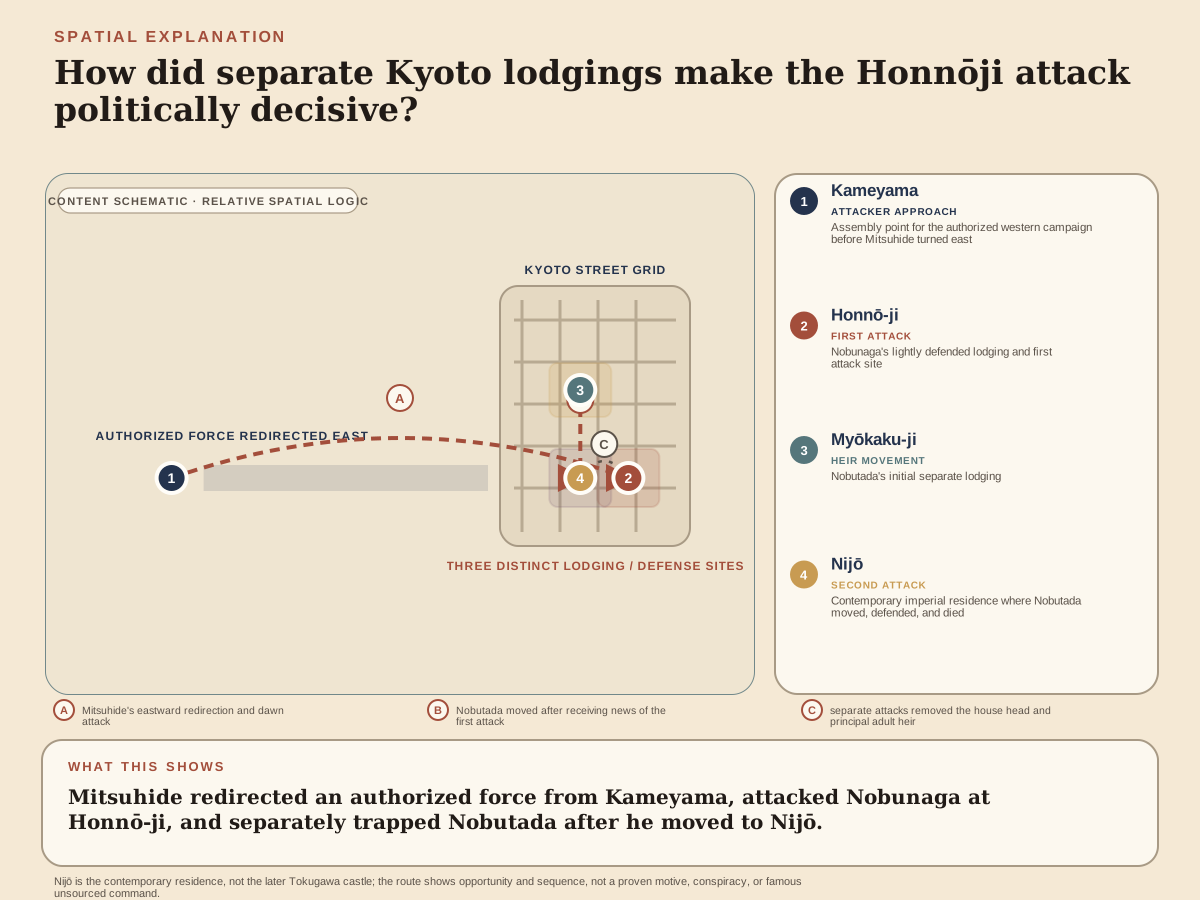
Nobunaga left Azuchi for Kyoto in the fifth Japanese month with a small personal following. He lodged at Honnōji. Nobutada, his adult heir and a commander in the recent Takeda campaign, stayed at Myōkakuji. Their main field armies were absent from these lodgings.
Mitsuhide had served Nobunaga in campaigns and central-province administration. An order to assist Hideyoshi brought him from Sakamoto to Kameyama in Tamba, where he could assemble troops for movement west. That mobilization supplied the force he redirected toward Kyoto.
The Oda succession already had a leading adult heir in Nobutada. Killing both men would remove that immediate line of leadership while leaving other relatives, provincial armies and territorial grants in place. Mitsuhide’s attack exploited their vulnerability in the capital; gaining recognition from those surviving networks required further action.
The orders for the western campaign passed through an established group of commanders. Gyūichi names Mitsuhide alongside Hosokawa Tadaoki, Ikeda Tsuneoki, Takayama Ukon and Nakagawa Kiyohide among those instructed to go ahead. Nobunaga intended to follow toward the Mōri front. Commanders returned to their own bases to prepare, while he traveled with household attendants rather than the assembled campaign army. The danger arose within an authorized mobilization, rather than from an enemy army unexpectedly entering central Japan.
Kyoto contained court residences, temples, merchant households and Nobunaga’s administrative connections. Nobutada’s lodging was separate from his father’s, and an imperial residence would become his place of defense. Orders and news moved between these sites and the commanders’ bases through messengers. Their recipients did not share a single, simultaneous view of the crisis: later letters could carry reassurance even after the men they concerned were dead.
Gyūichi’s Shinchō Kōki supplies an Oda-centered narrative; Jesuit reports preserve the concerns of another group under Nobunaga’s protection. Both require attention to how information reached their writers. The deployment and the attack can be described more securely than Mitsuhide’s private reasons.
Evidence and interpretation · A political plan after the attack?
Fujita Tatsuo interprets the coup in relation to preserving Yoshiaki’s shogunal position and obstructing Nobunaga’s Shikoku campaign. Watanabe Daimon disputes the evidence for coordination before the attack. The correspondence discussed in the next chapter belongs to attempts to build a political order after Nobunaga’s death.
An intention expressed after the attack does not establish a prior conspiracy. Lightly defended lodgings explain an opportunity; they do not prove private resentment or participation by the court or Hideyoshi.
On the night of the first day of the sixth Japanese month, Mitsuhide’s army left Kameyama and turned east. Ōta Gyūichi’s account follows its passage over Oinosaka, descent toward Kyoto and crossing of the Katsura River. At dawn, troops surrounded Honnōji and entered from several directions.
The defenders were Nobunaga’s household following. Gyūichi describes him fighting with a bow and then a spear before withdrawing into the burning buildings. Nobunaga died on the second day of the sixth month, corresponding to 21 June 1582 in the Gregorian calendar, and attendants also fell. The account preserves vivid last words and gestures, but the secure result is the destruction of the lodging and loss of the Oda leader. Gyūichi’s description ends with death inside the burning temple, without an account of an identified body. That gap does not establish an escape, nor does the narrative provide a record of Nobunaga’s final thoughts. The famous declaration that “the enemy is at Honnōji” should not be treated as a documented order to the whole army.
Nobutada moved from Myōkakuji to the Nijō New Palace after Murai Sadakatsu brought news of the attack. Prince Sanehito and his household left for the imperial palace before fighting there. Mitsuhide’s soldiers attacked, Nobutada died, and Murai and other senior followers were killed. This Nijō residence was distinct from the Tokugawa castle built later.
Mitsuhide’s soldiers searched Kyoto houses for fugitives, according to Gyūichi. He then pressed toward Ōmi and demanded Yamaoka cooperation. The brothers burned the Seta bridge and withdrew. At Azuchi, Gamō Katahide arranged transport and escorts with his son Ujisato, moving women and children to Hino.
Securing allies proved harder than taking the Oda lodgings. Hosokawa Fujitaka and Tadaoki withheld support despite marriage ties. A letter sent by Mitsuhide to Tsuchihashi Shigeharu on the twelfth day is interpreted by historian Fujita Tatsuo as pointing toward restoration of Ashikaga Yoshiaki. It concerns the post-attack political project; it does not by itself identify all prior organizers or prove a single motive.
Hideyoshi made peace in the west and marched back. His correspondence to Nakagawa Kiyohide records contacts and movement through Akashi, Hyōgo and Nishinomiya, together with coordination involving Niwa Nagahide and Takayama Ukon. The returning army and its allies defeated Mitsuhide near Yamazaki on the thirteenth day.
Kanamori Nagachika fought within the Oda–Tokugawa coalition at Nagashino. His role belongs to the coordinated deployment of retainers and allied contingents; it should not be enlarged into command of the battle as a whole.
In 1582 Akechi Mitsuhide attacked Nobunaga at Honnō-ji, a temple in Kyoto. Nobunaga died, as did his heir Nobutada in a separate encounter. Their deaths removed the center around which Nagachika and other retainers had built their careers. Hashiba Hideyoshi, another senior Oda commander and later known as Toyotomi Hideyoshi, soon defeated Mitsuhide, while surviving Oda heirs and senior commanders contested the settlement of the house’s power.
Nobunaga and Nobutada’s deaths removed the Oda head and principal adult heir together. Surviving sons and Nobutada’s young son remained, alongside commanders controlling troops and territory. Leadership therefore involved competing relatives, guardianship arrangements and military coalitions.
Mitsuhide’s victory in Kyoto did not secure durable regional support. Yamazaki broke his field position, and he died while retreating toward his eastern bases. The exact assailants and route are less secure than the defeat and death.
Hideyoshi gained the standing of the commander who defeated Nobunaga’s attacker. At Kiyosu on the twenty-seventh day of the sixth Japanese month, Shibata Katsuie, Niwa Nagahide, Ikeda Tsuneoki and Hideyoshi met to address the Oda inheritance. Nobutada’s young son Sanbōshi, later named Hidenobu, was recognized as the successor. The settlement also apportioned territory among surviving family members and commanders. Nobunaga’s sons Nobuo and Nobutaka received Owari and Mino respectively. Guardianship of a child and control of provincial forces remained distinct sources of influence. Hideyoshi still faced Shibata Katsuie and other rivals; Yamazaki had not settled all their competing claims.
The household losses also altered local administration and family security. Murai’s death removed an experienced Kyoto officer, while the evacuation from Azuchi depended on officers able to provide animals, porters and escorts. These movements were immediate consequences for people outside the two doomed lodgings.
Those arrangements answered a problem that victory at Yamazaki alone could not resolve. Hideyoshi could claim to have defeated Nobunaga’s attacker, but could not simply acquire every Oda grant, household or army on that basis. The surviving family and senior commanders still had resources with which to bargain or resist. Mitsuhide had failed to gather enough cooperation before the returning coalition arrived; Hideyoshi then had to negotiate with men who had withheld that cooperation from Mitsuhide.
Hideyoshi’s return connected rapid campaigning with correspondence that secured cooperation along his route. Earlier messages even claimed that Nobunaga and Nobutada had survived. Such communication could hold commanders within his network while news of the attack was still circulating.
The subsequent Shizugatake campaign in 1583 defeated Katsuie and advanced Hideyoshi’s territorial position. Other Oda commanders and their retainers entered new service arrangements through these later settlements. Nobunaga’s death began that redistribution; further battles determined much of its outcome.
Honnōji’s physical setting also changed. The present temple stands at a later Teramachi location, separate from the 1582 attack site. Nobutada’s Nijō New Palace was a separate complex from the Tokugawa castle that survives today. Modern landmarks preserve different stages of Kyoto’s rebuilding.
Mitsuhide’s short-lived success demonstrates the distance between killing a ruler and obtaining the cooperation of his commanders. Bridge resistance, withheld Hosokawa support and Hideyoshi’s assembled coalition explain the immediate failure in concrete terms. Questions about the original motive remain open beyond those observable actions.
A surviving order shows an Oda son exercising authority after the settlement. Mandaraji in Owari sought protection from Nobuo, who issued a prohibition in the eighth Japanese month of 1582. It barred cutting the temple’s bamboo and trees, disturbing its endowed lands and imposing new duties on cultivators in the temple domain. The document renewed protection through a surviving lord rather than through an automatic transfer of all authority to Hideyoshi. Its existence establishes an administrative act; it does not establish how completely the prohibitions were obeyed.
The capital’s inhabitants also appear differently in different records. Gyūichi describes searches for fugitives in Kyoto houses. A Jesuit annual report compiled by Luís Fróis records the missionaries’ fear for their church and Mitsuhide’s proclamation against burning the city or harming inhabitants. Fróis was then at Kuchinotsu, not witnessing events in Kyoto; his information came through a report from the missionary Francisco Carrión. These accounts concern different actions and observers. The proclamation is evidence of an attempt to secure urban order, rather than proof that every soldier complied.
Later stories turned disputed motives and unrecorded final words into memorable scenes. Such scenes belong to interpretation when identified as such. The event’s connected sites—Honnōji, the Nijō New Palace, Azuchi, Bitchū Takamatsu and Yamazaki—show a more recoverable sequence: the loss of ruler and heir, resistance and evacuation, a returning coalition, and an inheritance still to be settled. Hideyoshi’s subsequent supremacy should not be read backward as a complete plan already operating on the morning of the attack.