Read the article below. Interactive reading tools are available when scripts load.
Classic
The first Yuan-led attack in 1274 had reached northern Kyushu and then withdrawn. Diplomatic demands continued, and Japan’s government maintained opposition to submission. Kublai’s conquest of the Southern Song in 1279 gave the Yuan access to additional troops, maritime resources and bases for another expedition. In 1275, the warrior government had Yuan envoys including Du Shizhong executed at Kamakura. Another delegation was killed at Hakata in 1279. The Yuan history places news of Du's death in its account of renewed preparations. Refusal involved these specific acts as well as unanswered demands; their occurrence does not prove that every possible diplomatic channel had closed.
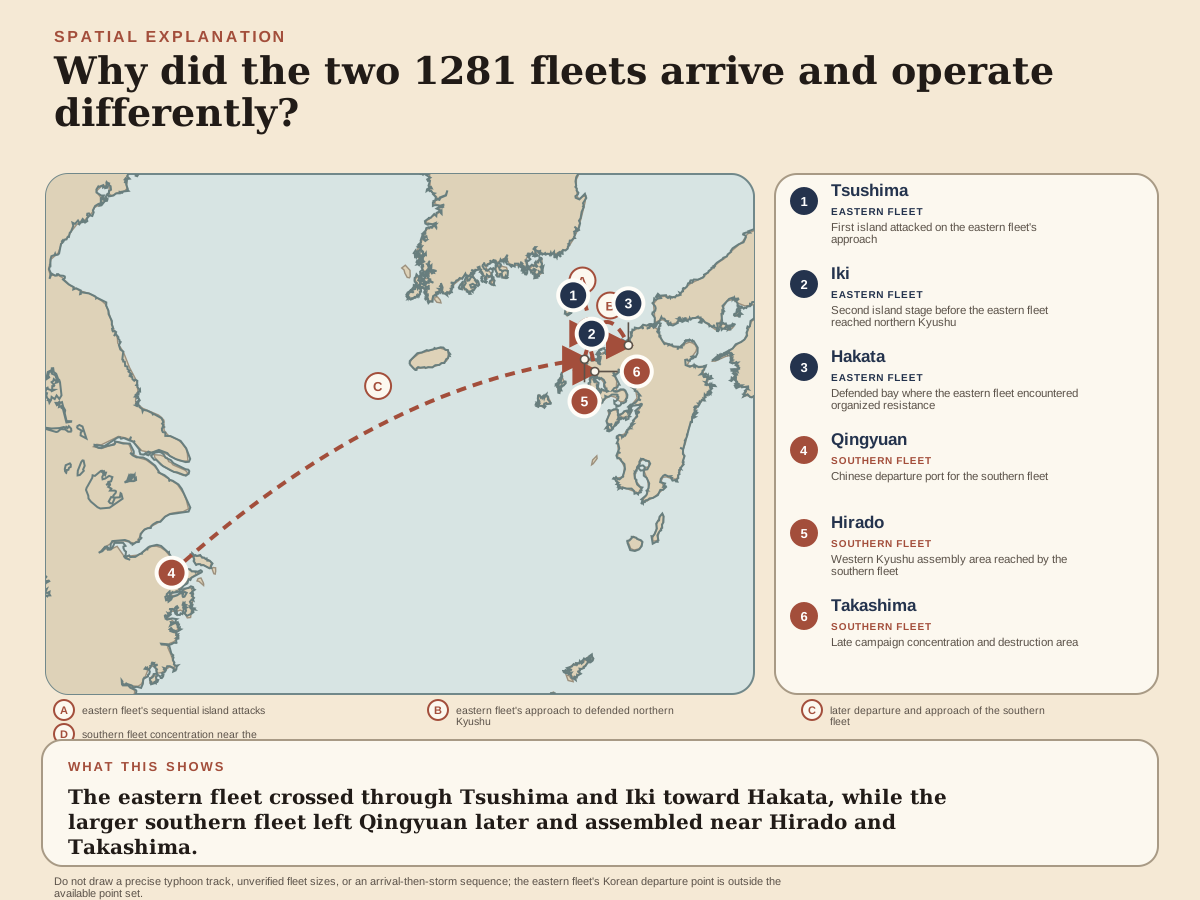
The 1281 plan divided forces between an eastern army sailing from Goryeo and a southern army sailing from Qingyuan on the Chinese coast. Separate departure schedules and commands made coordination necessary. The Yuan history records changes in senior command, including Alaqan’s illness and replacement. The army was not an ethnically uniform body of Mongol horsemen transported across the sea. Planning also extended beyond winning a beachhead. The expedition carried agricultural tools, seed rice and household utensils for an intended longer occupation. Such equipment would be of little use until troops could obtain a secure shore base.
In Japan, Tokimune’s government assigned coastal defense to Kyushu’s warriors. Stone barriers constructed along Hakata Bay in 1276 obstructed access from the shore and gave defenders positions from which to resist landings. Responsibility for stretches of coast brought service obligations to particular provincial and household groups.
Defense relied on men, boats, provisions and continuing guard duty as well as masonry. These preparations help explain why the later army spent considerable time operating from ships and islands. They do not imply that the walls prevented every landing or that every part of the coastline was equally fortified.
Construction likewise required work beyond bringing warriors together. At Nishijin, excavation found clay laid over the coastal sand before the stones were stacked. Higo warriors were assigned the Ikimatsubara sector for construction and guard duty. Building these positions and sustaining the men assigned to them required materials, transport and provisions from the surrounding economy. The excavated foundation explains one local construction method, rather than the design of every stretch of wall.
The eastern army attacked Tsushima and Iki in the fifth month, then reached Hakata in the sixth. Resistance at the shore limited a lasting mainland position. Fighting also took place around Shikanoshima and other islands, where the invaders could establish footholds and maintain contact with their vessels.
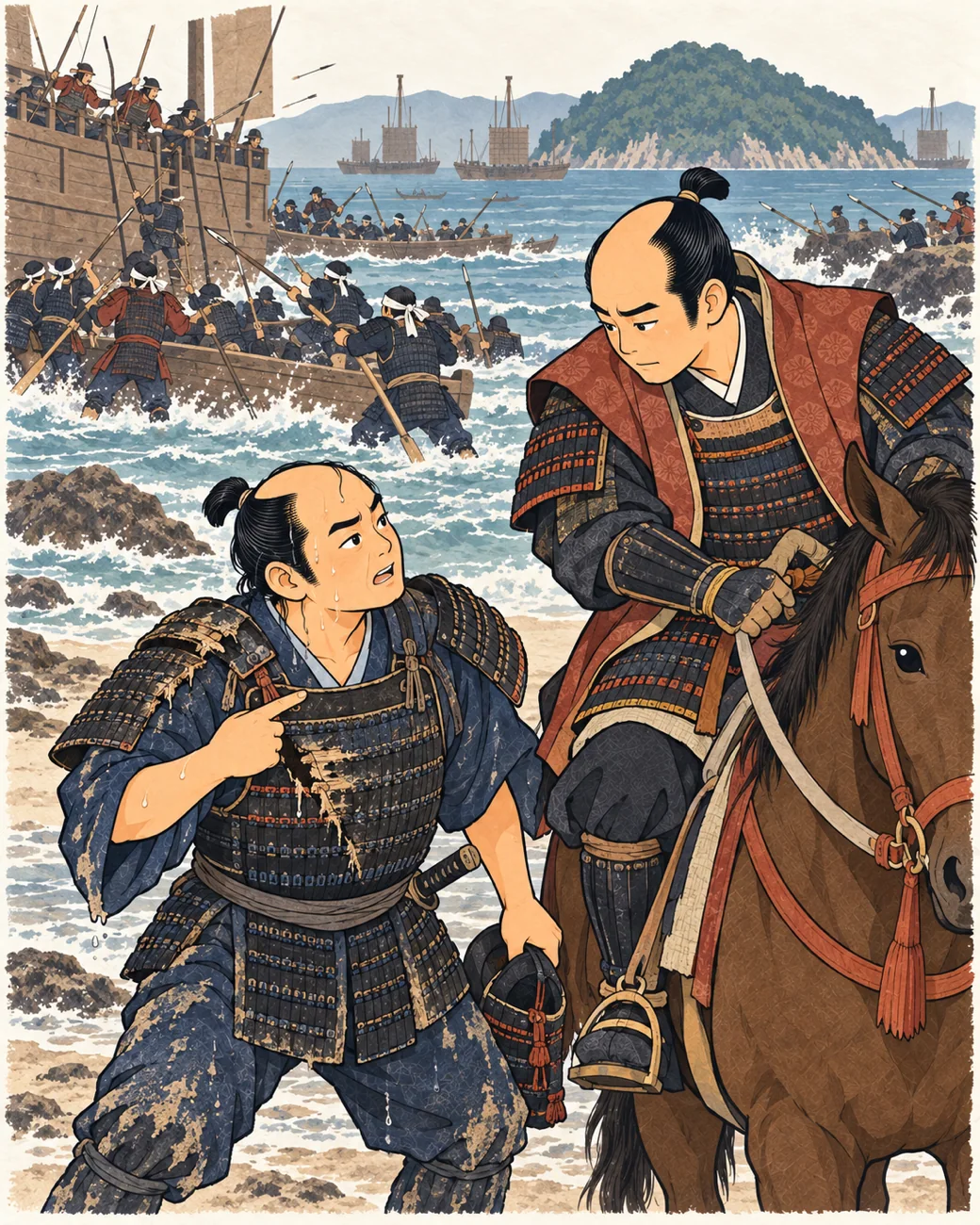
Japanese warriors used boats to approach and attack enemy ships. Suenaga’s illustrated account records him meeting Kikuchi Takefusa at Ikimatsubara on the eighth day of the sixth month and asking him to witness his service. The encounter connects fighting to the practical need for someone who could confirm a reward claim. Transport depended on access to a vessel and help from other participants.
The eastern army fell back toward Iki as the southern army approached. The fleets subsequently concentrated around Hirado and Takashima. The Yuan account describes a proposal to use Hirado based on information obtained from the crew of a Japanese vessel that had drifted to Yuan territory. Plans changed during the expedition; the waiting fleet was not simply following an uninterrupted march to a fixed landing place.
Operations now extended across an island-and-coastal zone, with ships providing transport and shelter while parties fought ashore. Kikuchi's account of the campaign records illness among the eastern army at Shikanoshima. Its withdrawal to Iki shifted the immediate fighting rather than resolving the problem of supplying troops and meeting the other fleet. The revised rendezvous, late departure and loss of a commanding officer were practical disruptions; differences among Mongol, Korean and former Song participants do not by themselves establish the motives or loyalty of individual units.
At the end of the seventh month in the Japanese calendar, a severe storm struck. Japanese dating runs into an intercalary seventh month, while Yuan accounts use a different calendar date. Treating all these numbers as modern July or August would create a false day-by-day sequence.
The storm struck forces whose positions and vessels differed. Remaining at an anchorage did not offer the protection of a settled land base, and ships that had carried soldiers and supplies also constituted the means of retreat. When those vessels were lost, escape depended on the craft still usable and the decisions of officers controlling them. The fighting had not sunk the entire fleet, but it had kept the invaders from obtaining the secure mainland position they needed before the weather destroyed their maritime capacity.
The fleet suffered catastrophic loss and the invasion failed to establish lasting control over Japan. Ships were driven apart, sunk or damaged. Soldiers and sailors who survived the storm still had to secure transport, provisions and a means of escape.
The Yuan history reports that senior officers left in usable vessels while troops remained at Takashima. Survivors selected a new leader and attempted to obtain timber for a return journey. The same account describes subsequent Japanese attacks, killing and enslavement. Its extraordinary totals cannot be accepted as a counted register, but it preserves a poststorm sequence of abandonment and continued violence.
Japanese testimony also places fighting at Takashima after the storm. The campaign therefore cannot be compressed into a single miraculous disappearance. Resistance before the storm, difficulties in coordination, exposure at sea and the storm’s destructive force contributed at different stages.
The coastal population had already faced attack, and the armies lost men through fighting and shipwreck. Japanese defenders also carried the cost of mobilization and guard service. No conquered enemy estates provided a general new fund for rewards. Service still had to be confirmed and evaluated; Suenaga’s successful claim after the first invasion demonstrates that complete absence of rewards is an inaccurate description of the wars.
The surviving stone barrier still needed repair, and coastal guards could not assume that two failed invasions meant there would never be a third. The Yuan history records renewed recruiting and shipbuilding plans in 1283, followed by further consideration of Japan as other campaigns competed for attention. For Kyushu households, the fleet's disappearance did not immediately release men and resources from defense obligations.
Religious service also entered claims for recognition. Temples and shrines sought rewards for rites they credited with protection. A 1293 petition draft described the installation of Kumano deities at Ikimatsubara through the Higo governor, with coastal guards attending in military dress. This is a recorded claim about gods and defense, rather than independent proof of supernatural action. In 1290, Emperor Fushimi and attendants copied a sutra for Iwashimizu Hachimangū; its colophon included a prayer that foreign raiders would not even be heard of. Ritual documents thus preserve continuing fear as well as the language of victory.
Tokimune’s government continued coastal preparations after 1281. The Yuan also considered another expedition before abandoning renewed plans. Victory did not immediately remove the need for watchkeeping or settle every claim for service. Those demands formed part of later political and financial pressures, without making the fall of Kamakura in 1333 an automatic consequence of one campaign.
Engakuji was founded in 1282 under Tokimune’s patronage with the Chinese monk Wuxue Zuyuan, known in Japan as Mugaku Sogen, as founding abbot. Temple tradition connects its purpose to mourning the dead on both sides. This is a specific institutional response to the war, distinct from a claim that victory brought peace to everyone.
The principal late-thirteenth-century portions of the Mongol Invasion Scrolls record Suenaga’s service in both campaigns. Their participant-centered perspective, losses and later rearrangement limit the use of every surviving detail as unchanged eyewitness evidence. Accounts of divine protection became another part of the wars’ religious memory.
At Takashima, embedded anchors, ship timbers, cargo and thirteenth-century ceramics preserve evidence of the anchorage and wrecked vessels. Excavation links the campaign to material traces beneath the sea. It cannot independently supply the total army size or prove each decision reported in later narratives.
Continued service made the defense both a claim to authority and an expense. Confirming existing rights or awarding an office could recognize a warrior, yet could not create an unlimited supply of new estates. The burdens affected households differently. They belonged alongside inheritance, debt and local disputes in the later history of retainer finances, rather than explaining every grievance or the end of the shogunate by themselves.
Objects from Takashima also restore the expedition's wider setting. An official military seal inscribed in the Yuan's Phags-pa script accompanies the evidence of ships, Chinese ceramics and weapons. The fleet drew on imperial offices, Goryeo manpower and maritime resources from the former Song territories. Its destruction can be studied within that interconnected East Asian history as well as within Japanese accounts of protection.
Later commemorations gave the invasions new public uses. In the Meiji period, the painter Yada Isshō produced large battle paintings for fundraising associated with Yuchi Takeo's campaign to build a statue of retired emperor Kameyama in Fukuoka. Battle scenes were exhibited at Higashi Park in 1910; the adjoining naval panorama was changed to the Mongol invasions in 1911. Paintings, exhibitions and monuments placed the medieval wars before modern audiences. Their choice of heroes and protective imagery belongs to that later act of commemoration, rather than to an eyewitness record of 1281.