Read the article below. Interactive reading tools are available when scripts load.
Quick
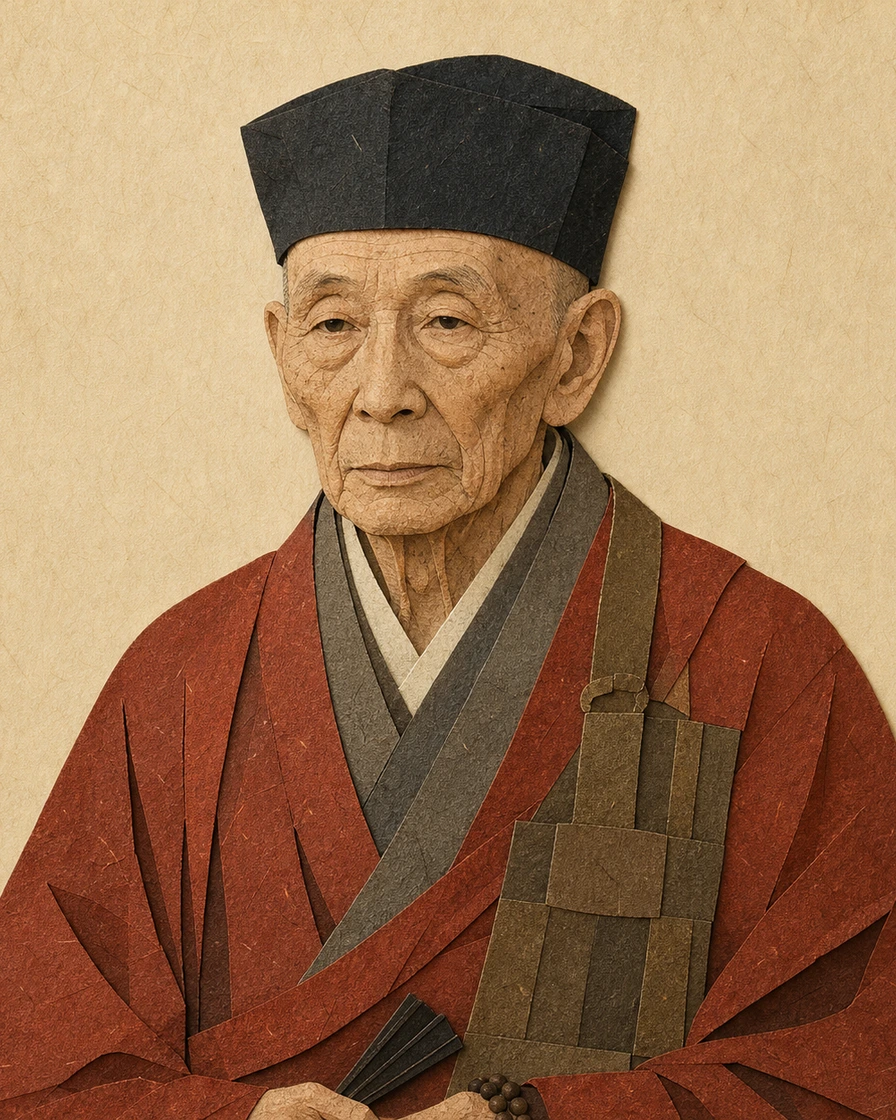
Tenkai was a Tendai Buddhist monk who later served three Tokugawa rulers. His conventional birth year is 1536, and temple traditions place his origin in Aizu, in present-day Fukushima. His family and early journeys remain uncertain. Later accounts describe training at Mount Hiei near Kyoto and other religious centers; they are not a continuous record of his youth.
Tendai communities combined religious learning with temple administration. Oda Nobunaga, a warlord extending his power around Kyoto, destroyed their principal monastery, Enryakuji, in 1571. Tenkai's whereabouts then are unknown, but his later work belonged to a network rebuilding after war. The claim that he was Akechi Mitsuhide, Nobunaga's commander defeated in 1582, lacks contemporary linkage. His traceable influence came through monastic offices and projects.
In 1599 Tenkai became head of Kitain at Senba in Kawagoe, near Edo, the Tokugawa seat that became Tokyo. The temple gave him clergy, resources and an operating base before his best-known memorial work.
Tokugawa Ieyasu, founder of the warrior government established in 1603, visited in 1611. Kitain records a land grant and an endowment assessed at 500 koku, a rice measure expressing income, with official Sakai Tadatoshi assigned to construction. Its regional Tendai standing strengthened in 1612. After a fire in 1638, Ieyasu's grandson Iemitsu ordered rebuilding and the transfer of Edo Castle buildings. Those surviving rooms belong to that later phase, not to Tenkai's first establishment.
In Ieyasu's final decade, Tenkai received important Tendai responsibilities. He worked on restoration associated with Enryakuji; Nikkō's chronology records a summons in 1610 to Sunpu, Ieyasu's retirement seat in present-day Shizuoka, and his appointment at the revived Kōmyōin in 1613.
Ieyasu had retired from the shogunal title while continuing to govern alongside his son Hidetada, the second shogun or head of the warrior government. He employed several specialists: Zen monk Sūden worked on legal and diplomatic matters, and Hayashi Razan supplied Chinese classical learning. Tenkai's field was religious interpretation and temple administration. The founder summoned Tenkai, Sūden and warrior official Honda Masazumi to hear final instructions in 1616. That service gave Tenkai standing with the successors without making him head of every policy.
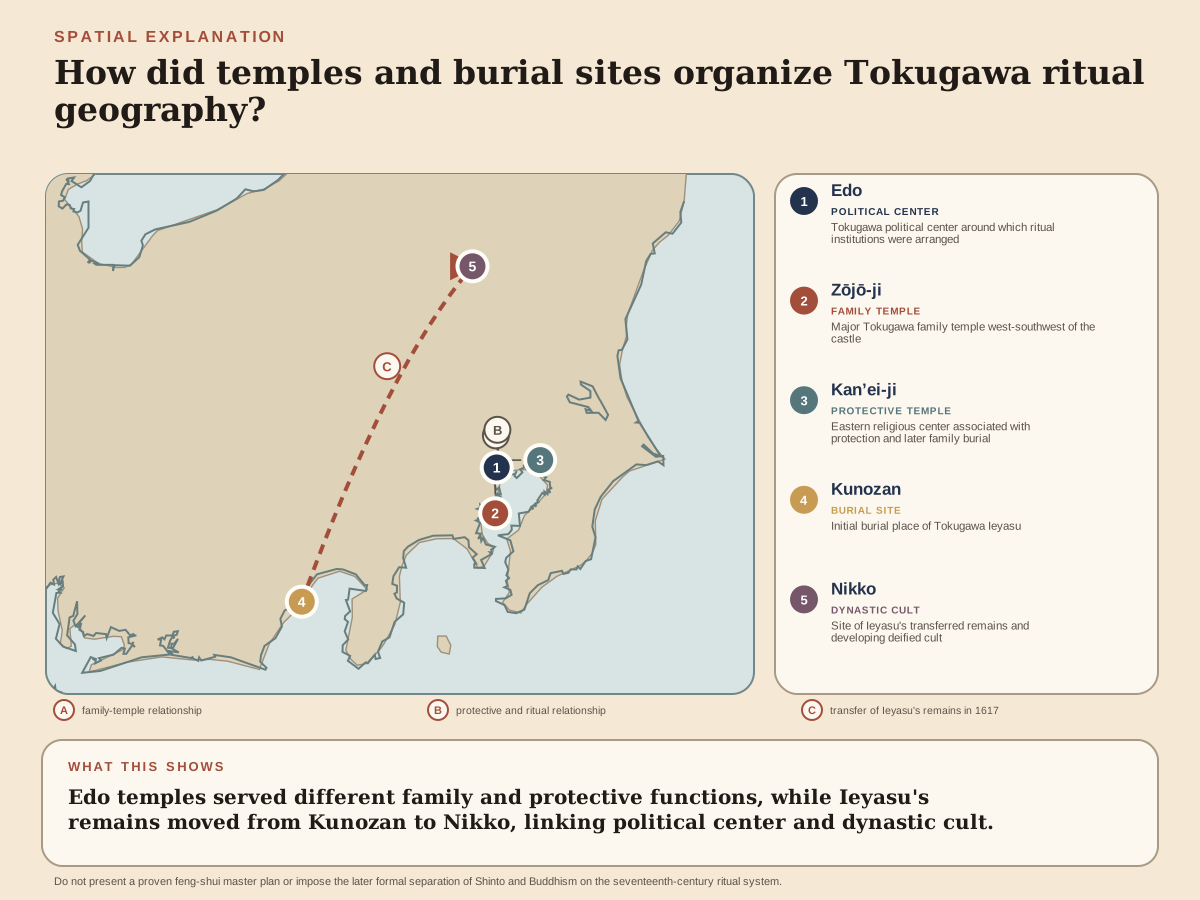
Ieyasu died on the seventeenth day of the fourth month of 1616, corresponding to 1 June Gregorian. His remains were first buried at Kunōzan near his retirement seat. Bonshun, a monk associated with the Yoshida lineage of court-linked deity rites, conducted initial worship.
The National Archives identifies Sūden as advocating the divine title myōjin, an honorific for a deity, and Tenkai as advocating gongen, a deity understood as a Buddhist manifestation. Hidetada chose gongen. Tenkai and other emissaries then sought court recognition, and the government selected Tōshō Daigongen from proposed titles. The decision involved clergy, the shogun and the imperial court. A famous comparison with the failed cult of Hideyoshi, Ieyasu's predecessor in national supremacy, survives in an account published in 1789, not a contemporary transcript.
Tenkai's explanation linked Ieyasu with Tendai traditions surrounding Sannō, the protective deities of Mount Hiei. Kami, Japan's deities, could be understood as manifestations of Buddhist beings. Temples and shrine worship often belonged to an integrated establishment, before later separation policies.
The teaching commonly called Sannō Ichijitsu Shintō represented Ieyasu as a protector of the dynasty. An older interpretation treated his deification as groundless political invention; historian Sonehara Satoshi traced inherited Tendai ideas and transmission from other religious traditions. Research has also examined how the teaching changed afterward. Tenkai did not invent a complete timeless system alone. He gave inherited religious learning a Tokugawa application and secured a continuing role for Tendai clergy.
In 1617 a formal procession left Kunōzan for Nikkō, a sacred mountain center north of Edo. Hidetada took part in the principal observances. Tenkai organized the religious dimension while officials and communities supplied construction, escorts and transport. Official reburial and ritual transfer descriptions do not settle the exact contents of the conveyance.
Nikkō already had Buddhist halls, deity worship and ascetic practice, with traditions tracing its opening to the eighth-century monk Shōdō. Tenkai restored and redirected that older center around Ieyasu's cult. Kunōzan remained a worship site. Today's separate institutions should not be projected backward: the prince-abbot succession of 1654 and Rinnōji title of 1655 followed Tenkai's 1643 death. The elaborate buildings also belong largely to Iemitsu's later rebuilding, not the first shrine of 1617.
Hidetada granted Ueno land to Tenkai in 1622 after daimyō residences, belonging to territorial warrior lords, were relocated. Kan'ei-ji formally opened in 1625 with support from Hidetada and his son Iemitsu, the third shogun. Its mountain title, Tōeizan, meant Mount Hiei of the east. Major buildings followed in 1627, 1630 and 1631.
The temple stood northeast of Edo Castle, in the kimon or 'demon gate' direction considered dangerous, following Mount Hiei's protective relationship with Kyoto. This explains a religious purpose, not a comprehensive plan for every Edo street. Kan'ei-ji began as a prayer temple; its major shogunal burial role began with Ietsuna in 1680, after Tenkai's death. Ieyasu's earlier patronage helped make the project possible, but he was not alive at its opening.
Other temples continued to serve the Tokugawa house. Zōjōji, a Pure Land Buddhist temple, became its family temple around 1590 and moved to Shiba in 1598. Iemitsu built his father Hidetada's mausoleum there in 1632. Kan'ei-ji initially supplied Tendai prayer and learning, while Nikkō held worship of the deified founder and Kunōzan preserved the first burial.
These places competed for patronage but did not perform identical tasks. Tenkai secured a strong Tendai network without taking over every family rite. Later six shoguns were buried at Kan'ei-ji and six at Zōjōji; their sequence was not a fixed alternating schedule devised in 1625. The final distribution resulted from later decisions, including Kan'ei-ji's development as a burial temple after Tenkai.
After Hidetada died in 1632, Iemitsu invested heavily in his grandfather's cult at Nikkō. In 1634 he combined its lands in a 7,000-koku grant across twenty-two villages addressed to Tenkai. The income supported religious institutions and administration, not simply the monk's household.
Rebuilding began late in 1634 and finished in 1636 for Ieyasu's twenty-first memorial observance. Akimoto Yasutomo was chief commissioner and Kōra Munehiro master carpenter. Workshops and domain contributions made the buildings; Tenkai conducted a temporary transfer in 1635 and explained the cult in Tōshōsha Engi, its origin account. Its first scroll received imperial calligraphy in 1636, with further portions around 1640. Tenkai's religious work, the court's written authority and Iemitsu's resources combined in the monumental result.
Printing began in 1637 on the Buddhist canon later called the Tenkai edition. With Iemitsu's support, the project used Kitain's Southern Song Sixi edition as its principal base, supplemented where needed. The canon collected authoritative Buddhist writings; Tenkai did not compose them.
The National Diet Library's 1638 Shokyō Yōshū, a Chinese compilation of scriptural extracts, preserves his statement of a vow and a printing notice. Kan'ei-ji's 264,688 surviving wooden types record the technical work, including specialized forms for notes and headings. Editors and printing specialists sustained the project. Tenkai died in 1643; completion followed in 1648. The edition made a complete Buddhist canon available in a printing produced in Japan, chiefly for temples and learned clergy.
Tenkai died at Kan'ei-ji in 1643. His traditional age of 108 depends on the uncertain 1536 birth year and inclusive counting, which began at one. The elapsed-year difference is 107, but a precise modern birthday age cannot be established from those year figures alone.
Kōkai became Kan'ei-ji's second abbot in 1643 and also served Nikkō, continuing the institutional connection. The canon reached completion in 1648, when Tenkai received the imperial posthumous title Jigen Daishi. Neither later achievement belongs to his living experience. His long service linked three Tokugawa generations; clergy and continued patronage made that link durable after his death.
The early biography Tōgenki was compiled in 1650. Historian Sonehara Satoshi, in a passage reported by Tochigi Prefectural Library, treats its monastic life as evidence against the Akechi identity claim. Successors developed the prince-abbot system in 1654–1655, after Tenkai.
Meiji separation policies divided Nikkō's integrated religious complex, while fighting at Ueno in 1868 destroyed much of Kan'ei-ji. Former temple land became park ground in 1873. A hall transferred from Kitain enabled rebuilding at a new site in 1879; permission to resume the Rinnōji title followed in 1885. Books and printing type also survived. The institutions endured through alteration and reconstruction rather than remaining unchanged. A 1916 biography falls beyond the narrative boundary and does not date the rumor's origin. [20]
Classic
Tenkai is conventionally said to have been born in 1536, with temple traditions placing his origin in Aizu, in present-day Fukushima. The date rests on accounts of his exceptional age later in life, not on a surviving birth record. He was initially known as Zuifū. His family and early movements remain uncertain; his later career belonged unmistakably to Tendai, a Buddhist tradition centered on Mount Hiei near Kyoto. [1][22]
The National Diet Library's profile describes childhood entry into Ryūkōji at Aizu Takada, followed by study at Mount Hiei and other centers. These are biographical traditions rather than a continuous record of his youth. They establish the education later communities attributed to him without locating him securely in every place or year. [1][22]
Tendai learning included Buddhist scriptures, ritual and the management of a clerical institution. A temple needed trained monks to sustain worship and an income to maintain its buildings. Religious property and appointments brought clergy into relations with warrior patrons long before Tenkai entered Tokugawa service. [1][22]
The civil wars damaged those relations. In 1571 the forces of Oda Nobunaga, the warlord then extending his power around Kyoto, destroyed Enryakuji, Tendai's principal monastery on Mount Hiei. Tenkai's whereabouts during the destruction are unknown. He nevertheless worked within a religious network changed by the loss of buildings, income and people. Restoring a temple required protection and grants as well as religious learning. [1][22]
The obscure beginning later encouraged the claim that Tenkai was really Akechi Mitsuhide, Nobunaga's commander who rebelled against him and was defeated in 1582. Modern library research finds thin support in coincidences such as place-names and crests. Historian Sonehara Satoshi instead points to an early monastic biography that treats the men as distinct. No contemporary record linking their identities has been established by these accounts. [7]
The adult monk's work can be followed through temples, appointments and religious projects. His capacity to conduct rites and manage institutions would make him useful to rulers rebuilding an order after war.
In 1599 Tenkai became the twenty-seventh head of the temple now known as Kitain at Senba in Kawagoe. Kawagoe lay in the region around Edo, the developing Tokugawa seat of government, and had its own castle, roads and religious institutions. Kitain gave Tenkai a place from which to lead clergy and approach warrior patrons before his famous work for the Tokugawa dead. [2]
The institution had suffered destruction before he arrived. Its revival required buildings and a dependable income, with official recognition securing what donations alone could not. Tenkai's leadership connected the religious work of the temple with the resources of a new ruling house.
Tokugawa Ieyasu, founder of the warrior government established in 1603, visited Kawagoe in 1611. Kitain's history records their meeting and support comprising a large site and an endowment assessed at 500 koku. A koku was a rice measure used to express assessed income, not a sum paid wholly in cash. Sakai Tadatoshi, a Tokugawa official, was assigned to the construction. [2]
The grant supported a community, not simply its abbot. Monks maintained rites and study, officials administered income, and builders repaired the physical establishment. Cultivators produced the yield on which temple support depended. Tokugawa patronage strengthened Tenkai's regional standing while making the temple reliant on continued recognition by the ruling house.
By 1612 Kitain's position within Tendai administration in Kantō, the region around Edo, had been strengthened. The operating base gave Tenkai clergy, resources and experience that later memorial projects would require.
In 1638 a great Kawagoe fire destroyed most of the complex. Ieyasu's grandson Iemitsu ordered reconstruction, including buildings transferred from Edo Castle. Those surviving buildings belong to this later rebuilding phase. Kitain's traditions associate particular rooms with Iemitsu's birth and his nurse Kasuga, but they should not be imagined as the rooms of Tenkai's first establishment. [2][22]
During Ieyasu's final years, Tenkai's responsibilities extended beyond Kawagoe. The founder retired from the shogunal title in 1605 but continued to govern from Sunpu, in present-day Shizuoka, alongside his son Hidetada, the second shogun. Tenkai entered a governing world in which access to the ruler mattered, while recognized religious offices gave his advice a defined field.
Ieyasu employed him in Tendai restoration and administration, including work associated with Enryakuji. Nikkō's municipal chronology records a summons to Sunpu in 1610 and Tenkai's appointment to the revived Kōmyōin at Nikkō in 1613. The latter placed him at a mountain center north of Edo several years before the founder's death. [1][9][22]
He was one specialist among several. Sūden, a Zen Buddhist monk, worked on legal and diplomatic affairs as well as religion. Hayashi Razan supplied Chinese classical learning. Honda Masazumi and other warrior officials transmitted commands and administered resources. Court recognition of ranks and divine titles involved authorities in Kyoto. Their responsibilities placed religious counsel within a government using several kinds of expertise. [4]
Religious counsel could nevertheless have practical consequences. Choosing a ritual lineage helped determine which clergy presided at a ceremony and which institution received patronage. A monk familiar with temple property and rank could turn a ruler's support into appointments and a continuing religious establishment. [9][22]
In 1616 Ieyasu summoned Tenkai, Sūden and Honda Masazumi to hear instructions about his final arrangements. The National Archives records that consultation separately from the later summons of Razan. Participation in the founder's last decisions strengthened Tenkai's standing with the successors. [4]
His strongest opportunity came after Ieyasu's death. The ruling family needed rites that commemorated its founder and connected the living successors with him. Tenkai offered an explanation grounded in Tendai learning, backed by the institutions he already administered.
Ieyasu died on the seventeenth day of the fourth month of Genna 2, corresponding to 1 June 1616 Gregorian. Hidetada already held the shogunal title, but the dynasty still had to decide how it would commemorate the founder. His remains were first buried at Kunōzan in Suruga, near his retirement seat. Bonshun, a monk associated with the Yoshida lineage of court-linked deity rites, conducted the initial worship. [4]
The divine title mattered because it carried a religious explanation and claims to ritual authority. Myōjin was an honorific designation for a deity; gongen described a deity as a manifestation of a Buddhist being. The National Archives' account identifies Sūden as advocating myōjin and Tenkai as advocating gongen. Hidetada ruled in favor of the latter. [13]
The decision then passed through court procedures. Tenkai and other emissaries sought recognition in Kyoto. The court proposed several titles, and the warrior government selected Tōshō Daigongen. Clerical argument, shogunal decision and imperial authorization all contributed to the result. [13]
A frequently repeated rationale compares the unhappy fate of the cult of Toyotomi Hideyoshi, Ieyasu's predecessor in national supremacy, whose title was Toyokuni Daimyōjin. The archival exhibit presents that explanation through a book published in 1789, long after the original decision. It is evidence of a later account of Tenkai's argument, not a contemporary transcript of his words.
Ieyasu's remembered final arrangements assigned different functions to several places. Kunōzan received the burial; Zōjōji in Edo conducted rites; Daijuji in Mikawa preserved ancestral memorialization; Nikkō would become a cult center on an established sacred mountain. These functions were not all equivalent to a modern grave.
Tenkai's success gave Tendai clergy an enduring role in worship of the founder. It also committed the successors to buildings, land and ceremonies through which the cult could continue. The religious form and the dynasty's resources now supported one another.
The chosen title placed Ieyasu within a religious world that already linked kami, Japan's deities, with buddhas and bodhisattvas, beings associated with enlightenment and salvation. Honji-suijaku described local deities as manifestations of Buddhist originals. Temples and shrine worship were often joined within the same establishment, although their relationships varied by lineage.
Tenkai drew especially on Tendai traditions surrounding Hie and Sannō, the protective deities of Mount Hiei. The teaching associated with him is commonly called Sannō Ichijitsu Shintō. It represented Ieyasu as a protecting divine presence while giving Tendai clergy an explanation through which to conduct his rites. [10][16]
Historical disagreement · Was Ieyasu’s deification a new political invention?
One older interpretation treated the founder's deification as doctrinally groundless political invention. Sonehara Satoshi's research instead traced inherited medieval Tendai teachings and elements transmitted from Yoshida and other religious traditions. His 1993 research report identifies both textual and personal channels of transmission around Tenkai.
The synthesis drew on learning already available to monks rather than appearing fully formed at a ruler's command.
The teaching also changed as it was transmitted. A 2005 academic symposium described its inheritance and later transformation, while historian Okada noted that its precise definition remained unsettled. These questions concern the formation and subsequent use of a religious synthesis, rather than a system fully invented by Tenkai alone.
The religious explanation carried institutional consequences. Clergy authorized to conduct the cult could train successors and obtain resources for worship. The shogunal house acquired a sacred relationship to its founder that extended beyond the memory of a military victory.
Participants need not have understood that relationship identically. A lord's attendance could express devotion and political obligation together; pilgrims might seek the deity's protection. The cult's public importance did not require every worshipper to share one private motive. [10][16]
The separation of Buddhist and kami institutions imposed after 1868 would alter this arrangement. During Tenkai's lifetime, however, their combination was an established form of religious life. His contribution was to give that inherited language a powerful Tokugawa application. [5][6]
In 1617 a formal procession left Kunōzan for Nikkō, a sacred mountain center north of Edo. Nikkō's municipal chronology dates departure to the third month and the principal enshrinement observances to the fourth, in the contemporary Japanese calendar. Hidetada came to take part in worship of his deified father. [9]
Official histories describe movement of Ieyasu's coffin and reburial; ritual descriptions can emphasize transfer of the divine presence. That terminology does not by itself establish the exact physical contents of the conveyance. Tenkai's documented importance lay in religious framing and organization at Nikkō, rather than in a modern examination of the remains. [9]
The government supplied command and resources. Honda Masazumi and other officials had construction responsibilities, while escorts and communities along the road provided lodging and transport. The procession crossed a populated country whose cooperation and obligations made the ceremonial movement possible.
Nikkō was already a religious center. Traditions traced its opening to Shōdō, an eighth-century monk, and its mountain worship combined Buddhist halls, kami and ascetic practice. Tenkai restored and redirected an existing establishment. Tokugawa sponsorship gave the mountain new resources and made the founder's cult central within it. [6]
Kunōzan remained a place of worship. Its continuing role preserved Ieyasu's connection with Suruga and the first burial, while Nikkō developed a larger dynastic function. The two places could reinforce one another without settling into a contest over which was the only authentic grave. [4][6]
The first shrine of 1617 was not the elaborate complex created in Iemitsu's rebuilding of 1634–1636. That later project changed the buildings and the scale of patronage. Tenkai's early organization provided a foundation on which the grandson acted.
Current divisions between Tōshōgū, Futarasan Shrine and Rinnōji likewise belong to successive changes. Kan'ei-ji's chronology places Prince Shuchō's accession as its third abbot in 1654 and the grant of the Rinnōji title in 1655. Rinnōji's own account summarizes the linked prince-abbot arrangement around 1655. Both stages followed Tenkai's death in 1643; he should not be assigned the later office without qualification. [3][6][12]
The Tokugawa cult had entered an old sacred landscape and altered its priorities. Successor clergy would extend the court connections and leadership system, while nineteenth-century separation policies eventually divided the earlier integrated complex. [5][6]
Hidetada granted Tenkai land on the Ueno plateau in 1622. Existing daimyō residences had to be rearranged; daimyō were the territorial warrior lords. The grant made room for a large Tendai center beside Edo, now Tokyo, rather than simply selecting an auspicious point on a map. [3][19]
Kan'ei-ji was formally established in 1625 under Hidetada and his son Iemitsu, the third shogun. Its name used the current era with imperial permission. Its mountain title, Tōeizan, meant Mount Hiei of the east, announcing a relationship to Tendai's older center near Kyoto. [3][5]
The complex developed through successive buildings. Kan'ei-ji's chronology lists major halls and a Tōshō shrine in 1627, a Shaka hall in 1630, and the five-story pagoda and Kiyomizu Kannon hall in 1631. The additions supplied places for different rites and made the eastern counterpart tangible over several years. [3][5]
The temple's own history explains its location through the kimon, the northeast 'demon gate' direction considered dangerous. Mount Hiei protected Kyoto from that quarter, and Ueno stood northeast of Edo Castle. The analogy belonged to the religious purpose of the foundation and should not be dismissed as an accidental modern resemblance. [5][19]
It does not establish that Tenkai laid out every street or major temple in Edo through one comprehensive occult plan. Ueno also offered land for a large precinct, and the relocation of residences depended on shogunal power. The recorded project joined religious protection with the expansion and reallocation of the governing city. [5][19]
Builders and officials made the grant into a working establishment, while clergy organized rites and study. Tenkai led the religious undertaking; the two shoguns supplied continuing support. Ieyasu's earlier patronage had helped establish his standing, but the founder had died nine years before the formal opening.
Kan'ei-ji began as a prayer temple for the dynasty. Its major burial role followed much later, with Ietsuna's interment in 1680, after Tenkai's death. The eventual mausoleums should not be projected into the first precinct of 1625. The foundation initially secured a substantial Tendai institution beside the seat of warrior government.
While Tenkai developed his Tendai network, other temples retained important relationships with the Tokugawa. Zōjōji, a Pure Land Buddhist temple whose teaching emphasized salvation through Amida Buddha, became associated with Ieyasu around his arrival in Edo in 1590 and moved to Shiba in 1598. It preceded Kan'ei-ji as a family temple. [18]
In 1632 Iemitsu built a great mausoleum for his father Hidetada at Zōjōji. Pure Land clergy conducted mortuary rites, and the new buildings gave the temple a visible dynastic role. Tenkai's access to the rulers did not erase that established relationship. [17][19]
Kan'ei-ji supplied prayer and Tendai learning at Ueno. Nikkō held the cult of the deified founder within an older sacred mountain, while Kunōzan continued worship at the first burial. The places overlapped in patronage without performing identical tasks. A funeral and worship of a protective deity could involve different clergy and different religious explanations. [17][19]
Temples competed for land, audiences and ceremonial precedence, while Tokugawa rulers continued to support several institutions. Tenkai's success secured a strong Tendai position within an arrangement that still depended on other clergy for important family rites.
The later distribution of shogunal graves—six at Kan'ei-ji and six at Zōjōji—can suggest an orderly alternating plan. Individual burials and later decisions produced a less regular sequence; Kan'ei-ji's chronology alone shows successive burials there in 1680 and 1709. The final total is not evidence of a schedule devised by Tenkai in 1625. [3][18]
Physical geography made the different functions visible. Zōjōji stood at Shiba, south of the castle; Kan'ei-ji occupied Ueno to the northeast; Nikkō extended dynastic worship beyond the city. Those relationships do not by themselves establish one blueprint controlling the entire network.
Tenkai linked a regional base at Kitain with Nikkō and a new center at Ueno. Their resources and clergy strengthened one another. He sought a durable place for Tendai service within Tokugawa rule, while the ruling house continued to use other traditions for the needs of its living members and its dead.
Hidetada died in 1632, leaving Iemitsu as the reigning head of a house now two generations removed from Ieyasu's conquests. The grandson made Nikkō a major object of patronage. Devotion to the founder and the public representation of hereditary authority could reinforce one another. [9][17]
In 1634 Iemitsu combined Tōshō and Nikkō lands in a grant addressed to Tenkai: twenty-two villages with a total assessment of 7,000 koku. The grant funded a religious establishment and its administration. Villagers and headmen supplied the revenue, while officials maintained the arrangements through which it reached the institutions. [9][12]
The great rebuilding began late in 1634 and was completed in 1636 for Ieyasu's twenty-first memorial observance. The commencement date in Nikkō's chronology uses the contemporary Japanese calendar. Iemitsu ordered and financed the work through the shogunal system. [9]
Akimoto Yasutomo served as chief commissioner and Kōra Munehiro as master carpenter. Commissioners coordinated supplies and reporting, while the master carpenter led technical work performed by workshops. Carving, painting and lacquer required their own specialists. Donations and transport obligations drew domains and working communities into the project. [9]
Tenkai maintained the cult's religious continuity. In 1635 he conducted the temporary transfer needed while rebuilding proceeded. He also prepared an account of its origins, the Tōshōsha Engi. Keeping worship valid during construction and explaining the deity's place in religious history were different responsibilities from designing beams or managing the treasury. [9][11]
The surviving written account gives that work a concrete form. Tochigi's cultural-property description dates Tenkai's initial text to 1635 and the imperial calligraphy of its first scroll to 1636. Further portions were prepared around 1640 and copied by princes and court nobles. The opening linked Ieyasu with Sannō Ichijitsu teaching; the later portions explained Nikkō's longstanding sacred character.
The text and the buildings therefore joined several kinds of authority. Tenkai supplied the religious interpretation, the court gave it prestigious written form, and Iemitsu supplied the resources for monumental worship. The finished complex made the founder's protection and the grandson's patronage visible in the same place.
Such worship supported hereditary legitimacy without replacing the regime's military and administrative institutions. Domains still encountered Tokugawa power through laws, taxation and service obligations. Nikkō gave that rule a sacred ancestry, while its rapid rebuilding demonstrated the capacity to concentrate money, materials and skilled work. [9][11]
In 1637 Tenkai began a printed edition of the Buddhist canon with Iemitsu's support. A canon was a collected body of scriptures and other authoritative writings, not a book composed by its sponsor. Complete imported and manuscript collections existed, but copying their thousands of fascicles, or textual units, required great resources. [8][14]
The principal base was the Southern Song Sixi edition preserved at Kitain. It carried the history of Chinese Buddhist translation and printing into Tenkai's Japanese project. Other editions supplied missing portions. Editors had to compare texts and maintain the sequence before printers could multiply them.
The National Diet Library preserves a 1638 printing of Shokyō Yōshū, a Chinese compilation by Daoshi of extracts from Buddhist writings. At the end of its twentieth volume are Tenkai's statement of his vow and the dated printing notice.
Wooden movable type made repeated composition possible. Kan'ei-ji preserves 264,688 pieces associated with the edition, including more than 220,000 for main text. Most are cherry wood, with some birch. Half-width forms served notes and headings; connected forms held more than one character. Some pieces named Iemitsu within the printing notice. [8]
The types were organized in storage furniture, with one group sorted by character radicals. Classification was essential to finding and returning the pieces. Carvers made the characters, compositors assembled pages, and printers and proofreaders turned an edited corpus into usable books. The surviving objects record this collective technical work. [8]
Tenkai died in 1643. Successors completed the edition in 1648, five years later. Calling it the Tenkai edition honors his initiative without assigning him personal work performed after death. Its continuation depended on finance, skilled people and an organization capable of sustaining the project. [3][8]
Its importance was the printing in Japan of a complete Buddhist canon, not the invention of Japanese printing or the first publication of Buddhist texts there. Large and costly sets chiefly served temples and learned clergy.
Tenkai died at Kan'ei-ji in 1643. His death belongs to a firm institutional chronology; the birth year from which his famous age is calculated is less secure. Using the conventional 1536 gives an elapsed-year difference of 107, while traditional inclusive reckoning gives 108. The precise modern birthday age cannot be established without a reliable birthday. [1][3]
Traditional counting began with one and increased at the new year. The two familiar numbers are consequently not necessarily competing claims about biological longevity. More serious uncertainty concerns the starting year itself. 'Traditionally 108' preserves what the later accounts claimed without making their birth evidence stronger.
His long life gave him standing across three Tokugawa generations. To Iemitsu he could represent direct service to the founder rather than only stories heard from parents. Seniority mattered in clerical rank and in relations with patrons, although younger monks and administrators increasingly carried the material work of his establishments.
Kan'ei-ji's chronology names Kōkai as the second abbot in 1643, resident at Edo and also responsible for Nikkō. The arrangement continued a connection that Tenkai had helped build. His death did not leave the temples without leadership. [3]
The unfinished canon likewise continued under successor direction. It reached completion in 1648, when Tenkai also received the imperial posthumous title Jigen Daishi, honoring the deceased monk. [3]
Kitain, Nikkō and Kan'ei-ji preserved different parts of his work. One supplied the earlier regional base, another the founder's cult, and the third a large eastern Tendai center and printing resources. Their continued clergy and patronage made his service durable beyond the life that had connected the ruling generations.
An early biography, Tōgenki, was compiled in 1650. In a passage quoted by Tochigi Prefectural Library from Sonehara Satoshi's 2008 study, the historian treats its account of Tenkai's earlier monastic life as evidence against identifying him with Akechi Mitsuhide. The biography is a posthumous religious account, not a contemporary birth register, but it preserves a life distinct from that military commander.
Successors also changed the institutions. Prince Shuchō became Kan'ei-ji's third abbot in 1654, and the Rinnōji title followed in 1655. The court-linked leadership joined the Tendai centers at Edo, Nikkō and Mount Hiei. Tenkai had contributed foundations for that arrangement without living to occupy its later prince-abbot office.
Meiji policies after 1868 separated Buddhist and kami institutions, dividing the older Nikkō complex. Buildings and sacred objects were reassigned through changes that produced much of the present institutional map. What Tenkai had known as an integrated religious establishment acquired boundaries formed after the end of Tokugawa rule. [3][5]
Kan'ei-ji suffered physical destruction in the Ueno fighting of 1868. Much of its central precinct burned, and in 1873 former temple land was designated for Ueno Park. The immense establishment could no longer continue in its old form. [3][5]
In 1879 a hall from Kitain in Kawagoe was moved to the new Kan'ei-ji site and rebuilt as its principal hall. Additional material from the surviving local hall was used. Reconstruction thus renewed the link between Tenkai's old regional base and his Edo foundation. Permission to resume the Rinnōji title followed in 1885, now with a senior Tendai monk rather than hereditary imperial-prince leadership.
Books and printing type survived alongside the changing buildings. The cultural-property account records partial canon reprinting in 1833; temple collections retained the equipment and earlier editions for later readers. Preservation did not depend on every seventeenth-century building or office remaining unchanged. [5][8]