Read the article below. Interactive reading tools are available when scripts load.
Quick
Ōkuma Shigenobu was born in Saga on 11 March 1838 into a hereditary domain-retainer household. His father, Ōkuma Nobuyasu, served the Saga domain. This was privileged warrior status, although it did not place the family among the highest governing houses. In 1844 he entered the domain school Kōdōkan. Its curriculum emphasized Confucian learning and retainer discipline. Saga was also responsible for part of Nagasaki's defense and, under Nabeshima Naomasa, invested in artillery, furnaces, ships, medicine, and imported knowledge. [1][10][11]
The domain paid for these projects through revenue collected from its villages. Specialized learning could offer retainers new opportunities, but appointments and education still depended on the hereditary government. Ōkuma began within that system. [10]
In 1855 a violent dispute among students led to Ōkuma's expulsion from the Kōdōkan. Rather than return, he entered Saga's Dutch-learning school in 1856 and later taught there. Around this period he also joined Edayoshi Shin'yō's Gisai Alliance, a circle discussing imperial loyalty and reform rather than a modern party. He studied English in the Nagasaki environment, including with the Dutch-born missionary Guido Verbeck. Foreign languages brought access to legal and economic information that domain administrators increasingly needed. [5][10][17]
Chinese and Japanese literacy remained necessary for translating foreign concepts into policy. Ōkuma learned to connect that traditional education with new languages, gaining skills Saga could use in trade and administration. [5][17]
From 1864 Ōkuma worked in Saga's product-trade administration. Commerce made foreign knowledge material: goods had grades and prices, transport took time, credit could fail, and brokers controlled access. In Nagasaki he and Soejima Taneomi helped establish the English school Chienkan in the mid-1860s, with Verbeck as an important teacher. The school joined language to law, politics, and international affairs, but depended on domain permission, funds, staff, and students. Ōkuma and Soejima also left Saga without full authorization to advocate a political transfer of power. [10][17][18]
Domain authorities recalled them. Their mission did not cause the shogun Tokugawa Yoshinobu's later return of governing authority, which emerged from several courts, domains, advisers, and pressures. The failure still mattered. Ōkuma was attempting to turn port knowledge and domain service into national political relevance before the Restoration government existed. [10]
The new government recruited Ōkuma into foreign-affairs work in 1868. His language and Nagasaki experience were scarce administrative assets, though court, Satsuma, Chōshū, Tosa, and other personnel still competed over appointments. He confronted British minister Harry Parkes during the international dispute over the punishment and removal of Urakami Christians. The episode later became proof of Ōkuma's courage. It was also a conflict over religious coercion in which the affected Christians, not the negotiators, bore the greatest burden. [1][10]
Ōkuma then held Nagasaki and central foreign offices before moving into accounting, civil affairs, and finance. His rise shows that the early Meiji government was not literally composed only of Satsuma and Chōshū. It does not disprove their structural advantage. Ōkuma's value depended on specialized competence, coalition protection, and a state urgently short of trained officials. [2]
Ōkuma rose through civil and finance offices and became a councillor in 1870. The new government faced domain notes, multiple coins, uncertain accounts, inherited debts, and revenues still tied to local authorities. Currency reform was therefore more than issuing a modern-looking coin. Mints, banks, tax offices, merchants, foreign exchange, metal supplies, and public confidence had to connect. Ōkuma worked with officials including Inoue Kaoru, Shibusawa Eiichi, and later Matsukata Masayoshi; their policies and conflicts must not be merged into one founder story. [2]
While the Iwakura Mission, an official overseas delegation studying foreign institutions and negotiating treaties, traveled, Ōkuma remained in Japan. The stay-behind government adopted the Gregorian calendar and advanced land-tax reform amid arguments over how far it could move before the embassy returned. These reforms expanded central capacity and imposed costs. A national ledger became possible only by converting local obligations, property, and labor into state categories.
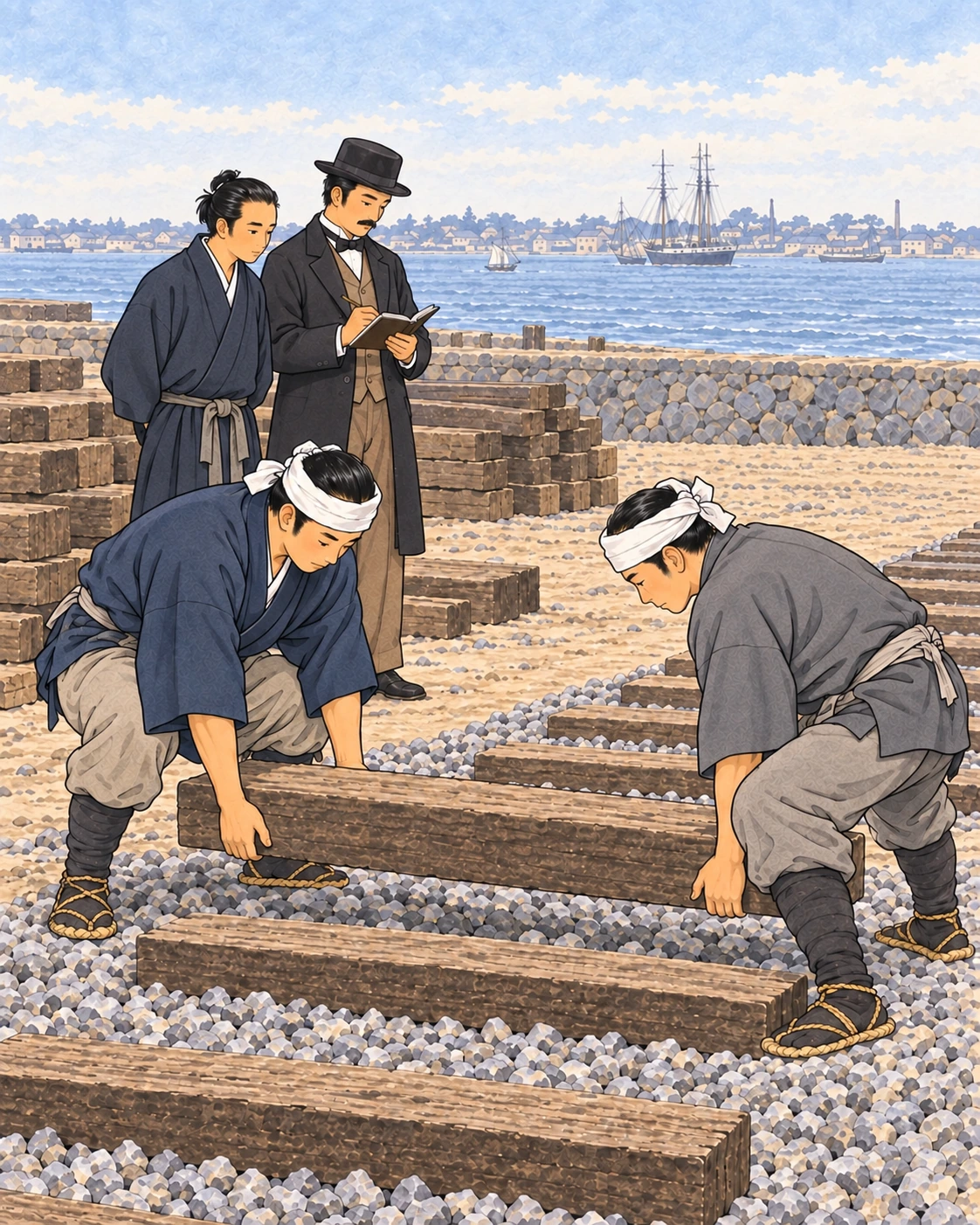
Ōkuma supported a railway linking Tokyo to the treaty port of Yokohama. In late 1869 the government authorized Date Munenari, Ōkuma and Itō Hirobumi to arrange British borrowing. Construction relied on engineers including Edmund Morel, who worked with Japanese trainees. Surveyors and laborers built the line, while land acquisition disrupted some communities along its route. The railway opened between Shimbashi and Yokohama in 1872. For Ōkuma, it was a commitment of scarce state money to future transport capacity; for the government, it was also a means of developing the domestic expertise needed to operate a growing network. [6]
After the 1873 cabinet split, Ōkuma remained and became a principal finance leader alongside Ōkubo's expanding Home Ministry. New transport and industry required investment before they generated reliable revenue. His office also entered coercive expansion. In 1874 Ōkuma headed the bureau administering Japan's expedition to southern Taiwan, launched after the killing of Ryukyuan castaways. Local Indigenous communities faced a campaign commanded by Saigō Tsugumichi, while Japan and Qing China disputed responsibility and Ryukyuan status. [1][2]
The 1877 Satsuma Rebellion imposed further military costs. Taxpayers, note holders, soldiers, families, and local communities carried the burden. Inflation and fiscal strain intensified debate over currency and spending. Ōkuma also supported trade and banking institutions, including the Yokohama Specie Bank, established in 1880. His record joined productive capacity to central power, war, and empire rather than forming a morally separate modernization story.
In March 1881 Ōkuma urged elections at the end of 1882 and an assembly in early 1883, with ministers drawn from the party commanding parliamentary support. Iwakura Tomomi and Itō Hirobumi favored a slower, more executive-centered route. Meanwhile, Kuroda Kiyotaka, chief of the Hokkaidō Development Commission, promoted the disposal of public assets. Godai Tomoatsu, a businessman associated with the Kansai Trading Company, became a focus of criticism over private access to them. Government leaders suspected Ōkuma's network of encouraging the campaign against the sale; that suspicion does not establish responsibility for a particular leak. [4][13]
On 11 October the government decided to cancel the sale, dismiss Ōkuma, and promise a national assembly for 1890. The public announcement followed. Many officials associated with him resigned. The crisis was constitutional, factional, fiscal, and personal. Ōkuma lost office, but his preferred timetable helped force the governing coalition to define its own slower route. [4]
Outside government, Ōkuma helped organize the Constitutional Progressive Party in 1882, competing with the Liberal Party led by Itagaki Taisuke. His parliamentary alternative was that the emperor appoint ministers from the party commanding a majority in the representative chamber. Itō Hirobumi favored an executive less dependent on party support. Ōkuma accepted monarchy and restricted suffrage, and received a countship in 1887. [1][2][13]
Tokyo Senmon Gakkō opened on 21 October 1882 with political-economy, law and science departments, alongside English studies. Ono Azusa and colleagues organized it; Ōkuma supplied land and financial support. Literature became a department in 1890, not at opening. Because opponents portrayed it as his political school, he initially avoided formal office and official ceremonies. Teachers and graduates could use its education without becoming followers of his party. The institution later called Waseda offered public influence on a longer timetable than a political coalition. [8][12]
Ōkuma returned to government as foreign minister in February 1888 and continued under Kuroda Kiyotaka. He sought to end consular jurisdiction and other unequal-treaty restrictions through separate negotiations with individual powers rather than one conference. The plan promised Japanese legal reforms while allowing foreign judges on the highest court in specified cases with foreign defendants. Ōkuma secured agreements with the United States, Germany, and Russia, but disclosure of the terms produced fierce opposition. Critics argued that appointing foreign judges compromised the judicial sovereignty revision was supposed to restore. [1][2][7]
Supporters could answer that a temporary concession might remove a broader and older system of foreign privilege. This was a real policy dilemma, not a choice between patriots and traitors. It also occurred within nationalism, press competition, factional politics, and the new constitutional order promulgated in 1889. [7]
On 18 October 1889, Kurushima Tsuneki threw a bomb at Ōkuma's carriage outside the Foreign Ministry. Ōkuma was severely wounded and lost his right leg; Kurushima killed himself at the scene. The National Archives describes the attacker as a member of Gen'yōsha, a nationalist political society founded in Fukuoka; that description does not establish an organizational order to attack. He acted against the treaty plan, but his violence did not represent all its critics. Negotiations stopped, Kuroda's cabinet ended and Ōkuma formally left the Foreign Ministry in December. Recovery and adaptation to disability preceded his eventual political return. [2][7]
Ōkuma returned as foreign minister under Matsukata Masayoshi in 1896 and added the agriculture and commerce ministry in March 1897. His Progressive Party and Itagaki's Liberal Party then opposed Itō's tax plans and merged as the Constitutional Party on 22 June 1898. On 30 June Ōkuma became prime minister and foreign minister, with Itagaki as home minister. Except for the army and navy positions, the cabinet drew its ministers from the new party. It is commonly identified as Japan's first party cabinet. [2][3]
The label needs limits. The emperor appointed the cabinet; military ministers remained outside party control; the House of Peers and bureaucracy retained power; and suffrage included only a small tax-qualified male electorate. Former Liberal and Progressive networks fought over offices and direction. A controversy over Education Minister Ozaki Yukio's speech led to his resignation and a factional fight over his successor. Despite its strong election result, the coalition split; the cabinet presented its collective resignation on 30 October 1898, after roughly four months, before it could manage an ordinary Diet session. [3]
After the 1898 split, Ōkuma led the Constitutional Government Main Party from 1900 until 1907. It remained a national opposition force but did not convert the failed coalition into immediate parliamentary alternation. Tokyo Senmon Gakkō took the name Waseda University in 1902 and expanded its academic organization. The title “university” marked ambition under the contemporary private-school framework; it did not make the institution identical to an imperial university. Teaching and publishing, supported by tuition and donations, carried its influence beyond the campus. [2][8][9]
Ōkuma's speeches and prestige mattered, but did not make learning a one-person broadcast. He became university president in 1907. Education and public politics were inseparable from empire, class, and gender. Ōkuma could advocate wider learning and international exchange while remaining a national leader in an expanding imperial state. [2][9]
After 1907 Ōkuma remained active as Waseda's president and a patron of public associations. He supported publishing and international knowledge, peace advocacy and military families. His backing of Shirase Nobu's Antarctic expedition included helping obtain a ship and requesting donations in a November 1910 letter. The explorers returned in June 1912. Educational and scientific exchange coexisted with the imperial order that had annexed Korea in 1910. [14][15]
The magazine Shin Nihon began in April 1911, offering a further channel for public discussion. When Emperor Meiji died on 30 July 1912, Ōkuma was seventy-four and still active in education and public affairs. [1][2]
Classic
Ōkuma Shigenobu was born in Saga, in northwestern Kyushu, on 11 March 1838. His parents, Nobuyasu and Miiko, belonged to a middling retainer household serving the Nabeshima lords. The boy was known as Hachitarō. His family's warrior standing gave him access to the Kōdōkan, the domain school, which he entered in 1844. There, Confucian texts, calligraphy and history prepared boys for ranked service. Senior councillors and wealthier houses stood above his family; most farming and artisan children had no equivalent route into office. [1][10][11]
Chinese-text literacy remained useful even as Saga invested in foreign technology. The domain shared responsibility for Nagasaki's defense, bringing ships and imported weapons close to its officers' daily concerns. Under Nabeshima Naomasa, furnaces and military workshops became a means of strengthening coastal defense. A reverberatory furnace heated metal without putting it in direct contact with the fuel. Successful casting required ore and charcoal, skilled mold makers and repeated testing; failures consumed domain money. Shipbuilders likewise had to fit imported information to local materials and working knowledge. [10]
Village taxes paid for Saga's experiments, and artisans supplied practical knowledge that official accounts often credited to the lord and his officers. Concentrating money in workshops did not give every inhabitant access to new schools or government employment. Nor did imported weapons always work: failed castings consumed funds, while successful methods could be guarded as domain property. Ōkuma grew up where selected technical skills were becoming valuable within a hereditary hierarchy. [10]
His schooling prepared him for domain service. Saga still controlled the appointments through which a young retainer could put specialized learning to use.
In 1855 Ōkuma was expelled from the Kōdōkan after a violent conflict among students over its education. In a 2015 account, Waseda historian Shima Yoshitaka describes him as one of those held responsible for an overnight dormitory brawl. The opportunity to return did not draw him back: he chose the Dutch-learning school instead, entering it in 1856. The episode gives the change of schooling a less orderly beginning than a simple account of a promising scholar discovering foreign knowledge. [5][10]
Ōkuma also joined the Gisai Alliance around Edayoshi Shin'yō in the mid-1850s. This was a circle concerned with imperial loyalty, domain reform and foreign danger, not an early version of his later parliamentary party. Dutch learning already served physicians, astronomers and military technicians. Saga's funding gave selected retainers books and teachers, while Nagasaki's interpreters and merchants brought them into contact with the language in use. Ōkuma returned to teaching after an intervening domain appointment; the regional chronology records his professorship in 1861, when the Dutch school and Kōdōkan were combined. [5][10]
English was increasingly useful for dealings with British and American power. The Dutch-born missionary Guido Verbeck taught it alongside Christianity and accounts of foreign law and political institutions. Learners encountered these subjects through particular teachers and texts. They still needed Chinese and Japanese literacy to explain what they had learned to domain officers. Translating a legal term also meant deciding whether an older expression carried the right meaning; borrowing a word did not settle how the institution should work in Japan. Books, instructors and time remained privileges that village taxpayers did not automatically share. [5][17]
Language study offered selected retainers a route beyond the duties normally associated with their rank. By learning and teaching, Ōkuma gained a competence that Saga's administrators increasingly needed. Trade work would soon test whether that knowledge could be used outside the classroom.
From 1864 Ōkuma worked as daihin-kata, an official in Saga's product-trade administration. He entered a business whose results depended on transport costs, credit and changing prices. Producers supplied the goods, while domain officials worked with brokers and merchants to get them to market. A shipment could spoil or lose its margin before a buyer paid. In Nagasaki, dealings with foreign commercial houses also brought officials into contact with consuls and the military power behind treaty privileges.
Nagasaki made English knowledge immediately useful. Ōkuma and Soejima Taneomi helped establish the Chienkan school, with Verbeck as an important teacher. Institutional chronologies differ on its founding year: Waseda's centennial history gives 1865, while Saga's education authority uses 1867. Language lessons opened into law, history and political economy, but the students remained retainers subject to domain service. Funding and permission tied the educational experiment to Saga's government. [17][18]
In 1867 Ōkuma and Soejima left Saga without authorization, seeking to advocate a return of governing authority to the emperor. Domain authorities recalled them. The shogun Tokugawa Yoshinobu, head of the Tokugawa warrior government, later returned governing authority to the emperor. His decision emerged from negotiations involving Tosa advisers, court factions and pressure from Satsuma and Chōshū, rather than from the recalled Saga mission. [10]
Recall showed the limits of their new political reach. Saga had paid for knowledge and could still discipline its use. Ōkuma entered 1868 with experience in commerce and foreign learning, and with a failed attempt to turn that experience into a national political role.
The Restoration did not instantly create a settled civil service. Offices changed names and jurisdiction; domain personnel arrived with different ranks and patrons; documents moved between court forms and experimental bureaus. Foreign governments demanded continuity even while Japanese authority was being reconstructed. Ōkuma’s usefulness came from language study, port experience, negotiation, and accounting. Those skills could raise a person who lacked a Satsuma or Chōshū identity, but appointments still depended on networks and confidence within the victorious coalition. The Urakami Christian dispute exposed the unequal setting. Tokugawa officials had arrested members of a Catholic community near Nagasaki; the new government continued severe policies, including removal and dispersal. Foreign diplomats protested. Japanese leaders regarded religious organization as a problem of sovereignty and political order, while Western powers used treaty presence and diplomatic pressure. [1][10]
Ōkuma's confrontation with British minister Harry Parkes became a famous episode in his ascent. Yet their argument did not end the persecution. Central leaders controlled policy, other foreign representatives pressed for change, and Urakami families continued to endure separation, confinement and pressure to recant. Their persistence kept the religious conflict alive. Diplomatic protection of Christians also served Western treaty interests, making protest part of an unequal negotiation over Japanese sovereignty. [1][10]
The Meiji government dispersed thousands from the Urakami community after 1868; the general prohibition on Christianity was not removed until 1873. Those dates separate a memorable diplomatic confrontation from years of confinement and pressure on families. Ōkuma subsequently held Nagasaki and central foreign posts, where customs work and communication with consuls depended on clerks and interpreters as well as senior negotiators.
By 1869 Ōkuma had moved toward accounting and civil-finance administration, serving as vice minister in the overlapping Minbu civil-affairs and Ōkura finance offices. Their responsibilities were still changing. Rival offices contested jurisdiction, and local officials possessed financial information the center needed. His appointment widened the new government's recruitment beyond Satsuma and Chōshū, but depended on political confidence within their coalition. Port experience and language study had made him useful to a state urgently short of trained personnel. [2]
The Restoration government inherited no single transparent national balance sheet. Domains had issued notes, borrowed money, promised stipends, collected taxes through different practices, and maintained separate records. Coin circulated by metal content and reputation as well as official denomination. Foreign trade exposed differences between Japanese and international ratios of gold and silver. Ōkuma's posts in civil and finance administration placed him near this disorder. Yet “finance minister” can falsely suggest a modern department with stable jurisdiction. Minbu and Ōkura functions were joined and separated; officeholders changed; councils disputed policy; local officers controlled information the center needed. The new currency legislation and minting programme sought a common unit and national authority. Coins required metal, dies, machinery, skilled operators, assay, transport, and protection against counterfeiting. [2]
Names and decimal relationships had to become familiar in markets. A legal unit did not instantly replace every old note or price habit. Domain abolition intensified the problem. The center assumed or classified obligations while deciding which debts to recognize. Former retainers depended on stipends; merchants held claims; local note holders feared loss. Settlement rules redistributed wealth and hardship rather than merely correcting arithmetic. Ōkuma worked in a field containing Inoue Kaoru, Shibusawa Eiichi, Mitsui and other merchants, foreign advisers, mint personnel, local officials, and eventually Matsukata Masayoshi. Their later institutional reputations should not be backdated into harmonious teamwork. They disagreed over spending, banking, convertible money, and the limits of fiscal expansion. The Iwakura Mission, an official overseas delegation sent to negotiate treaties and study foreign institutions, departed in December 1871, creating another division.
Iwakura, Kido, Ōkubo, Itō, and many specialists studied abroad; Sanjō, Saigō, Ōkuma, and other officials remained. The travelers did not represent the whole government, and the stay-behind group was not merely a caretaker. Instructions attempted to limit major changes during the embassy's absence, but emergencies and opportunity made that boundary disputable. Every stay-behind reform raised a procedural question about whether necessity authorized decisions the absent leaders had expected to review. Calendar reform illustrates its reach. Adopting the Gregorian calendar changed official dates and removed an intercalary month, with consequences for salaries, deadlines, festivals, contracts, and household planning. Printing and public explanation made the decree operative. Time itself became standardized through administrative force. Land-tax reform sought cash revenue assessed through land value and certificates rather than a uniform continuation of rice tribute.
Land-tax reform depended on surveys and ownership certificates that village officials and cultivators helped produce, often amid disputes over valuation. Currency reform moved on another schedule: the New Currency Act defined the yen system in 1871, while the Osaka Mint supplied coins through imported machinery and trained labor. Calendar reform was announced late in 1872 and took effect in 1873. Officials had to turn these decrees into usable money, dates and revenue. Returning mission leaders disputed both the pace of change and the stay-behind government's authority to make it.
In late 1869 the government authorized Date Munenari, Ōkuma and Itō Hirobumi to arrange British borrowing for a railway. Date headed the civil-affairs and finance administration; Ōkuma and Itō held senior finance posts beneath him. The surviving authorization places the loan within a government decision, rather than attributing the railway to a single founder. Its supporters still had to defend a large initial expense against military and fiscal demands. Track would require payment before fares could produce revenue. British credit made construction possible while committing future Japanese revenue to interest and repayment. [6]
The engineering work relied heavily on Edmund Morel and other specialists, who worked with interpreters and Japanese trainees. Surveying a route also meant crossing existing property and access claims. Officials and landholders negotiated over land, while construction altered roads and waterways along the line. Costs recorded in government accounts could mean considerable disruption for a household beside the track.
Imported iron and machinery traveled through docks and warehouses. Clerks handled tickets and schedules; crews learned signaling and movement; repair workers kept equipment in service. The ceremonial opening in 1872 made the line a political spectacle. Officials and invited passengers could experience speed and standardized time as evidence of a new era. Ordinary access depended on fare and location. The railway was public infrastructure without being socially universal. Construction began before the system had a settled domestic engineering profession. Morel advised training and institutional capacity but died in 1871, before the ceremonial opening. Japanese assistants who learned surveying, operation, and repair became essential to continuity. The project could survive a famous expert only because knowledge had begun to spread through a working organization. [6]
The first line linked Tokyo's Shimbashi district to Yokohama, a treaty port. Coastal shipping remained essential, and most regions were still far from a railway. Ōkuma's contribution lay in committing scarce state revenue and defending the project politically. The working organization developed by engineers and Japanese trainees made that commitment usable beyond the inaugural ceremony. [6]
Meiji development required payment before return. A railway collected fares only after construction; a mine needed surveys, machinery, transport, and workers; a state factory needed buildings, fuel, inputs, managers, and markets. Telegraph lines and administrative offices required maintenance as well as inauguration. Ōkuma's appointment as finance minister in October 1873 placed him at the center of these trade-offs. Ōkubo Toshimichi's Home Ministry sponsored development and control; finance officials had to provide funds and account for them. The relationship was cooperative and conflictual. A project useful to one ministry could appear unsustainable to another. Revenue came from society unevenly. The land tax supplied dependable cash but exposed cultivators to market fluctuations. Consumption levies, fees, borrowing, and note issues distributed costs differently. Merchants might profit from new connections while also facing unfamiliar rules; former retainers lost stipends; contractors gained state business; workers experienced disciplined employment. [1][2]
The 1874 Taiwan expedition demonstrates why “economic modernizer” cannot be isolated from state violence. The killing of people from the Ryukyu Kingdom after shipwreck became the basis for Japanese demands and military action in southern Taiwan. Japanese officials used the incident to assert protective authority over Ryukyuans and test Qing responsibility. Paiwan and other Indigenous communities had their own political geographies and decisions. They were not empty territory awaiting two states' definitions. The Qing government negotiated from its own administrative classifications. Ryukyuan survivors and dead were turned into evidence in an imperial contest that helped Japan's later annexation of Ryukyu. Ōkuma led the Taiwan Expedition office and handled finance and administration. Saigō Tsugumichi commanded forces. Diplomats negotiated; soldiers campaigned; transport crews supplied them; disease killed many Japanese troops; local people experienced violence and occupation. [2]
The Satsuma Rebellion of 1877 brought a much larger treasury emergency. The government paid to mobilize troops and keep them supplied across a lengthy campaign. Note expansion and wartime disruption increased inflationary pressure, strengthening arguments for monetary contraction. Matsukata Masayoshi's later retrenchment differed sharply from Ōkuma's expansionary approach, although both responded to changing war costs and revenues. Ōkuma ceased to head the finance ministry in 1880 but remained a councillor.
The Yokohama Specie Bank, established in 1880 with official support, addressed foreign-exchange and trade-finance needs. Merchants, shareholders, employees, overseas connections, and regulations made it function. It also served a state seeking stronger participation in international commerce, not an apolitical market. Ōkuma's developmentalism therefore contained a recurring question: which future capacity justified present extraction? His offices helped build infrastructure and financial institutions. The same offices funded military suppression and overseas force.
The government had already faced petitions and associations demanding a national assembly. It could not discuss constitutional form as a private philosophical exercise. Newspapers, local activists, former samurai, landholders, and emerging political organizations made delay itself a political decision. Ōkuma's March memorial proposed more than an abstract admiration for Britain. It proposed elections at the end of 1882 and an assembly in early 1883, together with the principle that ministers should be connected to parliamentary support. In the setting of 1881, that would alter who could enter national decision and how the executive might fall. The proposal was not modern universal democracy. Suffrage assumptions remained restrictive, women were excluded, and imperial sovereignty was not replaced by popular sovereignty. Ōkuma sought party competition within a monarchical national state. [4][13]
Iwakura, Itō, and allies favored an emperor-granted, gradual route with greater executive distance from parties. Their concern included state stability and imperial form, but also the survival of their governing coalition. Institutional principle and political interest cannot be cleanly separated. The Hokkaidō sale supplied a material crisis. The Development Commission had accumulated land, enterprises, buildings, and equipment through public expenditure. A plan to transfer assets on favorable terms to a group connected with former officials raised questions of price, patronage, and accountability. Kuroda Kiyotaka, the Development Commission's chief, sought disposal as the Commission approached reorganization. Godai Tomoatsu, a private businessman associated with the Kansai Trading Company, and that company became central to public criticism. The press translated administrative details into a national scandal. [4]
The property under discussion had been assembled through public expenditure and colonization, including Ainu dispossession. Price and access to the proceeds were therefore inseparable from the Commission's authority over Hokkaidō. Accounts of the crisis have also cast Ōkuma either as an opponent exposing a corrupt sale or as a conspirator using disclosure against his rivals. The National Diet Library's documentary account records government suspicions that he and Fukuzawa Yukichi stood behind the public campaign; it does not establish who secretly supplied the press with each document. Political benefit is not proof of a particular leak. On 11 October the imperial council decided to cancel the sale and remove Ōkuma. The promise announced on 12 October fixed 1890 for the national assembly. [4]
The government promised an assembly while rejecting Ōkuma's timetable and party-cabinet model. Officials associated with him resigned, carrying expertise into journalism, education and public politics. Yano Fumio and Ono Azusa would become important to his new organizations; other departing figures followed different careers. Expulsion reduced his influence inside the state but helped form a political network outside it. [4]
The 1881 expulsion carried experienced officials out of the ministries just as the promise of a national assembly made party organization urgent. Ōkuma helped form the Constitutional Progressive Party in 1882, drawing on former officials such as Yano Fumio, journalists and urban professionals, with support varying by locality. It competed with the Liberal Party led by Itagaki Taisuke, whose followers had grown through the Freedom and People's Rights movement. Both prepared for representative politics under laws that restricted public meetings and speech. A national party label did not erase local loyalties or leadership rivalries. [1]
Tokyo Senmon Gakkō opened on 21 October 1882. Ono Azusa helped organize its rules, finance and teaching; Takada Sanae and colleagues built its academic work. Ōkuma acquired land and lent it to the school, supplied regular subsidies and took part in important deliberations. At opening it had political-economy, law and science departments, with English studies as well. Literature became a separate department in 1890. The later university's range should not be projected back into the first classrooms. Private teaching widened access to professional knowledge, while its graduates still needed qualifications recognized by examinations and state institutions. [8][12]
Opponents branded the institution a school for Ōkuma's political faction. He stayed off its initial list of officers and did not attend its official ceremonies. A photograph of the first graduation in July 1884 shows him standing apart near the entrance, rather than presiding over the occasion. These details, discussed by education historian Tanaka Satoko in 2022, put limits on the familiar founder image. His support mattered, but planning and teaching required colleagues whose students could pursue careers without adopting his party allegiance. He moved his residence beside the school in March 1884, making it easier for teachers and students to visit. [8][12]
The party's constitutional alternative concerned who would govern after an election. Ōkuma's 1881 memorial proposed that the emperor appoint the leader of the parliamentary majority and allow that leader to assemble ministers from the party. If support shifted, a new majority should supply the government. An elected chamber would thus do more than contest budgets from outside an executive permanently insulated from it. Britain furnished his example, not a complete constitution ready for transplantation. Itō and Inoue Kowashi instead developed an arrangement influenced by German and Austrian public law, protecting executive authority from automatic dependence on lower-house confidence. [13]
Ōkuma accepted monarchy and a restricted electorate. He received a countship in 1887, entering the new hereditary peerage before the national assembly opened. Neither his parliamentary programme nor a privately supported school removed hierarchy. They did create organizations through which political and educational work could continue after expulsion from office. Party competition offered a possible route back to government; a school could accumulate teaching, publications and graduates across the fortunes of any one coalition. [2][13]
Under the treaty system, foreign consular courts judged many cases involving their nationals in Japan. Japanese tariff autonomy was also restricted. Ending these arrangements became a test of whether the Meiji state had gained international equality. Inoue Kaoru's earlier revision effort had collapsed amid opposition to concessions and the political symbolism surrounding foreign social life. Ōkuma inherited both the diplomatic problem and the lesson that secrecy or elite agreement would not prevent domestic mobilization. His appointment as foreign minister in February 1888 began under Itō's first cabinet and continued when Kuroda became prime minister. That continuity made treaty revision a government project across cabinet change, even though Ōkuma's name came to dominate its public defense. His strategy negotiated separately with treaty powers. Bilateral movement might avoid the veto dynamics of a large conference and allow a favorable state to set precedent. [1][2]
It also risked producing different obligations and exposing Japan to pressure from each government. The proposed instruments joined the end of consular jurisdiction to commitments about Japanese legal codes and a transitional role for foreign judges in the Great Court of Cassation, Japan's highest court, when foreign defendants were involved. The government treated that arrangement as a bridge toward full jurisdiction. Opponents treated it as contradiction. If a foreign national's presence determined the nationality of judges, they argued, Japan had not recovered unqualified judicial sovereignty. Legal professionals, politicians, newspapers, former officials, nationalist societies, and court figures entered the dispute for different reasons. Foreign governments were not neutral examiners of Japanese modernization. They protected commercial and legal privileges acquired under unequal power. Their willingness to revise depended on confidence in courts, bargaining advantage, relations with other powers, and domestic interests of their own. [7]
Ōkuma secured agreements with the United States, Germany and Russia. Their implementation still depended on Japanese legal reform and a wider diplomatic transition that other powers could frustrate. At home, lawyers and ministry officials were constructing new codes, while opponents disputed whether foreign recognition justified a temporary foreign presence in the highest court. Signatures advanced negotiation without settling that dispute. [7]
The Constitution promulgated in February 1889 created another frame. Subjects would soon have an Imperial Diet, a national parliament, but the first election had not occurred. Treaty responsibility remained concentrated in executive and imperial institutions while public debate expanded through the press and associations. Nationalist language simplified compromise into loyalty or betrayal. Yet every plausible route involved timing and concession. Immediate refusal preserved formal principle while consular jurisdiction continued; agreement might end the older inequality by temporarily embedding foreign personnel in Japanese courts. Ōkuma's responsibility was to choose and defend a compromise. Historical analysis can recognize the unequal order he tried to alter and still scrutinize the judicial concession. Neither the attempted assassination nor later successful revision can retrospectively decide whether every provision was necessary. [7]
Treaty opponents had turned the foreign-judge clause into a question of national dignity. On 18 October 1889, Kurushima Tsuneki attacked Ōkuma's carriage at the Foreign Ministry gate after a cabinet meeting. The explosion severely injured the minister, and physicians amputated his right leg. Kurushima died at the scene. Ōkuma's household and caregivers helped sustain a recovery that would change his daily mobility as well as his public image. [7]
The National Archives describes Kurushima as a member of Gen'yōsha, a nationalist political society founded in Fukuoka. That identifies a political association; it does not by itself establish that the society ordered the bombing. Nor did the assailant speak for every treaty opponent. Legal specialists and newspaper writers challenged the foreign-judge clause without endorsing violence. The government stopped negotiations, Kuroda's cabinet ended, and Ōkuma formally resigned as foreign minister in December. The attack disrupted the proposal without resolving the argument over judicial sovereignty. [2][7]
The injury also altered Ōkuma's daily circumstances. His household and caregivers supported recovery, and mobility required practical assistance and adaptation. The lost leg became conspicuous in photographs and public anecdotes, but the political return relied on more than an emblem of determination. He served as a privy councillor from December 1889, while correspondence and contacts with former officials and school associates kept him involved in public affairs. [2][7]
By 1896 Ōkuma could return to ministerial office. The negotiations he had defended were over; the party and educational connections developed during his years outside cabinet remained available.
By the mid-1890s, the Imperial Diet had become a consequential institution. Cabinets needed budgets and legislation; parties could obstruct them; dissolution and election could not guarantee compliance. Unelected leaders increasingly negotiated with organized representatives they had once treated as temporary agitation. Ōkuma re-entered cabinet under Matsukata in 1896 as foreign minister and added the agriculture and commerce ministry in March 1897. This was coalition politics before the famous party cabinet. Office gave his network influence while exposing tensions between party promises and an executive not responsible to a parliamentary majority. The former Liberal and Progressive organizations had different histories. Itagaki's network grew from the Freedom and People's Rights movement and regional organizations. Ōkuma's followers included former officials, professionals, journalists, and the line descending from the Constitutional Progressive Party. [2]
Each contained internal factions. Opposition to Itō Hirobumi's land-tax increase brought the parties together. On 22 June 1898 they formed the Constitutional Party. The merger had immediate parliamentary strength, but a common adversary and vote did not erase competition over personnel, local interests, and political culture. When Itō could not construct another arrangement, the emperor appointed Ōkuma prime minister on 30 June. Itagaki became home minister. Civilian portfolios were filled from the party coalition, while army and navy ministers remained attached to military institutions and direct imperial command. Calling this the first party cabinet identifies a genuine change. Party leaders who commanded the elected chamber now held executive office as party representatives. Yet the Constitution did not require the emperor to appoint the lower-house majority, and the cabinet's legal responsibility was not identical to British parliamentary convention. [3]
Tax qualifications excluded most adult men from the vote, and women had no national franchise. The Constitutional Party won a large majority in the election of 10 August, strengthening the cabinet's parliamentary position after its appointment. Former Liberal and Progressive members nevertheless fought over posts and influence. A speech by Education Minister Ozaki Yukio provoked accusations of republicanism, and he resigned. Choosing his successor then brought the old party factions into open conflict. [3]
The House of Peers, bureaucracy, genrō—the elder statesmen who advised the emperor—military and court remained potential obstacles. Their resistance mattered, but it cannot substitute for coalition failure inside the party. The new cabinet confronted both old-state constraints and its own organizational weakness. The coalition split in autumn. The cabinet presented its collective resignation on 30 October 1898 after about four months, essentially before demonstrating routine control of a Diet session. Its short life does not make it unreal; its novelty does not make it a stable parliamentary system. The failure became evidence for critics, but it also made party government a precedent that could no longer be treated as unimaginable. [3]
The collapse of the 1898 cabinet did not end Ōkuma's network. The former Progressive wing continued through new party forms, becoming the Constitutional Government Main Party, which he led from 1900. Parliamentary organization required candidates, funds, regional branches, newspapers, and repeated negotiation with other parties. Opposition was not political retirement. Budgets and legislation gave lower-house parties leverage, while the Constitution allowed cabinets, dissolution, ordinances, the House of Peers, and unelected institutions to limit them. Ōkuma's party had to choose when to obstruct, bargain, or cooperate. Waseda operated on a different calendar. In 1902 Tokyo Senmon Gakkō adopted the name Waseda University and organized university and specialist divisions. The change represented institutional growth, but legal status in the Meiji education system remained distinct from the state imperial universities and from later university law. [2][8][9]
Takada Sanae, professors, librarians, administrators, and governing bodies performed daily construction. Curricula required recognized subjects and instructors. Students paid fees, joined associations, produced publications, and carried ideas into journalism, business, law, and politics. Alumni networks expanded beyond Ōkuma's direct knowledge. Print extended the campus. Lectures, magazines, books, reference projects, and press reports joined education to a national public. Publishing could disseminate research and also cultivate institutional brand and political reputation. These outcomes cannot be divided into pure learning and pure propaganda. Access widened but remained unequal. Private tuition and prior schooling limited entry. Women's higher education developed through separate institutions and advocacy networks; Ōkuma supported such efforts, but women did not thereby receive equal political or academic power at Waseda. [2][9]
Students from overseas brought political concerns that the founder could not direct. The school had accepted its first overseas students in 1884 and established a department for students from Qing China in 1905. Learners sought courses and contacts amid reform, political exile and the demands of new professions. This expansion occurred alongside Taiwan's colonization, war with Russia and increasing Japanese intervention in Korea. International education belonged to that unequal regional setting, even when students used their learning for purposes beyond the founder's plans. [2][9]
Constitutional or educational activity did not automatically make Ōkuma anti-imperial. His public persona grew through ceremony, conversation, journalism, and institutional hospitality. Anecdotes made him approachable, but they were curated by household staff, visitors, reporters, and later memory. A genial elder image can conceal hard fiscal, colonial, and factional choices earlier in the career. Ōkuma stepped down from party leadership in 1907 and became Waseda's president. This did not place him outside politics. It shifted the mix of roles through which he influenced public life. The party and school offered different forms of influence outside cabinet, while tuition, prior schooling and restricted suffrage limited participation. [2][9]
After becoming Waseda's president in 1907, Ōkuma used his prominence to support fundraising, ceremonies and public associations. Professors and governing bodies continued the university's daily administration. Through the Great Japan Civilization Association he also supported translation and publication of international knowledge, extending the educational work beyond the campus. [14][15]
As patron of the Great Japan Peace Society, Ōkuma took part in a public language of peace that could coexist with military preparedness and imperial standing. His support for military families likewise belonged to the same career. Such associations do not, by their names alone, establish a consistent pacifist programme. A more tangible undertaking was his chairmanship of the support association for Shirase Nobu's Antarctic expedition. The expedition needed a ship and donations before it could sail. Ōkuma helped persuade the ship's owner to sell, using a meeting at his home to resolve a practical obstacle. [14][15]
A November 1910 letter to parliamentarian Umehara Ryō, described in Waseda's 2015 exhibition catalogue, announced the expedition ship's departure and requested a donation. It enclosed the support association's statement of purpose. Fundraising continued after the first Antarctic attempt forced the crew to retreat to Sydney. Shirase's party reached the Antarctic region again in early 1912 and returned to Japan in June; on 21 June the explorers visited Ōkuma's home to report their landing. His connections had helped pay for their work without making him its explorer. The letter shows what public patronage required between speeches. [14][15]
The magazine Shin Nihon—"New Japan"—began with its April 1911 issue, providing another channel for public discussion around Ōkuma. Editors and contributors shaped the issues readers encountered, extending debate beyond an individual patron's speeches. Japan had annexed Korea in 1910, so international learning and peace advocacy operated within an expanding imperial state, not outside its power.
When Emperor Meiji died on 30 July 1912, Ōkuma was seventy-four and remained a nationally prominent figure. His university and associational roles gave him influence beyond a cabinet or a single party. State finance, parliamentary opposition and private education remained connected in a public career that was still active at the end of the Meiji era. [1][2]