Read the article below. Interactive reading tools are available when scripts load.
Quick
Nitta Yoshisada came from a warrior house based in Kōzuke, in modern Gunma Prefecture north of Tokyo. The family claimed descent from the Minamoto, the lineage associated with the founders of Kamakura’s military government. That ancestry did not give every branch equal resources. The Ashikaga had stronger connections within government before 1333; their leader Takauji would later become Yoshisada’s principal opponent. [1]
The Kamakura government had a shogun, its appointed military ruler, as its formal head, but the Hōjō family exercised dominant authority. Provincial warriors depended on its recognition of land rights and were subject to military service. Yoshisada began within this order. His early life remains thinly documented compared with the campaigns through which he later helped destroy it.
Reference accounts describe Yoshisada serving in the government’s attack on Chihaya before returning to Kōzuke. In 1333, as Go-Daigo renewed resistance after exile, he raised an eastern force against the Hōjō center. Takauji attacked the government’s Kyoto authorities, while Kusunoki Masashige maintained imperial resistance in the west. Yoshisada’s task was to reach Kamakura.
The march crossed the Kantō, the region around modern Tokyo, through Kotesashigahara near Tokorozawa and Bubaigawara near Fuchū. The Taiheiki, a medieval war chronicle, describes a defeat at Bubaigawara followed by reinforcements and a victorious counterattack. Its named rescuer, Miura Yoshikatsu, lacks corroboration in other contemporary sources. Fuchū’s site history dates the victory over Hōjō Yasuie to the sixteenth day of the fifth lunar month of 1333. It cleared the way toward Kamakura.
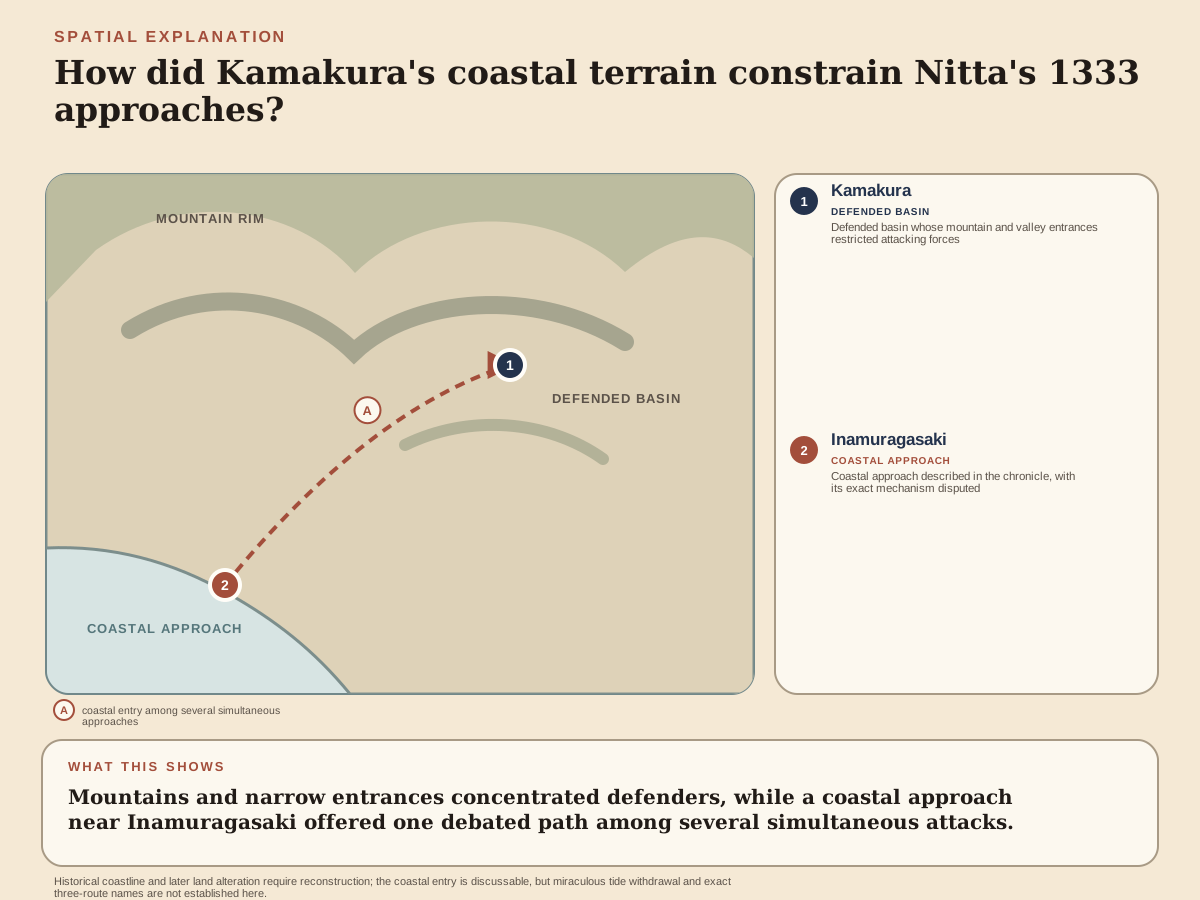
Kamakura lay between hills and sea, with restricted approaches. The Taiheiki’s tradition says Yoshisada cast a sword into the sea at Inamuragasaki, a coastal headland, and the tide receded. A military reconstruction instead examines coastal routes and simultaneous pressure on other entrances; Kamakura’s Central Library summarizes an assault through three main approaches. The sword episode belongs to the crossing legend. The documented outcome was that the city’s defenses were breached.
Yoshisada's campaign destroyed the main Hōjō leadership at Kamakura while other opponents of the government prevailed elsewhere. The fall killed or displaced the leadership that had coordinated warrior government, adjudication, and coercion. It did not erase every Hōjō connection or establish a ready successor. Yoshisada had accomplished a decisive military task inside a broader state collapse.
Go-Daigo’s Kenmu Restoration attempted direct imperial government. Yoshisada became governor of Echigo, on the Sea of Japan coast, and headed the Musha-dokoro, the court’s warrior guard office. These appointments rewarded the commander who had taken Kamakura. The court nevertheless had to settle competing claims to land, and office did not supply every holder with equally strong regional support.
In 1335, Hōjō Tokiyuki, from Kamakura’s former ruling family, briefly recovered the city. Takauji defeated him but then defied Go-Daigo’s court. Yoshisada’s expedition against Takauji lost at Hakone–Takenoshita late that year. He then helped imperial armies repel Takauji from Kyoto in early 1336. Takauji regrouped on Kyushu, the southwestern main island, and prepared another return.
Takauji returned in 1336. At Minatogawa near Kobe, Yoshisada and Kusunoki Masashige fought on the imperial side and were defeated; Masashige died. The Ashikaga recovered Kyoto, and Go-Daigo later withdrew to Yoshino, a mountainous refuge south of Kyoto. Yoshisada continued resistance and moved north toward Hokuriku, the region along the Sea of Japan coast. The loss of the capital changed the geography of his campaign without ending it.
In 1336 Yoshisada moved into Hokuriku with Princes Tsunenaga and Takayoshi, sons of Go-Daigo. They entered Kanegasaki Castle near Tsuruga in Echizen, largely modern Fukui Prefecture. The princes provided an imperial focus for regional supporters. That authority still depended on troops and a fortified base able to withstand Ashikaga pressure. The northern project soon faced siege.
During the 1337 siege, Yoshisada left Kanegasaki for Somayama Castle and attempted relief, but the Ashikaga side blocked the advance. His son Yoshiaki and Prince Takayoshi died when Kanegasaki fell; Tsunenaga was captured. Yoshisada continued fighting. Fukui’s prefectural history describes the castle’s later recovery, principally following the Taiheiki, with subsequent documents also indicating renewed Ashikaga efforts against it.
Yoshisada was killed near Fujishima in Echizen in 1338, during an active effort against Ashikaga positions. The Taiheiki supplies the dramatic final encounter; its details are less secure than the death and disruption of command. His brother Wakiya Yoshisuke continued the Nitta effort. Other Southern supporters retained bases, so Yoshisada’s sudden loss did not end regional resistance.
Yoshisada helped destroy Kamakura’s military government in 1333, then fought unsuccessfully to prevent the Ashikaga from controlling its replacement. His northern effort recovered from Kanegasaki’s loss before his death. Later memory emphasized imperial loyalty and heroic scenes; the military sequence joins a decisive victory, an unstable restoration and resistance that continued beyond its commander. Later remembrance acquired new institutions: a shrine was established in 1870, named Fujishima Shrine in 1876 and moved to its present location in 1901.
Classic
Nitta Yoshisada came from a warrior house based in Kōzuke, a province in the area of modern Gunma Prefecture north of Tokyo. The family claimed descent from the Minamoto, the lineage associated with the founders of the Kamakura military government. This ancestry supplied a recognized language of status, but it did not give every branch the same resources. [1]
Before 1333, however, its regional position was limited beside that of the Ashikaga, whose leader Takauji would become Yoshisada’s opponent.
Yoshisada’s early life is much less securely documented than his campaigns. His precise birth circumstances cannot be reconstructed into a detailed childhood narrative. The clearer starting point is the regional household from which he could gather followers. [1]
Yoshisada began inside the political order that he later helped destroy. Kamakura recognized warrior rights and demanded service from provincial households. His opportunity to challenge that government arose during its crisis.
The government at Kamakura was headed formally by a shogun, its appointed military ruler, but the Hōjō family exercised the dominant political authority. Its officials and decisions connected the eastern center to warrior households in the provinces. A dispute over land could require a judgment from the same government that demanded military service.
For a house such as the Nitta, recognition mattered because rights could be challenged by neighboring claimants. Independence in local affairs did not eliminate reliance on a wider authority to confirm a possession or resolve a conflict.
Yoshisada’s change of side was a departure from government service. The accounts by historians Chijiwa Itaru and Mori Shigeaki describe him participating in the attack on Chihaya, Kusunoki Masashige’s mountain position, before leaving the campaign and returning to his eastern base. Their reference articles place his rising in this transition; they do not establish a lifelong intention to overthrow the Hōjō.
In 1333, Yoshisada raised forces against the Kamakura government. Go-Daigo had renewed his challenge after escaping from exile, and resistance was spreading. The Nitta rising opened an eastern front against the Hōjō leadership while fighting continued around Kyoto and in other regions. [1]
Yoshisada initially drew on his regional following. As the campaign became credible, additional warriors could join it. Support for the imperial cause offered authorization for action, but assembling an effective force required people willing to commit their households and followers.
The exact balance of motives cannot be reduced to one recovered emotion. Local disputes and expectations about the government’s survival could accompany a commitment to the emperor. What the campaign demonstrates is the ability to turn a regional force into a coalition moving against the political center.
The rising was also part of a broader collapse. Ashikaga Takauji turned against Kamakura’s authorities in Kyoto, and Kusunoki Masashige maintained resistance around defended positions in the west. Yoshisada’s task was distinct: to advance through the eastern provinces toward Kamakura itself. Success on that route would give him a standing far beyond the household from which he had begun.
The force advancing from Kōzuke toward Kamakura grew as warriors joined the rising. Its route crossed the Kantō, the broad eastern region surrounding modern Tokyo. The campaign moved from Yoshisada’s provincial base toward the city in which the Hōjō government was concentrated. [1]
At Kotesashigahara, near modern Tokorozawa, and Bubaigawara, near modern Fuchū, Yoshisada’s forces encountered resistance on the approach to Kamakura. The campaign involved more than a single uninterrupted advance. Fighting and reversals required the attackers to regroup and draw on reinforcements. [1][6]
The Taiheiki, a medieval war chronicle, gives the reversal at Bubaigawara a definite sequence: Yoshisada’s side lost the first encounter, received reinforcements from Sagami, the coastal province southwest of modern Tokyo, and attacked again to win. It names Miura Yoshikatsu among those who arrived. Taniai Shinsuke of Yokosuka’s municipal library explains this account but notes that Yoshikatsu is absent from other contemporary sources and even his existence is questioned. The named rescuer therefore belongs to the chronicle’s account, not a securely verified roster. [6]
Fuchū City’s history of the site identifies the victorious encounter with the sixteenth day of the fifth lunar month of 1333 and names Hōjō Yasuie as the opposing commander. The regrouping mattered because the force now moved beyond the Tama River defenses toward Kamakura. A victory there changed the campaign from an advance across the Kantō into an immediate threat to the government’s seat.
Kamakura was protected by hills and a coastline, with narrow approaches into the city. The attacking force pressed more than one entrance. A response compiled by Kamakura’s Central Library describes the assault through three main approaches, drawing on published historical accounts and local studies. [2]
The best-known story concerns Inamuragasaki, a headland on the coast. In the Taiheiki’s tradition, Yoshisada cast a sword into the sea and the tide receded, allowing the army to pass. The episode gave the campaign a memorable sign of divine favor.
The alternatives are not two equally documented explanations of a miracle. The literary account presents providential assistance; a military reconstruction considers routes, coastal conditions, and the attacks made elsewhere. Evidence that attackers entered by the coast does not establish the supernatural cause narrated by the war tale.
Yoshisada’s campaign entered Kamakura in 1333. The Hōjō leadership was destroyed amid fighting and mass deaths at the government’s center. The fall ended the military regime that had governed warrior affairs for generations. [2]
Yoshisada had accomplished a decisive military task. His success coincided with the destruction of Kamakura’s Kyoto headquarters and the spread of resistance in other regions. Together these campaigns opened the way for Go-Daigo to return to government.
Go-Daigo’s attempt to restore direct imperial government is known as the Kenmu Restoration. Yoshisada received rank and office as a major victor in the struggle against Kamakura. His military reputation now gave him a place close to the court. He became Echigo no kami, the court-appointed governor of Echigo on the Sea of Japan coast, and headed the Musha-dokoro, the court’s warrior guard office. These appointments gave the recognition an administrative and military form. [1]
The government had to recognize many claims at once. Warriors expected rewards for service, and people displaced during the fighting sought restoration or confirmation of rights. The same piece of land could be claimed through different appointments or earlier possession.
Yoshisada’s standing depended partly on the emperor’s favor. An appointment could recognize his achievement without creating a regional network equal to the Ashikaga’s. His authority therefore had both a strong public basis—the conquest of Kamakura—and practical limits inherited from his earlier position. [1]
In 1335, Hōjō Tokiyuki, a survivor of Kamakura’s former ruling family, briefly recovered Kamakura in the Nakasendai uprising. Takauji moved east and defeated him, then remained in the region and rewarded his followers. The court’s attempt to recall and control him broke down.
Yoshisada was sent against the Ashikaga. The imperial commission authorized his campaign, but his opponent now commanded an eastern following whose interests were tied to Takauji’s leadership. The coalition that had attacked the Hōjō in 1333 could not simply be assembled again against him. [1]
Yoshisada’s expedition suffered a major defeat at Hakone–Takenoshita, on the mountain approaches between eastern Japan and the route to Kyoto, late in 1335. Takauji’s forces advanced to the capital. Yoshisada then joined the imperial commanders there, including Kitabatake Akiie’s army from the north, and forced Takauji to retreat west in early 1336.
This success did not eliminate the Ashikaga network. Takauji recovered support in western Japan and prepared another advance. Yoshisada’s role thus changed from leading an imperial expedition against the eastern base to participating in the defense against a returning coalition. The sequence connects the restoration’s internal rupture to the battle that would cost Go-Daigo control of Kyoto.
Takauji returned from the west in 1336 with forces moving by land and sea. Yoshisada and Kusunoki Masashige fought on Go-Daigo’s side at Minatogawa, near modern Kobe. The imperial army was defeated, and Masashige died.
The defeat opened the route toward Kyoto. Takauji recovered the capital, while Go-Daigo’s supporters had to find ways to continue outside it. The eventual withdrawal of the emperor to Yoshino, a mountainous refuge south of Kyoto, produced a Southern Court opposed to the imperial line supported by the Ashikaga in Kyoto. [1]
Yoshisada’s resistance did not end with the loss of the capital. His next major movement was toward Hokuriku, the region along the Sea of Japan coast. It offered the possibility of assembling another base with regional supporters. [1]
This was a change in the geography of his career. The commander who had captured Kamakura in 1333 was now trying to sustain the imperial cause away from both Kamakura and Kyoto. A royal household accompanied the northern project, giving its participants a focus of authority beyond Yoshisada’s own name. The northward move opened a new theater of war along the Sea of Japan coast.
Yoshisada moved into Hokuriku with Princes Tsunenaga and Takayoshi, sons of Go-Daigo. They entered the area of Tsuruga and Kanegasaki Castle in Echizen, a province largely corresponding to modern Fukui Prefecture. The royal party gave the northern resistance an association with the imperial household. [1]
The presence of princes could attract support beyond Yoshisada’s personal followers. It also made the project vulnerable: members of a succession-bearing household were now inside a military position that needed protection. Their authority had to be sustained by regional forces and a base able to withstand attack.
Kanegasaki stood in an area connected to Tsuruga’s port. The northern project therefore had a geographical setting different from the struggle around Kyoto. Local supporters, fortified positions, and routes through Echizen mattered to its survival.
As the siege tightened in 1337, Yoshisada left Kanegasaki for Somayama, another castle in Echizen. He and allied forces tried to break through toward Tsuruga, but the Ashikaga side blocked the relief effort and they had to retreat. His son Yoshiaki and the princes remained inside Kanegasaki. When it fell, Yoshiaki and Prince Takayoshi died, and Prince Tsunenaga was captured. [3]
The loss severely damaged the attempt to establish a northern royal base. It removed important members of the imperial party and of Yoshisada’s own household. It did not, however, begin an uninterrupted decline ending in his death.
The Fukui Prefectural History describes renewed activity and the recovery of Kanegasaki before Yoshisada’s final campaign in 1338, while acknowledging that much of the recovery sequence is known principally from the Taiheiki. Its following section also cites documents concerning Ashikaga efforts to reverse that recovery. The chronicle’s detailed sequence and those documentary traces do not have identical evidential weight.
Yoshisada was killed near Fujishima in Echizen in 1338. The encounter took place during an active campaign against Ashikaga positions, after his forces had recovered strength in the region. His death was a sudden loss of command rather than the final stage of a continuously shrinking resistance. [1][5]
The Taiheiki gives a detailed account of a small mounted party meeting enemy forces near Tōmyōji Nawate, a path along the fields. It supplies the dramatic circumstances of the fatal encounter. The Fukui Prefectural History explicitly attributes this scene to the chronicle while also describing the campaign through surviving documents. [5]
The distinction concerns the detail of the last action, not whether Yoshisada died in the region that year. Precise dialogue and final gestures are less secure than the death and the disruption it caused.
His brother Wakiya Yoshisuke continued the Nitta effort. Other Southern supporters retained bases, so the loss did not extinguish resistance in Echizen. Yoshisada’s direct career ended, while the cause and regional coalition continued under people making decisions of their own.
Yoshisada’s life connects the destruction of one warrior government with the struggle over its replacement. He led the campaign that entered Kamakura and destroyed the principal Hōjō leadership in 1333. He then served Go-Daigo against the Ashikaga, whose broader military network helped sustain a new government. [1]
Later commemoration gave his imperial service a lasting place around Fukui. In 1870, Matsudaira Shigeaki, governor of the former Fukui domain, established a shrine at the place associated with Yoshisada’s death. In 1876 it acquired the name Fujishima Shrine and an official shrine rank; it moved to its present hillside location in 1901. These dates describe successive acts of remembrance, not a medieval shrine founded by Yoshisada. [7]
The historical importance lies in the contrast between the outcomes he actually experienced. Yoshisada helped make the fall of Kamakura possible, gained standing in the restoration, and fought to preserve its imperial cause. His northern resistance recovered from a major setback before his death. The next warrior order was built by a different coalition, and the local struggle continued beyond the man whose name later memory made its emblem.