Read the article below. Interactive reading tools are available when scripts load.
Quick
Nichiren was born in 1222 near Kominato on the Pacific coast of Awa Province, in present-day Chiba Prefecture. Later tradition adds details of his family and childhood, along with sacred signs. His own writings describe low or despised coastal origins, but such language also served religious self-positioning and should not be converted mechanically into a modern caste or occupational record. Biographical evidence is unusually dependent on writings attributed to Nichiren and on later communities that revered him. [1][11]
The details of his family life are poorly documented. Access to Seichōji in the nearby Kiyosumi mountains changed his prospects: temple learning would give him texts, a teacher and connections beyond the coast. His later use of humble origins formed part of his religious authority.
Seichōji’s institutional tradition places Nichiren there from about age twelve and later associates his vows and the clerical name Renchō with the Tendai monk Dōzen-bō; surviving evidence does not establish every detail independently.
His training drew on Tendai, which placed the Lotus Sutra, a scripture teaching the possibility of Buddhahood for all, at the summit of Buddhist teaching. Other practices coexisted with that study, including devotion to Amida Buddha and his Pure Land, a destination after death, as well as initiatory rituals. Later itineraries describe learning at Kamakura, Mount Hiei near Kyoto and other major temples; individual visits are not equally documented. Nichiren developed his exclusive teaching from within this mixed religious world. [1][2][11]
Nichiren traditions commemorate his 1253 declaration at Seichōji on the twenty-eighth day of the fourth traditional month. He advocated the daimoku, chanting Namu Myōhō Renge Kyō in devotion to the Lotus Sutra's title, and criticized exclusive nenbutsu, calling on Amida Buddha for salvation. Around this time he came to use the name Nichiren. Accounts connect the government-appointed estate steward Tōjō Kagenobu's opposition with his departure, helped by fellow monks. Temple tradition places his flight soon after the declaration; historian Yutaka Takagi's reconstruction, described in Jacqueline Stone's 1999 review, puts the departure in winter 1254. A new public teaching emerged, but its doctrine and following continued to develop over the next decades. [1][8]
Nichiren came to argue that, in the Final Dharma age—a period in which Buddhist teaching and people's capacity for effective practice were believed to decline—devotion to the Lotus Sutra offered the necessary and highest path and that rival teachings misdirected people. He attacked exclusive nenbutsu, Zen claims to transmission beyond scripture, esoteric hierarchies, and influential precept movements. The targets and intensity developed over time rather than arriving as one unchanging package in 1253. Exclusivism gave followers a portable practice, a clear explanation for suffering, and a boundary against stronger institutions. It also cast ordinary practitioners and respected clerics as participants in grave error, making conflict structurally likely. His teaching sustained solidarity while calling rulers to withdraw support from rival traditions. [2]
Nichiren moved his public activity toward Kamakura, the shogunal center. Tradition places a hut in Matsubagayatsu, but several later temples claim the relevant ground, and current caves, halls, and monuments are not neutral remains of one verified 1250s dwelling. The place nevertheless fits his strategy: close enough to warriors, officials, routes, and dense religious institutions to make argument politically visible. Kamakura contained overlapping traditions: Pure Land devotees, Zen teachers patronized by Hōjō elites and monks such as Ninshō known for discipline and relief. [1]
Nichiren preached, disputed, wrote, and formed relationships with clergy and lay households such as Toki Jōnin, Shijō Kingo, and the Ikegami family; women also carried letters, faith, property, and patronage. This was not a free modern marketplace. Temples held land, patrons held office, speech could threaten order, and protection depended on networks.
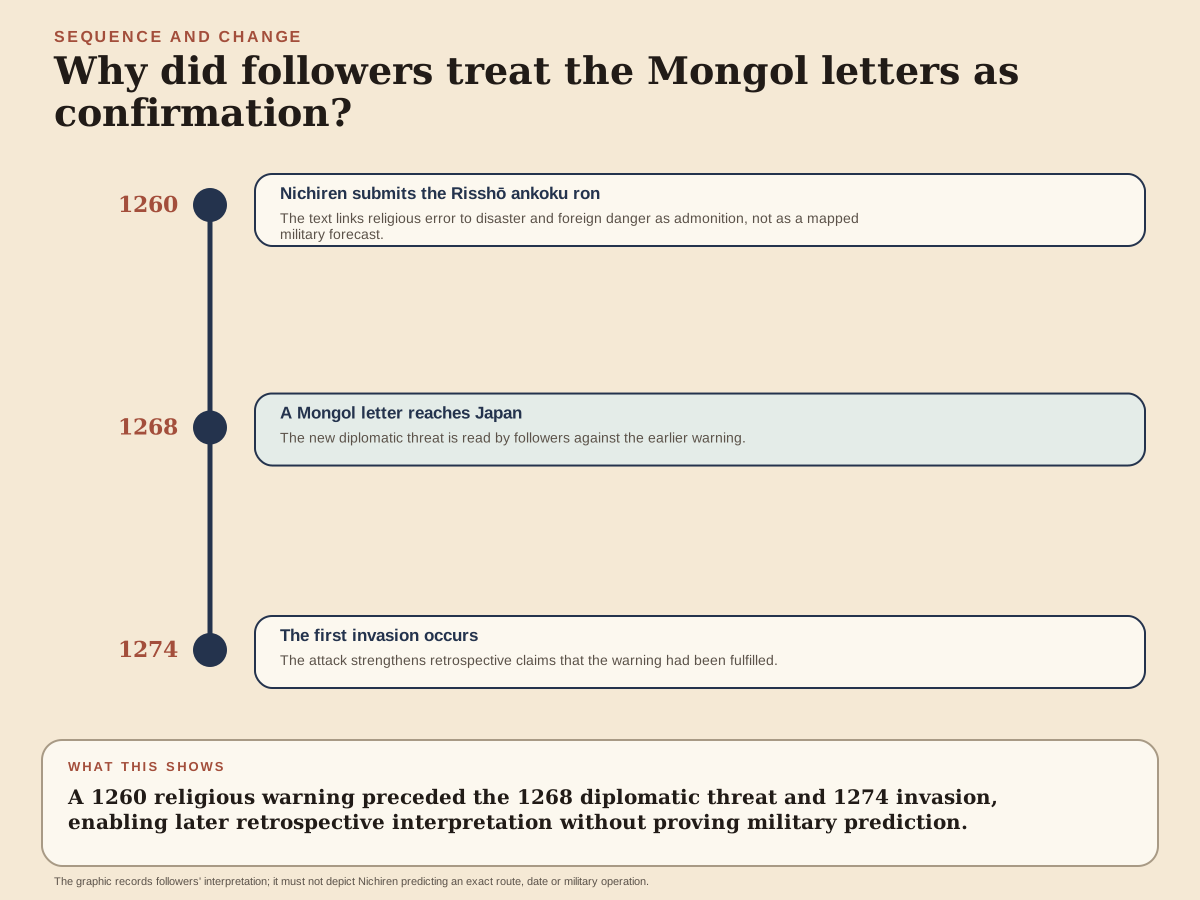
After the great 1257 Kamakura earthquake, continuing disease, famine, weather crisis, and social fear, Nichiren composed the Risshō ankoku ron. In the seventh traditional month of 1260 he submitted it through Yadoya Mitsunori to Hōjō Tokiyori, who had retired as regent but remained the dominant Tokusō (the head of the main Hōjō family line) figure. The work uses a dialogue between host and visitor, scriptural citations, and political counsel. Nichiren argued that support for mistaken teaching—especially exclusive Pure Land practice—had withdrawn sacred protection and would bring further disaster.
He warned of internal conflict and foreign attack. These were religious deductions made before letters from the Mongol ruler Qubilai reached Japan, not intelligence forecasts in a modern sense. Later events gave followers powerful confirmation; they do not prove supernatural causation. The text asked rulers to redirect patronage and suppress support for what Nichiren judged harmful. Its title's “land” was a medieval religious-political community, not the modern nation-state. [1][2]
Tokiyori did not adopt the program. Nichiren continued to circulate his argument; he read opposition through scripture's predictions of hostility to a Lotus defender. Rival devotees and officials could instead regard his preaching as a threat to religious care and public order.
Soon after the 1260 submission, Nichiren's Matsubagayatsu residence was attacked and burned or destroyed in the tradition. He escaped and relied on supporters, with accounts connecting refuge to regional networks such as Toki Jōnin's Shimōsa world. The assault marks a shift from polemic to organized physical danger. The evidence does not securely identify every attacker or prove a single command chain joining rival clergy, lay mobs, and government. Later biographies intensify providential escape, while several present-day temples claim the hut or refuge landscape. Those sites preserve community memory, not one uncontested archaeological floor. A vulnerable teacher lost a material base, survived through human networks, and interpreted violence as confirmation of his scriptural role; opponents may have understood themselves as defending religion and order. [11]
In 1261 Kamakura authorities exiled Nichiren to Izu, the peninsula southwest of the warrior capital. Local supervision restricted him, but tradition credits the fisherman Funamori Yasaburō and his wife with shelter and help. These accounts preserve the importance of hosts, although their miraculous episodes are not independently established. A banished preacher now depended on coastal households and contact with distant supporters.
Visitors and letters maintained contact during exile. An Itō healing-and-image story also survives in community tradition, though its miraculous cure is not independently verifiable. Pardon in 1263 allowed Nichiren to return with additional lay ties, but no government endorsement. [11]
After pardon, Nichiren returned to Awa. In 1264 a party associated with local steward Tōjō Kagenobu attacked him and followers at Komatsubara. The cleric Kyōnin-bō and lay supporter Kudō Yoshitaka were killed, others were injured, and Nichiren reported wounds including a cut to the head and injury to a hand. The violence showed that supporters, not only the leader, paid for doctrinal conflict. By 1268 Nichiren was again active in Kamakura when the Mongol ruler Qubilai's letter reached Japan. [4][12][13]
Nichiren renewed appeals to political and religious leaders. The collected eleven letters are disputed: Stone reports Kawazoe's view that the set is apocryphal, while accepting that Nichiren wrote to influential people. Followers treated the Mongol demand as confirmation of his warning; it did not establish his explanation of the threat's cause.
In 1271 drought and rivalry sharpened conflict between Nichiren and the influential precept monk Ninshō, also called Ryōkan. Nichiren-attributed accounts describe a challenge over rain rites, hostile complaints, and intervention by Taira Yoritsuna, a powerful Tokusō official. Later that year Yoritsuna's men arrested Nichiren, searched or disrupted his residence, and took him under guard. Nichiren was brought to Tatsunokuchi during the night and survived what his tradition and writings describe as an attempted beheading, then was held at Echi before exile to Sado, an island in the Sea of Japan off Niigata, across Honshu from Kamakura. Stone's review distinguishes Takagi's account of Nichiren's belief that he faced beheading from the uncertain luminous-object story, whose relevant passages some scholars regard as later insertions. [1][2]
Nichiren reached Sado late in 1271 and initially lived in a rough hall at Tsukahara associated with funerary ground. Winter, poor shelter, food insecurity, hostility, and surveillance made exile physically dangerous. In 1272 he moved to better conditions at Ichinosawa. A large religious debate at Tsukahara is central to tradition, though exact speeches and numbers are not transcripts. Sado became a major writing period. The Kaimoku-shō, or Opening of the Eyes, examined a Lotus defender's suffering; the Kanjin no honzon-shō addressed the object of devotion in his mature teaching. [6][7]
Supporters carried letters across the sea while mainland followers faced pressure from authorities and employers. Abutsu-bō and Sennichi became important island adherents. Their relationship with Nichiren continued after exile: the three autograph letters described by Sado City were written from Minobu, not during his island confinement.
Nichiren was pardoned in early 1274 and returned to Kamakura. His later account describes an audience with Taira Yoritsuna in which he again urged doctrinal reform and warned that a foreign attack would come within the year. The government did not adopt his religious program. Following a precedent that a wise person should withdraw after three unheeded admonitions, he left Kamakura later in 1274 and entered Mount Minobu under the patronage of Nambu, or Hakii, Sanenaga. [4][7]
In the tenth traditional month of 1274, forces from the Mongol-Yuan empire and Goryeo, a Korean kingdom under Mongol domination, attacked Tsushima, Iki, and northern Kyushu in the Bun'ei campaign. The timing gave Nichiren's followers a powerful confirmation narrative. It does not establish that Japanese religious practice caused Qubilai's expansion, or that Nichiren possessed unique operational knowledge. The attackers withdrew after intense fighting; the popular image of a single providential storm deciding the campaign exceeds the evidence.
Nichiren settled at Mount Minobu in 1274 on land controlled by Nambu, or Hakii, Sanenaga. A small hut, later enlarged within Kuonji's institutional memory, became a base for writing, instruction, ritual, and correspondence. Lay donors and routes through Kai, present-day Yamanashi Prefecture, kept the mountain community supplied. Cold and illness repeatedly constrained the work. Minobu was not a quiet retirement. Nichiren trained disciples, advised lay households, interpreted the second Mongol invasion of 1281, and received news of repression.
In the Atsuhara conflict of 1278–1279, followers connected with Nikkō among farmers and local communities faced pressure; twenty were arrested and sent to Kamakura, and three were beheaded. Early movement sources made their steadfastness exemplary, while the exact charges, interrogations, and motives require caution. The crisis shows that a supposedly marginal mountain teacher operated through a distributed network whose non-elite members could bear the state's violence. [3][7]
In the ninth month of 1282 by the traditional calendar, the sick Nichiren left Minobu for hot springs in Hitachi. He stopped at Ikegami Munenaka's residence in Musashi, now part of Tokyo, and could not finish the journey. Six senior disciples were designated, and Nichiren died on the thirteenth day of the tenth traditional month. The early death-and-funeral record preserves their names or marks and arrangements close to the event.
His body was cremated and ashes returned to Minobu. Ikegami Munenaka's residence and donated land became central to Honmonji tradition. After the founder's death, disciples and regional networks disagreed about custody, teaching, memorial duty, and succession. Later documents used to establish one exclusive transfer are contested and lack surviving autographs. Nichiren's legacy is therefore both unusually textual and institutionally plural. [7][9][10]
Classic
Nichiren was born in 1222 near Kominato on the Pacific coast of Awa, in present-day Chiba Prefecture. His later writings describe a socially low coastal origin, which he used to contrast inherited rank with religious vocation. Traditional biographies supply named parents, a childhood name and signs of a future mission; contemporary evidence for these particulars is much thinner. The coast itself connected his home region with fishing, shipping and routes toward Kamakura. It was distant from Kyoto, but not cut off from travel. [1][11]
A literal claim that one named father held one securely documented occupation goes beyond the same evidence. The term he employed in some writings evokes a despised or outcaste condition from Buddhist and South Asian vocabulary. The surviving evidence cannot be mapped directly onto a fixed Japanese legal caste category in 1222. Rhetorical humility and remembered social disadvantage may coexist. Traditional parental names and the childhood name Zennichimaro belong to lineage memory. They may preserve information, but their documentary route is weaker than Nichiren's date, province, and later temple entry. [1][11]
A coastal household somehow secured the boy's entry to Seichōji, a mountain temple in the Kiyosumi hills. The private arrangement is not preserved. There he would acquire the literacy and familiarity with Buddhist texts that later made comparison and argument possible. His adult writings tell us much more about his chosen account of origin than about his parents' daily work or property. The decisive change in his early circumstances was access to a teacher, texts and religious networks beyond the village.
Seichōji's institutional tradition places Nichiren there from about age twelve and associates his later vows and clerical name Renchō with Dōzen-bō, a Tendai monk. His surviving writings do not independently establish every stage of this training. [1][2][11]
Seichōji belonged to Tendai, a Buddhist tradition that placed the Lotus Sutra—a scripture teaching the possibility of Buddhahood for all—at the summit of its textual hierarchy. Temple practice could nevertheless combine Lotus study with initiatory rituals, devotion to Amida Buddha, whose Pure Land offered believers a destination after death, and local cults. Learning required access to texts in literary Chinese, often copied or borrowed, and guidance in reading and recitation. The teacher remained important to Nichiren even when he did not fully accept his former student's increasingly exclusive claims. [1][2][11]
Travel extended comparison. Kamakura, the warrior government's center, offered contact with Pure Land devotees and Zen teachers, who emphasized meditation and transmission between master and disciple. Mount Hiei near Kyoto retained enormous textual and institutional authority. Later itineraries place him at other major temples, but individual visits are not equally documented. Nichiren's later writings show learning that demanded cross-tradition engagement, but they are not a day-by-day travel diary. Sectarian biographies often produce a smooth grand tour in which every visit prepares his final doctrine. Thirteenth-century “schools” overlapped in personnel and practice. A Tendai monk could combine Lotus study with Amida devotion and esoteric rites, initiatory practices taught through ritual and specialized instruction. Zen institutions were growing in Kamakura but depended on Chinese teachers, patrons, interpreters, and older temple frameworks. [1][2][11]
Disciplinary revival associated with the monks Eison and Ninshō combined precept observance, ritual authority and social works. Pure Land practice reached far beyond one formal lineage. Nichiren's criticism therefore reached worship, death preparation and family memory. His method remained indebted to these traditions. Tendai classification and scriptural proof helped him rank teachings. He also adopted the concept of the Final Dharma age, when Buddhist teaching and people's capacity for effective practice were believed to decline. He sought a hierarchy and eventually an exclusive remedy, selecting and reinterpreting ideas acquired through his training.
In 1253 Renchō returned to Seichōji and publicly taught the primacy of the Lotus Sutra. Nichiren traditions commemorate the declaration on the twenty-eighth day of the fourth month of the traditional calendar. He advocated the daimoku, chanting Namu Myōhō Renge Kyō, an expression of devotion to the sutra's title, and came to use the name Nichiren. He also criticized exclusive reliance on nenbutsu, calling on Amida Buddha for salvation. That challenge reached people who trusted the practice for dying relatives and ancestors, including patrons of the temple that had educated him.
Polemic could appear not merely incorrect but dangerous.
Historical disagreement · When did Nichiren leave Seichō-ji?
Tōjō Kagenobu was a steward appointed by the warrior government to supervise an estate. Tradition depicts him as a Pure Land supporter enraged by Nichiren's words. The timing of the departure is disputed. Temple tradition makes him flee after the 1253 declaration; Yutaka Takagi, as described in Jacqueline Stone's 1999 review, reconstructs a longer temple and estate conflict ending in winter 1254.
Dōzen-bō's position was difficult. Protecting a former student need not mean accepting his claims. Accounts of assistance by fellow monks demonstrate that institutional attachment and doctrinal allegiance could diverge. The name Nichiren joined sun and lotus imagery in later interpretation. Whether every element of the naming occurred at the exact remembered hour is less important than the new public identity through which he wrote and organized. [1][8]
Historical disagreement · What did Nichiren’s declaration in 1253 establish?
The declaration gave Nichiren a public teaching and identity, not an immediately complete religious institution. Followers gathered through preaching, letters and household patronage. His mature positions on esoteric Buddhism, the object of devotion and his own religious role developed through later conflicts and exile. Nichiren lineages read 1253 differently: some see the complete founding teaching already proclaimed, while historical interpretations emphasize a public turn within Tendai-derived Buddhism.
Its small immediate organization and immense later authority belong to different stages of the story. [1][8]
The remembered declaration made staying at Seichōji difficult. Local opposition and support from fellow monks shaped his departure. He carried a teaching that could be repeated without a library, but establishing a community beyond his former temple would require patrons willing to sustain it.
Nichiren inherited the Tendai conviction that the Lotus Sutra occupied a supreme position within Buddhist classification. His innovation was not discovering the scripture but radicalizing what its primacy required in his age. The concept of mappō, the Final Dharma age, framed religious capacity as historically altered. A practice suitable in one era might fail in another. This transformed doctrinal ranking into emergency diagnosis. The daimoku offered concentration. A short vocal practice connected ordinary adherents with the scripture's title and promised participation in a vast teaching without requiring monastic mastery of every chapter. Exclusivity also organized identity. A small community surrounded by powerful temples needed reasons not to dissolve into common practice. Naming other paths as ineffective or harmful made adherence costly and therefore socially meaningful. [2]
Pure Land was the earliest central target because nenbutsu practice was widespread across formal institutions and households. Criticism reached deathbed hope, ancestors, patronage, and the authority of the Pure Land teacher Hōnen's legacy, not just a scholastic thesis. Zen became vulnerable to the claim that it privileged a mind-to-mind transmission beyond written scripture. In Kamakura, Chinese-lineage teachers enjoyed Hōjō patronage. Polemic against Zen could therefore implicate elite cultural and political choices. Nichiren's relation to esoteric Buddhism was complex. He used categories and ritual assumptions from the broader Tendai/esoteric world even as he increasingly condemned the subordination or misreading of the Lotus. His criticism still drew on concepts learned within these traditions. The Ritsu or disciplinary revival posed another rivalry. Figures such as Ninshō joined precept authority, social relief, construction, healing, and government patronage.
Nichiren's opponents were not empty figures of an establishment. Ninshō's religious authority, for example, was connected to relief and healing as well as elite patronage. Nichiren nevertheless represented rival practices as dangers to their adherents and the country. That claim could make resistance appear to confirm the persecution predicted for a Lotus defender. The surviving writings show changes in his arguments, but some texts later attributed to him remain contested. They cannot all establish his views at the same date or with equal confidence. [2]
Exclusivism was therefore theological conviction and minority strategy. It centered practice, authorized confrontation, explained persecution, and refused easy absorption. The same qualities that sustained the movement increased the chance that debate would become public-order conflict. The label “Nichiren Buddhism” is retrospective convenience at this stage. A durable institution developed only as adherents and patrons sustained these practices.
After leaving his home temple, Nichiren made Kamakura the center of his public activity. The warrior government's officials and Hōjō households were also patrons of religious institutions. Temples performed funerals and healing rites, held estates and offered learning or relief. Pure Land devotion crossed institutional boundaries, while Chinese teachers and Kenchōji gave Zen a conspicuous connection with Hōjō patronage. By condemning these practices, Nichiren challenged choices embedded in government service and ordinary households, not only doctrines debated by monks. [1]
Nichiren's hut was a material base. Its existence depended on local permission and households willing to support an outspoken teacher. Matsubagayatsu connected hillside shelter to routes through the city. Later Ankokuronji, Myōhōji, and Chōshōji traditions preserve different claims to Nichiren's residence and persecution. Their competition is reception evidence, not reason to choose one modern precinct as the uncontested exact floor. Follower formation extended beyond listening. Toki Jōnin in Shimōsa preserved writings and provided a regional household node.
Shijō Kingo's warrior service linked conviction to employment risk. The Ikegami brothers belonged to another family negotiation in which faith, inheritance, and paternal authority could collide. Women followers are harder to compress into one category. Some were married into warrior or local households; some traveled or exchanged gifts and letters; some lived through widowhood, illness, childbirth, property problems, or family opposition. Nichiren tailored correspondence to particular constraints. Texts traveled through them. Recipients and intermediaries helped letters reach audiences beyond his preaching place. Urban preaching and regional correspondence grew together. The city's disasters heightened competition. Earthquake, disease, hunger, fire, and political rumor produced demand for explanation and protection. Competing clerics could interpret the same suffering through different cosmologies. [1]
Kamakura brought Nichiren close to patrons able to maintain his work and officials able to punish it. Preaching in the city and corresponding with regional households grew together. When earthquakes, famine and disease intensified, these contacts gave him an audience for an argument that placed responsibility on the religious choices of rulers.
The great Kamakura earthquake of 1257, followed by famine and epidemic, gave Nichiren's argument a public urgency. In 1260 he composed the Risshō ankoku ron, commonly rendered as establishing the correct teaching for the peace of the land. Its dialogue begins with a visitor troubled by disaster; the host cites Buddhist scriptures and attributes the danger to support for mistaken religious practice. Nichiren wanted a change in patronage, not simply consolation for victims. He submitted the work through Yadoya Mitsunori to Hōjō Tokiyori, the retired regent who still led the main Hōjō house. [1][2]
Nichiren assembled recognized scriptures to argue that rulers should withdraw patronage from teachers he condemned. Religious institutions depended on land grants and protection; his proposal threatened their livelihoods as well as their doctrinal standing. Tokiyori had taken religious vows but remained powerful as Tokusō, head of the main Hōjō family line. Addressing the retired regent acknowledged that household leadership and current formal office were not identical. Nichiren wanted that authority used to redirect support toward the Lotus teaching. [1][2]
The work warned of internal revolt and external invasion through scriptural patterns of danger. In 1260, letters from the Mongol ruler Qubilai had not reached Japan. Later Hōjō family conflict and the Mongol expeditions gave followers striking examples of the two warnings. Believers understood them as fulfillment; historians distinguish the original warning from its retrospective application to particular events. The peace Nichiren proposed was conditional on religious correction, rather than equal government support for different teachings. [1][2]
The proposal could be heard as an attack on the care people gave dying kin and ancestors through trusted religious practices. Nichiren believed those same practices endangered their adherents and the country, making coexistence seem negligent. Lotus scriptures described hostility toward those who upheld the teaching; opposition could strengthen his conviction that he was fulfilling that role. Rival devotees and officials could instead regard him as generating the disorder he claimed to cure. [1][2]
Tokiyori did not adopt the program. Nichiren and his followers continued to copy and discuss the work, applying its warnings to subsequent crises. The dispute concerned government protection and resources as well as conviction: withdrawal of patronage would have harmed rival institutions, while Nichiren's own continued preaching exposed him to their opposition. That danger soon reached his residence.
After Nichiren submitted the Risshō ankoku ron in 1260, his residence at Matsubagayatsu was attacked, according to his later accounts and community tradition. He escaped with help from supporters. The hut had been a place where listeners gathered and writings were kept; its destruction removed a base for teaching as well as shelter. Identifying the attackers and who directed them is harder. Sectarian accounts blame rival devotees and powerful enemies, but no surviving operation order supplies a complete command chain. [11]
Later punishment does not by itself establish that officials ordered the assault. Nichiren survived with support beyond the damaged residence; Toki Jōnin's household in Shimōsa, east of Kamakura, offered a regional connection and later preserved important writings. Temple traditions at Ankokuronji, Myōhōji and Chōshōji identify different residence or refuge sites. Their competing claims preserve the attack's memory without settling the exact hut location. [11]
The visible caves and temple buildings belong to later custodianship. Choosing one visitor site as “the exact hut” would exceed current evidence. Refusing all connection would also miss how the valley's topography—steep slopes, narrow paths, urban proximity—shaped residence, danger, and escape. The attack strengthened a recurring pattern in Nichiren's self-understanding. Verbal opposition and physical harm could be read as fulfillment of scriptural expectations. Each survival increased authority among followers while confirming danger to officials and opponents. The competing accounts leave its exact date, site and official involvement uncertain. [11]
The loss of the hut made dependence on other households immediate. Nichiren's supporters could shelter him and carry his teaching, while placing their own standing at risk. The attack became a lasting persecution memory, but its physical consequences also changed how he could live and work.
In 1261 Kamakura authorities banished Nichiren to Izu, the peninsula southwest of the warrior capital. Exile put his travel and residence under supervision and removed his access to the city where he had preached. The fuller legal rationale has not survived. Accounts connect the sentence with religious complaints and the conflict following the hut attack. Izu was not an uninhabited margin: ports, local officials and households could either restrict him or provide support. [11]
Tradition credits Funamori Yasaburō and his wife with saving and sheltering Nichiren under harsh coastal conditions. The story correctly widens agency beyond named officials. Its detailed danger and providential meaning come through community transmission. Another tradition connects Nichiren with an Itō official who became ill and sought prayer, later offering a sea-recovered image. Healing, conversion, gift, and object custody are religious claims with material afterlives; a modern diagnosis or verified miraculous cure is unavailable. Hosts faced risk. Helping an exile could expose a household to official displeasure, rival pressure, expense, or obligation. It could also create a valued relationship with a compelling teacher. Correspondence defeated total isolation. Paper and ink allowed instruction to travel, but only through messengers able to cross roads and water. [11]
Oral messages could move faster and change more easily. Visitors carried news of followers and opponents. Displacement altered audience. Nichiren had to explain why punishment did not invalidate his claim. Lotus accounts of persecuted teachers supplied a framework in which exile could strengthen rather than destroy authority. That interpretation risked self-sealing logic: opposition became proof. Historically, it also offered followers a way to survive shame and fear. A punished teacher could be understood not as abandoned but as enacting a predicted role. Pardon in 1263 ended the legal condition without adopting his program. The reason for clemency is not securely established. Izu therefore changed the movement's technology and social map. [11]
The pardon of 1263 allowed Nichiren to return from exile, but did not signify acceptance of his program. His coastal hosts and correspondents had shown that removal from Kamakura could not end the community. Punishment became part of the account through which he explained his vocation to followers.
In 1264, Nichiren and his companions were attacked at Komatsubara in Awa. The tradition associates the armed party with the estate steward Tōjō Kagenobu. The cleric Kyōnin-bō was killed, and the lay supporter Kudō Yoshitaka died from his wounds. Nichiren himself reported injuries to his head and hand. The deaths made the danger of patronage tangible: followers' families inherited losses that their teacher's survival could not undo. His own account gives the episode a bodily immediacy, but cannot reconstruct every attacker's action or motive. [12][13]
Survival again acquired scriptural meaning. Followers could see two deaths and their teacher's wounds as persecution predicted for Lotus devotees. Opponents could see the same event as the result of deliberate provocation or local feud. The attack did not stop the network. Travel between Awa, Shimōsa, and Kamakura continued. Lay households offered refuge, messengers, and resources, while disciples became local teachers. The 1268 letter changed scale. The Mongol ruler Qubilai's imperial demand was not produced by Japanese religious practice; it emerged from Mongol expansion, the subordination of Goryeo, a Korean kingdom, to Mongol rule, and East Asian diplomacy. Nichiren interpreted rather than caused it. His 1260 text had included foreign attack as one scripturally predicted danger. Because the Mongol diplomatic approach now supplied a concrete candidate, the earlier warning gained evidentiary force unavailable at composition. [4]
Nichiren used the foreign demand to renew appeals to political and religious leaders. The collected set known as the eleven letters has a separate textual problem: Stone's review reports that Shōji Kawazoe considered that set apocryphal, while accepting that Nichiren had written to influential people. His correspondence with leaders and the authenticity of this particular collection are separate questions.
The attack and diplomatic demand were four years apart. Nichiren joined them in a religious interpretation of persecution and protection; the Mongol court pursued its own expansion and diplomacy. The letter gave his 1260 warning a new public relevance without establishing the cause he assigned to it.
Drought in 1271 brought Nichiren into a public dispute with Ninshō, the influential monk also known as Ryōkan. Nichiren-centered accounts say he challenged the rival's rain prayers and claimed their failure. Complaints then reached officials, including Taira Yoritsuna, who served the ruling Hōjō household. Yoritsuna's men arrested Nichiren and took him under guard to Tatsunokuchi near Kamakura. Shijō Kingo, a warrior follower, appears prominently in the account of his survival there. [1][2]
Shijō Kingo's presence shows the loyalty of a follower whose obligations to his lord could conflict with religious commitment. What happened at Tatsunokuchi must also be distinguished from the later miracle narrative. Stone's 1999 review says Takagi accepted that Nichiren believed officials intended to behead him, but omitted the luminous-object story. Stone treats its historicity as uncertain and notes that some scholars suspect later insertions in passages describing it. This preserves Nichiren's experience of mortal danger without certifying the light or inventing a natural explanation. [1]
Nichiren survived the night and remained in custody at Echi before transport to Sado, an island in the Sea of Japan off Niigata, on the opposite side of Honshu from Kamakura. He interpreted Tatsunokuchi as a transformation of his religious role; followers made it a central scene of protection and persecution. The luminous-object narrative belongs to that textual tradition. The continued detention and exile are firmer than any diagnosis of the light or reconstruction of every official instruction. [1]
Nichiren reached Sado late in 1271 and initially lived in a rough hall at Tsukahara, associated with funerary ground. Sea crossing separated him from mainland patrons, while winter cold and inadequate shelter made their support urgent. Custody did not seal him away from the island's households: residents could bring supplies, ask questions or dispute his teaching. A religious confrontation at Tsukahara became an important episode in the tradition, but the exact speeches and a complete victory over assembled opponents are not neutral transcripts. [6][7]
A move to Ichinosawa improved his shelter and access to supporters. Sado also became a major writing period. The Kaimoku-shō, or Opening of the Eyes, examined the suffering of a Lotus defender; the Kanjin no honzon-shō addressed the object of devotion within his mature teaching. Nichiren also inscribed devotional mandalas, written arrangements of sacred names and figures centered on the daimoku. Three autograph letters described by Sado City were written after he left the island for Minobu. They witness the continued relationship with Sado followers, not the date of manuscripts composed during exile. [6][7]
Letters crossed the sea through supporters able to supply writing materials and carry messages. Letters governed. Nichiren instructed disciples, interpreted punishment, answered doubt, thanked donors, and responded to household crises. Recipients could read letters aloud and preserve them for other followers. Mainland followers paid. Some faced pressure from lords or family, loss of land or position, arrest, or demand to renounce. Their choices cannot be reduced to passive faith in a founder. Sado followers such as Abutsu-bō and Sennichi appear prominently in later letters and temple memory. Their precise conversion scenes may be stylized; their subsequent participation and correspondence give them historical agency. [6][7]
Exile increased the community's dependence on writing and intermediaries. Mainland households continued to support the teacher, while island followers established lasting connections. The sentence that separated him from Kamakura also gave his teaching new recipients and made correspondence central to its survival.
Pardoned in 1274, Nichiren returned to Kamakura and again addressed Taira Yoritsuna. His later account says he warned that an invasion would occur within the year. The exact wording is known chiefly through his retrospective writing, but the renewed appeal did not win government adoption of his teaching. After repeated rejection, he left Kamakura for Minobu under a lay patron's protection. [4][7]
The government had reasons to listen without converting. Qubilai's envoys had already made the danger concrete. Officials were strengthening defenses, mobilizing Kyushu retainers, managing diplomacy, and evaluating intelligence. They did not need to accept Nichiren's causal theology in order to recognize his political persistence. His proposal required more than military preparation. He continued to link national safety with rejection of religious teachings he judged erroneous. Adoption would have damaged institutions and patrons on whom Kamakura itself relied. Refusal therefore arose from institutional interests as well as disbelief. The “three admonitions” frame gave withdrawal a classical and religious logic. After remonstrating in 1260, 1268, and 1274, Nichiren presented departure as principled rather than defeated. The neat count also organizes a long, uneven sequence and should be recognized as retrospective structure. [4][7]
Leaving Kamakura required a patron's protection rather than another official sentence of exile. Nambu Sanenaga, commonly called Hakii Sanenaga in the tradition, controlled land in Kai and was connected to Nichiren's disciple Nikkō. Minobu offered distance from Kamakura without the legal condition of exile. The invasion in the tenth traditional month devastated communities on Tsushima and Iki before fighting around Hakata. The invading force drew on the Mongol-Yuan empire and subordinated Goryeo, while Japanese defense depended on regional warriors and coastal preparation. These causal systems existed independently of Nichiren's polemic. Contemporary and near-contemporary records support hard fighting and withdrawal. Weather may have affected the fleet, but the later national story of a miraculous wind delivering Japan in one clear instant became more dominant over time. [4][7]
For followers, the sequence gave the warnings new force: their teacher had survived exile, renewed his appeal, and then seen a foreign invasion in the same year. The government continued its defense arrangements without adopting his religious explanation. Nichiren would interpret the war from a different base, away from Kamakura.
Nichiren settled at Minobu in 1274 on land protected by Hakii Sanenaga in Kai, present-day Yamanashi Prefecture. A small mountain residence became a base for teaching and correspondence. Sanenaga's support meant permission to build and access to local supplies and labor. Temple tradition records a larger structure in 1281 and connects these beginnings with Kuonji. The present complex reflects later rebuilding as well as the memory of Nichiren's residence. [3][7]
The mountain hut needed maintenance through cold and wet seasons. Letters reporting cold, hunger, or illness are not decorative asceticism; they reveal limits within which religious production occurred. Paper and ink connected the mountain to many households. Donors sent cloth, rice, coins, medicine, and writing materials. Messengers crossed difficult routes carrying questions and replies. Each surviving letter represents many journeys that left no document. Disciples turned correspondence into organization. Nikkō was especially active in the Fuji and Suruga region, while other senior disciples maintained networks elsewhere. They maintained local congregations and brought disputes to the teacher by letter. Authority was shared in practice even where later lineages claimed exclusive succession. The second Mongol invasion in 1281 renewed the prediction framework, but it also intensified fiscal and military pressure throughout warrior society.
Nichiren's letters interpreted the conflict religiously. Atsuhara exposes the movement below elite biography. From 1278, tensions around converts, temple estates, local clerics, and agricultural communities escalated. The conflict cannot be reduced to a ruler simply attacking belief; land, labor obligations, jurisdiction, and rival institutional loyalties were entangled. In 1279 twenty peasant followers were arrested and transported to Kamakura. Movement records say officials tried to force recantation and that three leaders—remembered as Jinshirō, Yagorō, and Yarokurō—were executed. The arrests and three deaths are strong early community memory; verbatim interrogation speeches and complete official rationale are not recoverable. Their social rank matters. Histories centered on founders can use followers as proof of the leader's greatness. The Atsuhara prisoners instead reveal people making decisions under threats to body, household, harvest, and dependents. [3][7]
Nichiren was not present to absorb the penalty for them. Letters allowed him to encourage resistance and interpret the crisis, but they could not control events at the estate or in custody. Nikkō and local organizers carried immediate responsibility. Minobu's achievement was not escape from politics. It was the conversion of patronage and distance into a durable communications center. Its cost appears in winter scarcity, bodily decline, and the execution of adherents whose names survived because a distributed community decided their deaths must not disappear. [3][7]
Long illness increasingly limited Nichiren's work at Minobu. In the ninth month of 1282, in the traditional calendar, he left for hot-spring treatment in Hitachi, northeast of Kamakura. He reached the residence of his lay patron Ikegami Munenaka in Musashi, now part of Tokyo, but did not complete the journey. Followers gathered there, and tradition records a final lecture on the Risshō ankoku ron. A household that had supported his teaching became the place of his death. [7][9][10]
The designation of six senior disciples on the eighth day of the tenth traditional month distributed responsibility among Nisshō, Nichirō, Nikkō, Nikō, Nitchō and Nichiji. Their regional bases and patrons differed, so a roster did not resolve every future question of leadership. Nichiren died at Ikegami on the thirteenth day of that month. The early death-and-funeral record preserves participants and arrangements close to the event, giving firmer evidence than many later accounts of his final words and signs. [7][9][10]
Cremation transformed the body into relic and custody problem. Ashes were returned to Minobu, where the disciples had to arrange continued memorial service. Ikegami developed another institutional center. Temple tradition holds that Munenaka offered land and that the residence became the basis of Honmonji. As with Minobu, current architecture should not be projected backward onto the rooms and estate of 1282. Plural leadership soon exposed regional difference. Disciples served communities separated by mountains, roads, patronage, and local conflict. Rotation at Minobu was difficult.
Disagreement over memorial responsibilities and doctrine generated lineages rather than a single seamless administrative succession. Nikkō-centered traditions preserve transfer documents naming him uniquely. Their original autographs do not survive, and other Nichiren lineages do not accept their authority in the same way. The writings did not settle everything because texts require authentication, copying, interpretation, and institutions authorized to teach them. Some works survive in autograph or early form; others are later copies or disputed attributions. Abundance creates a critical corpus, not automatic certainty. His durable legacy is therefore not one uncontested organization. His writings and distinct disciple communities sustained competing interpretations of what he had authorized. The person died at Ikegami; the struggle to define what his life authorized began among survivors. [7][9][10]