Read the article below. Interactive reading tools are available when scripts load.
Quick
Kusunoki Masashige became visible as a warrior based in Kawachi, near present-day Osaka. His birth year and earliest career are uncertain. One interpretation connects him with regional estate conflicts and groups accused as akutō, or ‘evil bands’; another looks for ties to the Hōjō household governing from Kamakura. The label akutō could express an authority’s accusation rather than a uniform criminal status. These social connections remain disputed. What becomes clearer in 1331 is his ability to gather followers for Emperor Go-Daigo’s cause.
In 1331 Go-Daigo challenged the Kamakura military government in the Genkō uprising. Masashige defended Akasaka, a fortified position in Kawachi. The position fell and the emperor was defeated, but Masashige survived. His resistance forced the government to keep resources committed in the region. Later accounts celebrated ingenious defenses; the loss of the fort did not eliminate the following that made renewed action possible.
After the lost defense, Masashige returned to action against the Kamakura military government. Matsubara City’s history cites a contemporary fighting record for his attack on the Dannan military governor’s office, in modern Matsubara, in the first lunar month of 1333. Its deputy and associated forces were expelled. Capturing Akasaka had not ended regional opposition. For the earlier recovery of Akasaka, Tondabayashi’s city history prefers the contemporary record’s late-1332 date over the Taiheiki’s earlier dating. [1]
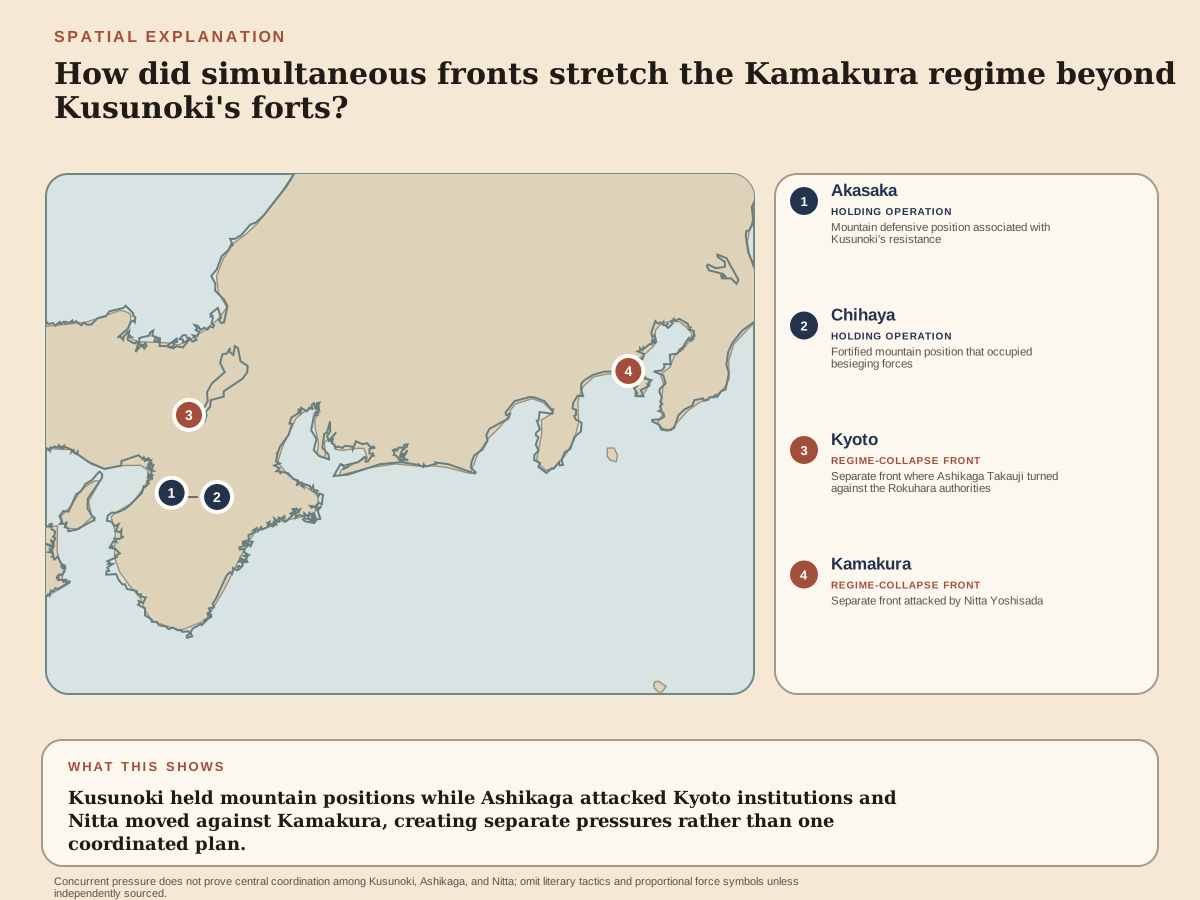
At Chihaya in 1333, Masashige held a mountain position and tied down government forces. Elsewhere, Ashikaga Takauji, originally a government commander, changed sides and attacked Rokuhara, its Kyoto headquarters. Nitta Yoshisada advanced on Kamakura in the east. These converging campaigns brought down the government; Chihaya’s resistance was one contribution to the collapse. Go-Daigo returned to rule and began rewarding his supporters.
Under Go-Daigo’s Kenmu Restoration, the attempt to restore direct imperial government, Masashige gained offices including provincial military governorships in Kawachi and neighboring Izumi, around present-day Osaka. He also participated in central administration. The new government had to recognize land rights and reward warriors whose claims could conflict. Masashige continued imperial service, but his regional following did not give him control over the entire settlement. [2]
In 1335 Hōjō Tokiyuki, a survivor of Kamakura’s former ruling family, briefly recovered Kamakura in the Nakasendai uprising. Takauji moved east against him, remained there and rewarded followers on his own authority. His dispute with Go-Daigo developed into war. Masashige and Nitta Yoshisada fought on the emperor’s side against a commander who had helped overthrow the same government in 1333.
In early 1336, Masashige, Nitta Yoshisada and Kitabatake Akiie, commander of an imperial army from northern Japan, drove Takauji out of Kyoto. Takauji regrouped on Kyushu, the southwestern main island, and won at Tatarahama near modern Fukuoka. He then returned with land and sea forces. The imperial victory in Kyoto had not eliminated the forces supporting him elsewhere.
The Taiheiki, a later war chronicle, says Masashige proposed temporarily yielding Kyoto and striking when occupation made the Ashikaga vulnerable. The court instead required defense before Takauji reached the capital. This account contrasts preserving military strength with protecting the emperor’s seat. Its polished speeches are not records of a council, but the proposal helps explain Masashige’s later reputation for foresight. The actual campaign took him to Minatogawa.
At Minatogawa, near present-day Kobe, Ashikaga forces defeated the imperial side in 1336 and Masashige died. Takauji’s land and sea forces opened the route toward Kyoto. Go-Daigo later withdrew to Yoshino, a mountainous refuge south of Kyoto, while a rival imperial line remained in the capital, creating the Northern and Southern Courts. Masashige did not live to participate in the Southern Court’s subsequent history. [2]
Masashige’s son Masatsura continued fighting for the Southern Court. In 1348 he faced Kō no Moronao, an Ashikaga commander, at Shijōnawate northeast of modern Osaka. He was defeated and died. The Taiheiki’s famous father–son farewell linked their reputations, but Masatsura’s campaign occurred twelve years after his father’s death, under different military circumstances.
The Taiheiki shaped Masashige into an ingenious defender, farsighted adviser and exemplary loyalist. Its father–son farewell takes place at Sakurai, a roadside stopping point in Shimamoto between Kyoto and Osaka, on the way to his final campaign. These scenes were influential literary accounts, not transcripts of conversations. They help explain the reputation that outlasted his military career.
In 1692 Tokugawa Mitsukuni, the Mito lord associated with the Dai Nihonshi historical compilation, sponsored a monument honoring Masashige at the later Minatogawa Shrine site. Admiration for the defeated commander thus preceded the Meiji government by nearly two centuries. Scholars and patrons interested in imperial legitimacy used his service to Go-Daigo within their own arguments about loyal government.
Minatogawa Shrine was founded in 1872 in the new Meiji state. Masashige was honored as Nan-kō, Lord Kusunoki, a model of imperial loyalty. In 1900, a bronze equestrian statue was installed outside Tokyo’s Imperial Palace, with Takamura Kōun directing its production. These monuments record later acts of remembrance, centuries after the commander’s death.
Classic
Kusunoki Masashige emerged as a warrior based in Kawachi, in the area south of modern Osaka. His name would later become one of Japan’s most recognizable symbols of loyalty to the emperor. The surviving account of his youth is much thinner than that fame suggests. His precise birth year and the circumstances of his earliest career are uncertain.
Historical disagreement · What were Masashige’s social origins?
His social origins have also been interpreted differently. One approach emphasizes a regional warrior connected to estate conflicts and groups labeled akutō, literally ‘evil bands.’ In medieval documents the term could express the accusation of a threatened authority, rather than identify a uniform criminal class. Another interpretation looks for connections with the Hōjō household at the center of the Kamakura government.
The family’s earliest status is not settled clearly enough to make either account a complete childhood biography.
What becomes visible is a capacity to gather followers and operate around fortified positions in Kawachi and neighboring regions. That capacity made him useful to Emperor Go-Daigo when the emperor challenged Kamakura. Masashige entered the national struggle with a local following and knowledge of the terrain. Those resources, rather than the loyalist reputation created after his death, provide the starting point for his military career.
In 1331, Emperor Go-Daigo’s challenge to the Kamakura military government brought fighting to several regions. Masashige supported the emperor and defended Akasaka, a fortified position in Kawachi. The conflict is known as the Genkō uprising.
The emperor’s cause gave local resistance a wider political purpose. Masashige could draw attention and military resources away from other fronts even though he did not possess an army comparable to the government’s total strength. His usefulness depended on being able to remain active where Kamakura’s forces expected to suppress opposition.
Akasaka eventually fell. The defense therefore should not be described as an unqualified battlefield victory. It prolonged resistance, but it did not rescue Go-Daigo from defeat and exile.
Masashige survived the loss of Akasaka and returned to the fighting. Capturing a fortified position had not eliminated the people and regional connections that supported him. This survival became important when opposition to Kamakura gathered strength again. Tondabayashi’s city history dates his recovery of Lower Akasaka to the twelfth lunar month of 1332, following the contemporary fighting record; it rejects the Taiheiki’s fourth-month date. This is the city history’s source-based judgment, rather than a claim that every detail of the renewed campaign is settled. [1]
Go-Daigo’s defeat had dispersed the imperial cause rather than ended it. Prince Moriyoshi, one of the emperor’s sons, helped sustain resistance. Local commanders could act in the name of the emperor or prince while drawing on followers whose immediate position depended on regional circumstances.
Masashige also attacked the government’s provincial machinery outside a fortress. Matsubara City’s account cites the Kusunoki gassen chūmon, a contemporary record of the fighting, for his attack on the Dannan military governor’s office in the first lunar month of 1333. The deputy governor and associated forces were expelled. Dannan lay in Kawachi, in the area of modern Matsubara: this was an assault on a local seat of government, not another famous mountain siege.
By 1333, opposition was growing on several fronts. Masashige prepared to hold Chihaya, a mountain position in the same regional landscape. Kamakura had taken Akasaka without ending the military activity around it.
At Chihaya in 1333, Masashige defended a mountain position against government forces. The terrain restricted the advantages of a larger attacking force. A prolonged siege required Kamakura’s commanders to keep men committed to a place where they had not secured a quick result.
The defense mattered beyond its immediate battlefield. Continued resistance showed that the government could not finish Go-Daigo’s opposition simply by defeating the emperor himself. As fighting and defections grew elsewhere, the time spent at Chihaya became more costly.
The Taiheiki supplied memorable accounts of the defenders’ stratagems. Its large army figures and elaborate scenes should not be treated as precise military statistics or transcripts. The strategic contribution can be stated more securely: Masashige held a position long enough to tie down forces while the political and military situation changed on other fronts.
In Kyoto, Ashikaga Takauji, a commander originally sent to support the government, turned against it and attacked Rokuhara, its headquarters in the capital. In the east, Nitta Yoshisada advanced on Kamakura itself. Masashige’s endurance helped resistance persist while these campaigns struck the institutions at its center.
The result opened the way for Go-Daigo to return to government. A local commander who had sustained his cause during defeat could now receive recognition from a victorious emperor. Masashige’s service carried him from regional resistance into the new court-centered political settlement.
Victory also changed the demands placed on that relationship. During rebellion, a commander could be useful by keeping armed opposition alive. After the collapse of the old government, the court had to settle rewards and recognize rights claimed by many different supporters. The military cooperation of 1333 did not answer those questions automatically.
Go-Daigo’s attempt to restore direct imperial government is known as the Kenmu Restoration. Masashige gained provincial military governorships in Kawachi and neighboring Izumi, around present-day Osaka, as well as a place in central administration. Habikino City’s historical account identifies him among the officials of the court’s records office. A regional commander now had responsibilities in a government trying to recognize and reward the men who had brought it to power. [2]
The court faced competing claims to land and office. Warriors expected recompense for campaigns, while other claimants sought to recover or confirm rights disrupted during the conflict. A grant to one person could threaten another’s possession. Decisions needed enforcement in regions where the emperor’s supporters had independent followings.
Masashige remained in imperial service. That continued allegiance is part of the record, but it does not supply his private opinion of every policy or give him control over the entire settlement. His own authority was rooted in his following and regional base.
The tensions became acute when Ashikaga Takauji asserted a larger role in the east. He too had helped overthrow Kamakura and commanded warriors whose rewards and security depended on his leadership. The restoration thus contained military resources that the court needed but could not always direct. Masashige would soon be required to fight a former partner in the uprising.
In 1335, Hōjō Tokiyuki, a survivor of the family that had dominated Kamakura, briefly recovered the eastern city. This attack is known as the Nakasendai uprising. Takauji moved east against him and reestablished his position there.
The dispute with Go-Daigo then deepened. Takauji remained in the east and rewarded followers, asserting a military authority that exceeded the court’s control. The conflict moved from disagreement within the restoration to open war.
Masashige served on the emperor’s side. Nitta Yoshisada, whose campaign had destroyed Kamakura in 1333, was another imperial commander confronting Takauji. The earlier victory had joined these men against one government; it had not removed differences over the authority that would replace it.
For Masashige, the enemy now possessed a substantial warrior network and experience inside the same political order. His earlier use of fortified regional positions could not by itself settle a struggle extending between the eastern provinces, Kyoto, and western Japan. The imperial side had to assemble forces from several commanders and defend the capital against an opponent able to regroup outside it.
In early 1336, Go-Daigo’s commanders forced Takauji out of Kyoto. Masashige fought in a wider imperial coalition that also included Nitta Yoshisada and Kitabatake Akiie, whose northern army had moved toward the capital. The success restored the immediate imperial position.
Takauji’s retreat did not destroy his following. He went west and recovered strength on Kyushu, the southwestern main island, including through victory at Tatarahama near present-day Fukuoka. From there, he prepared a return with forces moving by land and sea.
This recovery changed the military problem confronting Masashige. The imperial commanders were no longer dealing only with the force they had expelled from Kyoto. They faced a reorganized coalition supported from regions the court did not securely control.
The approach to the capital ran through the coastal area around modern Kobe. Holding that corridor could help keep Takauji away from Kyoto, but it required the imperial side to confront his returning forces before they were exhausted or dispersed. The choice of where and how to fight became inseparable from the political importance of defending the emperor’s seat. A victory in the capital earlier in the year had therefore been a temporary advantage, not the conclusion of the war.
The Taiheiki presents Masashige as advising against a direct confrontation with Takauji’s returning army. In its account, he proposed allowing the opponent into Kyoto and striking when the occupation made the Ashikaga position vulnerable. The court instead required a defense before Takauji reached the capital.
These are distinct strategic choices. One sought to preserve military strength at the cost of temporarily abandoning the seat of government. The other protected imperial prestige and access to Kyoto, but risked battle against a strong returning coalition. The surviving narrative gives the disagreement the shape of a commander whose correct advice was rejected.
The exact speeches and perfect foreknowledge belong to the chronicle’s literary presentation. They are not securely documented records of a council. Historians can discuss the plausibility of a strategic disagreement without knowing that Masashige used the words later assigned to him.
Masashige went to meet the Ashikaga advance and fought at Minatogawa. The counsel scene gave later readers a commander whose insight could not save him from the campaign that ended his life.
At Minatogawa, near modern Kobe, Masashige and other imperial forces confronted Takauji’s returning army in 1336. Nitta Yoshisada also commanded on Go-Daigo’s side. Ashikaga forces approached through land and sea movements, making the coastal battlefield part of a wider advance toward Kyoto. [2]
The imperial side was defeated. Masashige died with members of his following, ending the military career that had become visible only a few years earlier. Accounts of his final words and the precise manner of his death became central to the Taiheiki and later remembrance. They add a narrative interpretation to the firmer fact of his death in this defeat. [2]
The result opened the route toward Kyoto. Takauji recovered the capital, and Go-Daigo eventually withdrew to Yoshino, a mountainous refuge south of Kyoto. A rival imperial line supported by the Ashikaga remained in Kyoto. The Northern and Southern Courts era followed from this unresolved contest over succession and military authority.
Masashige died before the Southern Court’s subsequent history unfolded. His death was a major loss for Go-Daigo’s supporters, but it did not end their resistance. Other commanders and members of his family continued to act amid circumstances that changed after Minatogawa.
Masashige’s death did not remove the Kusunoki family from the civil war. His son Masatsura became a commander supporting the Southern Court, which continued to contest Ashikaga power from Yoshino. [3][4]
In 1348, Masatsura fought Kō no Moronao, an Ashikaga commander, at Shijōnawate in the area northeast of modern Osaka. He was defeated and died. This was another campaign in the continuing war, twelve years after his father’s death at Minatogawa.
The Taiheiki connected father and son through a celebrated farewell before Masashige’s final campaign. That scene shaped their shared reputation, but it is not a contemporary transcript of instructions controlling Masatsura’s later decisions. The son’s service unfolded under a Southern Court and military circumstances that the father did not live to see.
The Taiheiki, the fourteenth-century war chronicle, gave Masashige many of the scenes through which later readers knew him. His defenses displayed ingenuity; his counsel showed foresight; his final campaign demonstrated service despite the prospect of defeat. Together these episodes made a coherent exemplary figure out of a short and incompletely documented career. [5]
The farewell with Masatsura at Sakurai became especially influential. The place is a former roadside stopping point in Shimamoto, between Kyoto and Osaka; in the chronicle, Masashige paused there while traveling toward the final campaign. Another influential account connected Masashige and his brother with repeated rebirths devoted to overcoming the enemy. Such scenes gave loyalty a family setting and a memorable language that could be retold in performance, schooling, and commemoration.
The chronicle was shaped through composition and textual transmission. Its speeches are literary accounts, not recovered transcripts. The same caution applies to elaborate tactical details that lack independent support.
That distinction does not make the work dispensable. It explains how Masashige’s reputation developed and why selected moments became more familiar than the uncertain details of his early life. The historical commander’s campaigns and the literary figure’s exemplary conduct are related subjects. Their evidential bases differ.
Masashige’s defeat acquired new political meaning in the early-modern period. Writers and patrons interested in rightful imperial succession could honor a commander who had served Go-Daigo even though his side had lost control of Kyoto. The Southern Court’s cause became a subject of scholarship and moral argument.
A concrete example stands at the later Minatogawa Shrine site. In 1692, Tokugawa Mitsukuni, the Mito lord associated with the compilation of the Dai Nihonshi history, sponsored a monument honoring Masashige. The commemoration preceded the establishment of the modern shrine by nearly two centuries. [6]
The monument gave a defeated medieval commander a visible place within later ideas of loyal service. Its presence also shows that admiration for Masashige did not begin with the Meiji government. Different patrons could select his life for their own political and intellectual concerns. [6]
Minatogawa Shrine was established in 1872 to honor Masashige. Its foundation brought an existing tradition of remembrance into the religious and political order of the new Meiji state. Masashige was widely honored as Nan-kō, an affectionate and respectful name for Lord Kusunoki. [6]
The shrine gave imperial loyalty a physical and institutional focus. The commander’s service to Go-Daigo could be presented as a model at a time when the modern government placed the emperor at the center of national authority. The older monument sponsored by Mitsukuni remained part of the site’s layered history. [6]
Public commemoration extended beyond the shrine. In 1900, a bronze equestrian statue of Masashige was installed outside the Imperial Palace in Tokyo, with Takamura Kōun directing its production. The regional warrior who had died near Kobe could now be encountered beside the modern emperor’s palace.
The foundation date makes the separation tangible. The shrine is a modern institution remembering a medieval death, not a surviving institution that Masashige established. Its significance lies partly in that change of setting. It shows how a defeated commander’s reputation could become useful to a state created more than five centuries after his lifetime.
The places associated with him preserve these phases unevenly. Akasaka and Chihaya locate the defended positions; the Minatogawa area locates the final campaign; the shrine and commemorative monuments record later acts of remembrance. None alone supplies a complete account of his decisions.
A regional warrior’s short career became a durable language of loyalty in political worlds he never knew. The campaigns explain his importance to Go-Daigo’s struggle; the chronicle, monument and shrine explain why that defeated commander acquired a much longer public life.