Read the article below. Interactive reading tools are available when scripts load.
Quick
Kido Takayoshi was born Wada Kogorō in Hagi, the castle town of Chōshū, a warrior-governed domain in western Japan, on 11 August 1833. His biological father, Wada Masakage, served Chōshū as a physician. In childhood the boy was adopted by the neighboring Katsura warrior household and became Katsura Kogorō. The adoption supplied lineage and status obligations; early deaths in the adoptive family did not simply return him to an unchanged first identity. He studied in Hagi's educational world, including military learning under the young Yoshida Shōin at the domain school. [1][7]
Hagi gave him access to household and domain-school learning. Chōshū's permission and support remained necessary for his next step. In 1852 he left for Edo, where sword training would put him among retainers from other domains as foreign defense became an urgent question.
Katsura went to Edo, today's Tokyo, in 1852 and entered Saitō Yakurō's Renpeikan, a prominent Shindō Munen-ryū sword school. Training brought reputation, discipline, and friendships across domain boundaries. It also placed him in the capital just as coastal defense became an urgent common problem. He pursued military and technical subjects beyond swordsmanship, moving through networks interested in artillery, fortification, ships, and foreign knowledge. When the American commodore Matthew Perry's squadron appeared in 1853, practical questions of ports, guns, command, and diplomacy pressed on every domain. [1][15]
Edo education did not free him from Chōshū authority. Travel, study, and later appointment depended on domain permission and finance. Nor did sword skill naturally produce moderation. Dojos linked men who would choose incompatible political strategies. The important expansion was relational: Katsura could compare how officers of the bakufu, the Tokugawa shogunal government, instructors, and other domains faced one external crisis. The network widened the questions available to him before it supplied any final answer.
After Perry, Katsura served in posts connected to inspection, guard, and military preparation. Chōshū debated how to combine external defense, the treaties, the court, and bakufu authority. Its positions changed: Nagai Uta briefly won support for an open-country court-bakufu policy before opponents destroyed his programme. Katsura joined the court-centered activist side and worked in Kyoto, where Chōshū allied with radical nobles and pressed for imperially authorized expulsion of foreigners. The domain then fired on foreign shipping at Shimonoseki in 1863. [5]
This phase cannot be rewritten as a hidden plan for modern openness. Katsura's technical studies coexisted with political support for exclusionary action. Nor did he command every battery or crowd. Domain leaders, court nobles, younger activists, gunners, and local officials made different parts of policy. The contradiction was historical, not merely personal. Knowledge of foreign power could produce accommodation, urgent defense, or a belief that a dramatic clash would force national reform. [15]
On 30 September 1863—the eighteenth day of the eighth month in the Japanese calendar—court opponents backed by Aizu and Satsuma removed Chōshū from palace security. Seven allied nobles left Kyoto under Chōshū protection. Katsura lost the access his political work depended on. The following summer the Shinsengumi, a force policing Kyoto for the bakufu, raided activists at the Ikedaya inn. Katsura's exact movements in the famous scene are less secure than the arrests and deaths. [15]
Chōshū forces then advanced toward Kyoto. Katsura sought political restoration but did not possess uncontested command over every unit. On 19 August 1864 the Kinmon conflict ended in defeat and a great urban fire. Legitimacy had changed with control of palace gates. A movement claiming imperial loyalty was now condemned through imperial authority, revealing how contingent its earlier ascendancy had been. [15]
After the Kinmon defeat, Katsura escaped into Tajima. Local helpers moved him among Kusahata, Kinosaki, temples, and Izushi while bakufu and domain agents searched. In Izushi he used the alias Hiroe Kōsuke and hid behind the appearance of a small merchant. Ikumatsu, the Kyoto entertainer later known as Kido Matsuko, had supported his political activity and reached him in Tajima in the spring of 1865. Guides and the Hiroto family helped the pair return toward Chōshū later that spring. [7][12]
During his absence, conservative authorities punished reform leaders and moved toward submission. Takasugi Shinsaku challenged them at Kōzanji on the fifteenth day of the twelfth month of Genji 1, in the winter of 1864–1865. Armed companies overturned conservative government. Katsura returned to Chōshū after that change, bringing experience and contacts to a leadership others had already helped restore. [12]
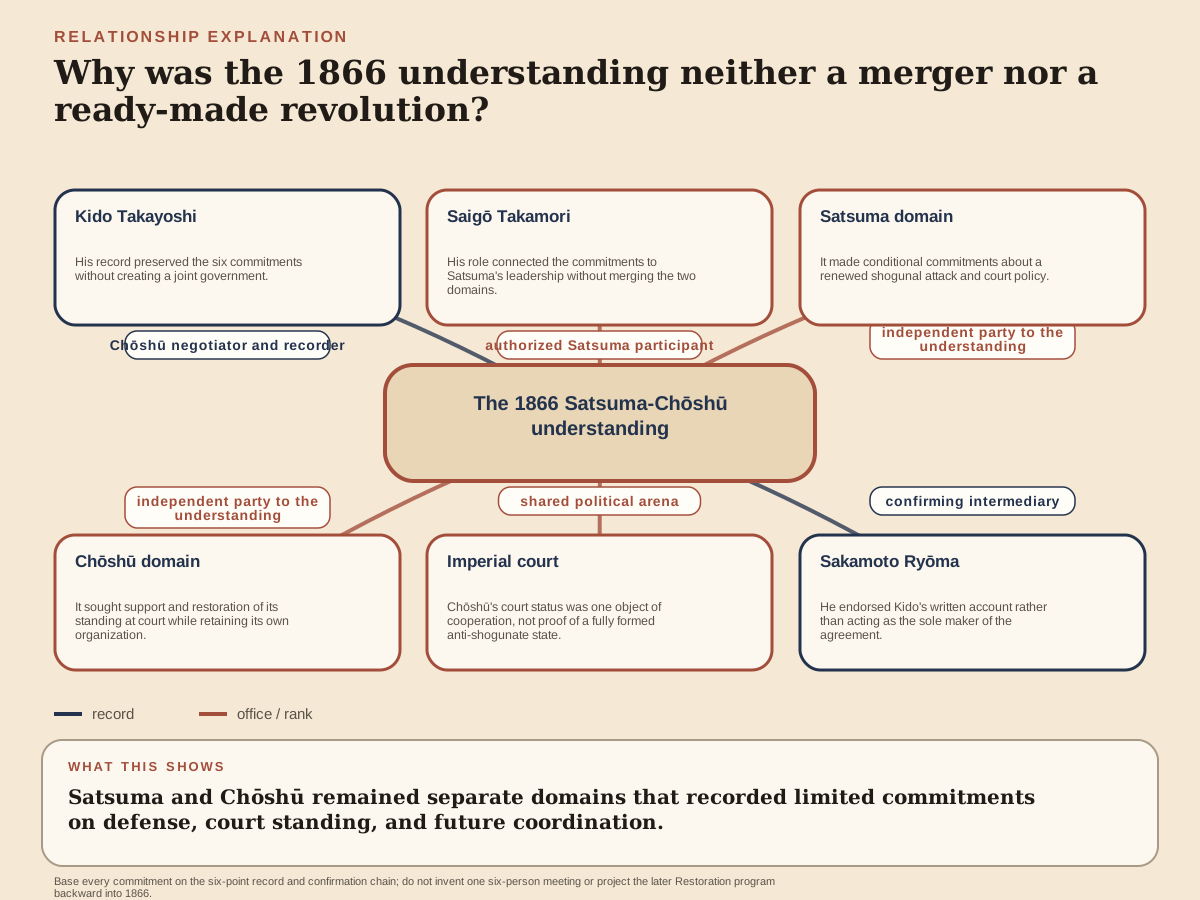
In early 1866 Katsura represented Chōshū in negotiations with Saigō Takamori, a Satsuma leader, and his colleagues. The two domains had fought in Kyoto less than two years earlier. Chōshū needed protection against isolation and another campaign; Satsuma wanted to prevent the bakufu from defeating rivals separately. The understanding set out how Satsuma would respond if the bakufu attacked and how it would support Chōshū's restoration at court. Katsura recorded six points and asked Sakamoto Ryōma to confirm them. [10]
Senior Satsuma councillor Komatsu Tatewaki and officials such as Ōkubo Toshimichi linked promises to domain authority; Nakaoka Shintarō and commercial networks helped connect the parties. Katsura's distrust remained visible in the need for confirmation. The agreement mattered because Satsuma acted consistently enough during the 1866 campaign. Taguchi Yuka's 2005 study distinguishes restoring court authority and Chōshū's standing from an agreement already committed to overthrow. The domains kept separate governments. [10]
After returning in 1865, Katsura had helped build a reform government now preparing for war. The domain had to reconcile armed companies, reorganize command, finance weapons, negotiate with branch domains, and prepare for another bakufu campaign. He served as a senior political coordinator. Military reform relied heavily on Ōmura Masujirō and officers who reorganized units, training, artillery, and supply. Takasugi retained influence while illness reduced his later role. Farmers, townspeople, merchants, sailors, and local officials sustained forces whose social composition extended beyond hereditary warriors. [1]
The second bakufu expedition opened fighting on four fronts in 1866. Chōshū units defeated or contained larger coalition forces, aided by terrain, mobile tactics, modern arms, uneven commitment among attacking domains, and the death of Shogun Tokugawa Iemochi. Victory restored political leverage. It did not prove that Chōshū had become a complete modern nation in miniature or that Katsura commanded every battle from the council chamber. [15]
Katsura began using Kido Kanji in 1865 under domain authority and subsequently used Jun'ichirō and Takayoshi. Kōin is another reading of the characters for Takayoshi, not a separate identity. As Chōshū regained national influence, he helped coordinate its part in replacing Tokugawa government. After the 3 January 1868 Restoration coup, he entered central offices concerned with policy and foreign affairs. [1]
That reversal depended on court action, Satsuma cooperation, military victory, and the young emperor's authorization. Toba-Fushimi opened civil war, and Chōshū troops fought on multiple fronts. Kido's problem changed. Opposition could unite around removing Tokugawa rule; government required offices, revenue, law, and a way to keep Satsuma and Chōshū from simply returning to separate domain sovereignty. [15]
Kido helped shape the Charter Oath, but he did not begin from an empty page. Yuri Kimimasa produced an initial statement on deliberative government; Fukuoka Takachika revised it; Kido then altered the text that became five principles. On 6 April 1868, Emperor Meiji swore the Oath before court nobles and domain lords in the Kyoto palace. It invoked broad deliberation, social purpose, rejection of bad customs, and knowledge sought across the world. A companion imperial text and public proclamation situated the principles within emperor-centered rule. [1]
The ceremony occurred during the Boshin War, the 1868–69 civil war between the imperial government and Tokugawa supporters. “Public discussion” did not mean universal suffrage, party government, or equal citizenship. The government was defining a coalition while fighting opponents. Later constitutional movements treated the Oath as a promise they could invoke. That reception matters, but it must not be backdated as Kido's complete plan for the Imperial Diet created decades later.
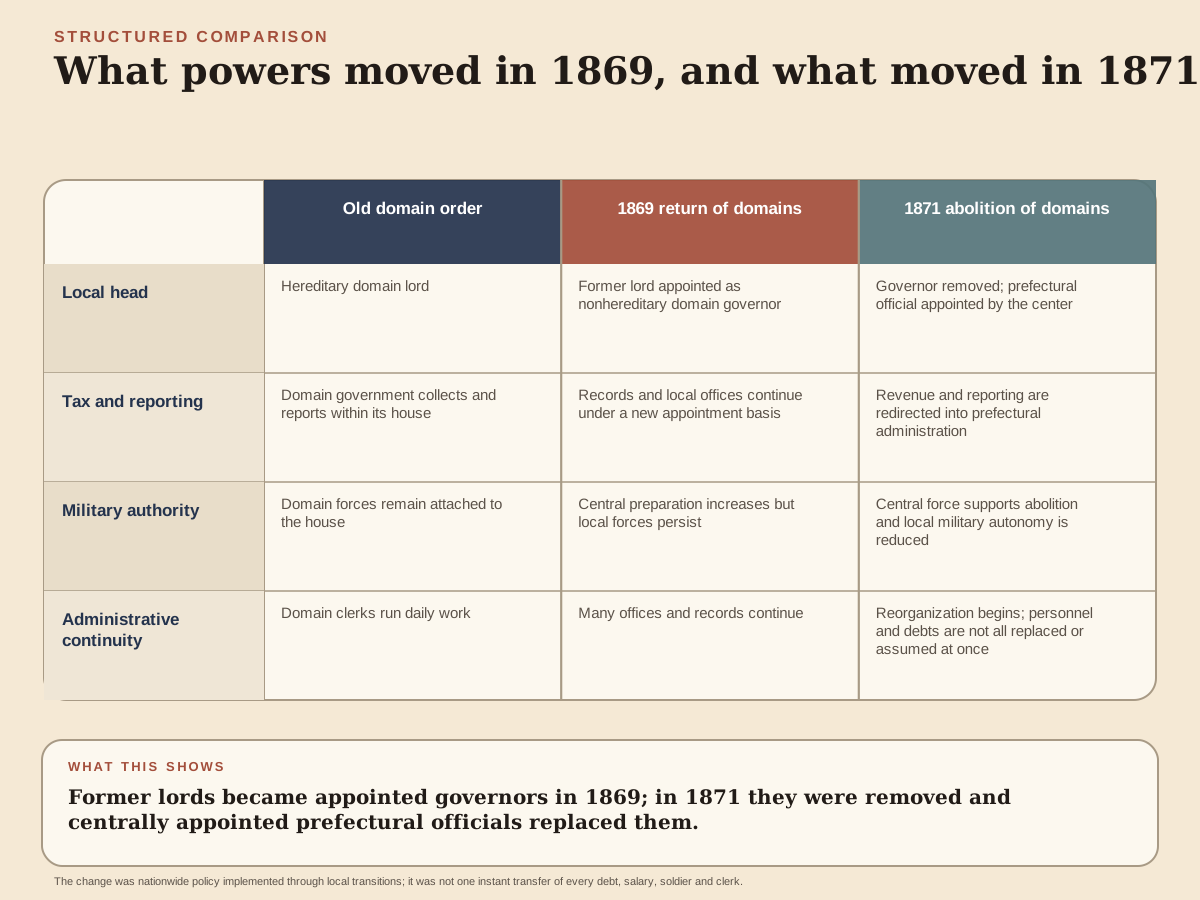
Kido urged the leading Restoration domains to return their territorial registers and governing claims to the emperor. In early 1869 Chōshū, Satsuma, Tosa, and Hizen submitted coordinated petitions; most other lords followed. The action was presented as loyal return rather than confiscation. The government then reappointed many former lords as governors of the same territories. Legal sovereignty shifted faster than administration. Domain officials still collected taxes, commanded retainers, and knew local records. Kido and Ōkubo concluded that stronger centralization was necessary. [1]
In 1871, with Saigō helping secure an imperial guard, a small leadership group prepared full abolition. Domain governors were summoned and informed that prefectures would replace their governments. The strategy combined language, compensation, secrecy, administrative reuse, and credible force. It reduced open resistance but did not make the transition voluntary for retainers or taxpayers whose obligations changed. [1]
Kido departed in December 1871 as an Iwakura Mission vice ambassador. The large embassy included diplomats, secretaries, specialists, interpreters, attendants, and students. It sought recognition, explored treaty revision, and studied institutions across the United States and Europe. The leaders' attempt to negotiate treaty revision exceeded their original authority. Ōkubo and Itō returned to Japan for credentials, yet negotiation still failed. Kido observed schools, government, industry, and law within this unequal diplomatic setting. In Germany he asked Aoki Shūzō to prepare constitutional proposals. [1][2]
The proposed constitution required political choices in Japan. After returning, Kido presented reasoning based on Aoki's work to the government and published it in Shinbun Zasshi. He pursued education and staged constitutional development as foundations for the new state, while the leaders who had stayed in Tokyo had already made far-reaching reforms.
Kido returned to a government facing Korea's rejection of diplomatic language associated with Japan's new imperial titles. Its leaders were debating Saigō's proposed mission to Korea. The conventional interpretation sees it as a possible route to war; Mōri Toshihiko argued that Saigō intended peaceful negotiation. Namihira Tsuneo discussed both interpretations in 2010 without deciding Saigō's intention. Kido joined Iwakura and Ōkubo in opposing immediate dispatch while domestic institutions remained unsettled. [14]
On 24 October 1873 Meiji accepted postponement after Iwakura's appeal. Saigō and four other councillors resigned. Kido's illness limited his participation, and victory did not remove differences among the opponents of dispatch. He would soon object to the government's Taiwan expedition and leave office himself. [5][14]
Kido opposed the 1874 expedition to Taiwan, which used the killing of Ryukyuan castaways to justify military action against Indigenous communities. He resigned as councillor in May. His dissent narrowed the government but did not stop troops from landing or Ōkubo from negotiating with Qing China. Political isolation, popular-assembly demands, rebellion, and external crisis encouraged negotiation. At the 1875 Osaka Conference, Kido, Ōkubo, and Itagaki agreed on gradual constitutional measures and the return of Kido and Itagaki to government. [1][4]
The April edict announced movement toward constitutional rule and created the Genrōin, a council reviewing legislation, and the Great Court of Cassation, the highest judicial body. Kido chaired the first Local Governors' Conference in June. These were appointed and consultative institutions, not a sovereign elected parliament. Disagreement continued. Kido resigned again in 1876 and served as adviser. His constitutionalism sought rules, courts, and wider counsel while retaining emperor-centered, staged change. [8][13]
The Satsuma Rebellion began in February 1877 while Kido was already chronically ill. He wanted the crisis resolved and participated as health allowed in government discussion, but he did not travel to command the Kyushu campaign. His condition worsened in Kyoto. Matsuko traveled to care for him, physicians attended, and political colleagues exchanged reports while battles continued. Emperor Meiji made an exceptional visit to Kido's Kyoto residence on 19 May. Kido died there on 26 May, four months before the war ended. [1][6]
Later accounts assign him a dramatic final appeal to Saigō or a perfectly lucid judgment on former comrades. The date, place, illness, visit, and death are strong; an exact terminal scene is not. He did not see Saigō's death, the 1889 Constitution, or the Imperial Diet. [1][6]
Kido left constitutional proposals but no opportunity to judge the system enacted after his death. Itō Hirobumi, Yamagata Aritomo, Inoue Kaoru, and other Chōshū-associated leaders continued to shape government while disagreeing among themselves. The Constitution promulgated in 1889 and Imperial Diet opened in 1890 combined representation with strong imperial and executive authority. They can be related to questions Kido pursued, but not called the simple fulfillment of his design. Matsuko lived until 1886 and helped sustain household memory. [9]
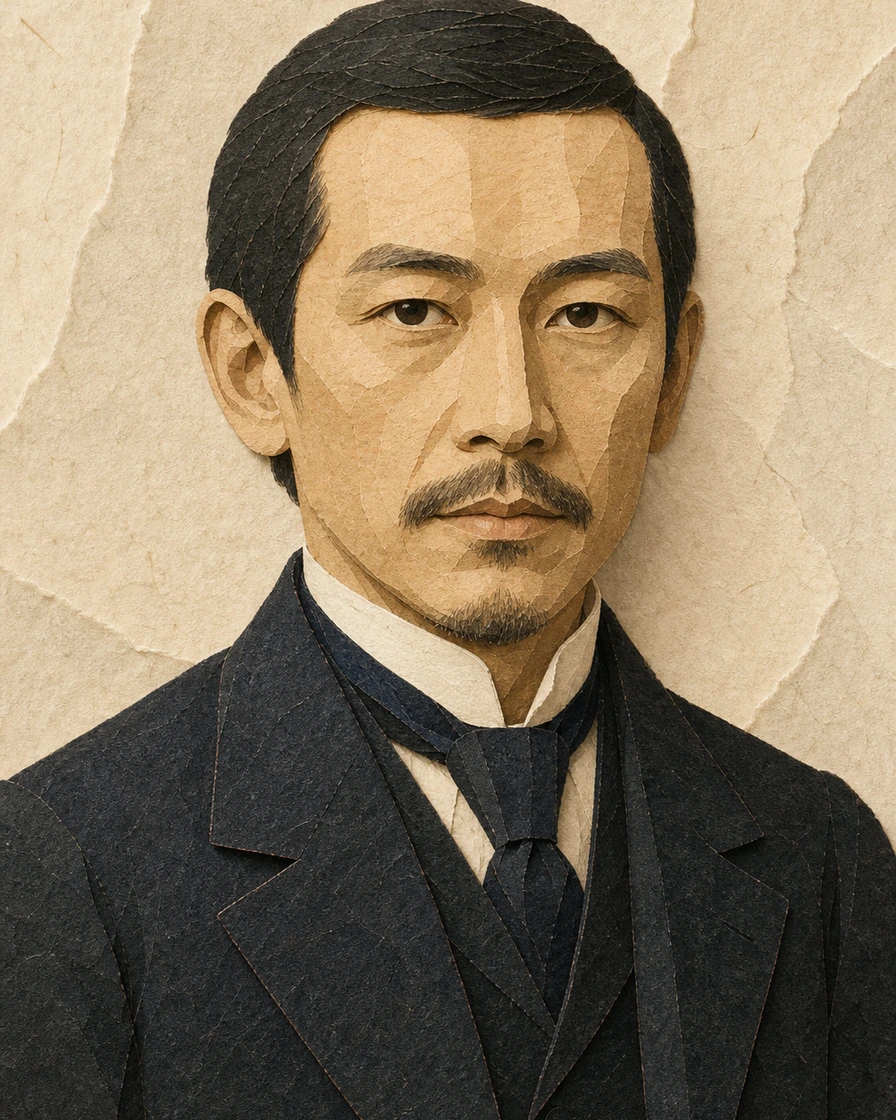
An engraved portrait commissioned by Kido Takamasa and issued by the Finance Ministry's Printing Bureau in 1887 presented Kido with his official title and honors. Graves and household papers also placed him in a founding story alongside Saigō and Ōkubo, often called the Restoration's "three heroes." His advocacy of deliberation and his leadership within a narrow domain coalition both left evidence. The classification made these mixed careers easier to remember, while later institutions and policies continued to develop beyond the men's own decisions. [3][12]
Classic
Kido Takayoshi was born Wada Kogorō on 11 August 1833 in Hagi, the castle town of the Chōshū domain in western Honshū. His father, Wada Masakage, was a domain physician. In childhood the neighboring Katsura warrior household adopted him as heir, giving him the surname under which he first became politically prominent. His adoptive parents died early. He spent much of his youth back in the Wada home while keeping his Katsura identity and the obligations it carried. Medicine, household succession and warrior service provided overlapping routes into the domain order. [1]
Kogorō studied at the Meirinkan, Chōshū's school for its retainers, where academic and military instruction served domain needs. In 1849 he briefly studied military subjects under Yoshida Shōin. This preceded Shōin's later teaching at the private Shōka Sonjuku school and his execution in 1859. Kogorō encountered him as a young teacher within Chōshū's educational system, not as the martyr around whom later Restoration memory would gather. [7]
Hagi's schools and households depended on the resources of the domain around them. A physician's son with warrior status could seek instruction unavailable to most subjects. Kogorō's teachers and family connections enlarged these opportunities, but appointments still required Chōshū's approval. Leaving for Edo would put him among retainers from other domains at a moment when foreign defense was beginning to unsettle their inherited duties.
His continued residence in the Wada home helps distinguish household identity from everyday care. The Katsura adoption remained legally important even when he lived with his birth family. When he left Hagi for Edo in 1852, he traveled as a Chōshū retainer whose education and responsibilities had been formed through both households.
In 1852 Katsura went to Edo, today's Tokyo, and entered Saitō Yakurō's Renpeikan, a school teaching Shindō Munen-ryū swordsmanship. Skill could win a reputation among men from different domains, opening relationships that rank alone did not provide. Students exchanged news and introductions while remaining answerable to their own lords. Katsura also pursued Western military subjects. Coastal defense required artillery, surveying and ships as well as personal martial ability. [1]
The American commodore Matthew Perry's arrival in 1853 made this mismatch visible. Steamships could enter a bay beyond the reach of most existing batteries. Consultation by the bakufu, the Tokugawa shogunal government, with lords distributed responsibility while revealing the absence of unified policy. Chōshū students in Edo had to report information home, where elders would decide which knowledge became expenditure. Artisans made equipment and translators explained foreign texts; military study depended on more than a sword instructor. Rangaku (the study of European knowledge through Dutch-language books) and newer English learning moved through interpreters and imported books. Political biography often turns their work into one samurai's awakening. Domain support imposed limits. Katsura's study was possible because Chōshū sent and maintained retainers for useful learning. Reports and permissions tied him to official purpose. Independent curiosity existed within a system able to recall, appoint, or punish him. [15]
Shōin's failed attempt to board Perry's ships led to imprisonment, while Katsura continued authorized study. Both sought foreign knowledge, but their institutional positions and tactics differed. Katsura's martial reputation helped him speak to armed activists; his domain credentials also allowed him to bring arguments and information before officials. His later work would require both forms of access.
Edo therefore enlarged his world in a precise sense. It showed that every domain faced the same foreign ships through separate chains of command and unequal technical resources. Recognizing a shared problem did not yet create a national government capable of solving it. Appointments after study show how knowledge returned to service. By 1858 Katsura held inspection and guard responsibilities, and in 1859 he was assigned to work connected with Chōshū's Yūbikan military institution. These posts converted reputation into domain duty; they did not grant independent authority to make foreign policy. Promotion remained revocable when policy changed.
Yoshida Shōin's execution during the Ansei Purge in 1859 sharpened conflict with the shogunate for many Chōshū associates. Katsura's technical study did not prescribe one political response. A retainer might recognize the strength of foreign navies yet oppose treaties made without imperial approval. Chōshū also had an alternative to expulsion: in 1861 Nagai Uta proposed opening the country through cooperation between the court and shogunate. Lord Mōri Takachika initially accepted it. Katsura and other opponents helped displace that policy. The domain's later militancy followed a struggle within its own government, rather than a unanimous purpose inherited from Shōin. [5]
Former pupils disagreed over timing, violence, foreign learning, and relations with the lord. Katsura's offices—inspection, guard, and military-study duties—embedded him in the domain rather than outside it. He could carry intelligence and organize contacts because he had credentials. Radical influence remained dependent on Mōri decisions and senior councils. Kyoto changed the scale. Court nobles could lend imperial language to a domain's programme, while domains supplied armed men and money. Chōshū activists worked with Sanjō Sanetomi and others to press the bakufu toward a publicly fixed expulsion date. Control of palace access became a material political resource. At Shimonoseki, Chōshū batteries attacked foreign merchant and naval vessels in 1863. The action involved commanders, gunners, coastal installations, and local communities. [5][15]
Katsura participated in the political coalition supporting expulsion, while commanders and gunners carried out the attacks. Foreign retaliation brought bombardment and disrupted commerce at Shimonoseki. The cost fell on coastal communities as well as domain forces. Emperor Kōmei's opposition to treaty policy did not amount to approval of every Chōshū initiative. Aizu and Satsuma feared the domain's influence over the court, and nobles themselves disagreed. The language of imperial service concealed competing claims to control the palace.
By 1863 foreign policy had become a struggle over who could speak for Japan. Chōshū sought court approval to give its program national authority, while the shogunate and other domains disputed its claim. The same palace gates that had given Katsura's allies access could be secured by another armed coalition. When that happened, imperial language would be used to exclude men who had claimed to act in the emperor's service.
The palace coup on 30 September 1863—the eighteenth day of the eighth month in the Japanese calendar—joined court officials, Aizu's Kyoto security role, Satsuma force, and Kōmei's distrust of radical plans. Chōshū was dismissed from gate duty; allied nobles lost position. A coalition able to secure the palace made its interpretation authoritative. The seven nobles' departure turned Chōshū into refuge and sponsor. Escort, lodging, communication, and support created ongoing obligations. Their presence also allowed activists to claim that excluded court authority remained with them. The court was therefore divided across place as well as opinion. Katsura's work after expulsion involved contacts and arguments about return. Later memory often makes him the single voice of caution against a reckless Chōshū. Evidence supports concern and political calculation, but the domain's policy emerged from councils, commanders, noble allies, and armed companies. [15]
In the summer of 1864 the Shinsengumi, a warrior policing force defending bakufu authority in Kyoto, raided activists at the Ikedaya inn. Katsura's exact movements during the famous raid are less secure than the arrests and deaths it caused. Demands for an armed return grew inside Chōshū. On 19 August 1864—Genji 1, seventh month, nineteenth day—its forces fought at the palace approaches and were defeated by defenders including Aizu and Satsuma. Kurushima Matabei and Kusaka Genzui died. Katsura was politically connected to the attempt, but he did not exercise uncontested command over its units. [15]
Fire spread through Kyoto, destroying a large part of the city. Wind, combat, incendiary action, and urban building conditions combined. Residents lost houses, shops, tools, manuscripts, and livelihoods. An account focused only on honor at the palace treats their disaster as scenery. The court declared Chōshū an enemy, and the bakufu prepared punishment. At the same time, foreign fleets attacked Shimonoseki. Domain leaders confronted military defeat from both Japanese and foreign coalitions. The programme that had promised national purification produced isolation. Katsura now faced personal danger and institutional collapse. Remaining visible in Kyoto would invite arrest; returning through official channels was uncertain because conservative leaders gained strength in Chōshū. Survival required people willing to hide, guide, feed, and misidentify him.
Almost eleven months separated the palace coup of 30 September 1863 from the Kinmon fighting of 19 August 1864. Chōshū had tried to recover court influence through increasingly forceful action and ended condemned as an imperial enemy. Before it could again claim a national role, the domain had to rebuild authority at home. Katsura, meanwhile, needed a route out of Kyoto and people willing to conceal him.
After the 1864 defeats Katsura hid in Tajima, a province north of Kyoto in today's Hyōgo Prefecture. Local helpers moved him through the Kusahata checkpoint and among Kinosaki, temple refuges and Izushi. The Hiroto family provided important local help. At Izushi he used the name Hiroe Kōsuke and the cover of a small goods shop. Concealment depended on households willing to feed and shelter a fugitive whose identity could bring investigation to their door. [7][12]
Ikumatsu's assistance connected Katsura's household to the networks protecting him. Born Kazu, the daughter of an Obama-domain retainer, she became a Kyoto geiko, a professional entertainer trained in music and dance, after family disruption. Her work created income, contacts, and access while exposing her to gendered vulnerability. She aided Katsura's activism before later becoming Matsuko. Her journey in the spring of 1865 to Izushi, and the guides who helped, show that household formation and political infrastructure overlapped. Later devotion narratives can reduce her to loyalty without asking what risks she chose or what information she controlled. Inside Chōshū, the conservative “submission” government punished leaders after the first bakufu expedition. Three senior councillors were ordered to die, armed companies faced dissolution, and reformists were pursued. The domain's earlier radical programme seemed defeated. [12]
Takasugi Shinsaku, another Chōshū activist, began the challenge to conservative rule while Katsura remained in hiding. On the fifteenth day of the twelfth month of Genji 1, in the winter of 1864–1865, he began a rising at Kōzanji with a small force; Itō Shunsuke, later known as Itō Hirobumi, and armed units joined. Fighting at Eshō and other locations expanded the movement. Irregular corps were not one homogeneous democratic army: their composition, commanders, and local relations varied. Victory depended on soldiers, money, ports, weapons, clan branches, and Mōri decisions, as well as Takasugi's initiative. Conservative authority fractured. The change opened space for the return and appointment of men formerly hunted. Katsura's re-entry in spring 1865 added political coordination, contacts, and a figure able to negotiate among lord, officials, and armed reformers. It did not retroactively place him at the first muster. Giving him total authorship would erase the risk assumed by those who acted while his whereabouts were uncertain. [12]
Katsura survived through local cooperation while Takasugi and the armed companies overturned conservative government in Chōshū. The two developments converged when it became possible for him to return in 1865. Ikumatsu and the people helping them travel shared risks that did not end when the statesman left. His return preserved an experienced political coordinator; it followed a change already won by others inside the domain.
Early in 1866, before the second punitive campaign, Katsura entered negotiations with Satsuma. Chōshū's reformed forces were stronger, but court condemnation and bakufu orders left the domain politically isolated. Satsuma possessed court access and an expanding maritime-commercial network. Each domain had something the other could not produce quickly. Former hostility made verbal reassurance inadequate. Satsuma troops had helped defeat Chōshū at Kinmon, and Satsuma had participated in the first punitive expedition. Katsura's caution was therefore rational rather than evidence of a naturally suspicious personality. Saigō Takamori, a Satsuma leader, conducted the core negotiation, while Katsura represented Chōshū. Komatsu Tatewaki's standing as a senior Satsuma councillor connected the promises to domain authority; Ōkubo Toshimichi linked the agreement to the policy of Shimazu Hisamitsu, Satsuma's leading dynastic figure; Sakamoto Ryōma and Nakaoka Shintarō carried information across hostile networks. None alone possessed both sides' command. Katsura recorded six contingent promises. If war began, Satsuma would send troops to secure Kyoto and Osaka as support behind the fighting front. It also promised to work at court to remove Chōshū's condemnation. These were concrete obligations under particular circumstances, not a merger of the domains. [10]
Ryōma's written confirmation authenticated Katsura's understanding of oral discussions. It did not transform Ryōma into the legal author of a treaty. Material cooperation preceded and accompanied the political terms. Chōshū sought weapons through Satsuma-linked channels; grain and shipping connected the domains. Nagasaki merchants, brokers, crews, foreign traders, and interpreters made strategic alignment tangible. Their participation carried commercial interests as well as patriotic narratives. Hisamitsu and Mōri authority remained necessary. Lower-ranking activists could meet, but domain names, troops, and treasuries belonged to lordly governments. Alliance was partly a method for reformers to redirect hereditary institutions rather than abolish them at once. The second expedition tested credibility. Satsuma refused meaningful participation in suppressing Chōshū and opposed bakufu coercion. Chōshū's own forces then won on the ground. [10]
Satsuma's refusal to support suppression reduced Chōshū's isolation during the second expedition, while Chōshū's own units fought on the fronts. Written confirmation gave Katsura grounds for expecting assistance without removing distrust. Both domains retained separate leaderships and interests. They would cooperate against Tokugawa power and later compete over offices and policy inside the Meiji government.
Historical disagreement · What did the Satsuma–Chōshū agreement initially seek?
Historians have differed over the agreement's immediate purpose. An older interpretation presented it as a military alliance already committed to overthrowing the shogunate. In her 2005 study of the war's political effects, Taguchi Yuka emphasizes restoration of court authority and the removal of Chōshū's condemnation, with Satsuma providing wartime support. The six recorded conditions matter to that distinction.
Cooperation would help make regime change possible, but that later result should not be substituted for every participant's purpose at the time.
By early 1866 Chōshū's reformists had displaced the conservative leadership, but preparing for war exposed continuing conflicts. Irregular corps had won political power through arms and expected recognition, pay, and influence. Senior retainers feared uncontrolled units. Mōri authority still authenticated government. Katsura's work lay partly in connecting forces that did not naturally form one chain of command. Ōmura Masujirō's military contribution was distinct. Trained through medical and Western-learning networks, he emphasized organization, firearms, artillery, and tactical allocation rather than hereditary status alone. His appointment by Katsura and domain leaders shows political sponsorship; it does not make Katsura the technical author of Ōmura's system. The corps varied. Kiheitai became famous for recruitment across status lines, but mixed composition did not eliminate hierarchy, discipline, or local coercion. Other units had different origins and commanders. [1]
Later national-army history selectively celebrated them as precursors while suppressing corps that resisted post-Restoration demobilization. Finance and procurement were as important as drill. Shimonoseki commerce, domain monopolies, loans, arms dealers, shipping, and Satsuma-linked acquisition moved rifles and matériel. Merchants and crews could change military balance without appearing in command lists. The bakufu's second expedition was not one army meeting another in a single field. Fighting opened at Ōshima, Geishū, Iwami, and Kokura. Commanders including Ōmura and Takasugi-associated officers responded to local conditions. Island inhabitants and border villages endured occupation, requisition, evacuation, and property destruction. Bakufu numerical superiority concealed political weakness. Participating domains varied in enthusiasm and equipment; some had little desire to strengthen central Tokugawa command. Long supply lines and divided objectives reduced coordination. [15]
Chōshū fought close to its own administrative base and could move forces between threatened points. Shogun Tokugawa Iemochi's death at Osaka in the seventh month of 1866 in the Japanese calendar disrupted the campaign's authority. A truce followed through negotiation involving Katsu Kaishū and Chōshū representatives. Military success and coalition fatigue mattered together. The bakufu was not destroyed on the fronts, but its inability to compel a punished domain transformed national expectations. Katsura's political role included coordinating policy, communicating with the lord, and building external relations while field officers acted. He was neither absent from victory nor its generalissimo. Separating levels of action preserves the professional agency of Ōmura and the local knowledge of units. Victory also created future problems. Armed corps that had defended Chōshū possessed claims the new national government would later reject. [15]
The fronts demanded different operations. Ōshima was an island; Geishū and Iwami lay along land borders; Kokura required movement across the strait separating Honshū and Kyūshū. These victories gave Chōshū leverage beyond its own borders, even while it remained condemned by the court. Katsura would use that changed position in the negotiations leading to a new government.
After his return to Chōshū, Katsura began using the name Kido Kanji in 1865. The change occurred under domain authority amid continuing danger from shogunal suspicion. He subsequently used Jun'ichirō and the personal name Takayoshi; Kōin is another reading of the same characters, 孝允. The changing names followed his career from fugitive and domain leader to national official. In November 1867 Tokugawa Yoshinobu, the last shogun, returned governing authority to the emperor. This did not settle the Tokugawa house's place in a new government. Kido worked to recover Chōshū's standing as allies sought a new government. On 3 January 1868 armed coalition forces secured the palace while Iwakura and other courtiers proclaimed imperial restoration. [1][15]
Kido was an important Chōshū political figure, but he did not control Satsuma troops, imperial ritual, or every appointment. The new government immediately confronted whether Yoshinobu would surrender land, office, and military capacity. Toba-Fushimi transformed political exclusion into battle. Chōshū units joined Satsuma and other forces; imperial banners altered legitimacy, while artillery, commanders, transport, and defections decided operations. Boshin War continued after Kyoto and Edo through Ueno, the northeast, Aizu, and Hokkaido. Kido worked as official and policy adviser rather than field commander on every front. Regional communities experienced the new authority through requisition, battle, punishment, and administrative replacement. Chōshū's rise created distributive questions. Formerly hunted men acquired central office; defeated officials lost it. Appointments from leading domains supplied trusted capacity but encouraged “domain faction” criticism. [15]
Kido could advocate national institutions while relying on Chōshū networks to staff them. Foreign affairs added pressure. Treaty powers sought stable counterparts and protection for commerce. The new government could not suspend international obligations while civil war continued. Translators and former bakufu specialists were necessary because revolutionary legitimacy did not produce diplomatic expertise. The emperor's role should be neither inflated nor erased. Emperor Meiji was an adolescent sovereign whose name authenticated measures shaped by adults. His court presence enabled a national claim that no one domain could make alone. Over time his participation would grow within institutions Kido helped form. Kido's own experience of 1863–65 made the danger of factional government vivid. Court access could change overnight; armed companies could overturn a domain.
National office required more than defending Chōshū's survival. Kido had to negotiate with other victorious domains while maintaining a government responsible for foreign relations and war. His preference for articulated principles and regular institutions developed in this unsettled setting. Central authority was growing, but a representative system remained to be defined.
The Charter Oath was an 1868 statement of principles for the new imperial government. Yuri Kimimasa's initial draft drew on Fukui's reform discussions; Tosa official Fukuoka Takachika revised it before Kido worked on the final text. Broad deliberative language helped unite leaders with different plans. It did not settle a franchise or create an elected national legislature. Meiji swore the Oath before nobles and lords, giving their developing programme the form of an imperial commitment. [1]
The ceremony took place on 6 April 1868, the fourteenth day of the third month in the Japanese calendar. The Boshin War—the 1868–1869 civil war between the new imperial government and Tokugawa supporters—was underway. Promises of deliberation operated within a coalition still fighting opponents. The five principles were broad enough to support education, foreign learning and changes to inherited customs, leaving officials to decide how those commitments would become institutions.
Breadth gave the text durability. Later Freedom and People's Rights activists cited deliberation against oligarchic rule. Government leaders cited gradual fulfillment through controlled institutions. Both used real language while extending it into conflicts the 1868 drafters had not resolved. Kido's own later constitutional advocacy makes the connection significant but not complete. He would ask Aoki Shūzō for a draft and support staged institutions. Those later choices show continuing concern; they do not prove that the Oath secretly contained the 1889 Constitution or universal democratic intent. Other actors also made the Oath effective. Calligraphers, court officials, messengers, translators, and local governments reproduced and explained it. Subjects encountered it through proclamations shaped by administrative capacity. A principle unread or unenforced would remain palace language.
A companion imperial message placed the principles within sovereign authority and national purpose. Neither document specified how an elected assembly would be formed. Kido's later proposals and his critics' demands would turn that open language into an argument about who should participate, and how soon.
The new government lacked the immediate force and staff to seize every domain in 1869. A petition from victorious lords could turn surrender into exemplary loyalty. Once Satsuma, Chōshū, Tosa, and Hizen offered land and registers, other houses faced pressure to demonstrate equal service. Kido's Chōshū position made him central to coordination. Ōkubo and other leading-domain officials worked on parallel lines, while lords supplied the legal voice. Saying “Kido returned the domains” erases the difference between drafting strategy, lordly petition, imperial acceptance, and local implementation. Registers mattered because they represented governed households and taxable land. The older phrase “land and people” can sound like one elite transferring ownership of subjects to another. The reform changed jurisdiction without seeking popular consent from those entered in the books. [1]
Reappointing lords as governors made the first step workable. They now held office by imperial appointment rather than hereditary claim, but the same personnel and buildings continued much daily rule. The distinction was constitutionally significant and socially partial. Domain finances remained separate and unequal. Debts, stipends, monopolies, arsenals, schools, and troops complicated national policy. A center responsible for foreign relations and war could not reliably command resources still filtered through hundreds of administrations. The 1871 abolition was prepared secretly by Kido, Ōkubo, Saigō, Iwakura, Yamagata, and others. An imperial guard formed from leading-domain troops gave the center a force not dependent on obtaining each lord's permission after announcement. Coercive capacity reduced the need to use coercion openly. Former governors were ordered to Tokyo and offered treatment preserving high status.
Former retainers faced a less secure future as local offices and stipends were reorganized. Elite compensation was one reason structural change could proceed without a great rebellion by the daimyō, the territorial warrior lords. Implementation remained staged. More than three hundred prefectural units were consolidated, boundaries changed, and former domain officials entered new service. Debt recognition varied. Local subjects might encounter familiar officials carrying unfamiliar titles and orders. The strategy reveals Kido's political method. He favored a publicly legitimate step that altered the legal principle, followed by stronger administrative action once resources were ready. That sequence can be admired as prudent; it also concentrated decision among a very small coalition. Domain abolition opened the way to common taxation, conscription, and law. It did not itself determine whether those institutions would be representative or authoritarian. [1]
Common taxation and conscription would now depend on national decisions rather than separate domain permissions. The center had obtained the means to enforce them, but abolition did not decide whether its institutions would become representative. That question followed Kido into his study of governments overseas.
In December 1871 Kido left Japan as a vice ambassador of the Iwakura Mission, an official delegation visiting the United States and Europe. Domain abolition had only recently changed government at home. In Washington the mission attempted treaty revision without sufficient initial authority; Ōkubo and Itō returned across the Pacific for credentials, but negotiations still failed. Japan faced foreign consular jurisdiction and restricted control of tariffs, treaty privileges that the other powers would not readily surrender. Overseas institutions were therefore studied under unequal diplomatic conditions, not simply as admired models. Hosts arranged visits and interpreters mediated what delegates could ask and learn. [1]
A specific industrial visit brought training into view. On 3 September 1872 the mission visited the Whitworth works in Britain. Kido's diary, quoted in Uemura Shōji's study, noted powerful pressing machinery and two Brazilian military officers learning there. Equipment and the training of people appeared together in the same workshop. That observation does not by itself explain his entire education policy, but it gives a concrete setting for an interest otherwise easy to describe only in slogans. In Germany he asked Aoki Shūzō, a Chōshū-born diplomat working there, to prepare constitutional proposals. Aoki's language skills and study of Prussian law supplied knowledge Kido could not gather from visits alone. [2]
Aoki's constitutional work moved beyond private study abroad. Kido submitted reasoning based on it to the government in 1873 and had it published in the newspaper Shinbun Zasshi. This placed proposals before a wider readership while keeping them within a network of elite sponsorship. At home, leaders who had remained in Tokyo were implementing major reforms. Returnees would find both new institutions and colleagues whose authority had grown during their absence.
The constitutional comparisons did not supply one ready-made answer for Japan. Kido favored rules and deliberative institutions beyond personal bargaining among leaders, while worrying about stability in a state still forming. A monarch-centered constitution could combine those priorities without transferring immediate control to an elected chamber. The proposals brought home from the mission would have to survive disagreement among the people who governed Japan.
The mission leaders returned at different times and with different priorities. Kido emphasized education and constitutional order; Ōkubo stressed administrative and productive capacity; Iwakura held court-government authority. Their shared resistance to an immediate Korea mission did not erase disagreements over finance, offices, and pace. The left-behind government had not simply waited. It created institutions and commitments that affected households across Japan. Returnees accused colleagues of exceeding agreements; colleagues could answer that governing required decisions in their absence. The dispute was a struggle over both policy and ownership of the Restoration. The Joseon court rejected documents containing forms associated with Japan's new imperial titles and maintained its own diplomatic hierarchy. Japanese officials experienced this as refusal, but Korea did not exist to validate Japan's transformation. [14]
Historical disagreement · What did Saigō intend as envoy to Korea?
Saigō proposed going personally as envoy. The conventional interpretation sees his letters anticipating murder as evidence that the mission might prepare grounds for war. Mōri Toshihiko argued instead for an intended peaceful negotiation, treating that language as an attempt to persuade Itagaki.
Namihira Tsuneo set out both interpretations in his 2010 study without deciding Saigō's intention.
Kido opposed immediate dispatch while taxes, army obligations and administration were still being reorganized. After Sanjō Sanetomi, the government's chief minister, became incapacitated, Iwakura carried an opposing opinion to the emperor, who accepted postponement on 24 October 1873. [5][14]
Kido's health matters because heroic cabinet narratives assume constant presence. He had endured prolonged travel and recurring illness. His papers reveal political engagement, but not every decisive meeting should be reconstructed as an equal three-man performance. The resignations concentrated government around a narrower group while driving talented former ministers into opposition. Itagaki moved toward popular-rights organization; Etō entered events leading to Saga rebellion; Saigō returned to Kagoshima. Policy victory altered the field on which future resistance formed. Calling one side “modernizers” and the other “feudal militarists” fails. Etō was a judicial reformer; Itagaki became a constitutional activist; Saigō had built the central army. Kido and Ōkubo soon supported external coercion differently or disagreed about it. Modernity did not belong to one faction.
For Kido, postponement protected time for domestic institutions. What those institutions should be remained unresolved. His next conflict with the government over Taiwan would show that sequence could become a substantive limit rather than a temporary slogan. Budget conflict lay underneath the foreign-policy drama. Land-tax transition, conscription, ministries, education, and former-stipend obligations competed for revenue. A Korean mission could not be evaluated only through honor because mobilization, transport, occupation, or retaliation would require money and personnel. The cabinet's political arithmetic was also fiscal arithmetic imposed on taxpayers outside the room. Those taxpayers possessed no seat in the October council.
Taiwan made Kido's dissent concrete. The expedition invoked deaths of Ryukyuan castaways, but the government's policy also asserted Japanese sovereignty over people whose kingdom maintained relations with both Japan and Qing China. Indigenous Paiwan communities were attacked in territory Japan did not govern. Kido objected to the expedition and left the council in May 1874. His resignation distinguished him from Ōkubo's government, which continued the campaign and later used negotiation to secure withdrawal and political advantage. Dissent did not protect Taiwanese settlements or soldiers from the decision already made. The episode prevents treating the Meiji leaders as one oligarchy with no internal policy differences. It also prevents making Kido wholly anti-imperial by extrapolation. He had helped build a coercive central state and supported national strength; the evidence establishes opposition to this operation and sequence, not a complete doctrine for all future East Asia. [1]
At home, Itagaki and allies submitted the elected-assembly memorial. Saga rebellion introduced armed opposition. Kido's resignation and Ōkubo's concentration of power weakened the founding coalition. Political reconstruction became useful to all sides for different reasons. The Osaka meetings of January and February 1875 joined Ōkubo, Kido, and Itagaki through mediation by Itō, Inoue, and others. They agreed to gradual constitutional development and returns to office. Negotiation was not conversion of Ōkubo into a liberal or surrender of Itagaki's independent movement. The 14 April edict established the Genrōin as a legislative-review body, the Great Court of Cassation at the judicial apex, and a route to local-governor conferences. Appointment remained controlled by the government. Separation of functions advanced without ministerial responsibility to an elected chamber. [4]
Kido chaired the June Local Governors' Conference. Governors brought local administrative experience, but they were officials rather than popular representatives. The meeting could gather territorial information and debate regulations while leaving subjects indirectly represented at best. The gap mattered to Freedom and People's Rights activists. They could cite both the Charter Oath and the new constitutional promise in demanding a national assembly. Government could answer that gradual institutions were already fulfilling the principle. The same documents supported opposing timetables. Kido's return proved temporary. Friction over policy and the limited realization of agreements contributed to another resignation in 1876. He retained advisory and court-related roles rather than becoming a party organizer outside government. His method sought influence from within elite institutions even when he left a formal seat. [8][13]
He continued seeking public counsel and legal regularity through elite institutions, with imperial authority at their center. Agreement on gradual development did not settle who would control its pace or how much influence elected representatives would eventually acquire.
The Satsuma Rebellion forced Kido to confront a movement led by a former coalition partner. His earlier resignations had criticized government policy, yet he remained committed to the central state's survival. Opposition within government did not imply acceptance of regional armed reversal. His exact desired operational role is less important than the verified limit: illness prevented field command. Government forces operated under Prince Arisugawa, Yamagata, Kawamura, and other military leaders. Kido's name should not absorb battlefield responsibility because he worried over the conflict from Kyoto. Chronic illness had affected his work before 1877. Modern sources describe physical and mental strain, stomach or neurological symptoms, and worsening attacks, but diagnostic categories vary and retrospective medicine is uncertain. “Stress killed him” is an interpretation, not a clinical conclusion established by contemporary tests. [1]
Matsuko's care restores household agency. She had supported him as Ikumatsu during fugitive politics and later maintained the Kido household. Travel to Kyoto and bedside work were not decorative signs of devotion; they were labor performed while senior men continued public business. Physicians, attendants, messengers, and officials mediated access. A seriously ill patient does not continuously receive complete war information or dictate coherent policy. Documents produced around him record what others observed and chose to preserve. Meiji's visit on 19 May was exceptional enough to become commemorated at the residence. It reflected a relationship between sovereign and senior adviser and helped mark the site as political memory. The visit does not authorize a verbatim private dialogue unless directly documented and contextually secure. [6]
Kido died on 26 May at the Kyoto property acquired from a Konoe-family residence. Japanese age accounts can call him forty-five, while completed Gregorian years make him forty-three. Stating date and convention is safer than treating age numbers as contradictory. Later biographies repeatedly stage a final appeal to Saigō to stop. The sentiment may reflect reported utterance and his known concern. Terminal speech is especially vulnerable to memorial editing. The war continued through Kumamoto relief, retreat, and Shiroyama until September. Kido did not know its final course. Writing as if he understood Saigō's eventual defeat would impose survivor knowledge on the dying. [1][6]
Kido's death removed a critic from inside the founding leadership while the war continued. Burial at Ryozen in Kyoto linked him to Restoration loyalist memory. Matsuko's later burial beside him extended the household association. Ōkubo remained influential until his own assassination in 1878, but the developments after 26 May 1877 belonged to survivors, not a final policy issued by Kido. [3][12]
Kido died before the Satsuma War ended and before formal constitutional settlement. This chronological fact limits every legacy claim. Notes, drafts, and commissions establish his concerns; they cannot answer how he would have responded to the 1889 text, party cabinets, wars, or colonial rule. Itō's constitutional work drew on European study and Meiji political bargaining. Yamagata built military and administrative power through a different emphasis. Inoue pursued diplomacy and economic policy. Their shared Chōshū origins supported networks of trust and patronage, but “Chōshū faction” was not one inherited mind. The 1889 Constitution created an elected lower house within imperial sovereignty, a House of Peers composed of imperial-family members, hereditary nobles and imperially appointed members, ministers responsible to the emperor, courts, and defined rights subject to law. This structure resembled some of Kido's interest in gradual, monarch-centered constitutionalism. [9]
The exact allocation of powers resulted from later drafters and conflicts. The Diet's opening in 1890 gave opposition parties a budgetary arena. Participation was limited by sex, tax qualifications, and status. Kido's broad language of deliberation could be invoked to criticize such limits or to justify staged expansion. He could not arbitrate the argument. Matsuko's post-1877 life matters because memorialization was household work. She became a widow and later entered religious life before dying in 1886. Her earlier identity as Ikumatsu was increasingly folded into a loyal-wife story. That story preserved her assistance while narrowing her independent social history. Documents shaped Kido's image. Diaries and letters offer unusually rich evidence of doubt, disagreement, and institutional observation. Archive density can make one elite actor appear to contain the whole government. [3][9][12]
Family commissioning and official printing gave Kido's memory a dated public form. An engraved portrait issued in 1887 had been commissioned by the household head Kido Takamasa and others from the Italian artist Edoardo Chiossone. The Finance Ministry's Printing Bureau issued it with Kido's government title and honors. It presented an honored imperial servant, while also reflecting a family's choice about how he should be remembered. A different medium recalled fugitive politics: an 1894 color print showed Katsura evading pursuit with Ikumatsu's assistance. That paired image, described by the custodians at the Kinosaki inn, preserved her contribution within an increasingly familiar story of devotion. Neither portrait nor print measures the whole career. [3][12]
The institutions built after Kido's death had answered some of his questions and opened others by 1912. The elected Diet gave opponents a budgetary arena within strong imperial authority. His opposition to the Taiwan expedition remained part of a career that also helped concentrate state power. Portraits, household papers and graves supplied different ways to remember that mixture. They show the work of survivors, not Kido's approval of later constitutions, wars or annexations.