Read the article below. Interactive reading tools are available when scripts load.
Quick
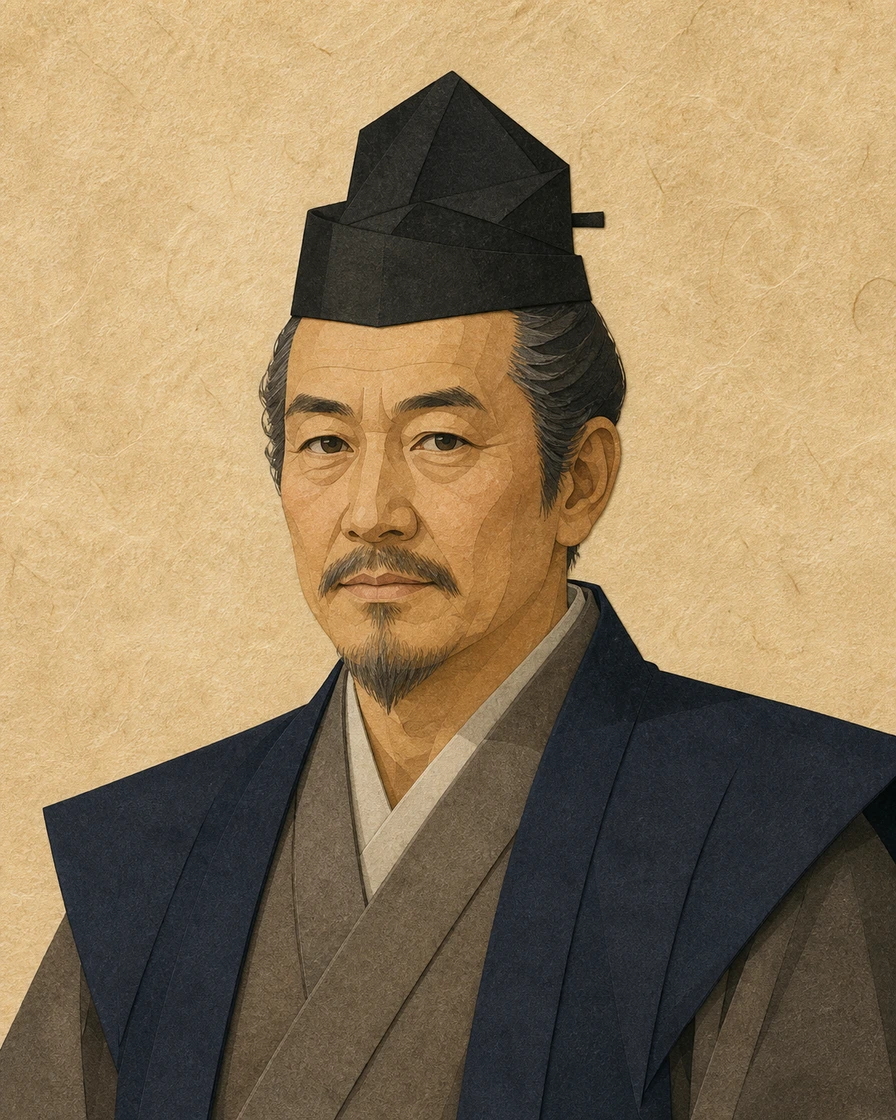
Horio Yoshiharu was born in 1543 into a local warrior family in Owari, now part of Aichi Prefecture in central Honshū. He entered Oda Nobunaga's service network and came to serve Toyotomi Hideyoshi while Hideyoshi was still Nobunaga's subordinate. His house did not yet have the independence of a daimyō, a territorial warrior lord. The later nickname 'Buddha Mosuke' describes an admired reputation, not a documented childhood temperament. [2]
As Nobunaga consolidated Owari and expanded outward, Yoshiharu advanced through service within Hideyoshi's following. A useful retainer needed to assemble men and sustain orders away from home. Holding positions and maintaining supplies mattered after a battle as well as during it. Yoshiharu's opportunities grew with the command above him.
Oda expansion carried Yoshiharu into wider campaign geography. A catalogued letter dated to early 1582 commends Tsubouchi warriors for service at Takato in inland Shinano and reports a planned movement toward Bizen, near present-day Okayama in western Honshū. It records the communication required to coordinate subordinates across distant assignments. Yoshiharu's service was becoming larger than a single local following.
In 1582 Akechi Mitsuhide attacked Nobunaga at Honnō-ji, a Kyoto temple, killing the ruler whose authority organized Yoshiharu's service. Hideyoshi defeated Mitsuhide, but Oda heirs and senior retainers still contested the succession. Yoshiharu continued serving Hideyoshi through that struggle. Hideyoshi's victory over the rival retainer Shibata Katsuie at Shizugatake in 1583 strengthened the coalition on which Yoshiharu's advancement depended.
Yoshiharu continued serving Hideyoshi through the struggles that established Toyotomi rule. By 1585 he held Sawayama near Lake Biwa at forty thousand koku, a measure of assessed rice yield and territorial income. The grant supported a larger following and responsibilities for collection and government. His appointment at Hamamatsu in 1590 expanded that territorial role.
After the 1590 Hōjō defeat, Hideyoshi moved Tokugawa Ieyasu, a powerful territorial lord, to the Kantō around present-day Tokyo and placed trusted retainers across former Tokugawa lands. Yoshiharu received Hamamatsu at 120,000 koku. Hamamatsu City's archaeological interpretation attributes stone walls and a tiled keep to the Horio decade; the nearby Futamata and Tobayama complex was also reworked. Yoshiharu did not erase Ieyasu’s castle or build on empty ground. He converted inherited earthwork centers into more visibly Toyotomi early-modern fortifications while governing the Tōkaidō corridor.
Near the end of Hideyoshi's rule, Yoshiharu transferred formal headship to his son Tadauji. The father remained active and influential, while the adult son needed standing to act in his own name. That distinction mattered when Tadauji served the Tokugawa side in 1600 and later obtained permission to relocate the governing seat.
In 1600, the Horio house aligned with Tokugawa Ieyasu’s eastern coalition. Tadauji’s recognized service was central; stories that Yoshiharu was wounded in a pre-battle altercation are less securely established than the house's service and grant. After victory, the house received Izumo and Oki, conventionally 240,000 koku, though Matsue documentation also notes a 235,000-koku source variant. Matsue's preservation plan records both figures.
The Horio initially governed from Gassantoda, a powerful inland mountain castle with a history of defense by the rival Amago and Mōri warrior houses. Its location and form were effective for warring-state defense but less suited to the Horio plan for a concentrated lowland administrative, commercial, and transport center. Tadauji and Yoshiharu examined the Suetsugu area by Lake Shinji, and Tadauji obtained permission from the Tokugawa shogunate, the warrior government led by the shogun, to relocate before dying in 1604. The choice did not condemn Gassantoda as useless; it reflected changed governing priorities and preserved Tadauji’s agency.
Tadauji died in 1604 before construction began. His young son Tadaharu inherited, while Yoshiharu returned to practical leadership as guardian. The grandson remained the recognized lord. The family's permission to move the seat survived Tadauji's death, but the project still needed preparation.
Construction at Kamedayama began in 1607 under Yoshiharu's direction for the young lord Tadaharu. A temporary residence allowed the guardian to stay near the work. Leveling enclosures and opening access routes prepared the site, while plots for townspeople and retainers organized the emerging town. The project began with the infrastructure required to build and govern a city.
In the later construction years, workers cut the inner moat and reused its soil to raise wet ground in the town. Specialized teams built the stone base and timber keep. Two prayer plaques dated to Keichō 16, conventionally labeled 1611, support the completion chronology. Yoshiharu directed the work for Tadaharu's house; officials coordinated the builders and labor needed to carry it out.
Matsue's moats and canals defended the castle and carried bulky materials and goods. They also drained and divided urban land and connected the town to Lake Shinji. Concentrated warrior households depended on suppliers using this waterborne system. Maintaining channels and banks remained a continuing task for townspeople and later governments, beyond the initial Horio construction.
Matsue Castle reached its recognized completion threshold in 1611, the year Yoshiharu died. The central infrastructure was functioning, although town construction continued. Tadaharu remained lord, and officials carried on administration and maintenance. No securely documented final inspection or farewell declaration links the two events.
Horio rule ended when Tadaharu died without an heir in 1633. Kyōgoku and then Matsudaira rulers altered the inherited seat. In 1875 most buildings faced dismantling. The former official Takagi Gonpachi sought support from Katsube Motoemon and his son, whose payment and negotiations helped preserve the keep. Repair in 1894 sustained it for new public uses before 1912.
Classic
Horio Yoshiharu was born in 1543 into a local warrior family in Owari, in what is now Ōguchi in Aichi Prefecture, central Honshū. His house belonged to the smaller landholding warrior world rather than the highest provincial rulers. Owari was divided among competing authorities. Oda Nobunaga's later predominance was still ahead. A family could have property and followers without the independence of a daimyō, a territorial warrior lord. [2]
Yoshiharu entered the expanding Oda service network and came to serve Toyotomi Hideyoshi while Hideyoshi was still Nobunaga's subordinate. The precise circumstances of first recognition are less secure than this adult career. Later encounter stories gave the successful retainer a dramatic beginning. [2]
Nobunaga's consolidation of Owari drew smaller warrior houses into a larger command. Yoshiharu's service developed within it, through Hideyoshi's following. A retainer answering orders also had to assemble his own men and sustain their service between campaigns. His authority was delegated. Advancement meant becoming useful to a superior whose own command was growing, rather than immediately acquiring an independent province.
Guard duty and the supply of men remained necessary after a position changed hands. An expanding lord needed retainers who could hold what an army had won. Responsibility for such work gave the retainer opportunities for further appointment, while making failure a danger to his own house.
The nickname Hotoke no Mosuke, roughly 'Buddha Mosuke,' presents an admired reputation for calm or kindness. This is a reputation preserved in later accounts, not evidence of his childhood disposition. The family's initial position gave Yoshiharu a local base from which larger service became possible. His future advancement depended on the patrons he served and the responsibilities they entrusted to him. Matsue, far away on western Honshū's Sea of Japan side, entered his career only after several changes of ruler and territory. [2]
Oda expansion carried Yoshiharu beyond his birthplace into central and western Japan. Service at greater distances required command that could endure away from its local base. Holding a position depended on supplies and communication as well as battlefield success.
A letter in Fukui's published catalogue of Horio documents, dated to early 1582, commends members of the Tsubouchi family for service at Takato in Shinano and reports a planned movement toward Bizen. It shows Yoshiharu communicating with subordinate warriors across the expanding campaign geography. The catalogue records its signature as 吉定, one of the earlier written names associated with Yoshiharu.
Campaign movement drew on local roads and communities. Orders to move men also meant obtaining provisions and reaching the next assigned position. The retainer's effectiveness depended on knowledge held by people along those routes.
Larger command increased his responsibility for coercion. It did not turn service into a purely civil occupation or remove the burdens imposed by military movement.
Hideyoshi's following operated within that wider expansion. Yoshiharu's fortunes grew through a patron who could coordinate campaigns and reward subordinates. Those acquired relationships would survive the loss of Nobunaga in 1582, although the authority governing them would have to be rebuilt.
In 1582 Akechi Mitsuhide attacked Nobunaga at Honnō-ji, a Kyoto temple, and Nobunaga died. The commanding figure of the Oda order was gone. Hideyoshi defeated Mitsuhide at Yamazaki, but Oda heirs and senior retainers still had claims to authority.
Yoshiharu continued with Hideyoshi. His existing service relationship gave that alignment a basis while exposing his house to the fortunes of a patron whose predominance was not yet settled. [2]
Hideyoshi could claim to avenge Nobunaga while developing power around himself. Other former Oda servants could contest that claim. Shibata Katsuie remained a strong rival, and settlement of the Oda succession did not bring immediate peace.
For Yoshiharu, continuity of service now required recognition from a center being formed through conflict. The same followers and experience could be retained under a new superior authority.
Hideyoshi's subsequent victory over Katsuie at Shizugatake in 1583 strengthened his ability to grant land and command service. Yoshiharu's alignment became a continuing obligation through the wars that established Toyotomi rule. It was a choice renewed across changing settlements, not one secure transfer on the day Nobunaga died.
Yoshiharu's service under Hideyoshi brought more substantial territory before the Hamamatsu appointment. By 1585 he held Sawayama in Ōmi, near Lake Biwa, at an assessment of forty thousand koku. Koku measured expected rice yield and served as a measure of income and territorial standing. The grant placed him among men able to maintain a substantial following. It also made him responsible for collection and government in a territory assigned by a superior ruler.
A larger retainer body needed regular income and orders. Yoshiharu's rise therefore increased the administrative work within his own house. Military command and land management remained linked because the resources of the territory sustained the men required for further service.
In 1590 Hideyoshi defeated the Hōjō at Odawara and moved Tokugawa Ieyasu into the Kantō, the eastern region surrounding present-day Tokyo. Former Tokugawa centers then needed new lords. Yoshiharu's appointment at Hamamatsu gave his house a larger territorial task within that redistribution.
Hideyoshi granted Yoshiharu Hamamatsu at 120,000 koku in 1590. The castle stood on the Tōkaidō corridor, the route connecting the central capitals with eastern Japan. Other trusted lords occupied former Tokugawa centers along it. [2][4]
The Horio phase brought high stone walls and tiled buildings to a castle already developed by Ieyasu. Hamamatsu's archaeological interpretation attributes a substantial keep to the same period, although that building does not survive intact. Later Horio construction overlaid earlier layers. Some evidence for Ieyasu's castle now lies beneath it. The sequence records physical rebuilding on an inherited seat. [4][5]
The Horio also reworked nearby Futamata and Tobayama with stone walls. Governing this territory involved a connected system of fortified and residential sites, not only the central tower at Hamamatsu.
Yoshiharu's decade at Hamamatsu joined territorial government to large construction. The house had to sustain service while adapting a former Tokugawa center to Toyotomi authority. Its work drew on specialized building knowledge and local resources. The post-Hideyoshi struggle in 1600 would end this phase. Experience gained in governing and remaking a castle territory could be carried elsewhere with the Horio household.
Hideyoshi's death in 1598 unsettled the authority through which the Horio had risen. An adult successor allowed the house to answer the coming crisis without first making an abrupt transfer. Father and son entered it with distinct roles and a shared territorial base.
Near the end of Hideyoshi's rule, Yoshiharu transferred formal leadership to his son Tadauji. The retired father remained politically active. The house now had an adult head and an experienced predecessor whose standing continued to matter. Tadauji needed authority to act in his own name. Retaining Yoshiharu's experience could support that transition while leaving their practical responsibilities overlapping.
In 1600 the Horio aligned with Tokugawa Ieyasu's eastern coalition. Tadauji served as the current head, with Yoshiharu still influential. Accounts of Yoshiharu being wounded in a pre-battle altercation remain less securely established than the house's service and subsequent reward. [1][2]
After victory, Tadauji received Izumo, including the area around present-day Matsue, and Oki, offshore islands in the Sea of Japan. Matsue's preservation plan gives an assessment of 240,000 koku and notes that some sources record 235,000. Both figures represent a large expansion from Hamamatsu. [6]
The grant required relocation into lands with established local authorities and settlements. Victory supplied recognition, but the incoming house still had to make its authority operate there. The Horio first occupied Gassantoda, an inherited mountain castle, rather than immediately founding Matsue. Existing defenses gave the new rulers a usable seat. Only afterward did they seek a different center near Lake Shinji, through a process begun while Tadauji was alive.
Gassantoda had been a major fortified center during the struggles between the Amago and Mōri houses. Its mountain defenses and associated settlement gave the Horio an immediate base after the grant. [1][6]
The new rulers sought more space to concentrate retainers and the commercial population supplying them. A center beside Lake Shinji would also offer closer access to water transport. Moving the seat changed the balance among those needs rather than proving the old castle had never been effective.
The Suetsugu area beside Lake Shinji already had a port settlement. Matsue's planning account credits Yoshiharu and Tadauji with selecting the new seat and records Tadauji obtaining permission from the shogunate, the warrior government headed by the Tokugawa shogun. [6]
The decision would reorganize an inhabited waterfront. Existing transport and commercial activity offered resources for a castle town, while the low wet ground created engineering demands. [6]
Tadauji died in 1604, before construction began. His permission and plans remained available to the family, but leadership of the building project passed to Yoshiharu. The transfer preserved a process already begun by the adult son.
Tadauji's young son Tadaharu inherited in 1604. Yoshiharu returned to practical leadership as his guardian. The grandson remained the recognized lord, while the grandfather's experience supplied adult direction. The arrangement linked continuity of the line to authority exercised by a predecessor. Retainers serving the child needed orders from adults able to govern and represent the house before the shogunate. [1]
The new seat was still a plan. The household had recently moved from Hamamatsu and continued governing from Gassantoda while preparing another transfer.
The intervening years do not have a securely reconstructed sequence of building milestones. They belong to the establishment of minority government and preparation for the project, not to an invented continuous construction scene.
Construction began at Kamedayama in 1607 and continued through 1611. A temporary residence enabled Yoshiharu to stay near the works. Leveling the main and second enclosures prepared the hill for fortifications and buildings. [6]
New or improved roads and waterways brought materials to the site. The city-scale project needed access before its keep could rise. The older Shirakata bridge was replaced from bamboo to timber in the construction account preserved by Matsue's planning history. That crossing connected the works to settlement that predated the castle.
Plots around Tenjinmachi, Suetsugu and Shirakata were arranged for townspeople, with warrior residential districts elsewhere. The allocation organized proximity to the new government and its customers. [6]
Yoshiharu could authorize and supervise work without providing all its technical knowledge. The domain's officials coordinated construction that relied on specialists and local resources. Collective execution took place within an unequal command. The priorities extended beyond a defensible residence. Roads, water and town plots were being organized to support a large household and the circulation on which it depended. [6]
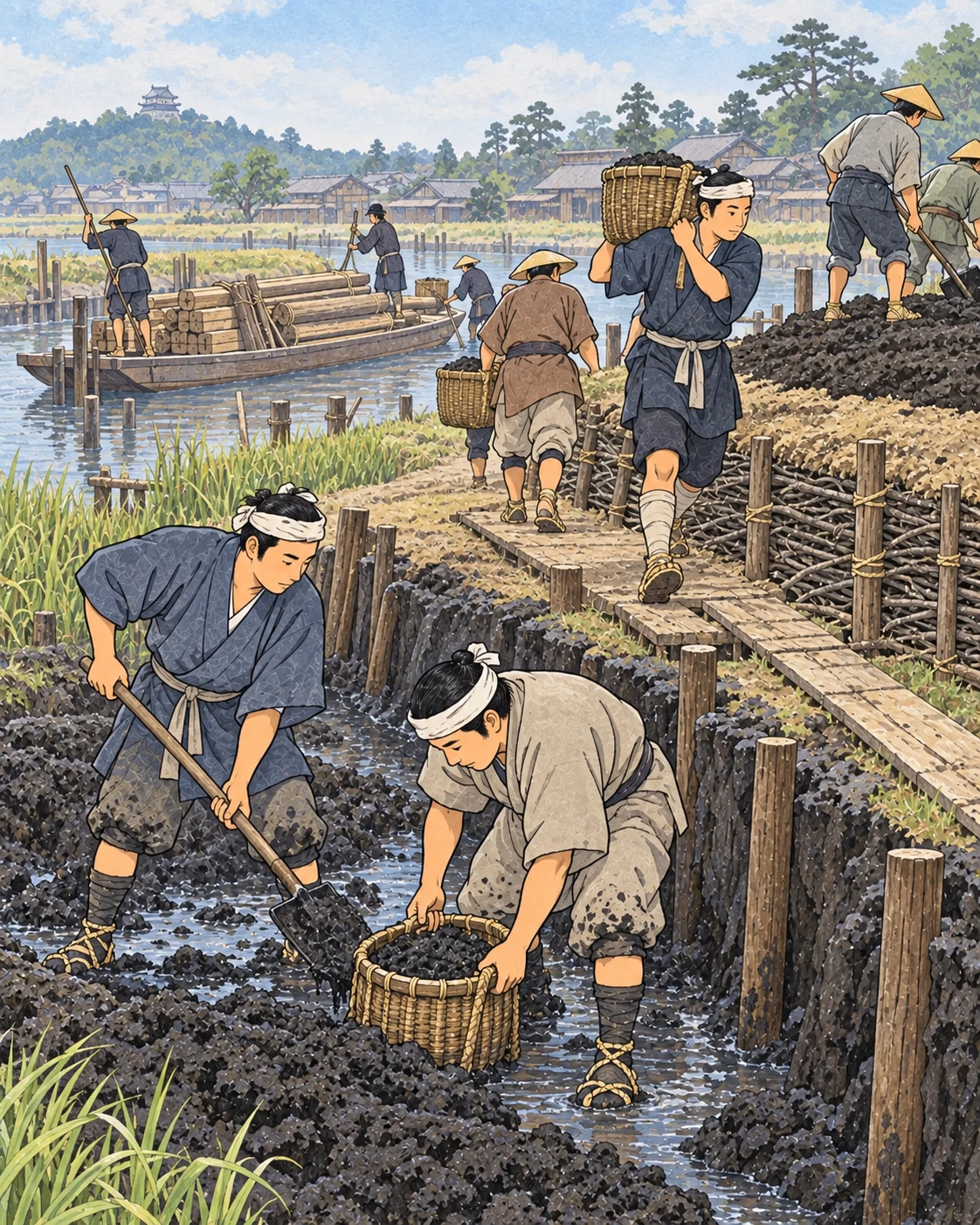
In the second-year construction account, work on the main enclosure and keep base accompanied excavation of the inner moat. Soil removed for the moat was used to raise wet ground for the town. Defense and land formation were connected operations. [6]
Reclaimed ground still required drainage and maintenance. Shaping the hill and surrounding lowlands created a foundation for urban growth while changing existing water conditions.
Specialized teams produced the timber frame and finished the keep. Its structural methods preserve choices made by builders, not evidence that Yoshiharu personally invented them. [3]
Two prayer plaques bear a Keichō 16 date, conventionally labeled 1611. Their inscriptions connect completion dating to ritual protection. The central castle had become functional, while town construction and later additions continued. [3][6]
Tadaharu's lordship supplied the project's dynastic authority; Yoshiharu provided practical leadership. Officials translated that authority into work undertaken by builders and laborers. The surviving keep preserves their material achievement through centuries of subsequent repair. [1]
Matsue's water system made the town operational. The inner moat protected castle enclosures, while broader canals connected districts and provided routes for bulky materials. Lake Shinji extended that circulation beyond the immediate works. [6]
On low and reclaimed ground, drainage remained essential. The same water that made transport possible could threaten the town when levels and flows changed.
Concentrated retainer households created demand for food and goods. Merchant districts and landing places connected those customers to suppliers. The domain could establish plots and obligations, but daily circulation depended on the people using the waterways.
Later Kyōgoku and Matsudaira governments adapted the center. Their changes belong to the life of the town after Horio rule, rather than to repeated construction by Yoshiharu.
Keeping canals usable required silt removal and bank repair. Bridges and outlets also needed renewal. The framework established under the Horio endured through continuing maintenance and changed uses. [6]
The castle reached its recognized completion threshold in 1611, the year Yoshiharu died. The official chronology places completion before his death, though it does not establish a personal final inspection or farewell declaration. [1]
Tadaharu remained lord. The central infrastructure could be used while residences and town works still required further construction.
The guardian's death removed the adult who had led the founding build. Officials and builders retained the knowledge acquired during it. Government and maintenance continued under Tadaharu, using institutions that did not depend solely on the grandfather's presence.
Yoshiharu left a functioning center begun through decisions made with his son and built for his grandson's house. Later completion of the full complex passed to other rulers. His role ended at the founding phase rather than extending through every later form Matsue took.
Tadaharu died without an heir in 1633, ending Horio rule. Kyōgoku Tadataka entered in 1634 but also died without an heir in 1637. Matsudaira Naomasa followed in 1638, beginning the much longer Matsudaira tenure. [1]
The castle's full form developed through those successive houses. Yoshiharu's initial framework became infrastructure used and altered by rulers with their own priorities.
Domain abolition changed the castle from a lord's governing infrastructure into property subject to disposal. In 1875 most buildings were sold and dismantled. The keep also faced removal at a price of 180 yen.
Takagi Gonpachi, a former domain official, sought support from Katsube Motoemon and his son. Matsue's preservation history credits their payment and negotiations, including intervention with the military authorities, with securing the keep on site. Its survival depended on nineteenth-century action, not the founder's foreknowledge. [1][6]
Preservation did not end with purchase. A major repair in 1894 sustained the keep for new public uses. By 1912 the building was already part of a landscape transformed by domain abolition and local efforts to retain it.
Matsue remembers Yoshiharu as a founder because he led its first early-modern construction. The structure through which that memory is encountered also records the work of his successors and later preservers.