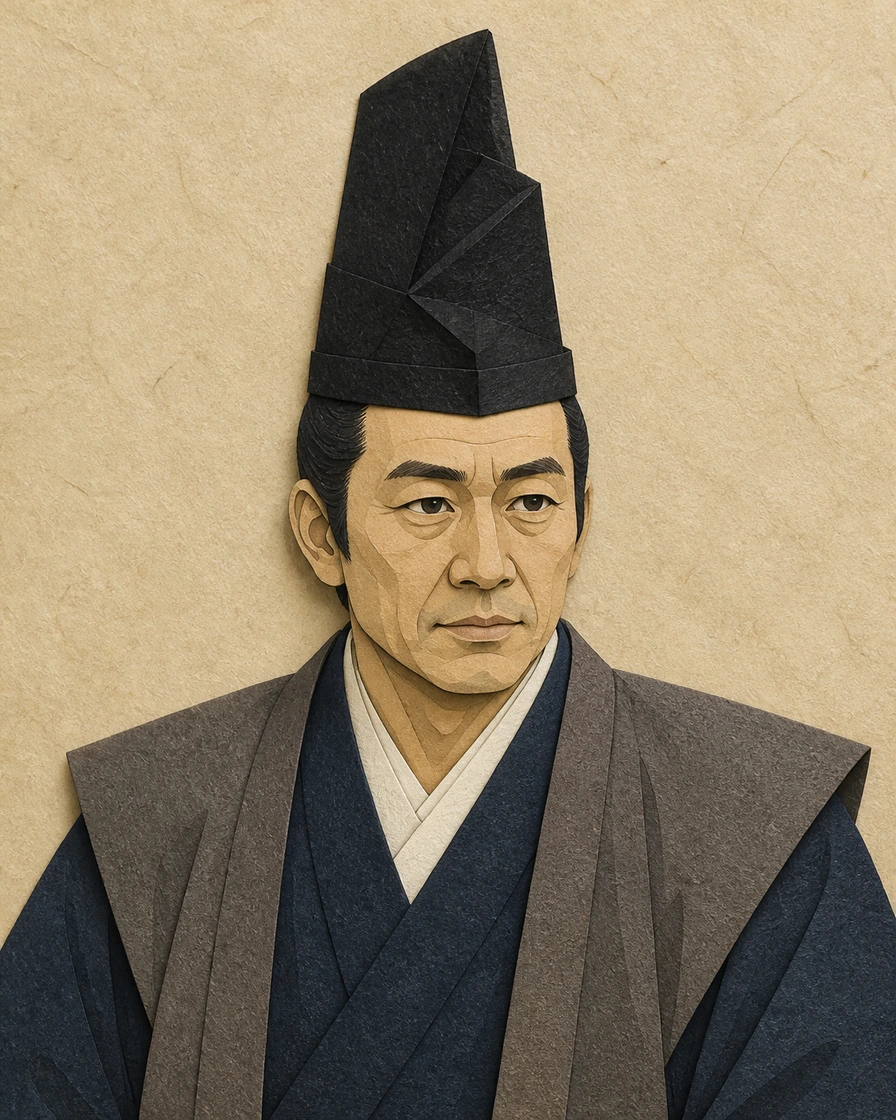
Read the article below. Interactive reading tools are available when scripts load.
Quick
Hōjō Yasutoki was born in 1183, the eldest known son of Hōjō Yoshitoki, a leading retainer in Minamoto no Yoritomo's emerging warrior government at Kamakura, south of present-day Tokyo. His childhood name was Kongō; he became Yoritoki at his coming of age and later took the name Yasutoki. Later genealogies name his mother as Awa no Tsubone but leave her origins uncertain. In 1194 Yoritomo sponsored his coming-of-age ceremony and arranged a marriage into the powerful Miura family. These public acts gave him a recognized place among the government's warrior households. [1]
Yasutoki's adult standing accumulated through service rather than lineage alone. He married Yabe Zenni of the Miura house; their son Tokiuji was born in 1203. The marriage later ended, and Yasutoki had children through another wife and women less fully recorded. These relationships linked him to several branches rather than one simple succession line. He served the shogunal government, held land and office, fought against Wada Yoshimori, another senior warrior leader, in 1213, and became head of the Samurai-dokoro (the shogunate office responsible for retainers and policing) in 1218. [1]
By 1219 he also held court rank and the title governor of Musashi, a province covering much of today's Tokyo region. He served Minamoto no Sanetomo, the shogun—the court-appointed lord of the warrior government, whose formal authority remained distinct from the growing power of the Hōjō family. [1]
In 1221 retired emperor Go-Toba ordered Yoshitoki's punishment. Kamakura's leaders had to decide whether to defend their eastern base or march on Kyoto. Masako, Yoritomo's widow and Yasutoki's aunt, invoked the founder's benefits to his direct warrior vassals, the gokenin. Administrator Ōe no Hiromoto argued for immediate advance. Later war narrative says Yasutoki left with eighteen followers, not the whole army that eventually fought. He commanded forces along the Tōkaidō, the eastern coastal road toward Kyoto, while his uncle Tokifusa and other commanders shared responsibility for the advance. Fighting at river approaches including Uji and Seta opened the capital to the eastern armies. [1]
After the Jōkyū victory, Yasutoki and Tokifusa remained at Rokuhara, Kamakura's base in Kyoto for court surveillance, security and western affairs. Confiscations brought new warrior stewards, or jitō, onto lands whose aristocratic or temple proprietors retained other rights. Installing a steward did not give him every right over an estate. Yasutoki's work in Kyoto required orders to pass between jurisdictions and reach local officers able to enforce them. [1][4]
After Yoshitoki died in 1224, Masako supported Yasutoki's return as shikken, or regent: the officer directing government under the formal shogunal lord. Family headship and private estates did not pass by the same rules as this public office. Masako removed Iga no Kata, Yoshitoki's widow, and associated figures. The chronicle presents their circle as plotting to elevate Yasutoki's half-brother Masamura and replace the shogunal lord; Nagai Susumu has challenged that interpretation. Yamamoto Minami's 2020 study emphasizes the struggle over funeral rites and household succession, while still allowing weight to the traditional conspiracy account. [2][6]
Masamura and Miura Yoshimura remained politically active, and some punished Iga men later returned. Yasutoki divided his father's estates among siblings and organized a separate administration for the leading Hōjō household. His succession depended on support and negotiation rather than an automatic rule favoring the eldest son. [1][2]
In 1225 Hiromoto and Masako died, removing two founding-era authorities. Tokifusa returned from Kyoto to work beside Yasutoki as rensho, the senior co-signatory who confirmed important orders with the regent. Their sons took the leading Rokuhara posts, linking the two Hōjō branches across the government's eastern and western centers. [1][6]
That year Yasutoki and Tokifusa selected eleven warriors and administrative specialists for the hyōjōshū, a regular council for deliberation and judgment. With the two Hōjō leaders, it had thirteen members. Its decisions drew on men with land and family interests of their own, not independent professional judges. The government moved from Yoritomo's older Ōkura complex to Utsunomiya-zushi, near the main avenue leading to Kamakura's shrine. The aristocratic boy Mitora, brought from Kyoto in 1219 after Sanetomo's death, took the name Kujō Yoritsune and received appointment as shogun in 1226. The Hōjō directed his government without taking his position as its lord. [1]
Public institution did not shield Yasutoki from family loss. His son Tokizane was killed by a retainer in 1227. In 1230 his heir Tokiuji died of illness. A daughter married to Miura Yasumura died after childbirth soon afterward, as did her infant. Succession shifted toward Tokiuji's young sons, including Tsunetoki and Tokiyori. The same years brought the Kanki famine, driven by severe weather and crop failure and reaching its worst around 1231. [1]
The famine drove hunger and debt, threatening the land and income that sustained warrior households as well as village life. Yasutoki's government offered grain relief and tax remission in damaged areas. Accounts praise his austerity, but do not establish how widely relief reached. Emergency land sales also increased the disputes judges had to settle. [1]
Alongside the work of government, Yasutoki supported improvements to Kamakura's physical connections. In 1232 the monk Ōamidabutsu proposed harbor works at Wakae on its exposed coast; the shogunate authorized and assisted the project. A move of the government complex in 1236 marked another change within the city. In Izu, southwest of Kamakura, municipal accounts associate him with a northern tower at Ganjoju-in in the mid-1230s, following separate projects by his grandfather Tokimasa and father Yoshitoki. [1][5][7]
Azuma Kagami records work in 1241–1242 on the road now called Asaina, connecting Kamakura with Mutsuura on Tokyo Bay. It also describes Yasutoki carrying material when work fell behind. Whatever his personal contribution, the passage depended on the labor of many workers and required later maintenance. [5][7]
In 1232 Yasutoki, the council and legal specialists issued fifty-one articles for judicial decisions, later called the Goseibai Shikimoku. New wartime appointments and famine-driven land transactions had made older precedents insufficient for every case. The formulary offered shared principles based on received practice and dōri, or reason. Legal officials including Ōta Yasutsura, Yano Tomoshige and Saitō Jōen helped prepare the work; Yasutoki led and authorized a collective undertaking. [1][3][4]
Yasutoki explained the new formulary to his brother Shigetoki at Rokuhara. His September 1232 letter addressed warriors' unfamiliarity with learned court law and the need for an understandable basis of judgment. It explicitly left Kyoto's legal administration and ritsuryō, the court's older penal and administrative codes, unchanged. Scholars differ over stages of compilation and relations with the court; Sugihashi Takao and Ueshima Rieko's 2021 negotiation-based reconstruction acknowledges that its proposed initial fifty-article stage has not won broad acceptance. The secure point is narrower: the received fifty-one articles defined Kamakura's standard without abolishing every other jurisdiction. [3][4][8]
The formulary begins with shrine and temple duties, then limits shugo, provincial military governors, to defined functions. It condemns unauthorized seizure and requires stewards to respect other estate rights. Article 8 gives weight to twenty years of actual possession; other provisions recognize women's land claims in specified circumstances. These standards constrained officers and guided litigants within an unequal society. A rule still needed a petition, evidence and an enforceable decision to change possession. [4]
A lawsuit began with a written petition and an answer from the opposing party. Literacy, resources and patrons affected who could use the forum. Documents could conflict with possession, and delay favored the person already occupying disputed land. Even a favorable judgment was ineffective if a local officer could not enforce it. The council offered an alternative to armed recovery without eliminating influence or unequal access. [4]
In 1235–1236 Yasutoki's government intervened in a dispute between Kōfuku-ji, a powerful Buddhist temple in Nara, and Iwashimizu Hachimangū, a shrine near Kyoto. Appointing a military governor in Yamato and stewards on Kōfuku-ji estates pressured the temple into accepting a settlement. A separate conflict involved Enryaku-ji on Mount Hiei and the Sasaki governors of Ōmi. Shogun Yoritsune visited Kyoto in 1238, renewing court connections. After Tokifusa died in 1240, Yasutoki prepared his grandson Tsunetoki to succeed and sought branch support from Hōjō Sanetoki. [1]
When Emperor Shijō died without an heir in 1242, Kamakura rejected a candidate descended from Juntoku and backed Go-Saga, a son of Tsuchimikado. Both fathers had been retired emperors, but their roles in the 1221 conflict differed. The intervention angered some courtiers. Yasutoki fell gravely ill, took Buddhist vows and died in 1242. Reports of intestinal illness and fever do not establish a modern diagnosis; Go-Toba's curse belongs to the rumors surrounding the death. [1]
Tsunetoki succeeded as regent. The council, document forms and fifty-one articles continued, while later leaders supplemented the rules and developed further case-handling machinery. That adaptation explains their durability. Yasutoki also became an exemplary just regent in chronicles and Buddhist tales. Stories of him obeying a rule despite sympathy and then helping the loser express an ideal of judgment, not a transparent record of every case. [1]
His government remained coercive and hierarchical. Its institutional achievement was to give some claims written standards, some officials clearer limits, and decisions a continuity beyond the memory or will of one leader.
Classic
Hōjō Yasutoki was born in 1183, the eldest known son of Hōjō Yoshitoki. His childhood name was Kongō. In Kamakura, on Japan's eastern coast south of present-day Tokyo, his father served Minamoto no Yoritomo, whose warrior government was still taking shape. The Hōjō shared influence with other powerful warrior families; their later dominance was not yet assured. The chronicle Azuma Kagami does not record Kongō's birth or name his mother. Later genealogies identify her as Awa no Tsubone, a woman attached to the shogunal household, but her origins remain uncertain. [1]
Yoritomo publicly sponsored Kongō's coming-of-age ceremony, or genpuku, in 1194. Senior gokenin—the shogun's direct warrior vassals—attended. The boy received the adult name Yoritoki, taking its first element from his sponsor. Yoritomo then directed Miura Yoshizumi to select a granddaughter as his bride. Ceremony and marriage gave the young Hōjō a recognized place within the shogunal household and an alliance with one of the strongest eastern warrior houses. [1]
The bride was Yabe Zenni, a daughter of Miura Yoshimura. An Azuma Kagami anecdote also portrays the young Yasutoki defending a retainer accused of insufficient deference and receiving Yoritomo's praise. The story helped establish his later reputation for justice; it is less secure evidence of his childhood character than the recorded ceremony and arranged marriage. Those public acts supplied advantages that his mother's obscure background alone could not have provided. [1]
Yasutoki's marriage linked him to the Miura without determining their allegiance. Yabe Zenni, a daughter of Miura Yoshimura, bore Tokiuji in 1203; through his children Yasutoki's line would continue. The marriage later ended, and her religious name is better preserved than the circumstances of the separation. Yasutoki also married a daughter of Abo Sanekazu and fathered another son, Tokizane. His daughters formed further ties with warrior households. [1]
Service brought him into the conflicts of the wider warrior government. In 1213 he fought against Wada Yoshimori, an old retainer of Yoritomo whose family belonged to the broader Miura network. His marriage therefore did not dictate his allegiance. Wada's defeat brought executions and confiscations, and Yoshitoki took control of the Samurai-dokoro, the office supervising retainers and policing. In 1218 he placed Yasutoki at its head. The son now had responsibility for men whose loyalties could become a matter of government survival. [1]
The office required Yasutoki to handle service and discipline as well as military affairs. Court appointments gave his standing another form: by 1219 he held the title Musashi no kami, governor of Musashi, a province covering much of the present-day Tokyo region. These titles linked Kamakura leadership to imperial recognition. He still served Sanetomo, a Minamoto shogun who wrote waka, classical Japanese court poetry, and pursued advancement at court. Hōjō access did not remove the formal authority of the lord around whom the government was organized. [1]
In 1221 retired emperor Go-Toba issued an order calling for Yoshitoki's punishment. The resulting Jōkyū war threatened to divide warriors between the court and Kamakura. Hōjō Masako, Yoritomo's widow, appealed to the benefits they had received from her husband; the experienced administrator Ōe no Hiromoto argued for an immediate advance on Kyoto. Yoshitoki stayed in Kamakura while Yasutoki carried the decision west. A later war narrative describes him departing with eighteen followers. That small first party conveys the urgency of the move, not the size of the army that gathered along the road. [1]
Yasutoki led the force along the Tōkaidō, the main eastern coastal road. Other armies approached on inland and northern routes under commanders including his uncle Tokifusa. The converging columns made resistance harder to concentrate. Allegiance divided families: Miura Yoshimura supported Kamakura while his brother Taneyoshi served Go-Toba. Near Kyoto the court's forces defended the river approaches at Uji and Seta, where crossings exposed men and horses to the current and enemy fire. [1]
Fighting at the river approaches opened Kyoto to the eastern armies. Once there, Yasutoki faced a responsibility no battlefield victory could finish: settling the claims created by defeat and confiscation.
He remained with Tokifusa to supervise the defeated court, governing far beyond the eastern households in which his career had begun.
The Jōkyū settlement removed the court leaders who had challenged Kamakura. Retired emperors Go-Toba and Juntoku went into exile; Tsuchimikado, Go-Toba's other son, also left the capital despite not having joined the rising. The child emperor Chūkyō was replaced by Go-Horikawa. Yasutoki and Tokifusa stayed in Kyoto at Rokuhara, the shogunate's base for court surveillance, security and western affairs. Their authority rested on victory, but court offices and the great religious institutions continued to govern much of the world around them. [1]
A proprietor might retain rights while a defeated steward's office passed to an eastern warrior. A new jitō, a military estate steward, could invoke his reward without acquiring every right to collect dues or direct work on the land. A temple proprietor could hold an older document yet need warrior cooperation to enforce it. Clerks and local informants helped Rokuhara distinguish these claims and turn an appointment into usable authority. [4]
Rokuhara needed to communicate with both governments. Orders from Kamakura had to reach western warriors; reports from Kyoto had to convey developments at court. Yasutoki's work brought him into contact with people whose rights rested on aristocratic confirmations or temple records rather than service to Yoritomo. His authority could install a new steward without making those older claims disappear. [1]
The settlement made disputes over old rights and new appointments part of Kamakura's daily work. Yasutoki returned east in 1224 with experience of administering a conquered region, where an order still needed local knowledge and enforcement to become effective.
Yoshitoki died in 1224 while Yasutoki was still in Kyoto. Masako managed the immediate crisis in Kamakura and supported his return as regent, or shikken: the officer who directed government under its formal shogunal lord. This public office was distinct from headship of the Hōjō family and its private estates. Eldest-son status did not settle either succession. Yoshitoki's widow, Iga no Kata, had sons of her own, including Yasutoki's half-brother Masamura, and relatives with substantial interests.
Historical disagreement · What was at stake in the Iga Incident?
Azuma Kagami presents the Iga circle as plotting to raise Masamura to the regency and replace the shogunal lord. Masako removed Iga-linked figures, but the punishments do not establish every part of the alleged plan. Nagai Susumu has challenged the received conspiracy account. Yamamoto Minami's 2020 study instead draws attention to the struggle over Yoshitoki's funeral and family headship: Masako's public direction of the rites helped establish Yasutoki's succession at the widow's expense. Yamamoto also treats the traditional interpretation as still deserving consideration.
The disagreement concerns what the purge prevented, not whether it occurred.
Masamura and Miura Yoshimura survived politically, and some punished Iga men later returned. Yasutoki's settlement also involved dividing Yoshitoki's lands among siblings. Tales praising his generosity need the context of his own existing rewards, rather than an image of a man giving up all his wealth. For the leading Hōjō household, he appointed Bitō Kagetsuna to manage its affairs. This private administration was distinct from the shogunate's offices. In later generations the main line's household retainers, called miuchibito, would acquire a much wider political role.
Yasutoki had survived the succession without destroying every potential rival. Maintaining that coalition would require a way for senior relatives and administrators to share responsibility without reopening the contest each time an order was issued.
In 1225 Ōe no Hiromoto died in the sixth month and Masako in the seventh, dates in the Japanese calendar. Kamakura lost both an experienced administrator and its strongest connection to Yoritomo's family. Fujiwara no Teika's diary, Meigetsuki, transmits a report that Yasutoki had considered religious withdrawal and that Masako urged him to continue protecting the realm. It records a circulating account of her counsel, rather than words Teika heard at her bedside. Tokifusa, Yoshitoki's brother and an experienced commander and Kyoto official, became Yasutoki's senior collaborator. [6]
Tokifusa returned from Kyoto in 1225. His role developed into that of rensho, a senior co-signatory working beside the regent. Important orders now carried both men's confirmations, recording concurrence and making each answerable for the decision. Tokifusa's standing as an older Hōjō relative mattered: collaboration recognized a branch that could not be treated merely as Yasutoki's staff. Two signatures could restrain a private instruction without guaranteeing an impartial one. [1]
The arrangement did not apply identically to every document. Absence and urgency still required clerks to authenticate an order and determine how it should be confirmed. Meanwhile Yasutoki's son Tokiuji and Tokifusa's son Tokimori took the leading posts at Rokuhara. The two Hōjō branches thus remained connected in Kyoto as well as Kamakura. [1]
To draw on knowledge beyond the two leaders, Yasutoki and Tokifusa brought senior warriors and administrators into regular responsibility.
In 1225 Yasutoki and Tokifusa established the hyōjōshū, a council for regular deliberation and adjudication. Eleven selected councillors joined the two Hōjō leaders, making thirteen members. Miura Yoshimura brought the experience of a powerful warrior house; administrators from families such as Nakahara and Miyoshi brought knowledge of documents and precedent. This was a new regular body, distinct from the thirteen men associated with the much looser arrangement after Yoritomo's death in 1199. [1]
The councillors were themselves landholders and men with family alliances. A dispute could involve their relatives or dependants. Bringing several of them into the same deliberation allowed different knowledge of documents and precedent to enter a decision, while also making powerful houses participants in the forum. The council could constrain a private favor without becoming an independent court. [1]
In 1225 the government moved from Yoritomo's older Ōkura complex to Utsunomiya-zushi, near the main avenue leading to the shrine. Council deliberation followed the move. The boy Mitora had been brought from the aristocratic Kujō family in Kyoto to Kamakura in 1219 after Sanetomo's death. He took the name Kujō Yoritsune on coming of age and received formal appointment as shogun in 1226. The Hōjō directed government through their offices, but did not take his position as its appointed lord. [1]
Petitions and orders now passed through a government with a young shogun, a regent and senior co-signatory, and a regular council. Their unequal responsibilities offered continuity after Masako's death, without resolving the interests that could divide them.
In 1227 Yasutoki's son Tokizane was killed by a retainer. Three years later Tokiuji died of illness. Tokiuji had served at Rokuhara and was the expected successor, but his own sons were still children. Yasutoki now had to prepare for a grandson, with senior relatives and officials supporting the transfer. A married daughter and her infant also died after childbirth. These losses narrowed the family's available successors while imposing burdens that office could not resolve. [1]
These losses coincided with the Kanki famine of 1230–1231. Abnormal cold and rain damaged crops and reduced the income of estates as well as village subsistence. Debt could turn a temporary shortage into lasting land loss. A family might pledge a holding to obtain food, then find that repayment or forfeiture endangered its ability to cultivate and provide military service. For government, relief and the enforcement of agreements could pull in different directions. [1]
Flight reduced estate dues and the resources needed for military service. Yasutoki's government is associated with grain relief and tax remission in devastated areas. Praise traditions add stories of his personal austerity, including limits on new clothing and entertainment. The measures addressed hunger while also protecting revenue and the households on which the government relied. The surviving accounts do not establish how far relief reached or how consistently local collectors observed it. [1]
The crisis also intensified disputes over land. A desperate sale could keep a family alive but remove the holding that supported its future service. By 1232, when Kamakura issued a written formulary, judges were confronting emergency transactions as well as the older conflicts created by wartime appointments.
Alongside the legal and council work, Yasutoki's government improved the routes supplying Kamakura. The city lay between hills and an exposed coast. Ships needed somewhere to unload, and goods arriving on Tokyo Bay still had to cross the ridge into the city. Another move of the shogunal complex in 1236, after the relocation of 1225, also changed the setting in which officials worked. [1]
In 1232 the monk Ōamidabutsu proposed harbor works at Wakae, and the shogunate authorized and supported them. Stone placed in the tidal shallows provided a more protected landing; the remains have since been altered by repair and coastal change. The eastern route toward Mutsuura, on Tokyo Bay, posed a different problem. Azuma Kagami records work on the passage now called Asaina in 1241–1242 under Yasutoki's supervision. The road made Kamakura's connection with this bay-side port easier. [7]
The chronicle also describes Yasutoki carrying earth and stone when the Asaina works fell behind. It is a specific account of his participation, although it cannot measure the labor of the workers who made the route. In Izu, southwest of Kamakura, Ganjoju-in connected his patronage with earlier Hōjō generations. His grandfather Tokimasa had founded the temple, which preserves sculptures by the Buddhist image-maker Unkei; Yoshitoki added a hall. Municipal accounts associate Yasutoki with a northern tower in the mid-1230s. These were successive acts of patronage, not a single building project completed by one man. [5][7]
The harbor and road served trade and military movement alike. They depended on monks proposing projects and workers carrying them out, as well as on the government assigning resources. The council's decisions needed these physical connections if orders and supplies were to reach beyond its rooms.
In the eighth month of 1232, in the Japanese calendar, Yasutoki and the council issued a fifty-one-article formulary for judgment. Its later name, Goseibai Shikimoku, means a set of articles for judicial decisions. Precedents associated with Yoritomo supplied authority, but could not answer every dispute created by later appointments and inheritance. After Jōkyū, a new warrior steward might face a western proprietor whose family or temple had held rights for generations. The council needed shared principles for claims its members could not settle from personal memory alone.
The famine intensified these problems. A hungry landholder might pledge a holding for food; enforcing the agreement could leave the household unable to perform military service. Death and flight disrupted testimony as well as cultivation. The formulary combined received precedents with the customary principles warriors described as dōri, or reason. It gave the council a reference for emergency transactions and the older disputes alike.
Preparing the articles required specialist knowledge. Legal officials associated with the work include Ōta Yasutsura, Yano Tomoshige and Saitō Jōen, alongside consultation among the thirteen participants. Yasutoki supplied leadership and authority to a collective undertaking. The text's religious duties and legal forms also drew on a world older than the warrior government; it was not a private treatise written outside that tradition. [3][4]
The new standard could be invoked by an official who had never heard Yoritomo speak, or a litigant far from Yasutoki's residence. Its authority would nonetheless depend on the matters Kamakura could hear and the officials able to enforce its decisions. Explaining those limits was part of introducing the law.
Yasutoki explained the formulary in letters to his brother Shigetoki, who served at Rokuhara. In the September 1232 letter, he addressed the difficulty of judging warriors through learned court law they had not studied. The new articles were meant to make the basis of judgment understandable and reduce decisions shaped by a party's strength or weakness. He asked Shigetoki to explain that purpose to critics in Kyoto. The letter gives an audience and a practical problem to a work easily mistaken for a claim to govern every kind of law. [3][8]
A temple could regulate its clergy and dependent communities; an estate proprietor might rely on a court confirmation; Kamakura could appoint a steward to the same land. Each exercised authority over a different aspect of the holding. A dispute could therefore involve several forums and incompatible documents. [4][8]
Historical disagreement · How was the fifty-one-article formulary compiled?
The same letter explicitly left Kyoto's legal administration and the older ritsuryō codes—the court's penal and administrative law—unchanged. Scholars disagree over the formulary's stages of compilation and how its changing name expressed relations with the court. Sugihashi Takao and Ueshima Rieko's 2021 study treats the letters as part of a negotiation over publication and western application; it also acknowledges that the proposed initial fifty-article stage has not won broad acceptance.
That reconstruction should be distinguished from the secure existence of the received fifty-one articles and Yasutoki's explanation of their intended scope.
The first articles required the maintenance of shrines and temples, whose estates and rituals depended on resources supplied by landholders and officials. The code then limited shugo, provincial military governors, to defined responsibilities such as guard service and pursuit of serious offenders. Deputies who seized unauthorized benefits or intruded into local administration could be removed. This mattered because an officer could use security duties to expand his household's income. The formulary gave injured proprietors and local officials a standard against which to challenge him. [4]
Possession mattered alongside documents. Article 8 gave weight to twenty years of actual control, following a precedent associated with Yoritomo, even when an older grant pointed toward another claimant. This offered stability, but could make recovery difficult for someone long kept from a holding. Inheritance similarly joined private interests to public service: dividing an estate could weaken a warrior household's ability to serve, while disinheritance could provoke a lawsuit or armed recovery. [4]
Women appear as right-holders. The articles recognize particular circumstances in which they could receive, inherit and transfer land, although household force and later policy could narrow those rights. Criminal provisions also distinguish an offender's act from automatic punishment of relatives in some cases. These rules offered standards for judgment within a ranked society, not a guarantee that every person could use the forum on equal terms. [4]
A written grant still needed to be compared with possession and other records. Officials could be accused of unlawful confiscation or excessive demands; a favorable judgment meant little without an order a local officer would carry out. The formulary attempted to restrain the regime's agents as well as those who petitioned it. [4]
For a litigant, the code was useful only after a claim reached the council. A petition needed a written statement and an answer from the opposing party. Someone without money, literacy or a patron could struggle even to begin. A grant or will might support one claimant while actual possession favored another. Missing records, whether lost through fire or war, could weaken a claim that had once been easier to prove. [4]
Delay favored the person already occupying disputed land. The claimant spent resources pursuing the case while harvests passed and witnesses could die. Even after a decision, distance or armed resistance might prevent restoration. An article made the government's reasoning more explicit; enforcement determined whether that reasoning changed anyone's circumstances. [4]
The council's members brought experience as well as interests to this work. Recording an outcome and referring to an article allowed later cases to draw on it, without abolishing favoritism. The forum offered a possible alternative to private armed recovery, but its credibility depended on carrying decisions beyond Kamakura.
This daily work was less dramatic than the advance on Kyoto. It nevertheless concerned the same source of warrior power: the rights and income attached to a holding. Yasutoki's government tried to make their settlement repeatable, rather than reopen the question by force each time.
In 1235–1236 a dispute between Kōfuku-ji, the powerful Buddhist temple in Nara, and Iwashimizu Hachimangū, a shrine near Kyoto, drew Kamakura into religious politics. Yasutoki's government appointed a military governor in Yamato and stewards on estates held by Kōfuku-ji monks. This pressure forced the temple to accept a settlement. A conflict in the same period between Enryaku-ji, the great temple on Mount Hiei, and the Sasaki military governors of Ōmi was a separate affair. The code's limits on officers did not prevent government using appointments to compel institutions it judged obstructive. [1]
Shogun Yoritsune's visit to Kyoto in 1238 renewed his government's court connections. Court rank and recognition still mattered to rulers in Kamakura. Yasutoki's exact participation in the journey is less secure than the visit itself. In 1240 Tokifusa died, ending the long partnership at the head of government. With Tokiuji already dead, Yasutoki prepared his grandson Tsunetoki to succeed and sought the support of Hōjō Sanetoki, a grandson of Yoshitoki from another branch. [1]
In 1242 Emperor Shijō died without an heir. Some courtiers favored a prince from Juntoku's line. Kamakura rejected that choice and supported Go-Saga, a son of Tsuchimikado. The two retired emperors had taken different parts in the Jōkyū crisis; choosing between their descendants extended the consequences of 1221 into a new succession. Kamakura used military-political leverage to determine which branch could accede, provoking resentment among courtiers connected with Kujō Michiie, Yoritsune's father. This was intervention in the imperial house, not an ordinary lawsuit settled by the formulary. [1]
Yasutoki fell gravely ill that year, took Buddhist vows and the name Kan'a, and died in 1242. Reports of intestinal illness and fever do not establish a precise modern diagnosis. Rumor attributed his death to Go-Toba's spirit, recalling the defeated emperor and the season of the Jōkyū conflict. That explanation belongs to the political memory of the settlement, not to its medical cause. Yasutoki left a prepared successor and established procedures, but also court resentment and competing interests that neither his council nor his code could remove. [1]
Yasutoki died in 1242, leaving the regency to his young grandson Tsunetoki. Branch support and experienced officials helped make the prepared transfer effective. The fifty-one articles remained in use, supplemented by later regulations as new cases arose. Subsequent warrior governments drew on their authority, while later Kamakura officials developed more specialized case-review machinery. This continued adaptation explains the code's durability better than an image of an unchanged legal system. [1]
Later leaders concentrated more power in the Tokusō household, the main Hōjō family line and its private retainers, changing the balance with the council and other gokenin. Yasutoki's memory also acquired a religious setting through his burial and association with Jōraku-ji. The site's later buildings and grave marker should not be mistaken for an unchanged funeral landscape. Tales of austere living, personal labor and compassionate judgment gave the institutions a human exemplar.
The just-regent image drew on works written for different audiences. Azuma Kagami was compiled under later Hōjō dominance; Buddhist tales taught exemplary conduct; court accounts could carry resentment toward Kamakura. Kitabatake Chikafusa, a fourteenth-century writer defending imperial legitimacy, nevertheless praised aspects of Yasutoki's government. Stories in which Yasutoki follows the law despite sympathy and then helps the loser express an ideal of justice; they are not transparent records of individual cases. [1]
Written standards, shared confirmation and deliberation made some claims more predictable and some official abuses easier to challenge. Their reach remained unequal and depended on coercive power. Yasutoki's lasting contribution was a government able to carry a decision beyond one leader's memory or will; the reputation of the just regent later helped other warrior governments explain why their law deserved obedience.