Read the article below. Interactive reading tools are available when scripts load.
Quick
Fujiwara no Nakamaro was born in 706, the second son of Fujiwara no Muchimaro and a woman of the Abe lineage. His elder brother was Toyonari. Muchimaro’s descendants formed the southern house of the Fujiwara, one of four branches descended from Fujiwara no Fuhito’s sons. The name placed Nakamaro near the court, but it did not guarantee leadership even within his own family. His father became a senior minister and died in the smallpox epidemic of 737, when Nakamaro was about thirty-one. [1][2]
The epidemic killed all four of Fuhito's sons within months. Tachibana no Moroe then became the leading minister, and the younger Fujiwara sought advancement within his government. Nakamaro was already an official when these losses changed the court's balance.
Nakamaro entered service in 725 as an attendant in the imperial household and then held a junior post associated with the state university. In 734 he advanced from the lower sixth rank to the lower junior fifth rank. His later offices broadened his experience: minister of popular affairs in 741, councillor and administrator of the left capital in 743, governor of Ōmi, the province around Lake Biwa, in 745, and minister of ceremonies and personnel in 746. He also received military-supervisory duties along the Tōsandō, an inland route through eastern Japan. [2]
After 737 Tachibana no Moroe led the Council of State, the imperial government's senior governing body. Nakamaro rose within that administration, while Empress Kōmyō, Nakamaro's aunt and Emperor Shōmu's consort, gave him a second route to influence. Kibi no Makibi, a learned official with imperial connections, was displaced from the center during his ascent. Moroe's retirement in 756 removed a senior constraint, leaving Nakamaro with rank, experience and a powerful imperial patron. [1][3]
Empress Kōmyō, Nakamaro’s aunt, was the decisive imperial relationship in his ascent. After Emperor Shōmu abdicated in 749 and their daughter Kōken took the throne, Kōmyō became empress dowager. Nakamaro became dainagon, a senior councillor, and head of the new Shibi Chūdai, the office serving her household. Kōmyō’s sphere included Buddhist patronage, welfare institutions, estates, stores, and attendants; it was not merely domestic. Surviving administrative documents show a practical chain: Kōmyō’s intention could be received through Shibi Chūdai, handled by Nakamaro in his senior council capacity, and transmitted through officials responsible for implementation. Kinship created trust; overlapping offices gave trust public effect. This does not prove that Nakamaro authored her decisions, or that Kōmyō was only the cover for his ambition. [3]
Five surviving council orders from 749–757 that name the promulgating officer all identify Nakamaro. This shows repeated control over transmission, not sole authorship of every decision. In 757 he received the exceptional title shibi naishō, combining leadership of Kōmyō's establishment with ministerial standing and military responsibility. The household's influence worked through public officials and accepted documents. [3]
In 757, reports reached the court of a plot associated with Tachibana no Naramaro, Moroe’s son. The recorded plan called for killing Nakamaro and removing Crown Prince Ōi, the designated heir. It also involved deposing Kōken and seizing Kōmyō's seals and station bells so another prince could be enthroned. The seals authenticated orders; the bells authorized use of government relay horses. Multiple denunciations before the arrests support the existence of a real conspiracy, but much detail comes from interrogations conducted under violence. The response was enormous. A later amnesty record counted 443 people implicated or punished. [3]
Several accused died under torture; that does not establish Naramaro's individual fate. Others were exiled, demoted, or driven to suicide. Nakamaro’s elder brother Toyonari was demoted and sent toward Dazaifu, the government's administrative center in northern Kyushu. Confiscated property was redistributed, including land later granted to Tōdai-ji, a major Buddhist temple at Nara. The plot was a threat to Nakamaro, and its suppression also destroyed rival networks and expanded his supremacy. [2][3]
Prince Ōi’s connection to Nakamaro existed before he became crown prince in 757. Ōi had married the widow of Nakamaro’s deceased son and lived within Nakamaro’s Tamura residence. During palace rebuilding in 757, Kōken and the new heir also stayed there. When Kōken abdicated in 758, Ōi became Emperor Junnin, giving Nakamaro an imperial relationship built through household as well as office. Nakamaro received the name Emi no Oshikatsu and gained exceptional privileges: authority connected with minting coin, lending grain, and use of an Emi family seal with public-like force. These grants blurred family and state. Junnin depended heavily on Nakamaro’s government, but evidence of dependence is not evidence that the emperor possessed no agency or practical authority. [2]
In 760 he reached daishi, the renamed office of chief minister. This was an office at the head of government, distinct from personal court rank.
Before Junnin's accession, Nakamaro's growing influence had already shaped a governing program. In 757 the court delayed the age at which young men entered heavier tax categories and reduced the maximum annual labor levy from sixty to thirty days. In early 758, investigators were sent through the circuits to report hardship; the western mission returned twenty-nine problems for the Dazaifu administration to address. Later that year provincial governors’ terms were extended from four to six years, paired with review after three years. [3][4]
In 760 traveling inspectors examined local conditions and hidden land. These measures joined relief to supervision. They reduced specified burdens, sought better information, lengthened administrative continuity, and protected the revenue base by exposing unregistered fields. The government put the Yōrō legal and administrative codes into force in 757 and ordered preparations in 759 for an invasion of Silla, the Korean kingdom; the invasion never occurred. Political vocabulary from China's Tang dynasty supplied official models. The government was collective, so not every edict can be claimed as Nakamaro’s personal invention. His dominance nevertheless shaped the program’s personnel and force. [1][2]
Empress Dowager Kōmyō died in 760. Her death removed the person whose authority had founded Shibi Chūdai and joined Nakamaro’s family connection to an imperial household. It was a structural loss, but not an immediate collapse. Nakamaro remained chief minister, retained high court rank, possessed exceptional Emi privileges, and served a reigning emperor deeply connected to him. The problem was a change in foundation. Offices and associates remained, but Kōmyō could no longer authorize action, mediate with her daughter Kōken, or renew personal trust. [1][10]
Ishikawa no Toshitari, an experienced controller connecting Nakamaro's work to the council, died in 762. Nakamaro reached the highest personal court rank that year, but the distinction could not replace the experienced partners he had lost.
In 762, relations between the retired Kōken and Emperor Junnin openly broke down. Kōken established herself at Hokke-ji, a Buddhist convent near Nara, declared that she would live separately as a Buddhist nun, accused Junnin of failing in filial conduct, and announced that major affairs and the powers of reward and punishment belonged to her while he would handle ordinary ceremonies and routine matters. The declaration did not create a clean constitutional chart. Junnin’s government continued to issue decisions, and scholarship finds that he retained practical authority. [5]
During Kōken's illness in 762, the monk Dōkyō attended her. A screen loan in the twelfth month of that year records his place in her household; in 763 he became shōsōzu, a senior official supervising Buddhist clergy, and undertook organized scripture-copying work. His religious service was developing into another route for appointments and administration under Kōken. Reliable evidence does not establish a sexual relationship between them. [2][10]
In 764 Nakamaro obtained a military commission covering the capital region, strategic barriers and nearby provinces including Ōmi around Lake Biwa. Such a command gave him a legal basis to request men across strategic regions, but its existence alone does not prove that every preparation was already rebellion. The crisis accelerated when Takaoka no Hiramaro and Ōtsu no Ōura reported his plans to Kōken’s side. On the eleventh day of the ninth month in the Japanese calendar, Kōken moved to recover the station bells and the inner and outer state seals from Junnin’s location. Nakamaro’s son Kusumaro briefly intercepted the party but was killed by loyalists. Kōken stripped Nakamaro of name, rank, office, and estates. Efforts to secure weapons and mobilize followers followed within hours. The struggle had crossed from disputed command into armed defiance. An inventory from the Shōsōin, Tōdai-ji's repository of treasures and records, documents a counted release of weapons during the crisis, but it is not a complete order of battle and does not identify Nakamaro as the recipient. [2][5][10]
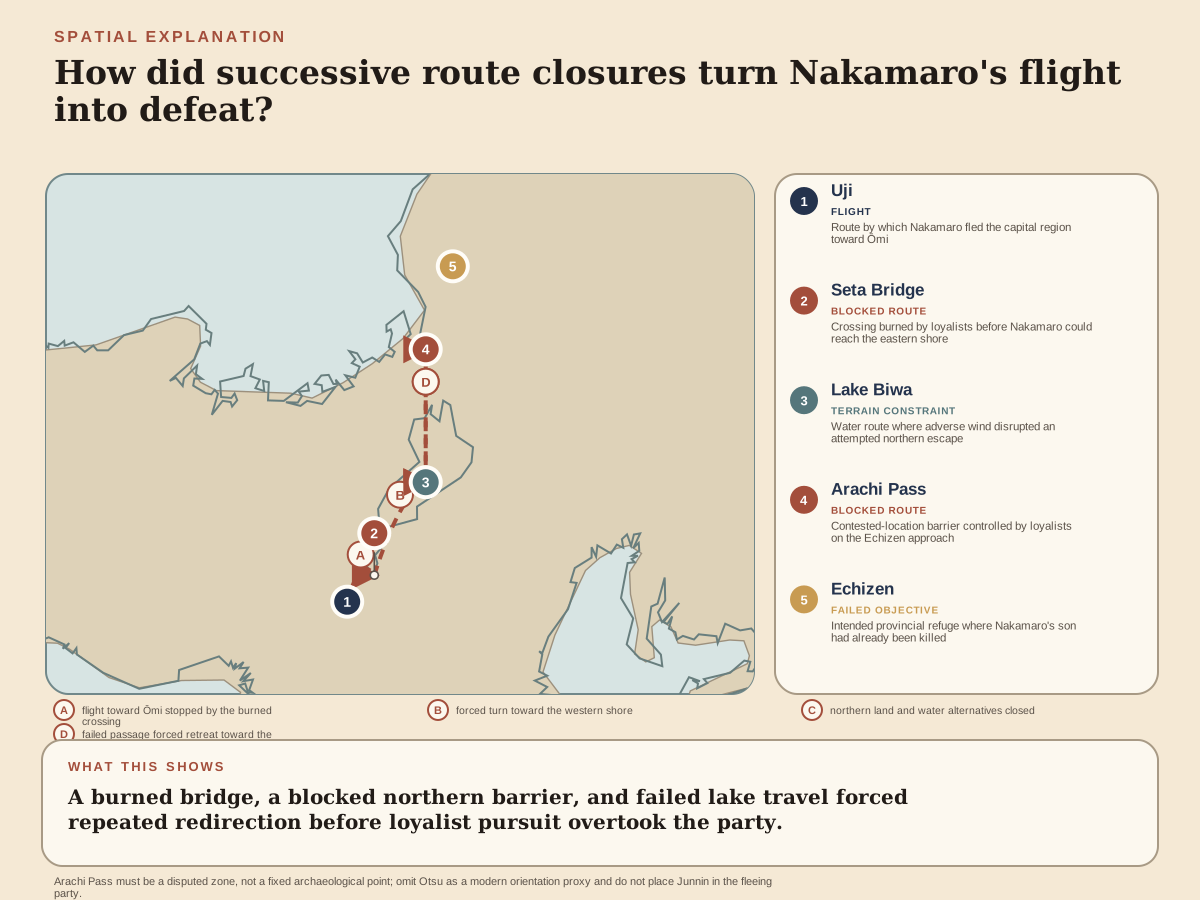
Nakamaro fled with relatives, followers and Prince Shioyaki, whom the official account presents as an alternative sovereign. Junnin was not with them. Loyalists took the Tahara road and burned the Seta bridge, blocking access to the Ōmi provincial office. Nakamaro turned north along Lake Biwa toward Echizen, where his son Karakachi was governor. [2][5]
Court forces reached Echizen first and killed Karakachi. The Arachi barrier was closed. Attempts to force or bypass it, including a water journey disrupted by wind, failed. The party retreated toward the western lakeshore and was defeated near Miozaki in Takashima. After further pursuit Iware no Iwatate captured and beheaded Nakamaro on the eighteenth day of the ninth month of 764, in the Japanese calendar. Prince Shioyaki and approximately thirty-four relatives or followers also died. [2][5]
Arachi's precise site remains disputed: published proposals place it on different approaches and road junctions between Lake Biwa and Echizen. The battle and pursuit are better established than a single modern coordinate. [5]
After Nakamaro’s defeat, Kōken returned to the throne as Empress Shōtoku. Junnin was deposed, reduced in status, and exiled to Awaji, an island in the Inland Sea. Officials tied to Nakamaro lost rank and office; a surviving wooden tablet records the removal of his partisans from the registers. “Removal of name” was not only rhetoric. It suspended recognized standing, promotion, and the administrative identity on which an elite career depended. Nakamaro entered the official record as a rebel, a classification supported by his armed resistance but written by the regime that defeated him. Documents created before 764 still preserve his work, titles, and policy; later judgment cannot make those records disappear. [2][3][8][10]
The Shoku Nihongi, an official court chronicle completed in 797, records Junnin trying to escape his enclosure in 765, being stopped and returned, and dying the next day. It gives no cause of death. The circumstances remain uncertain, rather than proving either illness or murder.
Classic
Fujiwara no Nakamaro was born in 706, the second son of Fujiwara no Muchimaro and a woman of the Abe lineage. His elder brother was Toyonari. Muchimaro was one of Fujiwara no Fuhito's four sons, whose descendants formed competing branches of an influential court family. Nakamaro belonged to the southern branch. His birth gave him sponsors and access to an official career, but Toyonari's seniority and the claims of other branches made leadership a matter of competition within the family as well as at court. [1]
In 737 smallpox killed Muchimaro and his three brothers, removing the senior Fujiwara generation within months. Nakamaro had already entered court service; this was an interruption of an adult career, not a childhood event. Tachibana no Moroe subsequently led the Council of State, the imperial government's senior governing body. The surviving Fujiwara sons had to seek advancement in a court no longer headed by their fathers.
Nakamaro lost paternal sponsorship while vacancies opened above him. His rise would depend on administrative experience and changing imperial relationships, not simply inheritance. His elder brother continued to have a separate position and following, so the southern Fujiwara branch did not act as one political unit.
Nakamaro's court career had begun in 725 as an imperial-household attendant. He then held a junior post connected with the state university. In 734 he reached the lower junior fifth rank, a significant step within the court hierarchy. He became minister of popular affairs in 741, dealing with household registers and revenue, and a councillor and capital administrator in 743. The ritsuryō system—the court's legal and administrative order based on penal and government codes—relied on officials turning central rules into provincial records, taxes and labor obligations. These posts placed Nakamaro inside that work. [2]
He became governor of Ōmi in 745 and minister of ceremonies and personnel in 746, and also received military-supervisory duties along the Tōsandō, an inland route through eastern Japan. The governorship connected him to territory around Lake Biwa, northeast of the capital. Personnel work gave him experience of distributing appointments. The same career brought together revenue, appointments and provincial command. [2]
These promotions took place while Tachibana no Moroe led the Council of State. Nakamaro remained below Moroe and his own elder brother Toyonari in the hierarchy. Family membership did not make Toyonari his subordinate, and the younger Fujiwara had not simply displaced the government that followed the epidemic. [2][3]
Empress Kōmyō, Nakamaro's aunt and Emperor Shōmu's consort, provided another source of support. Kibi no Makibi, a learned official with imperial connections, was sent away from the center during Nakamaro's ascent. The transfer increased Nakamaro's room to act, although its outcome alone cannot establish that he personally ordered it. Moroe's retirement in 756 removed a senior constraint. Nakamaro had acquired administrative experience and Kōmyō's confidence while serving within Moroe's government. [1][3]
The household office that helped Nakamaro's rise was established in 749, when Emperor Shōmu abdicated and his daughter by Kōmyō, Kōken, took the throne. Kōmyō became empress dowager. As the former empress and mother of the reigning sovereign, she retained dynastic standing, staff and material resources. Her religious and charitable projects needed supplies, estate income and communication with offices outside her residence. The Shibi Chūdai, the office serving her household, organized that work. [3]
Nakamaro became dainagon, a senior councillor, and headed the Shibi Chūdai. Some household papers bear the signatures of its own officers; council orders passed through Nakamaro in his public capacity and the controller handling central paperwork. His household responsibilities brought him into repeated contact with the offices implementing Kōmyō's projects. [3]
Among five surviving council orders from 749–757 that name the promulgating officer, all identify Nakamaro. That small surviving group cannot establish that he issued every order. It does show his repeated involvement at the point where a decision became an instruction to other officials. The household's work used recognized public procedures even when it served the empress dowager's particular priorities. [3]
In 757 Nakamaro received the exceptional title shibi naishō, an office combining leadership of Kōmyō's establishment with ministerial standing and military responsibility. It was created outside the ordinary list of ministries in the codes. Legal-historical scholarship reconstructs broad military powers, although no complete office manual survives to settle every competence. [3]
Kōmyō retained her own dynastic authority and a long record of religious patronage. Surviving signatures cannot reveal which of them initiated each decision. Their interests reinforced one another: she needed an official who could carry household projects through government, and he gained both practical responsibilities and her continuing protection. [3]
In 757 the court received warnings of a plot associated with Tachibana no Naramaro, Moroe's son. The recorded objectives were to kill Nakamaro, remove Prince Ōi, the designated heir, and replace the sovereign. Several denunciations preceded the arrests, supporting the existence of a conspiracy. Much of its detail, however, comes from interrogations conducted with violence. Men died in custody, and the official chronicle preserves the victorious government's account rather than independent testimony from the accused. [3]
The subsequent record of clemency counts 443 people implicated or punished. It includes a wider network than men accused of gathering under arms, and it does not mean 443 executions. Several accused died under violent interrogation; Naramaro's individual fate cannot safely be inferred from those group-level deaths. [3]
Nakamaro was named as a target, but he also gained from the suppression. Naramaro's circle collapsed, and Nakamaro's elder brother Toyonari lost office and was sent toward Dazaifu, the court's administrative center in northern Kyushu. The punishment weakened another possible center of leadership within the southern Fujiwara family. [2]
Confiscation turned punishment into a redistribution of property. A Nara National Museum record documents land taken from Naramaro and granted months later to Tōdai-ji, a major Buddhist temple in the capital. The court could answer a threat while also breaking rival networks and transferring their resources. The violence of the investigation is therefore part of the affair, not evidence that can be set aside once a real plot is acknowledged.
Prince Ōi had married the widow of Nakamaro's deceased son and lived at the minister's Tamura residence. This household connection preceded his selection as crown prince in 757, which occurred before the Naramaro conspiracy later that year. The plot sought to remove an heir already designated. During palace rebuilding, Kōken and the heir also stayed at Tamura, bringing Nakamaro's household unusually close to the reigning sovereign and her successor.
In 758 Kōken abdicated and Ōi became Emperor Junnin. Nakamaro received the honorific surname Emi and personal name Oshikatsu, along with exceptional privileges connected with minting coin, lending grain and using a family seal in public administration. These grants allowed his house to undertake functions normally associated with government. Offices also received names modeled on China's Tang dynasty, while their work continued through inherited Japanese procedures. [1][2]
In 760 Nakamaro rose to daishi, the renamed office of chief minister. The office placed him at the head of the ministerial hierarchy.
Junnin relied heavily on Nakamaro's personnel and governing program, and his own household was entwined with the minister's. Nevertheless, he held the throne and continued to perform imperial business. Dependence on the man who had supported his rise did not remove the emperor's formal authority or establish that every decision was Nakamaro's.
The alliance tied Nakamaro to a reigning emperor, but Junnin had been selected by Kōken, the sovereign who retired in 758. Her dynastic standing continued after abdication. Nakamaro's household connection with Junnin would become a liability when the reigning and retired sovereigns disagreed over the authority each retained.
The accession and privileges belonged to a wider governing program that had begun before Junnin took the throne. In 757 the court changed male age categories, postponing full adult liability for some young men. It also reduced the annual legal ceiling for corvée—mandatory labor owed to the state—from sixty days to thirty. This changed a specified obligation, not the whole tax system, and a lower statutory limit does not by itself show how much labor each household actually supplied. [3]
In early 758 envoys were sent through the administrative circuits to investigate distress. The western mission reported twenty-nine matters for Dazaifu to address. These were reported problems with an instruction to deal with them, not twenty-nine documented successful remedies. Later that year governors' terms were extended from four years to six, with inspections after three years intended to check their conduct. [4]
The reforms joined relief to supervision. Longer tenure could give a governor time to understand local conditions, but could also strengthen his provincial following. Kimoto Yoshinobu's study of the investigators identifies relatives of Nakamaro and his associates among them. The appointments served political recruitment as well as the stated work of inquiry; the reports do not demonstrate uniform results across the provinces. [4]
Late in 759 the court received reports of concealed land in Musashi and Bitchū, provinces in eastern and western Honshu. Wider inspections followed in 760. Unregistered fields threatened revenue and placed unequal demands on households still recorded for taxation. Nakamaro's administration sought to recover that information while easing some specified burdens.
The government brought the Yōrō legal and administrative codes into force in 757. In 759 it also ordered Dazaifu to prepare an expedition against Silla, a kingdom on the Korean peninsula. The invasion never occurred. These were decisions of sovereigns, councillors and implementing ministries, not all Nakamaro's personal inventions. His accumulated offices nevertheless gave him substantial influence over the program and its personnel.
Kōmyō died in 760. Nakamaro retained senior rank, associates and the government he served under Junnin, but he lost the empress dowager who had authorized his unusual household role. His promotion to the highest personal court rank in 762 would not restore that protection. Staff and records could remain without renewing the same relationship. The same overlapping responsibilities now depended more directly on Junnin's support. [1][10]
Kōmyō had joined several relationships in one person: Nakamaro's aunt, Shōmu's widow, Kōken's mother and a senior dynastic figure for Junnin. Her presence could not guarantee harmony, but she gave the competing households a shared point of reference. After her death Nakamaro depended more directly on Junnin, while Kōken's standing as former sovereign and Shōmu's daughter remained independent of him. [1][10]
The loss extended to experienced officials. Ishikawa no Toshitari, the controller whose office had helped carry instructions between Nakamaro and the council, died in 762. Staff and procedures might remain even as the people who had made the overlapping institutions work disappeared.
Kōmyō's death did not produce immediate rebellion. Nakamaro retained high office and Emi privileges. It removed an important patron two years before the reigning and retired sovereigns openly disputed their respective authority. [1][10]
In 762 Kōken broke openly with Junnin and established herself at Hokke-ji, a Buddhist convent near the capital. She accused him of failing in filial conduct and declared that she would retain major affairs, rewards and punishments while he handled ordinary matters. Becoming a nun and living apart did not mean relinquishing rule. She was Shōmu and Kōmyō's daughter, the former sovereign who had selected Junnin, and she retained her own household and followers. [5]
The distinction between major and ordinary business left no clear division of command. Junnin's ministers continued administering the government, but Kōken claimed the powers of appointment and punishment that determined those officials' standing. Nakamaro's position was tied to Junnin's active administration; an instruction valid there could be challenged by the retired sovereign's center. [5]
Seals authenticated official orders, while station bells authorized bearers to requisition horses from government relay stations. Both centers depended on the same officials and communications network. A provincial governor could receive an instruction from Junnin's ministers and then be told that its subject belonged to Kōken's reserved authority.
During Kōken's illness in 762, the monk Dōkyō attended her. A screen lent to him in the twelfth month of that year places him within the material routines of her household. In 763 he became shōsōzu, a senior official supervising Buddhist clergy, and records connect him with organized copying of Buddhist scriptures. Religious service was acquiring rank and administrative connections. [2][10]
Dōkyō's growing access to Kōken mattered because she claimed authority over important appointments and punishments. A sexual relationship between them is not established by reliable evidence. That uncertainty does not erase the appointments and work documented under her authority.
In 764 Nakamaro obtained a military commission covering the capital region, strategic barriers and nearby provinces, including Ōmi around Lake Biwa. It provided an authorized basis for requesting men, while also giving him access to the routes and forces needed for an armed political move. Takaoka no Hiramaro and Ōtsu no Ōura warned Kōken's center about his preparations. Their reports brought the conflict to a crisis before he had secured those instruments of command. [2][5]
On the eleventh day of the ninth month in the Japanese calendar, Kōken sent men to recover the seals and station bells from Junnin's location. Nakamaro's son Kusumaro intercepted them, briefly recovering or trying to recover those credentials before loyalists killed him. The dispute over command now involved armed men and a death within Nakamaro's household. [2][5]
Kōken's decree removed Nakamaro's Emi name, rank, office and estates. These measures attacked the recognized standing on which he could ask officials to obey him. The stripping and armed response occurred within the crisis, rather than as a punishment imposed only after a final battle. [2][5]
The Shōsōin, Tōdai-ji's repository of treasures and records, preserves an inventory of swords, bows, armor and arrow equipment issued that day. It shows stored arms entering the response, but is neither a complete order of battle nor evidence that Nakamaro received those weapons. With credentials contested and his office stripped, he turned to flight and mobilization. [10]
Nakamaro left the capital region with relatives, armed followers and Prince Shioyaki. Junnin was not with them. The official account presents Shioyaki as an alternative sovereign; his freedom of choice and the precise ceremony remain unclear. Nakamaro was attempting to establish another center of command with a different dynastic figure. [2][5]
The party headed toward Ōmi, where Nakamaro had served as governor. Loyalist forces took the Tahara road and burned the bridge at Seta before he could reach the provincial office across the river. The destroyed crossing blocked the administrative base he sought and forced a change of direction. [2][5]
He moved north along Lake Biwa toward Echizen, a province on the Sea of Japan side of Honshu. His son Karakachi held its governorship, but court forces reached the province first and killed him. They also controlled Arachi, the barrier guarding the northern route. Nakamaro's men failed to force their way through. [5]
Escape by water toward the north shore was disrupted by adverse wind. A further attempt along a mountain route also failed, and the party retreated toward the western lakeshore. The expected provincial ally was dead, the barrier was closed, and pursuers were cutting off the remaining routes. [5]
Historical disagreement · Where was the Arachi barrier?
Arachi's location affects how this flight is reconstructed. Tateno Kazumi's 2006 review distinguishes proposed sites on the western approach, at its junction with the Shiozu road, farther west near the Shiratani route, and where the approach emerged into the plain. Tateno himself proposes a main barrier near Seki, on the approach through Wakasa, and a smaller checkpoint near Michinokuchi on the direct northern route.
These hypotheses place facilities on different roads; the proposed sites were not established by excavation. The pursuit sequence is firmer than a precise modern coordinate. [5]
Near Miozaki in Takashima, Nakamaro's party was defeated. After further pursuit on land and water, Iware no Iwatate captured and beheaded him on the eighteenth day of the ninth month of 764, in the Japanese calendar. Prince Shioyaki and approximately thirty-four relatives or followers were also killed. The account does not establish the same responsibility for every companion, or preserve reliable final words from Nakamaro. [2][5]
After Nakamaro's defeat, Kōken returned to the throne as Empress Shōtoku. Her court's settlement began with personnel control. Nakamaro’s associates were dismissed, demoted, exiled, or otherwise stripped of standing. A wooden administrative tablet (mokkan) from the following period preserves a terse instruction concerning the removal of his partisans’ names. Such language represents a procedure, not merely an insult. The institutional explanation of this tablet relates removal from the register to loss of rank and merit standing for six years under the law. That comparison is not an individually documented six-year sentence for every partisan. Purge worked through clerks and lists as well as executions. Earlier documents still preserved Nakamaro's old titles in orders, accounts, property transfers and appointments. A man could be deleted from current eligibility without being removed from every archive. The punitive record labels him, while pre-rebellion documents preserve what he did when the same state accepted his authority. [2][8]
Junnin was deposed and sent to Awaji, an island in the Inland Sea. The Shoku Nihongi, the official chronicle covering this period, records that in 765 he tried to escape over the enclosure wall, was stopped and returned, and died the next day. It does not give illness as the cause of death. The sequence has invited suspicion, but does not establish murder.
The chronicle was completed in 797 under Emperor Kanmu, more than thirty years after Nakamaro's defeat. His armed resistance and use of an alternative prince support its classification of rebellion. That ending cannot explain away the earlier orders, appointments and policies made when the same government recognized his authority. [2][3][10]
The suppression of 757 involved torture and a wide purge, while Nakamaro's accumulation of office brought family privilege close to public authority. In 764 his resistance exposed relatives and followers to death. The government he had helped coordinate could still act against him once its recognized commands came from his opponents. [2][3][10]