Read the article below. Interactive reading tools are available when scripts load.
Quick
Fuhito first appears in the record as a judge in 689 under Empress Jitō. Usually dated to 659, he was Kamatari's son; stories place his upbringing in Tanabe no Ōsumi's household at Yamashina. The tradition helps explain the alternative written name Fuhito, “史,” but it does not preserve a witnessed account of his training. His office provides the secure beginning of the political career. [1]
His daughter Miyako became Emperor Monmu's consort, linking that career to the ruler's household. In 698 the Fujiwara designation was restricted to Fuhito's descendants; other members returned to the Nakatomi name. A distinction within a wider kin group now identified the line that would carry Fujiwara status. Family recognition and government service would advance together during the production of a new code. [2]
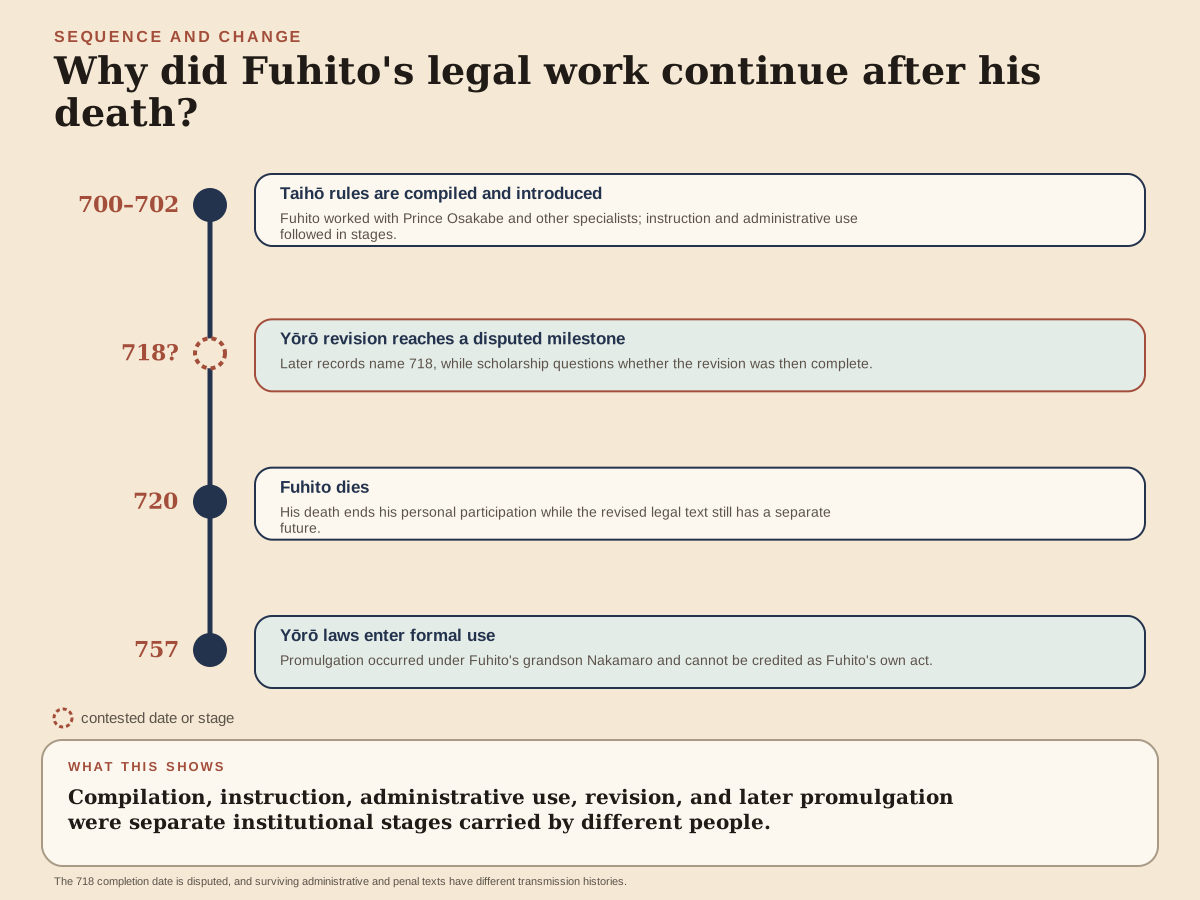
Fuhito worked with Prince Osakabe and learned collaborators on the Taihō laws. Penal rules and administrative provisions supplied two parts of the undertaking. Around 701–702, the new order entered use through reorganized offices and ranks, instruction for those expected to apply it, and distribution of the penal code. Accounts differ over the precise stages; the change was more than a single completed manuscript. [3]
Fuhito's own position rose to the right ministry in 708. A court tradition also describes a grant of five thousand revenue households in 707, of which he accepted two thousand. The larger award has been questioned in historical research, so its number should not establish unquestioned absolute power. The household grants nevertheless point toward a concrete institution: officials received assigned tax income through the state's administration. Law shaped both office and resources. [1][6][7]
Empress Genmei moved the court to Heijō-kyō, the new capital at Nara, in 710. Kōfuku-ji's institutional account associates Fuhito with relocating and renaming the family temple there. Its predecessor had existed in other places; the new capital move did not create the entire foundation from nothing. Government and an aristocratic religious institution acquired new settings in the same city. [8][4]
The succession connections extended across two generations. Miyako's son Obito became crown prince in 714, and in 716 Fuhito's daughter by Michiyo, the future Kōmyō, became his consort. Genmei had meanwhile abdicated to Genshō in 715. The prince's future was therefore supported within a court of reigning and retired women sovereigns, rather than by Fuhito alone. Another daughter married Nagaya, joining the family to an imperial prince who would later lead government. [2][9]
Left minister Isonokami no Maro died in 717. Fuhito then led the ministers while retaining the right ministry. He directed work on the Yōrō revision of the code. The conventional 718 completion date does not settle how far the text had actually been completed: Hayakawa Shōhachi questions that record and argues that work continued, then stalled after Fuhito's death while still unfinished. Other explanations differ over the project’s character. [2][5]
Fuhito died in 720, leaving offices, family ties and a legal undertaking with separate futures. His four sons became important officials, but neither their later careers nor the future imperial titles of his descendants can be read as an outcome he lived to see. The code, too, would wait decades before its formal implementation. [2][5]
In 721 Genmei and Genshō directed Nagaya to establish Kōfuku-ji's Northern Round Hall for Fuhito's memorial. That joint act complicates an image of rigid camps separating his family from imperial princes. Obito became Shōmu in 724 and Kōmyō became empress in 729; those changes belonged to a later court. Fuhito's earlier marriages made the connections possible without proving his control over every subsequent decision. [11][9][10][2]
The Yōrō code was promulgated and implemented in 757 under Nakamaro, Fuhito's grandson. Its administrative text is largely known through later commentaries, while much of the penal code is lost. The memorial hall also changed: it suffered damage in 1180 and was rebuilt around 1210. Legal transmission and a rebuilt religious setting preserve different parts of his legacy; neither is an unchanged survival from 720. [5][11]
Classic
In 689, under Empress Jitō, Fuhito appears in the record as a judge. Kishi Toshio identifies this as his first recorded appearance. His birth is generally placed in 659, although Kishi also gives 658 as an alternative. Fuhito was Kamatari's son, but the years between that origin and the judicial appointment are not a continuously documented career. Tradition places his upbringing in the Yamashina household of Tanabe no Ōsumi and links that association with the written name “史.” The story supplies a setting; the office supplies a dated act. [1]
This mattered for the kind of service through which Fuhito advanced. A judicial appointment placed him within the court's legal work before the great Taihō compilation. It does not identify a particular teacher or a complete course of legal education. Aoki Kazuo also notes the family’s relations with Tenmu's household through Fuhito's sisters. These connections locate him among people already tied to the throne, while the later work on the laws would give his own career a more specific basis. [1][2]
Under Emperor Monmu, his daughter Miyako became the ruler's consort. The relationship joined two positions: Fuhito served at court and his daughter belonged to its imperial household. In 698 the Fujiwara designation earlier granted to Kamatari was restricted to Fuhito's descendants, while other members of the wider group reverted to Nakatomi. The restriction distinguished the line that would carry the Fujiwara name from related people whose identity followed another designation. It was a public recognition of a family boundary, rather than evidence that all related officeholders now formed a single political will. [2]
Office, imperial marriage and the restricted designation had therefore supplied different advantages by the end of the century. Neither childhood tradition nor the family's later prominence should make them interchangeable. The next undertaking would require collaboration with an imperial prince and learned specialists to produce rules that officials beyond Fuhito's household were expected to use. [1][2][3]
Fuhito participated in the Taihō compilation with Prince Osakabe and other learned officials. Hayakawa Shōhachi describes a group of nineteen, including men of immigrant origin or from immigrant-descended families. The undertaking brought together access to the throne and specialist knowledge. Fuhito's importance as a compiler consequently belongs alongside that collective work, rather than replacing it. The code combined ritsu, penal provisions, and ryō, administrative rules. It drew on Tang models while adapting provisions to Japanese conditions. [3]
The laws entered government through a sequence of measures. In Ishigami’s account, offices and ranks at the fifth level or above were reorganized first, with lower ranks following.
Historical disagreement · When did the Taihō laws enter use?
Ishigami Eiichi describes a sequence: administrative provisions completed in 700, ranks and offices reorganized during 701, instruction for officials, Buddhist administrators and provinces, and general administration under the rules that year. The penal text was completed in 701 and distributed in 702.
Hayakawa Shōhachi’s account presents a different reconstruction: after the administrative code’s completion in 700, both codes entered force together in 701. It distinguishes this from the older picture of successive implementation as each part was completed.
Compilation, instruction, distribution and legal effect need not share one date. The substantial transition around 701–702 is firmer ground than a single date made to stand for every stage. [3]
The sequence defines a mechanism behind “making a code.” Written rules had to reach the officials and institutions expected to apply them. Changes in rank and office altered the people’s formal positions; instruction made the new provisions part of their work. Compiling a text, teaching it and executing government under it were distinguishable responsibilities. Fuhito's participation in compilation put him within this transition, without making him the personal instructor of every audience or author of every clause. [3]
Historical disagreement · How large was Fuhito’s revenue-household grant?
Resources attached to official service also worked through the new order. Kishi's biography recounts a grant of five thousand revenue households to Fuhito, of which he accepted two thousand; Kawachi Sachiko's study dates the award tradition to 707. Its introductory description registers Satō Sōjun's challenge to the larger number, including the standing of Isonokami no Maro above Fuhito at that point.
The disputed figure should therefore not be used to calculate unquestioned absolute power. It is a record whose political meaning depends partly on the reliability of its magnitude. [1][6]
The institution itself was concrete. Kitō Kiyoaki explains that assigned households supplied half their rice-tax revenue and their other specified taxes and labor to the recipient, collected through provincial and district officers. A 705 adjustment defined a standard number of liable adult males per revenue household, responding to uneven household composition. Such a grant was an arrangement within state collection and payment, rather than simply the gift of a private landed estate. Fuhito became right minister in 708; his own senior office and the system of material support belonged to the legal order he had helped compile. [7][1]
Empress Genmei moved the court to Heijō-kyō, the new capital at Nara, in 710. Fuhito's family temple moved into the capital's new setting as Kōfuku-ji. The temple's institutional history associates this relocation and name with Fuhito, while distinguishing its earlier foundation from his work. It traces Yamashina-dera to Kagami no Ōkimi's prayers during Kamatari's illness in 669, then a move to Umayasaka after the Jinshin conflict of 672. Fuhito's contribution in 710 was thus the relocation of an existing institution, with a past that included a woman’s act of patronage and more than one political center. [8][4]
The capital was an imperial undertaking and the temple move was one aristocratic institution's place within it. Their overlap does not make Fuhito the sole author of Heijō’s construction. It does show how the court's changed center gave a family foundation a new location. Kōfuku-ji’s subsequent importance should be traced through later patronage and institutions, rather than treated as a territorial power already fully possessed by Fuhito in 710. [8][4]
Family connections meanwhile reached into the next generation of rulers. In 713 Monmu's other consorts lost their formal consort designation; Aoki places that change beside Miyako's position and Obito's appointment as crown prince in 714. These status changes altered the succession setting within Monmu's family. Fuhito was Obito's maternal grandfather, but Monmu had died in 707 and the reigning sovereign was Genmei, Monmu's mother. A connection to the future ruler therefore existed inside a court whose government still belonged to other people. [2][8]
Genmei abdicated to her daughter Genshō in 715. In 716 Fuhito's daughter by Agatainukai no Michiyo, the future Kōmyō, became Obito's consort. The Fujiwara connections now joined Miyako to Monmu and Kōmyō to Monmu's son. Genshō's reigning position and Genmei's retirement remained distinct from these marriages. Explanations that make the women sovereigns merely Fuhito’s instruments would claim more than the succession dates and household relationships establish. [2][9][10]
The broader, undated family connections included a daughter's marriage to Nagaya, an imperial prince, and another daughter's marriage to Tachibana no Moroe. These connections reached beyond the two imperial consort households. They complicate an image in which the Fujiwara family belonged to one self-contained camp and every imperial prince to another. The precise intentions behind each marriage are not preserved by the fact of the relationship. That wider network would be visible again when Nagaya participated in Fuhito's commemoration after his death. [2][11]
Isonokami no Maro, the senior left minister, died in 717. Fuhito then became the leading minister while remaining right minister. Aoki distinguishes leadership of the ministers from possession of a different office. The next legal undertaking was likewise a new stage of work, rather than a fresh creation of the entire system: Fuhito led collaborators revising the Taihō laws into the text later called the Yōrō code. [2][5]
Historical disagreement · Was the Yōrō Code complete in 718?
The recorded completion year, 718, conceals a substantial question. Hayakawa Shōhachi argues that the official account of completion is doubtful: compilation continued beyond that year, and after Fuhito died it stalled while still unfinished. Yagi Atsuru points to evidence that the work's rewards were given in 722 and traditions placing completion within a broader span of Yōrō years.
These assessments do not settle every stage in the same way, but both prevent the usual 718 date from standing for a certainly finished and already operative code. [5]
Historical disagreement · Whose project was the Yōrō Code?
The character of the undertaking is also debated. Hayakawa registers one explanation treating it as Fuhito's private project and another linking Genmei and Fuhito with a proposed promulgation under Obito, preserving lawmaking within that imperial line.
These are scholarly explanations of the project’s purpose. They are not a surviving statement by Fuhito that reveals his complete private design. His participation, collaborators and imperial kinship can be stated with firmer confidence than the precise intention attributed to the revision. [5]
Historical disagreement · How far did the Yōrō Code revise earlier law?
The scope of revision raises a further difference. Hayakawa emphasizes changes of terminology and correction of contradictions rather than a fundamentally new order; the Yamakawa dictionary gives more weight to substantive alterations in particular provisions.
The Taihō framework and the Yōrō text were therefore connected without being identical in every clause. Fuhito's legal importance does not depend on claiming that his final project replaced all earlier rules or transformed every institution at once. [5]
Fuhito died in 720. His daughters’ household connections and his four sons’ official careers continued, while the revised text still had a separate future. Posthumous honors included the highest ministry and first rank. Those distinctions belonged to commemoration, not offices he began to exercise after his death. The future Shōmu's accession, Kōmyō's empress status and Yōrō’s formal promulgation remained events of later generations' courts. [2][1][9][10][5]
In 721 Genmei and Genshō directed Nagaya to establish Kōfuku-ji's Northern Round Hall for Fuhito's memorial. The temple's account joins a retired sovereign, a reigning sovereign and an imperial prince in the foundation. Nagaya's family connection with Fuhito makes the act less surprising than a rigid opposition between “Fujiwara” and “imperial” would suggest. It remains a specific act of commemoration rather than proof that those relationships could never become politically strained. [11][2]
Obito became Shōmu in 724. Kōmyō became empress in 729, after the crisis that ended in Nagaya's death. Fuhito did not live to direct those decisions. Oshibe Yoshichika's biography distinguishes Kōmyō's crown-prince consort status in 716, her status after Shōmu's accession, and her later appointment as empress. The sequence shows the difference between a marriage made during her father's life and an imperial office obtained afterward. [9][10]
The Yōrō laws were promulgated and put into effect in 757 under Nakamaro, Fuhito's grandson. Later commentaries, notably the Ryō no Gige and Ryō no Shūge, preserved much of the administrative text; the penal text survived much less fully. In 760 Fuhito received the posthumous designation Tankai-kō. His name could thus be honored within a later court that also made his legal undertaking operative. That later use supplies a historical continuation, while the long interval preserves the uncertainty of the project's completion during his lifetime. [5][2]
The material memorial also underwent replacement. Kōfuku-ji's Northern Round Hall suffered damage in 1180 and was rebuilt around 1210. The later hall preserves the memorial association through a changed building, just as commentary preserves law through changed textual settings. Neither continuation is an untouched survival of Fuhito's own court. The distinctions between his recorded service, disputed project and later appropriation make his considerable contribution visible without turning the entire subsequent Fujiwara history into a plan already completed in 720. [11][5][2]