Read the article below. Interactive reading tools are available when scripts load.
Quick
The future Empress Jitō was born Princess Uno-no-Sarara in 645, a daughter of Prince Naka no Ōe, later Emperor Tenji, and Soga no Ochi no Iratsume. She married Tenji's younger brother Prince Ōama, later Emperor Tenmu, at thirteen by traditional reckoning. Her elder sister Ōta also became his consort. Uno-no-Sarara's son Kusakabe and Ōta's son Ōtsu therefore shared a father and maternal descent through sisters. Their succession claims would depend on the standing and support of different royal households. [2][6]
Tenji died in 671. His son Prince Ōtomo led the government at Ōmi, near Lake Biwa; his younger brother Ōama had withdrawn with Uno-no-Sarara to Yoshino, a mountain refuge south of Nara. In 672 Ōama left that refuge to seek eastern allies and fight Ōtomo's government in the Jinshin War. Uno-no-Sarara and their son Kusakabe traveled within his household. Another of Ōama's sons, Prince Takechi, helped command the fighting. Victory secured their household's position; Uno-no-Sarara's descent from Tenji helped connect the new court with the royal branch it had defeated. [3]
After the Jinshin victory and Tenmu's accession, Uno-no-Sarara became empress at the center of the Asuka Kiyomihara court. In 679 she joined Tenmu and six princes at Yoshino in an oath of family unity. The group included sons of both Tenmu and Tenji; Kusakabe stood first in the preserved sequence and received elevated succession standing by 681. Her position combined Tenji descent, marriage to Tenmu, motherhood of Kusakabe, and ritual seniority in the royal household. These were mechanisms of power before she held the throne. Her central dynastic position does not establish an equal division of every decision with Tenmu. Presence, access, and succession work are better evidenced than private policy conversations. [2]
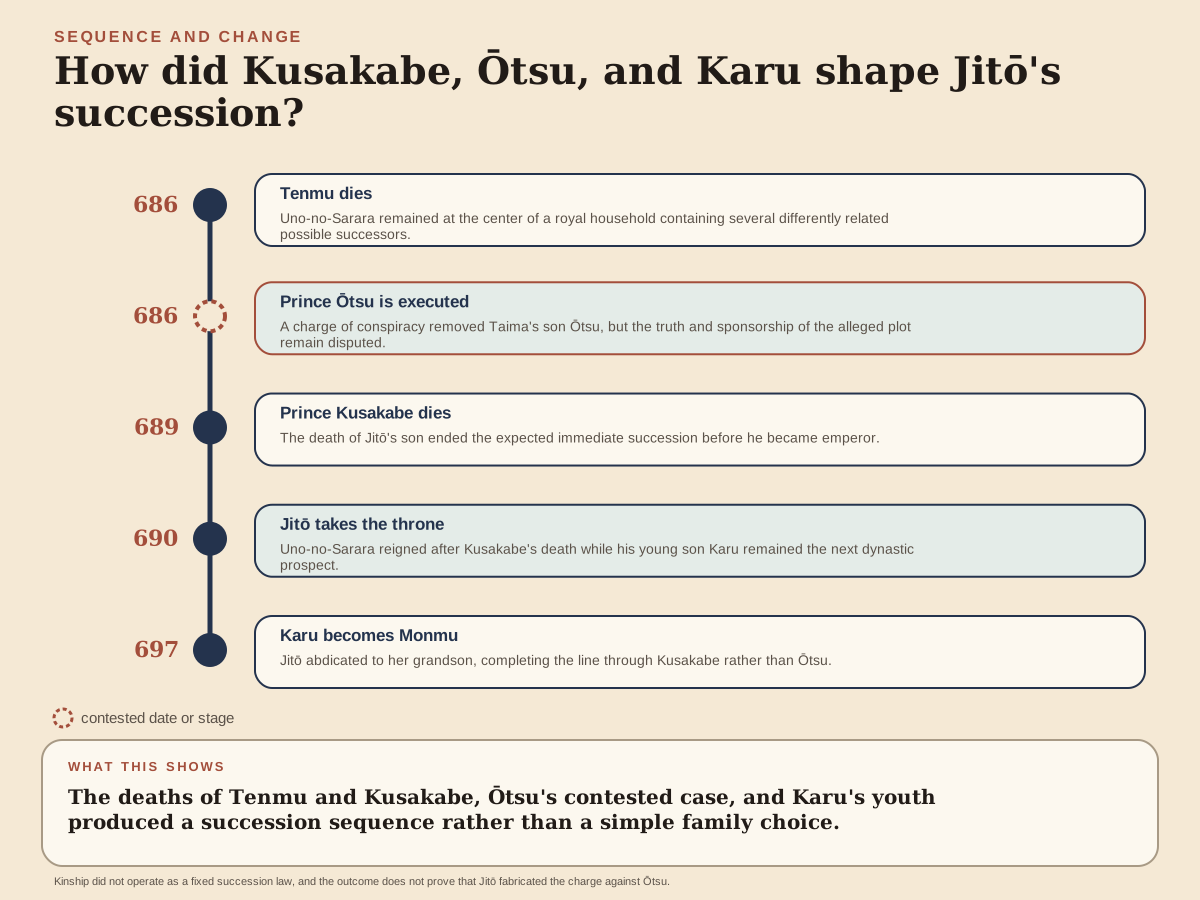
Tenmu died in the ninth month of 686. Uno-no-Sarara, who had handled affairs with Kusakabe during his illness, continued governing without formal enthronement—a phase called shōsei. In the tenth month Prince Ōtsu was accused of conspiracy, arrested on the second day and ordered to die on the third. His wife Princess Yamanobe died with him. The punishment removed Kusakabe's closely related rival. It may have answered an actual plot or served to eliminate a succession competitor; the surviving record does not establish that the accusation was fabricated. Ōtsu's elder sister Princess Ōku, a royal priestess at Ise, returned from her service the following month. Her father's death also preceded the return, so it cannot simply be treated as punishment for her brother's case. [2]
Tenmu was finally buried in 688 at the mausoleum later shared with Jitō. Prince Kusakabe played a leading role in the mortuary order but never became emperor. He died in the fourth month of 689, leaving his young son Prince Karu as the surviving focus of the line Jitō had worked to establish. No single explanation for Kusakabe's non-accession before death is secure. The lengthy mortuary observances and possible illness offer explanations, but neither is established as the cause. His death forced a new choice: enthrone another adult prince, place a young Karu on the throne, or preserve the grandson's future through Jitō's own sovereignty. [2]
In the sixth month of 689, Jitō's government distributed the twenty-two-volume Asuka Kiyomihara Code to offices. Tenmu had ordered compilation in 681; princes, officials and scribes carried out the work. Jitō authorized the offices to receive it after his death, at a moment when Kusakabe had also died and formal accession still lay ahead. The complete code is lost, so its contents cannot simply be reconstructed from later laws. Its distribution nevertheless records legal reform continuing across an unsettled throne. [1][2]
Uno-no-Sarara formally took the throne in 690 as Empress Jitō. The enthronement gave recognized sovereign form to authority she had exercised since Tenmu's death. Her accession followed the execution of Ōtsu, Tenmu's burial, Kusakabe's death, and the promulgation of law. It did not begin her political activity. Japan already had precedents for reigning women. Jitō's rule neither represented a modern campaign for gender equality nor lacked independent consequence because it protected Prince Karu's future. She possessed royal descent, experience, ritual standing, and control of government. Her reign was simultaneously a government in its own right and a succession strategy centered on Kusakabe's line. [2]
After the code's distribution, Jitō's government ordered household registration. The Kōin registers, named from the cyclical year 690, classified people for land rights and obligations such as taxes and service. The full national register does not survive. The government also continued military training and inspections. Written population records helped extend central reach, but their accuracy depended on local officials and households whose circumstances kept changing. [1]
Tradition at Ise, a major shrine complex associated with imperial ancestry, dates the first periodic rebuilding to Jitō's reign: the Inner Shrine in 690 and the Outer Shrine in 692, linked to an intention formed under Tenmu. Jitō's court also continued offerings at Hirose and Tatsuta and made repeated journeys to Yoshino. In 692 she undertook an Ise journey despite recorded official objection. Ise connected the dynasty with its divine ancestry; Hirose and Tatsuta addressed water and wind, while Yoshino recalled the household's refuge before the Jinshin War. Royal journeys required accommodation, provisions and local labor. The present twenty-year Ise system is a later developed institution; its full rites, objects, buildings, and continuity cannot be copied backward into the seventh century. [4]
Fujiwara-kyō had roots in capital planning under Tenmu, but Jitō's government turned the project into an occupied political center. Between 690 and 694, the record shows inspections of the palace site and roads, ground-consecration rites, reports to major kami, or Japanese deities, and standards for allocating residential land. Jitō moved to Fujiwara Palace on the sixth day of the twelfth month of 694 in the traditional calendar. The new capital, south of present-day Nara, arranged palace, offices and residential plots within a planned grid. Canals, workshop remains and wooden tablets reveal construction and deliveries before and after the ceremonial move. The city continued in use under Monmu and Genmei. Jitō's agency lay in inspection, allocation, authorization, and the operational move—not in personally designing or building every part. [2][11]
Prince Takechi, the senior royal actor who had served in the Jinshin War and Jitō's government, died in 696. In 697 Prince Karu, Kusakabe's son, was elevated and took the throne as Emperor Monmu. Jitō abdicated after seven years of formal reign and more than a decade of effective authority. The transfer fulfilled the succession route through Kusakabe while avoiding an abrupt transition. Monmu was young but held formal sovereignty and developed a government of his own. Jitō retained exceptional rank, experience, and access. [2]
After abdication Jitō became daijō tennō, or retired sovereign. She remained active beside Monmu's government. The Taihō Code was completed and put into effect in 701, revising the legal order whose earlier stage she had promulgated. In the same year she joined a journey to Kii, on the peninsula southeast of the early capitals. Headnotes in the Man'yōshū, an early collection of Japanese poetry, record her presence. Her title and continuing court relationships gave Jitō extraordinary influence, but not automatic authorship of every Monmu decision. Princes and officials produced the new code; Monmu was reigning sovereign; Jitō provided senior authority and continuity. Historian Haruna Hiroaki interprets the early retired-sovereign institution as allowing two sovereigns with different functions. That does not make Monmu a ruler in name only or establish joint authorship of each order. This early arrangement preceded the later, more developed institutions of insei, government conducted through a retired sovereign. A mission to Tang China was dispatched in 702; its later encounters took place after her death. [2][5][9]
Jitō died in the twelfth month of 702. In 703 her body was cremated, the first recorded cremation of a Japanese emperor, and her remains were interred with Tenmu at Hinokuma no Ōuchi mausoleum. The joint burial connected their political partnership in one place while preserving different treatment of the two bodies. [2]
The Nihon Shoki, an official history completed in 720, ends with her abdication to Monmu. Its structure presents that transfer as a dynastic achievement. Jitō's distinctive contribution was to make inherited projects operate across successive deaths while protecting Kusakabe's descendants. Law, the capital and a precedent for retired authority survived her; execution and burdens on households were also part of the order she sustained.
Classic
The future Empress Jitō was born Princess Uno-no-Sarara in 645, a daughter of Prince Naka no Ōe, later Emperor Tenji, and Soga no Ochi no Iratsume. Her birth year was also the year of the palace coup led by her father and his ally Nakatomi no Kamatari against the powerful Soga family. Her mother's ancestry connected her to a lineage whose relationships with the royal house survived that defeat. At thirteen by traditional reckoning, Uno-no-Sarara married her father's younger brother Prince Ōama, the future Emperor Tenmu. The marriage joined the two royal branches within her immediate family. [2]
Her elder sister Ōta also became Ōama's consort. Their sons, Kusakabe and Ōtsu, shared a father and descended maternally from Tenji through sisters. Paternal blood alone therefore could not decide between them. Their mothers' standing and the support of surviving relatives mattered to succession. Royal women maintained households and attendants through which they could influence access to the ruler, although the chronicle records their ordinary political activity less fully than male appointments and conflicts. [6]
These relationships explain the stakes of later decisions without making their outcome inevitable. Kusakabe did not become sovereign automatically. Ōtsu's later execution is not proof that their mothers had always been rivals, and Uno-no-Sarara's own accession was still decades away. As the brothers' households grew and succession approached, marriage would leave her close to both sides of the conflict.
Tenji died in 671, leaving a succession conflict between his son Prince Ōtomo and his younger brother Prince Ōama. Before Tenji's death, Ōama had withdrawn from court to Yoshino, a mountain refuge south of Nara, taking the future Jitō with him and declaring a religious retirement. Ōtomo's government remained at Ōmi, near Lake Biwa. In 672 Ōama left Yoshino to gather eastern allies against it. Uno-no-Sarara traveled within his moving household with their son Kusakabe. The Jinshin War thus divided her father's family: she accompanied her husband against her half-brother's government. The party crossed toward Iga and Ise while agents sought support in Mino, making its survival depend on routes, local allies and news from beyond the household. [3]
Travel required food, shelter, animals, attendants, and decisions about pace and safety. Sources centered on command do not fully record those who sustained the mobile court. If the coalition failed, Uno-no-Sarara could not rely on later title or gendered exemption. Royal women in succession conflicts could lose rank, family, freedom, or life. Communication inside the moving household was itself political. Reports had to be assessed, children and attendants protected, and routes chosen while distant agents acted with incomplete news. The archive attributes principal commands to Ōama; it leaves open which judgments were discussed among those physically sharing the flight. After victory, her lineage offered political continuity. As Tenji's daughter, she allowed the new court to present more than the triumph of one fraternal branch over another.
Kusakabe embodied combined descent. This did not erase the defeated Ōtomo route, but it gave the winning house a way to absorb Tenji legitimacy. The label “coalition member” is broader than commander and more accurate than companion. A royal household brought attendants, relationships, and future claims into the campaign. Uno-no-Sarara's interests shaped what victory needed to secure, even if the chronicle does not name her as issuer of tactical orders. Prince Takechi, another of Ōama's sons, helped command the fighting. That role belongs to him, just as the support supplied by local allies and workers belongs to them. For Uno-no-Sarara, the conflict threatened her household and son; for Ōama, it established a route to the throne; for Ōtomo, it destroyed the existing government. The war's later success can invite romance: husband and wife struggling together toward a destined state. The evidence supports shared danger and later partnership, not every private emotion. [3]
After Ōama's victory and accession as Emperor Tenmu in 673, Uno-no-Sarara became empress at the Asuka Kiyomihara court, in the early royal center south of present-day Nara. Her position connected marriage, ritual precedence and the future of their son Kusakabe. Attendants and kin relationships gave the senior royal household a role in access to the sovereign, even though ordinary conversations seldom entered the chronicle. She occupied that center before becoming sovereign herself. [2]
Succession supplied the strongest continuing interest. Kusakabe's status joined Tenji's maternal line through Uno-no-Sarara with Tenmu's paternal line. Promoting him was both a maternal and dynastic project. Concern for her son and for the dynasty met in the same succession decision. The Yoshino oath of 679 made Uno-no-Sarara central to the political family. Tenmu and she promised parental care while Kusakabe, Ōtsu, Takechi, Kawashima, Osakabe, and Shiki pledged cooperation across different mothers and branches. Her placement within the oath has been interpreted as consolidating the status later named empress. The source is the Nihon Shoki, an official history completed in 720, which ended its narrative under the order created by this dynasty. Its account can preserve the event and named participants while making subsequent hierarchy appear more settled than it felt in 679.
Exact speeches function as public political memory, not a neutral transcript of private harmony. Kusakabe's later elevated position gave the oath a hierarchy. The princes were joined as brothers but not made equal successors. Uno-no-Sarara's maternal role thus carried a constitutional effect: the household's internal ordering supported one line while demanding cooperation from alternatives. Calling her “co-ruler” can illuminate the unusual concentration of status. It can also flatten chronology by attributing every Tenmu measure equally to her. Her participation in one undertaking does not establish authorship of every legal or military measure. Her later continuation of some projects proves capability and commitment, not necessarily original authorship of each command. Power before accession was therefore relational rather than hidden. Uno-no-Sarara did not need a secret modern office to matter.
Tenmu died in the ninth month of 686. During his illness Uno-no-Sarara and Kusakabe had assumed responsibility for affairs; afterward she continued governing without immediate enthronement, a phase commonly called shōsei, the exercise of sovereign authority before formal accession. Tenmu's body entered mogari, an extended mortuary observance during which the court still made appointments and decisions. Succession remained unsettled while government and mourning continued together. [2]
In the tenth month, Prince Ōtsu was accused of conspiracy. The surviving account places his arrest on the second day and his ordered death on the third. His wife Princess Yamanobe died with him. Ōtsu was the son of Uno-no-Sarara's elder sister Ōta, and thus another grandson of Tenji as well as a son of Tenmu. His elimination left Kusakabe without this closely related rival while Tenmu's mortuary rites were still beginning. [2]
Historical disagreement · Was Prince Ōtsu’s alleged plot real?
One interpretation sees the punishment as a response to an actual plot; another sees a succession struggle resolved through a charge against Kusakabe's rival. The timing and political benefit support the latter possibility, but do not prove that Uno-no-Sarara fabricated the accusation. Later literary admiration of Ōtsu as a cultivated, tragic prince does not independently settle the case either.
The charge survives through the dynasty that carried out the punishment, rather than through a neutral investigative record.
Ōtsu's elder sister Princess Ōku was serving at Ise as a royal priestess devoted to Amaterasu, the deity associated with imperial ancestry. She returned from Ise in the eleventh month of 686. Her father's death as well as her brother's punishment preceded that return; its timing alone cannot establish that she was recalled in retaliation against Ōtsu. The execution and Yamanobe's death show the human cost of narrowing succession. The government continued to function, but an alternative royal household had been destroyed.
Tenmu was buried in 688 after a mortuary observance lasting nearly two years. Kusakabe's prominent place in its ceremonies displayed his standing as the preferred successor, but he still had not taken the throne. The Yoshino oath of 679 had placed him first, and his position had risen further in 681. Why he remained unenthroned is less clear. His health and the length of the funeral observances are possible explanations; neither can be selected as a demonstrated cause from the surviving record.
Kusakabe died in the fourth month of 689, changing the succession immediately. Prince Karu, his son by Princess Abe—the future Empress Genmei—carried descent through Kusakabe but was young. Another adult royal such as Takechi possessed experience and supporters. The choice was not simply “heir versus no heir.” It was a contest among kinds of continuity. Jitō's own position offered a solution because she was not outside the dynasty. She had Tenji's descent and experience of government since Tenmu's illness, and could take the throne while preserving Karu's future. This was neither an ordinary regency nor an unrelated seizure. Grief belongs to the history but not as invented quotation. Court poetry preserves laments for Kusakabe, including works associated with Kakinomoto no Hitomaro and the prince's mortuary context. [2]
Literary commemoration shows the scale of public loss and the construction of his memory. It does not give direct prose access to Jitō's private emotions. Kusakabe's death also reclassifies the Ōtsu case without resolving it. Later knowledge that both leading princes died can make Ōtsu's execution appear either tragically unnecessary or proof that Jitō had no alternative. Neither conclusion follows automatically. Decisions in 686 were made without knowing 689. The transition demonstrates the limit of family oath and legal development.
In the sixth month of 689, Uno-no-Sarara's government distributed the twenty-two-volume Asuka Kiyomihara Code to offices. Tenmu had ordered compilation in 681, and princes and officials had carried the work forward. Distribution made the compiled order available for administrative use after both Tenmu and Kusakabe had died. She could thus make law operative before her own formal accession. [1][2]
The complete code is lost. Later laws and historical notices help reconstruct the developing ritsuryō order—the court-centered system of penal and administrative codes—but cannot recover every provision of these twenty-two volumes. In particular, the later Taihō and Yōrō codes must not simply be copied backward into 689. The distinction between ritsu, penal rules, and ryō, administrative rules, does not establish that both parts of the later system were present in the same form.
Distribution also distinguishes the sovereign's decision from the work of officials who compiled and reproduced the text. Tenmu had initiated the undertaking; Uno-no-Sarara authorized offices to receive it after his death. The order connected government across reigns even while the throne remained unsettled. Its use in household registration is more tangible than a complete modern reconstruction of its contents: the court was preparing to classify people and obligations through a written administrative framework. [1]
In the first month of 690 Uno-no-Sarara formally took the throne. Known to later history as Empress Jitō, she now held the sovereign office whose authority she had already exercised during Tenmu's illness and after his death. Earlier women, including Suiko and Kōgyoku/Saimei, had also reigned. Her accession belonged to that dynastic practice while answering the immediate problem left by Kusakabe's death. [2]
The “interim” label catches one truth: Jitō ultimately transferred sovereignty to Kusakabe's son. It becomes misleading when it treats everything from 690 to 697 as empty time. Household registration and the move to Fujiwara changed government while she reigned. Modern celebration produces a different distortion. Jitō did not challenge royal lineage as the foundation of rule or open office generally to women. Her authority narrowed succession around a particular grandson and operated within hierarchy. A historically strong woman need not become a modern egalitarian symbol. Enthronement also reclassified her relation to Tenmu. She was no longer only empress continuing a deceased husband's government. Her decisions now belonged to a reign of her own.
Shared projects remained shared, but her decisions acquired their own temporal authority. The ritual itself developed with the state. Scholarship treats Jitō's accession as an important stage in the formation of later enthronement practice. The later, fully developed enthronement rites are not all documented for her accession. The ceremony made the new hierarchy public. Recognition had documentary consequences. Appointments and ritual precedence now referred to a formally enthroned Jitō rather than an empress exercising shōsei. Messages to provinces and exchanges with foreign polities could situate authority in a clearer public person even though the administrative personnel largely continued. The accession also altered how future memory would classify the preceding years.
After the code's distribution, Jitō's government ordered household registration. The project became known as the Kōin registers from the cyclical designation of 690. Entries organized people by household and legal status, providing information for land entitlement and obligations. The court depended on local and provincial officials to assemble documents that could be compared across distance. [1]
Land allocation under the emerging system required age and status data. Taxation and labor service required adult categories. Military mobilization required knowledge of eligible men and local organization. Record systems joined institutions that modern summaries often separate into agriculture, taxation, family, and army. The archive survives unevenly. Later registers, fragments, legal provisions, and references help reconstruct practice. No such surviving totality exists. Later ritsuryō practice ordered new household registers at six-year intervals. The Kōin register remained an important reference even after new rounds were made, which shows that registration created durable legal memory. It also means an old classification could continue affecting people after their lives had changed. Local officials mediated every entry. They knew households, collected declarations, resolved or reproduced disputes, and sent documents onward. [1]
Household heads had incentives to protect dependents or reduce burdens. Migration, death, birth, servile status, and absence made the paper order unstable from the day of writing. Classification could injure. A wrong status could alter tax, freedom, service, marriage possibility, or land claim. Women were visible within registers but through categories designed for state administration. Being entered in the registers did not give women an equal role in defining the categories. Military measures reveal why legibility mattered. Sending instructors in formations and inspecting horses converted the memory of Jinshin mobilization into more regular preparedness. Yet knowing that a household contained an eligible person did not supply training, equipment, food, or consent. Mobilization still depended on local material capacity. Jitō's state thus acquired reach through paper but not omniscience. [1]
Ise, a shrine complex east of the early capitals associated with imperial ancestry, dates its first periodic rebuilding to Jitō's reign: the Inner Shrine in 690 and the Outer Shrine in 692. Its institutional history links Tenmu's wish with Jitō's carrying out the project. New structures and ritual objects required timber and skilled work, followed by the transfer of sacred presence. Rebuilding established continuity through renewal rather than preservation of one building. Ise's own account also distinguishes earlier, smaller places of worship from the monumental complex that developed later; the complete present-day system cannot be projected into the seventh century. [4]
Jitō's 692 Ise journey generated objection from the court official Miwa no Takechimaro in the chronicle. The surviving dispute reveals costs: the timing of agricultural work, mobilization of attendants, and the burden of royal movement could conflict with ideals of good government. The shrines at Hirose and Tatsuta connected the court to water, cultivation, wind, and destructive weather through recurring paired rites. Repetition formed a calendar that later law could regulate. These were not “nature appreciation” visits; they addressed food and security through ritual relationships managed by officials and specialists. Yoshino carried a different memory. It had been Tenmu and Jitō's refuge before the Jinshin campaign and the site of the six-prince oath.
Yoshino had been the refuge before the Jinshin War and the site of the 679 family oath. Jitō returned there repeatedly as sovereign. The journeys could commemorate that past, renew ritual ties or combine those purposes; no surviving record provides one secure private motive. Court poetry made the landscape part of royal representation without becoming a transcript of her feelings. Each visit also required accommodation and provisions from people along the route. The official objection at Ise makes those demands visible alongside the court's religious purposes.
Prince Takechi inspected the Fujiwara palace site in 690, and Jitō herself visited the area during preparations. In 691 the court issued standards for residential allotments according to rank and household category. Ground rites and offerings to deities accompanied the measuring and construction. The move to Fujiwara Palace on the sixth day of the twelfth month of 694 in the traditional calendar then committed the government to its new center. [2][11]
Planning had begun under Tenmu. Excavated roads and canal deposits show substantial work before Jitō's move, rather than a city created in one reign. Fujiwara-kyō, south of present-day Nara, was laid out on a grid influenced by continental capitals, with the palace at its center. The larger plots allotted to higher-ranking officials made the hierarchy of the court visible in land. Existing roads and the surrounding landscape also shaped the design; continental influence did not mean an exact copy of a Chinese city. [11]
Canals brought construction materials into the site. Tiles required production in kilns and transport to the buildings, while roads and drains needed continuing maintenance. Wooden tablets recorded deliveries, names and brief instructions. They connect the palace to supplies and work that the major decrees seldom describe. Officials could allocate land and order a move, but builders and transporters had to make the city usable.
Occupation in 694 did not finish every building or end construction. Later deposits belong to use under Monmu and Genmei as well as Jitō. Archaeology can expose parts of that continuing work, though surviving layers do not recover every worker or give each structure one certain date. Fujiwara remained the capital for sixteen years before the move to Heijōkyō, the new capital at Nara. Jitō's contribution was the operational move and the decisions that enabled it, within a project begun by Tenmu and sustained by subsequent governments.
Prince Takechi died in 696. A son of Tenmu with military prestige from the Jinshin War and a senior role in Jitō's government, he had been an important adult royal alternative, though his position did not automatically make him heir. In 697 Prince Karu was elevated and took the throne as Emperor Monmu. Eight years after Kusakabe's death, his son had reached the reigning office. Jitō abdicated while alive, choosing the moment of transfer rather than leaving it to another deathbed crisis. [2]
Formal sovereignty brought real responsibility. Monmu's government appointed officials, continued legal revision, managed provinces, and later promulgated the Taihō system. Describing him as a nominal ruler for Jitō erases his role and the officials whose careers developed around the new reign. Jitō did not become politically ordinary. She had ruled during shōsei, occupied the throne, occupied the new capital, and controlled the succession. Her personal networks and superior generation did not vanish when the regalia and title passed. The new arrangement made a distinction between the reigning sovereign and a former sovereign of exceptional authority. Overlap can stabilize and strain. An inexperienced ruler gains counsel and legitimacy from a predecessor; officials may be uncertain whose preference controls; the senior figure may protect policy or inhibit change.
Sources do not preserve every disagreement. The evidence distinguishes shared agency without assuming perfect harmony. The event also institutionalized staged succession as a technique. Waiting until the heir could rule, then transferring while the predecessor remained alive, reduced the vulnerability of deathbed succession. Later Japanese retired rule took many forms; Jitō's case is an early powerful precedent, not a ready-made medieval insei (government conducted through a retired sovereign) system. Karu's elevation before enthronement gave the court a short public sequence in which succession could be recognized and prepared. That sequence was brief compared with Kusakabe's long designation, but it separated selection from accession and allowed office and ceremony to converge around the chosen successor. The succession preserved Kusakabe's line without suspending the government until Jitō's death.
After abdication in 697 Jitō became daijō tennō, or retired sovereign. She retained exceptional standing beside her grandson Monmu. In 701 his government completed the Taihō Code, a more comprehensive system of penal and administrative law. Princes and officials carried out the compilation under the reigning sovereign, building on the earlier legal development continued during Jitō's reign. [2][9]
Jitō also joined the royal journey to Kii in 701, on the peninsula southeast of the early capitals. The Shoku Nihongi, an official history of the eighth century, and headnotes in the Man'yōshū, an early collection of Japanese poetry, associate her with the journey. Temporary accommodation and the route connected the retired sovereign's movements with the work of the current court. Headnotes place her in the landscape, including the Kose route; they do not establish that she composed every associated poem or reveal all her private feelings. [5]
Historian Haruna Hiroaki has interpreted the early retired-sovereign institution as allowing two sovereigns with different functions, rather than a former ruler simply withdrawing. The title and Jitō's continuing activity support a substantial political role. They do not, however, show that she and Monmu jointly issued every order or that his reign was nominal. Officials who had served under Jitō remained part of a government whose formal decisions belonged to Monmu's reign. This arrangement preceded medieval insei, the more developed practice of government through a retired sovereign. [9]
A major mission to Tang China was dispatched in 702. Jitō lived into that diplomatic reopening but died before the envoys' later encounters. Those events belong to the surviving court and its representatives, not to her personal experience.
Jitō died as retired sovereign in the twelfth month of 702 in the Japanese calendar. Her body was cremated in 703 and her remains placed with Tenmu at the Hinokuma no Ōuchi mausoleum. Nara Prefecture's account identifies this as Japan's first recorded imperial cremation. The distinction concerns adoption by the royal house, rather than the introduction of cremation to Japan. [2]
Nara's cultural history describes a silver container for her remains, and a medieval account of the tomb chamber recorded a coffin and metal vessel beside one another. Those observations followed disturbance of the tomb and are not an untouched modern excavation. The octagonal mausoleum stands on the extended axis south of Fujiwara Palace. The alignment is material evidence; it does not by itself recover every intention of the original planners. Joint burial connected the civil-war founder with the woman who had continued government after his death, while their bodies received different treatment.
The official Nihon Shoki, completed in 720, ends with Jitō's abdication to Monmu. Her successful transfer thus occupies the culmination of a history produced under the dynasty that benefited from it. That framing helps explain her enduring place in accounts of early state formation, but must be distinguished from independent evidence of every decision or private motive.
She had turned inherited undertakings into operating law and an occupied capital, and preserved Kusakabe's line through repeated deaths. Officials and local households made the registers function; builders and transporters sustained Fujiwara. The same continuity included Ōtsu's execution and the obligations imposed on registered people. After her death, those institutions and the succession precedent remained available to governments that would revise them rather than merely complete one personal plan.