Read the article below. Interactive reading tools are available when scripts load.
Quick
Date Masamune was born at Yonezawa Castle in northeastern Japan in 1567. His father, Date Terumune, headed the Date warrior house; his mother, Yoshihime, came from the neighboring Mogami family. The houses competed in southern Ōu, the northeastern region, where marriages connected rivals without ending their territorial conflicts. Called Bontenmaru as a child, he was raised to succeed Terumune. [1]
Childhood smallpox left Bontenmaru blind in his right eye. His father arranged instruction under the Zen Buddhist monk Kosai Sōitsu, while the retainer Katakura Kagetsuna helped with his upbringing. In 1577 the boy underwent genpuku, a warrior's coming-of-age ceremony, and took the name Masamune. He married Megohime of the Tamura family in 1579 and first campaigned in 1581. The household had brought its heir into public marriage and military duties despite his impaired sight. [1]
Terumune transferred Date leadership to Masamune in 1584. The new head was still in his teens—eighteen by traditional Japanese counting, which begins at one and advances at New Year. Retainers brought established loyalties and experience, while neighboring houses could test the successor. His early campaigns aimed to strengthen command and enlarge the Date base. Terumune remained nearby as a retired head with contacts of his own. [1][3]
In 1585 Nihonmatsu Hatakeyama forces seized Terumune during a meeting; he died during the Date pursuit. Later accounts say he ordered his son to fire even at the cost of his own life, but that command is not a verified transcript. Masamune continued the war, struggled against neighboring opponents at Hitotoribashi and took Nihonmatsu Castle in 1586. He had lost an experienced former head while gaining responsibility for the house's next expansion toward Aizu. [1]
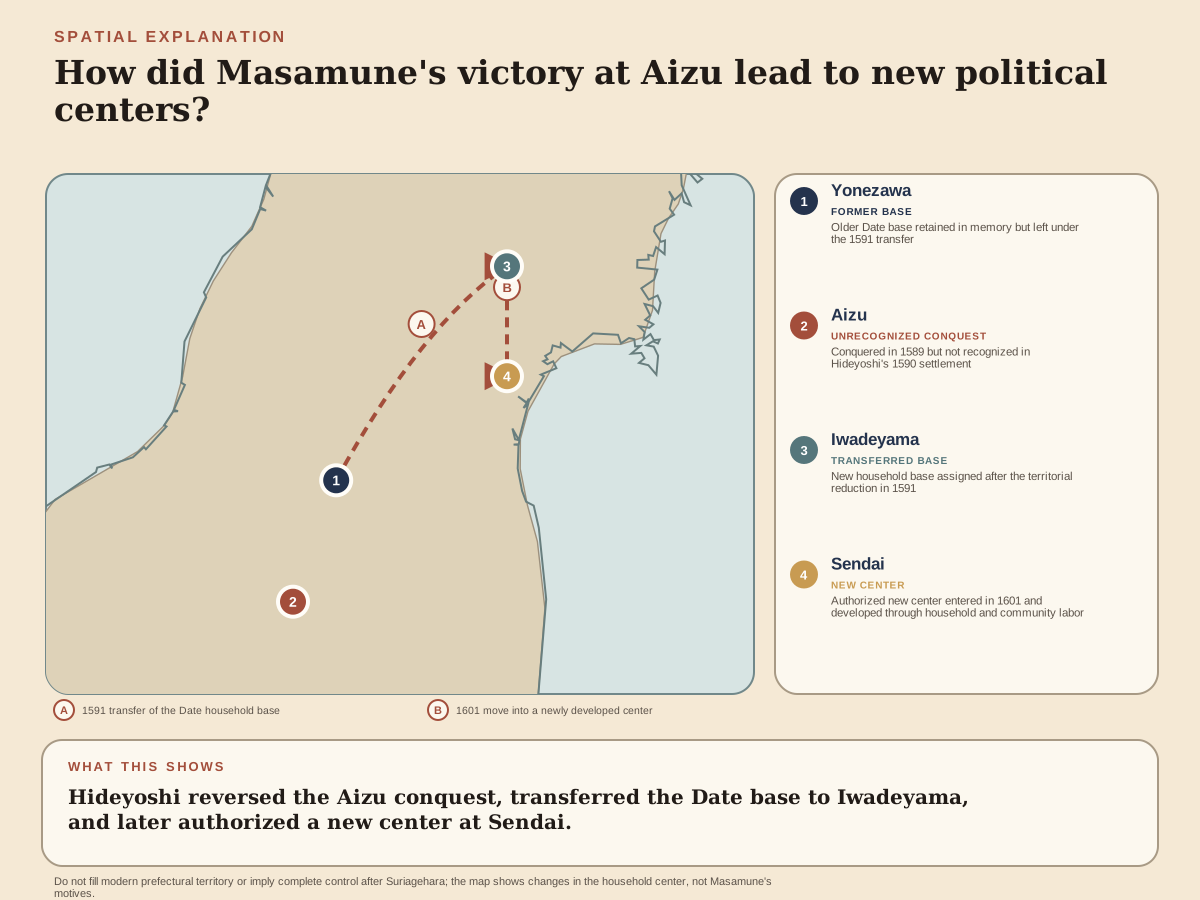
Masamune's forces defeated the Ashina at Suriagehara in 1589 and took control of Aizu, bringing Date territorial power to its greatest pre-Toyotomi extent. The victory depended on armies, retainers, local alliances, logistics, and Ashina weakness—not one commander alone. It also arrived late. Toyotomi Hideyoshi, the military ruler unifying Japan, was imposing a nationwide political order in which unauthorized regional war could be judged as disobedience. Masamune's greatest local gain therefore increased the urgency of submission. [1][2]
Hideyoshi ordered Masamune to join the 1590 Odawara campaign. Masamune arrived and submitted after delay. Later stories emphasize white clothing, theatrical apology, and fearless performance; the secure consequence is more important. Hideyoshi preserved the Date house's older core while refusing to recognize all recent gains, including Aizu. Submission transformed territory from the apparent product of regional victory into land subject to central confirmation. Masamune survived by accepting a hierarchy he could not defeat. [2]
In 1591 Masamune defeated Kasai–Ōsaki rebels at Sanuma, helping suppress resistance to Hideyoshi's new northern settlement. Hideyoshi then transferred him to former Kasai–Ōsaki territory. He established his base at Iwadeyama, leaving Yonezawa and the briefly held Aizu behind. Retainers and households moved with him, while officials reorganized service and collection on the newly granted land. The Date survived, but their territorial position now depended on Hideyoshi's settlement. Iwadeyama would serve as their center for roughly a decade. [2]
During the 1590s Masamune spent substantial time near Kyoto and Osaka, serving Hideyoshi while officials governed from Iwadeyama. In 1593 Masamune took his troops to Busan during the invasion of Korea and returned to Japan later that year. Masamune also practiced poetry, tea and Noh, a stylized theatrical drama, building relationships with elites and specialists in central Japan. Hideyoshi's death in 1598 unsettled the hierarchy under which the house had adapted. [2][4]
In 1600 Masamune supported Tokugawa Ieyasu, the leading challenger to Toyotomi central authority. His troops took Shiroishi Castle from the Uesugi side and reinforced Mogami Yoshiaki, a neighboring lord defending against Uesugi attack. The northern campaign joined the national struggle to local territorial interests. Ieyasu promised former Date lands whose addition would have brought the domain above one million koku, a unit of assessed rice-producing capacity. Only Katta district was granted. The Date secured a place under Tokugawa rule, but could not dictate its territorial settlement. [2][8]
Having obtained Ieyasu's permission before the 1600 campaign, Masamune planned Sendai Castle after the settlement. Construction began in 1601, and he moved into the unfinished site that year. Retainers and townspeople relocated from Iwadeyama, and nearby residents were mobilized for construction. The castle stood above the Hirose River; its town concentrated warrior service and commerce around a permanent domain center. Work continued for years, with the great hall completed in 1610. [4]
Masamune began rebuilding the Matsushima temple then called Enpukuji in 1604; it took the Zuiganji name in 1608, and the main hall's raising ceremony followed in 1609. Painted interiors continued into the 1620s. Patronage linked Date authority, Zen institutions, artisans from central Japan, ancestral memory, and Matsushima's established sacred landscape. Unlike Sendai Castle's lost buildings, major Masamune-period Zuiganji fabric survives, but the achievement belongs to clergy, designers, workshops, laborers, and material suppliers as well as the patron. [7]
Masamune's government expanded rice cultivation and redirected parts of the Kitakami River system. Ishinomaki became a port for shipping tax rice toward Edo, linking new productive land to wider trade. Officials supervised the work, while village labor and repeated maintenance sustained it. Later projects extended these waterways. The complete network eventually called the Teizan Canal incorporates work after Masamune's lifetime, although its name commemorates him. [3][4]
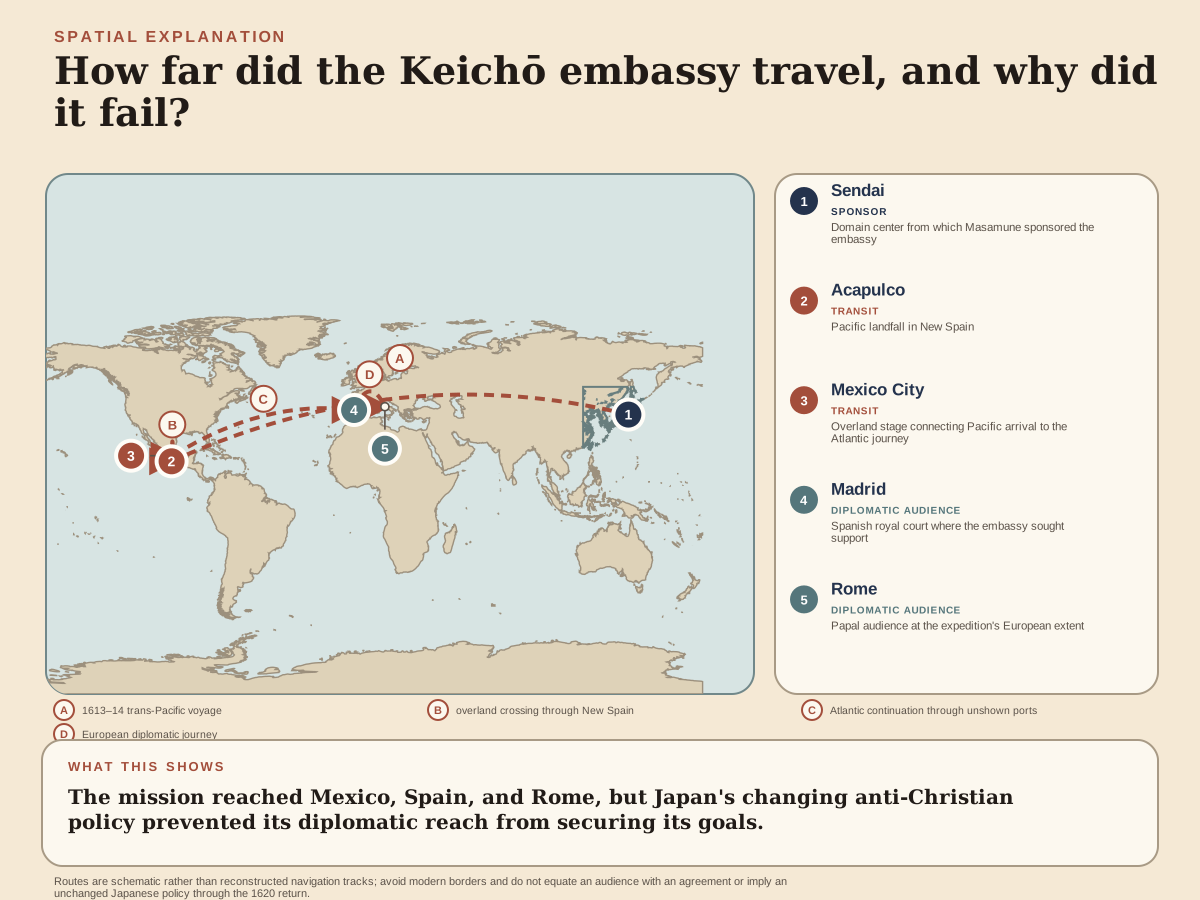
In 1613 Masamune sent the Date retainer Hasekura Tsunenaga and the Catholic friar Luis Sotelo aboard the Sendai-built San Juan Bautista. They crossed the Pacific to New Spain, the Spanish colonial viceroyalty centered on present-day Mexico, then traveled to Spain and Rome. Negotiations sought trade and access for Christian missionaries. When Hasekura returned to Sendai in 1620, Tokugawa prohibition and persecution of Christianity had transformed conditions in Japan. The mission had reached major European audiences but had not established a durable trading relationship. [5][9]
Masamune fought for the Tokugawa side in the 1614–1615 Osaka campaigns that destroyed the remaining Toyotomi political center. He had once served Hideyoshi; after 1600, Date security depended on Tokugawa recognition. This was not modern national betrayal but a shift inside a warrior order whose superior authority had changed. Date service helped eliminate the Toyotomi center while confirming Masamune's dependence on Tokugawa rule. [2]
Masamune moved to Wakabayashi Castle in 1628 as a late-life residence. He died at the Date upper residence in Edo in 1636, aged sixty-eight in completed years or seventy by traditional count. He was buried at Kyōgamine in Sendai; his successor, Date Tadamune, built the Zuihōden mausoleum in 1637. The domain, its cultural institutions and the embassy's documents outlasted him. House histories and memorials continued shaping his reputation through 1912. [3][4]
Classic
Date Masamune was born in 1567 at Yonezawa, in present-day Yamagata Prefecture in northeastern Japan. His father, Date Terumune, headed a powerful warrior house; his mother, Yoshihime, came from the neighboring Mogami family. The child was called Bontenmaru. Southern Ōu, the northeastern region in which the Date competed, contained rival lordships and smaller landholders whose service was negotiated. Terumune's marriage connected his household to the Mogami without ending competition between the two houses. The heir would grow up within that unstable regional balance. [1]
Oda Nobunaga was expanding his power in central Japan. In the northeast, however, local succession and territorial rivalries still set the immediate demands on a lord. The Date could pursue an alliance through marriage while preparing for conflict with the same kin network. Terumune had to secure his successor and maintain the service on which the house's military strength rested. Northern politics would eventually collide with central unification, but the settlement that later constrained Masamune did not yet exist. [1]
Yoshihime maintained ties between her natal and marital houses. Within the Date household, attendants and retainers cared for the heir and prepared him for public duties. Religious instruction supplied literacy and standards of conduct; military training prepared him to lead men who already had their own experience and loyalties. His standing depended first on the continuity of this household, including the adults who could act while he was a child.
The maternal connection remained politically important as Masamune grew older. It offered communication across rival houses but could also place Yoshihime between conflicting family interests. The Date heir's future therefore depended on succession within his own house and on relationships beyond it. Neither side of that inheritance was secure simply because a son had been born.
Childhood smallpox left Bontenmaru blind in his right eye. Terumune nevertheless continued preparing him to lead the house. In 1572 he brought Kosai Sōitsu, a Zen Buddhist monk from Mino in central Japan, to teach the boy; Katakura Kagetsuna was appointed to help with his upbringing. Zen is a Buddhist tradition emphasizing disciplined practice and meditation. The household provided education and support despite the illness. Stories that the damaged eye was removed, or that one episode instantly hardened his character, are later traditions rather than a securely recorded account of his childhood. [1]
In 1577 Bontenmaru underwent genpuku, the coming-of-age ceremony that recognized a warrior boy as an adult, and took the name Masamune. It recalled an earlier Date ancestor. Two years later he married Megohime, daughter of the Tamura lord of Miharu, strengthening another regional connection. His first campaign followed in 1581. These stages brought him from a protected heir's position into the public obligations of marriage and military service, while Terumune still headed the house.
The familiar black eyepatch belongs to a much later image of Masamune. Sendai City Museum curator Sasaki Tōru notes that surviving Edo-period portraits do not depict him wearing one. Some accounts say that he requested portraits with both eyes intact, which also cautions against reading a painted likeness as a literal record of his condition. The portraits show how the lord was represented; they do not recover his daily experience of impaired sight. [1][6]
In 1584 Terumune transferred leadership of the Date house to Masamune. His son was still in his teens—eighteen by traditional Japanese counting, which begins at one and advances at New Year. Terumune's retirement left an experienced former head nearby, with established advisers and diplomatic contacts. Masamune now had to issue orders and reward service in his own name. Retainers and neighboring lords would judge the new head by his ability to maintain the house's position. [1][3]
Mobilization tested whether Masamune's calls for service produced troops and provisions. Success could supply land with which to reward followers; failure could encourage rivals or undermine confidence within the house. Terumune's relationships, Kagetsuna's experience and the marriage connection to the Tamura were assets he inherited. Turning them into coordinated action was the practical test of his new authority. [1]
Masamune's immediate ambitions remained regional. Toyotomi Hideyoshi, the military ruler unifying Japan after Nobunaga's death, had not yet brought the northern lords into the settlement that would follow his campaigns. The young Date head sought a defensible base and stronger command of southern Ōu. Expansion could secure service and revenue, but it also provoked neighbors capable of joining against him. Those dangers soon reached the retired head himself.
Megohime's Tamura connection helped link the new head to another local ruling family. Like the Mogami marriage, it could support communication and claims without making all relatives dependable allies. Masamune's authority was being formed within several overlapping relationships, not within a unified territory whose obedience had already been settled.
In 1585 Nihonmatsu Hatakeyama forces seized Terumune during a meeting connected with a settlement. Date men pursued the captors, and Terumune died in the pursuit. Later narratives portray him ordering his son to fire even though he would be killed with his captor. That famous command is not a verified transcript. The death removed a former house head whose experience and contacts had remained available to Masamune, leaving the new leader to manage the resulting war without him. [1]
Seizing a retired lord could give an opponent leverage that ordinary negotiation had failed to produce. The fatal pursuit destroyed that possibility and intensified the conflict with Nihonmatsu. Masamune's subsequent campaigns carried a filial claim to revenge, while also determining territory and submission. The loss of Terumune and the military contest were inseparable in the Date house's position, even though the sources do not reveal one private motive governing every later decision.
The fighting did not produce an effortless revenge. At Hitotoribashi, Masamune faced severe resistance and relied on commanders including Date Shigezane to avoid defeat. The battle exposed how dangerous a coalition of neighboring enemies could become. Terumune's death had consolidated responsibility in Masamune's hands, but it had not removed the need for experienced followers or secured victory.
The Date took Nihonmatsu Castle in 1586. Its capture strengthened their position for further pressure toward Aizu. Revenge had become a territorial outcome, achieved through another year of campaigning rather than a single decisive scene after Terumune's death.
Suriagehara is often narrated as the purest display of Masamune's military ascent. The result was indeed major: Ashina power collapsed, Aizu came under Date control, and the house held the broadest territory of its history to that point. But the battle did not occur in an isolated arena. It joined local rivalries to a rapidly changing national hierarchy. Victory required more than a lord's decision. Retainers mobilized and supplied troops, while commanders coordinated their movement. Neighboring houses decided whether to support the Date or the Ashina, whose political weakness gave Masamune an opening. Control after battle was another problem. [1]
Aizu contained castles and communities with their own landholders and tax obligations. Their cooperation could not be assumed. The Date needed garrisons and officials to confirm holdings and obtain local service. Rapid expansion stretched the same network that produced victory. A map colored after a battle can make possession look complete, while lived authority remained negotiated and uneven. At the same time, Hideyoshi's campaigns and peace commands increasingly claimed the right to stop private war and adjudicate territorial possession. The precise application of sōbuji (Hideyoshi’s order restricting unauthorized private warfare) policy varied and remains a field for careful interpretation, but the structural point is firm: a central ruler was asserting authority over conflicts that regional lords had previously treated as their own. Masamune could no longer evaluate Aizu only against the Ashina. [2]
He had to evaluate it against Hideyoshi's power to recognize, confiscate, or redistribute land. The more formidable Masamune became locally, the more visible he became to the unifier. A regional victory did not supply the resources to defeat the coalition Hideyoshi could bring against Odawara and beyond. Nor did late compliance guarantee that newly conquered territory would be accepted. It is the subordination of a regional victor whose timing placed expansion against a new jurisdiction. Later “One-Eyed Dragon” narratives sometimes turn Suriagehara into evidence that Masamune would have taken the country had he been born earlier. That counterfactual ignores institutions, geography, population, alliances, and the achievements of other houses. His real accomplishment in southern Ōu is substantial enough without imaginary nationwide victory.
Masamune moved his seat to Aizu after the victory. It was the largest territorial expansion of his early career, but the new center would be held only briefly. Hideyoshi's approaching settlement would decide how much of the conquest the Date could retain.
Odawara exposed the scale difference between southern Ōu success and Hideyoshi's national coalition. Masamune could mobilize a powerful regional army, but Hideyoshi had summoned and coordinated major houses across Japan against the Hōjō. The demand to appear was not a polite invitation. Attendance signaled entry into a political order that claimed authority over war, rank, and land. Masamune delayed, and the reasons cannot be reduced to one emotion. Distance, incomplete information and the fate of recently acquired territory complicated the decision. His household had to calculate whether Hideyoshi's campaign would succeed, whether resistance was possible, and what lateness would cost. Later biography often converts this calculation into a dramatic gamble by a fearless individual. Institutional history keeps advisers, messengers, routes, and competing risks visible. [2]
Later accounts describe Masamune appearing in white garments associated with death or apology. His submission and its territorial consequences are firmer than the elaborate performance attached to the story. Hideyoshi preserved the older Date base but did not recognize Aizu and all the house's recent gains. Military possession now faced a superior ruler's judgment. Accepting that ruling preserved Masamune's house while sharply limiting the reward from his preceding victories. [2]
Survival was an achievement, but not proof that charm alone saved him. Hideyoshi had reasons to preserve useful northern lords who complied, while demonstrating that disobedience could cost land. Masamune had retainers, fortresses, knowledge, and regional value. He also faced overwhelming pressure. Negotiated incorporation served both ruler and subordinate, though from unequal positions. His house survived because he accepted the victorious system. From this point, ambition operated inside structures built by stronger rulers. Adaptation—not untouched independence—became the central skill. The settlement's coercion extended beyond elite negotiation. When land was reassigned, garrisons, officials, cultivators, and religious institutions faced new superiors and revised obligations.
Masamune's preserved core did not mean that recent warfare left ordinary life undisturbed. Hideyoshi's ruling converted battlefield outcomes into administrative orders, and those orders had to be enforced locally. A plausible calculation can be reconstructed from visible military imbalance and territorial stakes, but pride, panic, and the exact performance before Hideyoshi remain unrecoverable. The surviving sequence shows negotiation, punishment and retained authority rather than a single moment of unconditional surrender.
In 1591 Masamune helped suppress the Kasai–Ōsaki uprising against Hideyoshi's new northern settlement, defeating its forces at Sanuma. Hideyoshi then granted him former Kasai–Ōsaki territory and removed the Date from their older Yonezawa base. Masamune established his headquarters at Iwadeyama. The transfer brought a lord and his followers into communities already unsettled by rebellion and its suppression. Incoming officials needed local knowledge and had to decide which holdings and obligations they would recognize. Retainers expected rewards, while construction and revenue collection required cooperation from the people on the land. Service households moved with the lord; traders and craftspeople also had to find their place around the new center. [2]
Transfer was a central technology of unification. It broke some links between a warrior house and its established base, forced the house to rely on recognized grant, and placed strategically important territory under a lord the ruler expected to control. It could punish, reward, and reorganize simultaneously. Masamune lost the Aizu prize but remained a substantial lord. The settlement therefore resists simple labels of ruin or triumph. Iwadeyama was not a waiting room with no history of its own. Masamune spent roughly a decade using it as a base while often attending Hideyoshi's centers and military obligations elsewhere. Local administration continued during absence through delegated authority. The lord's physical presence mattered, but documents, stewards, retainers, and household routines allowed rule across distance.
Iwadeyama served the Date for roughly a decade and connected inland routes through their new territory. It gave officials experience in governing a transferred domain, an organization the later move to Sendai would carry into a more permanent center.
During the Iwadeyama decade Masamune spent substantial time near Kyoto and Osaka, attending Hideyoshi alongside other daimyō, the territorial warrior lords. Access to the ruler depended on service and participation in an elite courtly world. He practiced poetry and calligraphy, joined tea gatherings and performed Noh, a stylized drama combining music, movement and verse. These pursuits created relationships with court nobles, clerics and specialists whom he could later invite north for Date building projects. [2][4]
Military service remained compulsory within Hideyoshi's hierarchy. In 1593 Masamune crossed to Busan with his troops during the invasion of Korea and returned to Japan later that year. The Date were participating in a war whose wider strategy belonged to Hideyoshi. Extended absences also required officials at Iwadeyama to supply the campaign while maintaining the domain's revenue and government. [2]
Religious policy and overseas awareness were likewise developing in a world of mixed signals. Christian missionaries, Iberian merchants, and Japanese converts operated alongside Hideyoshi's restrictions. Knowledge of foreign trade did not yet make the later 1613 embassy inevitable. Contacts accumulated; conditions changed; opportunities would later be organized into a mission.
Hideyoshi's death in 1598 unsettled the order under which Masamune had served. The Date remained based at Iwadeyama, while rival leaders sought control of the government protecting Hideyoshi's young heir. Masamune's next choices would connect his regional interests to that succession struggle. The capacities acquired under Toyotomi rule would remain useful even as the superior authority changed.
“Sekigahara” names a nationwide struggle more accurately than a single field when used with care. The decisive clash occurred in central Japan, but competing coalitions mobilized campaigns across regions. In the north, Uesugi power, Mogami defense, Date ambition, and Tokugawa strategy interacted. Masamune's support for Tokugawa Ieyasu, the leading challenger to Toyotomi central authority, joined a national alignment while pursuing regional security and opportunity. His forces took Shiroishi Castle from the Uesugi side and sent reinforcements to Mogami Yoshiaki, the neighboring lord resisting Uesugi attack. The northern terrain imposed its own timing. Armies needed passes, river crossings, supplies, intelligence, and defended bases. Messages between Ieyasu and allies could not make distant forces move without delay. Local lords carried memories of earlier conflict and possessed goals not reducible to obedience. An alliance worked because interests overlapped enough for action, not because Ieyasu controlled every movement from afar. Masamune's relationship with Yoshiaki also involved family ties and older rivalry. [2]
Yoshihime linked Masamune to the Mogami house, but the two lordships had their own territorial interests. Uesugi pressure made cooperation useful without resolving their older rivalry. Support for Ieyasu offered security within a wider coalition; it did not give Masamune the authority to decide the northern settlement himself. A memorandum now held by Sendai City Museum promised grants of former Date lands to Masamune's senior retainers. Added to his existing domain, they would have exceeded one million koku, the unit of assessed rice-producing capacity. The museum explains that only Katta district, captured from the Uesugi, was actually granted. The object records a promise and its unfulfilled extent; it does not by itself establish why all the rewards were withheld. [8]
Ieyasu's victory provided the superior framework for the Date domain. Masamune could present his service and territorial claims, but he could not enforce his preferred settlement against the victor. Cooperation secured his place under Tokugawa rule while leaving him subject to its restrictions on warfare and succession.
The northern front continued to matter after news of the central victory arrived. Garrisons had to stand down or transfer, settlements had to be negotiated, prisoners and claims handled, and the winning coalition translated into local authority. A one-day Sekigahara label obscures this extended settlement.
Having obtained Ieyasu's permission before the 1600 campaign, Masamune planned a new center at Sendai after the settlement. He renamed the earlier Chiyo site, and castle construction began in 1601. In 1601 he moved into the still-unfinished castle above the Hirose River. The steep height provided a strong defensive position, but the residence and town developed through years of work. The great hall was completed in 1610. Masamune had chosen the center; making it usable required organized construction and the relocation of the Date household and its dependants. [4]
Castle and town were one governing project. Warrior residences organized service and rank. Merchant quarters concentrated exchange. Roads directed movement and connected regional routes. Water systems enabled households and fire response. Temples and shrines structured ritual, burial, and urban edges. Storehouses, workshops, and markets supported domain government. The center made taxation, communication, ceremony, and military readiness more durable. Human cost belongs inside the achievement. Samurai and townspeople were moved from Iwadeyama. Nearby residents were mobilized for construction. Craftspeople recruited from other regions brought expertise while local labor supplied knowledge and effort. Land was reassigned; settlement patterns changed; household routines adjusted. The move also transformed a wartime retainer organization into domain administration. Men rewarded for campaign service needed peacetime offices, stipends, residence, and rules. [4]
Delegated officials kept the domain operating when Masamune was absent in Edo. The castle town brought service households, stores and exchanges into a durable center, making the Date less dependent on continual campaigning for territorial gains. Its original principal buildings are now lost. Surviving stonework and excavated foundations, including those of the great hall, preserve parts of the successive building phases rather than a complete seventeenth-century castle. [4]
The town's wooden buildings also made fire a continuing danger. Water access and routes through the settlement served practical needs as well as the ordering of rank and trade. Maintaining this center required rules and communal effort after the initial construction. The founder's decision gave the Date a new seat; its survival depended on successive residents and administrators.
Zuiganji was not created on an empty sacred shore. Matsushima already possessed religious history, local communities, caves, memorial practices, and scenic reputation. The temple's institutional identity had changed across centuries.
Historical disagreement · Did the Zen and Tendai temples coexist at Matsushima?
Zuiganji's current history contrasts the older view that a Zen foundation replaced the Tendai temple, belonging to a Buddhist school centered on the Lotus Sutra, with the view, supported by excavation and reconsideration of the documents, that the two establishments coexisted.
Masamune's project renewed and redirected that inheritance rather than beginning religion at the site.
The official temple chronology supplies unusually useful anchors. Work on Enpukuji began under Masamune in 1604. The name became Zuiganji in 1608. A main-hall raising ceremony occurred in 1609, after years of construction. Painted decoration proceeded later, especially from 1620 to 1622. These phases prevent a single “built in 1609” label from erasing planning, finishing, and artistic production. Patronage served several purposes without becoming cynical disguise. Supporting a Zen temple generated religious merit and ritual capacity. [7]
It associated Date rule with an older sacred and scenic place. It created spaces for memorial and reception. It displayed the domain's ability to recruit specialists and materials. Political legitimacy and religious commitment could coexist; historical explanation need not choose one as the only sincere motive. Architecture redistributed cultural skill. Building and painting workshops, supported by suppliers and transport crews, worked under organized authority. Artists connected to major central traditions produced interiors suited to elite reception and Buddhist use. Monks determined liturgical requirements and lived with the resulting buildings. The patron authorized resources and direction, but did not personally carve a beam or paint every panel. The Date relationship to Matsushima also created a place network. Sendai held the administrative castle center; Matsushima offered temple, memorial, artistic, and maritime-scenic meanings. [7]
The route between Sendai and Matsushima linked the administrative seat to a major religious and cultural center. Zuiganji's interiors were produced by specialist workshops for Buddhist worship and elite reception, with their work continuing beyond the main hall's construction. Later visitors, including the poet Bashō, encountered this Date-renewed temple within an older landscape. Their descriptions helped extend Matsushima's reputation beyond the domain.
After the Meiji Restoration, the abolition of its Date-supported income and anti-Buddhist disruption weakened Zuiganji. An imperial visit and donation in 1876 helped its recovery, followed by major repairs in 1900–1903. By 1912 it continued as a Buddhist establishment and a place associated with Date patronage. Its buildings had survived through institutional change and repair, rather than remaining untouched since Masamune's project.
Under Tokugawa rule the Sendai domain's strength depended increasingly on cultivated land and the movement of its produce. Masamune's government undertook river works that joined the Kitakami with the Hasama and Eai rivers in 1626 and developed new rice fields. Ishinomaki, at the river's outlet, became a port through which tax rice could be shipped toward Edo. River works joined agricultural expansion to transport, enlarging the revenue base that supported the Date household and its retainers. Officials supervised construction and collection; cultivators and local labor sustained the system between floods and repairs. [3][4]
They could change wetlands, fisheries, commons, and flood exposure. Settlers needed seed, tools, dwellings, and time before stable harvest. Tax claims could burden the same communities whose work created revenue. “Development” is therefore an observable institutional program, not an automatic synonym for universal benefit. Transport linked cultivation to markets. Rivers and coastal routes moved rice and other goods, while castle-town demand attracted merchants and craftspeople. Ports were not passive endpoints; boat crews, warehouse workers, brokers, and officials organized exchange. Domain policy operated through licenses, tolls, measures, contracts, and protection. Sendai's economic base was a network, not simply the land immediately visible from the castle. The name Teizanbori requires a chronological boundary. “Teizan” derives from Masamune's posthumous name, and the canal system's later completion and naming in the Meiji period layered subsequent engineering onto earlier sections. [4]
The full canal network developed through projects extending beyond Masamune's lifetime. Its later name commemorated him while incorporating the work of successor governments and engineers. Early Date investment helped establish a direction for domain growth, but the system could not be maintained or extended by one generation. Rice assessed in koku represented expected productive capacity; actual harvest and the obligations villages could meet varied with weather and water management.
New fields and transport routes strengthened Date finances. Cultivators supplied both the labor of improvement and revenue from the land, tying official development plans to the communities whose work made them productive.
In 1613 Masamune authorized the Keichō embassy to seek overseas trade and negotiations with Spain and Rome. A Date retainer, Hasekura Tsunenaga, led the delegation with Luis Sotelo, a Franciscan friar acting as religious advocate and intermediary. Franciscans belong to a Catholic religious order founded by Francis of Assisi. The domain built the San Juan Bautista for the voyage, drawing on maritime knowledge already circulating through Iberian contacts. Masamune supplied authority and resources in Sendai; Hasekura, Sotelo and the crew had to negotiate the journey abroad. [9]
The delegation crossed the Pacific to Acapulco in New Spain, the Spanish colonial viceroyalty centered on present-day Mexico. It then crossed the Atlantic to Spain and continued to Rome. Surviving correspondence, portraits and Hasekura's Roman citizenship document record its European audiences. Negotiations took years, during which the Tokugawa government tightened restrictions on Christianity. Spanish authorities faced growing doubts about whether the promised religious and commercial access in Japan could be sustained. [5][9]
Trade negotiations depended on assurances about missionary access that the domain could not sustain against the Tokugawa government's changing policy. Sponsoring a mission involving missionaries does not securely prove private conversion, and later persecution cannot be erased to preserve an “internationalist” brand. His government could seek foreign trade while enforcing the superior regime's religious direction. That contradiction is historically substantive. The embassy also demonstrates that “closed Japan” is a poor label when projected backward. In 1613 maritime policy was narrowing but not yet identical to the mature later system. Japanese and foreign actors still tested possibilities across the Pacific.
Hasekura was baptized and received honors in Europe. These acts belong to his journey, not proof that Masamune privately converted. When Hasekura returned to Sendai in 1620, Christian practice in Japan faced prohibition and persecution. The hoped-for trading relationship had not become durable. The mission left a substantial documentary record of contact, while Hasekura returned to political conditions very different from those at departure. [5][9]
Osaka closed a political cycle that Odawara had opened. In 1590 Masamune preserved his house by submitting to Hideyoshi. A quarter-century later he mobilized under the Tokugawa order against Hideyoshi's surviving house. The change appears inconsistent only if vassalage is imagined as permanent allegiance to a modern nation. Warrior service was personal, institutional, negotiated, and vulnerable to the collapse of superior power. The Toyotomi center at Osaka remained a focus for lords, retainers, and displaced warriors who did not all interpret the post-Sekigahara settlement alike. Tokugawa strategy sought to remove that alternative. Masamune's participation demonstrated that the Date domain would support the victorious hierarchy in a final, costly test. Military service was both obligation and political communication. Campaigning depended on contingents rather than isolated champions. [2]
Date commanders, mounted warriors, foot soldiers, gunners, suppliers, messengers, and servants moved under a larger coalition. The destruction of Osaka also had civilian and material costs. Fire, siege, displacement, death, and the end of the Toyotomi household cannot be narrated only as proof of Masamune's adaptability. For the Date house, service strengthened credibility under the shogunate. It did not create independence. Domain status still rested on Tokugawa recognition, attendance, military obligations, and succession approval. Masamune retained room for patronage and administration because he demonstrated compliance at crucial moments.
His renowned boldness operated inside that dependency. The embassy and Osaka campaign overlapped in revealing ways. While Hasekura pursued overseas negotiations, Masamune fought in the domestic settlement that would increasingly restrict Christianity and foreign access. The two policies were not necessarily conceived as opposites at dispatch, but events made their tension visible. A “global visionary” narrative that omits Osaka and persecution is incomplete; a “mere obedient vassal” narrative that omits the embassy is equally incomplete. Masamune survived multiple regimes by recalibrating service, yet survival imposed participation in their wars. The campaigns also clarified succession security. A daimyō house needed more than battlefield survival: it required a recognized heir, orderly transfer, and continuing shogunal confidence. Masamune's conduct was evaluated against those expectations.
Date security now depended on shogunal recognition of its domain and succession. Osaka service confirmed that alignment at the cost of participation in the destruction of a former superior's house. Relationships formed under Hideyoshi nevertheless survived in marriage ties, former service connections and objects that crossed into Tokugawa households. Military defeat ended Toyotomi political power without instantly dissolving every social connection to it.
In 1628 Masamune moved to Wakabayashi Castle as his late-life residence. He continued to attend the shogunal capital and died in 1636 at the Date upper residence in Edo. He was sixty-eight in completed years, or seventy by traditional Japanese counting. His body was taken to Kyōgamine in Sendai for burial. In 1637 his son and successor, Date Tadamune, built the Zuihōden mausoleum there, creating a dynastic place of worship and remembrance. [3][4]
Reputation began changing long before modern media. Date house records organized an official lineage narrative, but some compilations were produced generations later and completed into the Meiji era. Portraits followed conventions and patron needs. Temple commemoration emphasized patronage. Local memory connected urban and agricultural development to the founder. Foreign documents preserved the embassy from different institutional viewpoints. These archives sometimes reinforce and sometimes complicate one another.
By 1912 Masamune was remembered as a regional conqueror, the founder of Sendai and a patron of religious buildings and overseas diplomacy. Date house compilations, including the Date Jike Kiroku, preserved valuable accounts but were assembled over generations, rather than written as a contemporary diary of the whole life. Their dynastic viewpoint helped shape the founder's reputation. That memory sat beside foreign embassy documents and surviving works at Zuiganji. Together they preserve a life that combined durable regional creation with war, compelled service and religious coercion.