

 1868
1868The Charter Oath Sets the New Government’s Principles
五箇条の御誓文
Why it mattersOn April 6, 1868, Emperor Meiji pledged five principles at the Kyoto palace, calling for deliberation, common effort, opportunities across social ranks, reform of harmful customs and knowledge from abroad while civil war continued.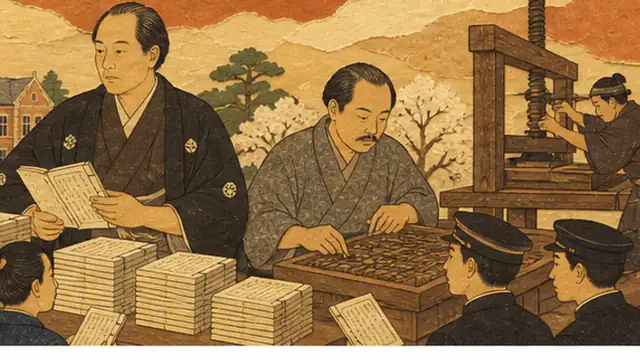 1872–1876
Publishing Gakumon no Susume
『学問のすゝめ』の刊行
Why it mattersBetween 1872 and 1876, Fukuzawa Yukichi issued the seventeen pamphlets of Gakumon no Susume, using a rapidly expanding print market to argue that practical learning and individual independence were foundations of national strength. 1873
1873The 1873 Conscription Rules Recruit through Local Offices
徴兵令
Why it mattersJapan’s 1873 conscription rules required eligible twenty-year-old men to undergo examination and selection for a centrally controlled army, while exemptions, payments and uneven local implementation limited the reach of the proclaimed national obligation. 1874
1874Eight Signatories Petition for an Elected Assembly
民撰議院設立建白書
Why it mattersOn January 17, 1874, Itagaki Taisuke and seven other signatories petitioned the government’s Left Chamber for an elected assembly, linking the duty to pay taxes with the right to participate in government.- 1876
Sapporo Agricultural College Opens a Program of Scientific and Practical Training
札幌農学校の開校
Why it mattersSapporo Agricultural College opened its specialist course on August 14, 1876, combining English and scientific instruction with surveying and experimental agriculture for the Kaitakushi’s development program. - 1881
The Liberal Party Organizes for a Future Elected Assembly
自由党の結成
Why it mattersOn October 29, 1881, organizers of the movement for representative government founded the Liberal Party, elected Itagaki Taisuke and Nakajima Nobuyuki as its leaders and adopted a covenant and rules for national political activity. - 1882
Ōkuma and Ono Build a Political Party and Tokyo Senmon Gakkō
大隈重信・小野梓と東京専門学校
Why it mattersIn 1882, Ōkuma Shigenobu and associates led by Ono Azusa founded the Constitutional Progressive Party and opened Tokyo Senmon Gakkō, creating organizations for parliamentary politics and higher education outside government. - 1882
Jiji Shimpō Opens a Daily Newspaper and Commercial Newsroom
『時事新報』の創刊
Why it mattersFukuzawa Yukichi and associates launched Jiji Shimpō on March 1, 1882, combining unsigned political editorials, news and advertisements in a daily newspaper financed through sales and advertising. - 1890
The First Imperial Diet Opens under a Restricted Franchise
第一回帝国議会
Why it mattersFollowing Japan’s first lower-house election on July 1, 1890, the Imperial Diet formally opened on November 29, bringing elected representatives and the House of Peers into legislation and contentious budget negotiations. - 1890-1916
Factory Investigation Leads to a Limited Worker-Protection Law
工場調査と工場法
Why it mattersFollowing investigations of factory labor, Japan promulgated the Factory Act in 1911 and began implementing it in 1916, regulating women’s and children’s work while retaining extensive exemptions and transition periods.