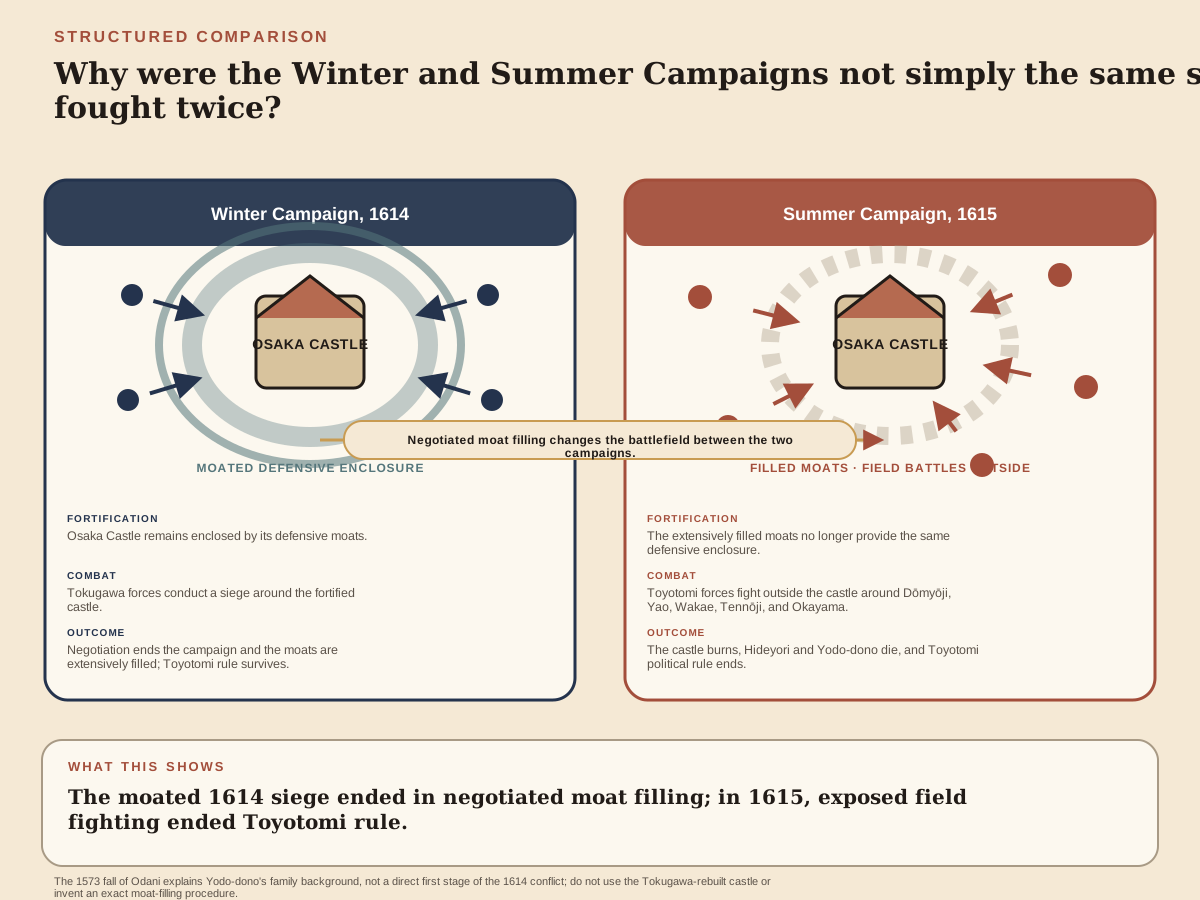
The dispute over the Hōkōji bell inscription in 1614 escalated relations between the Tokugawa and Hideyori’s government at Osaka. Katagiri Katsumoto’s mediation failed, and the Toyotomi gathered rōnin while Ieyasu and Hidetada mobilized lords for a siege. The winter campaign ended in negotiations and extensive filling of the castle’s defensive moats.
Chacha, later known as Yodo-dono, was the daughter of Asai Nagamasa, who held Odani Castle in Ōmi, in present-day Shiga. Her mother Oichi was Oda Nobunaga’s sister. The marriage linked two military houses, but the link did not prevent war between them. In 1573 Nobunaga’s forces took Odani. Nagamasa died, while Oichi and the daughters left the castle and came into Oda protection. Chacha’s sisters were Hatsu and Gō. The family relationship survived the destruction of the father’s territorial position, leaving the women attached to a house that had also brought about that destruction.
After Nobunaga’s death in 1582, Oichi married Shibata Katsuie, one of his leading commanders, and the sisters moved to Kitanoshō in Echizen, now Fukui. Katsuie’s struggle against Hideyoshi, a rival for power within Nobunaga’s former command, ended in defeat in 1583. Oichi died with him when Kitanoshō fell, but the three daughters survived and came under Hideyoshi’s protection. The two fallen castles belonged to different conflicts: the first broke the Asai lordship under Nobunaga; the second settled a contest among men seeking power after Nobunaga. Chacha’s circumstances changed with each settlement.
Neither an intact Asai domain nor their parents remained to determine the sisters’ adult positions. Their ancestry nevertheless connected them with prominent houses. Hatsu later married Kyōgoku Takatsugu, while Gō married Tokugawa Hidetada. Chacha entered Hideyoshi’s household as a consort. These different placements would eventually connect the sisters to opposing sides at Osaka. The sisters retained their family connections while taking different places in households built by the commanders who had prevailed.
The castle depended on revenue from the Tsugaru plain. Assessment stated what land was expected to produce; a poor harvest could leave collection far below the figure on the register. Snow and a short growing season limited what the domain could demand from northern agriculture.
Village officials apportioned dues and communicated orders. They stood between the administration seeking revenue and communities responsible for producing it. Water control made that relationship practical: irrigation required cooperation among settlements sharing the same channels.
Irrigation could favor upstream fields at the expense of those below them. Flood works could protect one settlement while redirecting danger toward another. The domain's authority included judging such conflicts, not simply ordering new acreage cultivated.
Renewed demands over Hideyori’s residence and the removal of rōnin led to another campaign in 1615. With the moats gone, Toyotomi troops fought outside the castle. Gotō Mototsugu and Kimura Shigenari died in the fighting around Dōmyōji, Yao and Wakae. The final defeat near Tennōji and Okayama was followed by the castle’s burning and the deaths of Hideyori and his mother Yodo-dono. Senhime escaped.
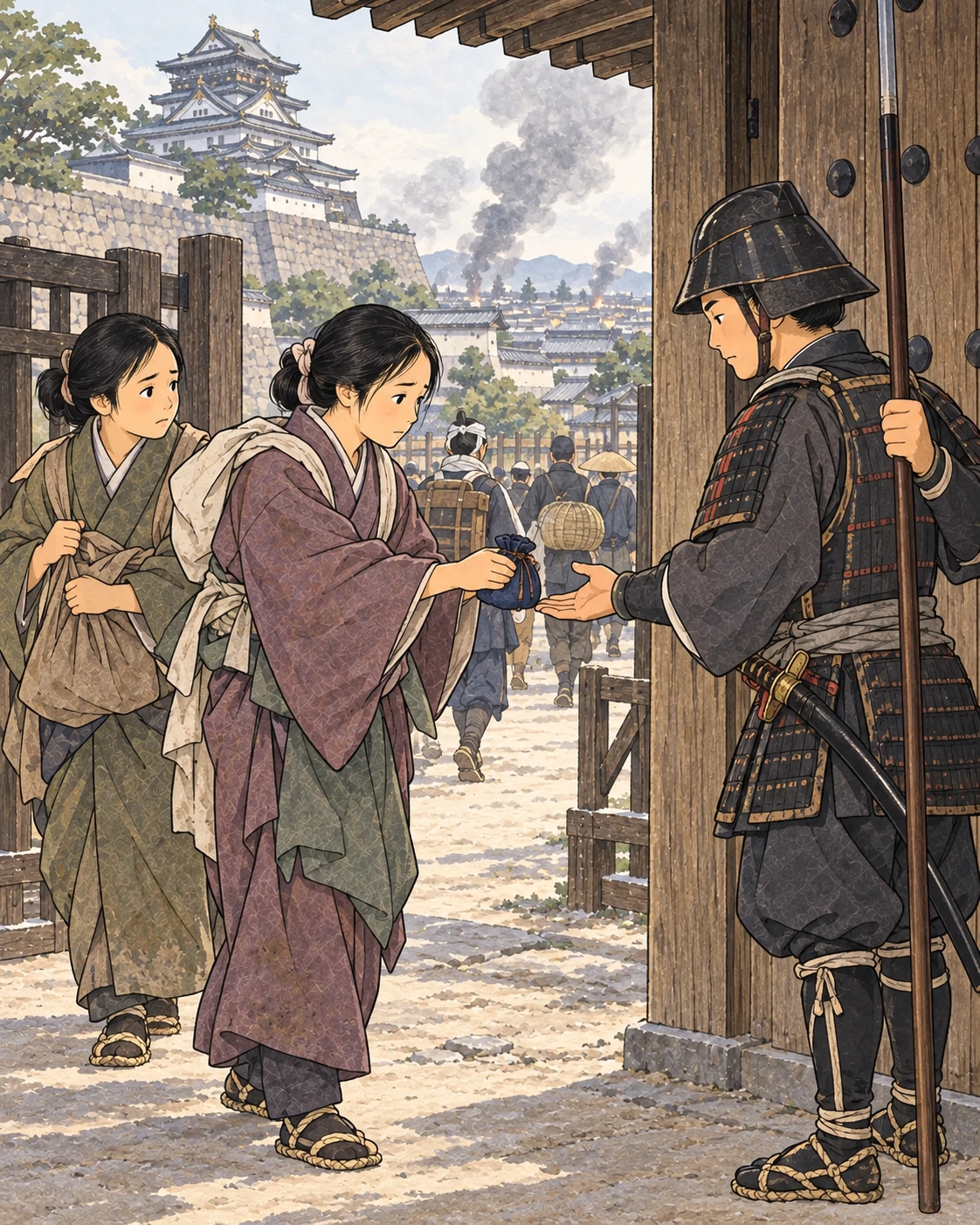
An attendant remembered another route through the catastrophe. In the later-published Okiku Monogatari, she recalls leaving despite a guard’s warning, surrendering valuables to pass an armed man and finding refuge with Yodo-dono’s sister. She later heard that the fate of many women left behind was unknown. The destruction ended Toyotomi rule, while castle residents faced flight, separation and uncertain survival.
Nobuhira's recognized position carried obligations outside Tsugaru. The municipal history records work for Takada Castle in 1613 and his participation in the Osaka winter campaign in 1614. The Tokugawa were attacking the surviving Toyotomi center; the campaigns of 1614–1615 ended that rival house's political power.
The distance from Tsugaru increased the burden of movement. Provisioning forces and preserving administration during absence drew on the same resources needed for the new castle town.
Yodo Castle stood in Yamashiro, the region around Kyoto. Chacha’s association with that residence gave her the designation Yodo-dono, meaning the lady of Yodo. She also appears under other household designations, including Ninomaru-dono. The name Chacha occurs directly in Hideyoshi’s correspondence; Yodo-gimi is a later designation. These names refer to the same woman at different points of use and remembrance. Around 1588 she became Hideyoshi’s consort, and in 1589 she bore Tsurumatsu. After his early death, Hideyori’s birth in 1593 again supplied the ruler with a young son.
A letter identified by the Hyogo Prefectural Museum of History and the University of Tokyo Historiographical Institute addresses Chacha by name. Hideyoshi writes that he has heard about her extensive treatment with moxibustion, a method applying heat from burning medicinal material. He also reports hearing that her condition has improved. Food, fish and a promised performance of Noh theater enter the message alongside concern about treatment. These details disclose an exchange of news within the family. Hideyoshi’s concern reached Chacha through this correspondence while news of her condition travelled in the other direction.
The letter identifies Chacha as the mother of Hiroi, Hideyori’s childhood name. That wording helps date it after the boy’s birth in 1593 and before the change to Hideyori around 1596. The historian Yabuta Yutaka proposes 1594 by comparing its concerns with other letters; the document itself does not carry a secure year. The reference to maternity belongs to an affectionate family message, yet it also points to the child on whom the ruling house’s succession depended. A woman known largely through the later siege appears here as a living recipient whose health and ordinary needs mattered to the household.
In 1625 the shogunate permitted shipping from Tsugaru toward Edo, the Tokugawa seat now called Tokyo. Nobuhira used that opening to establish a new port town on Mutsu Bay. In 1626 he issued a black-seal order to Moriyama Yashichirō, his retainer, initiating town formation under the name Aomori.
The city's anniversary chronology distinguishes shipping permission from town construction and places Moriyama's involvement chiefly in the first two or three years. Nobuhira authorized a project that took much longer than his own remaining lifetime to complete.
The coast already had residents and maritime activity. Aomori's growth reorganized an inhabited shore rather than creating exchange on empty land. Rural rice could now move toward Edo through a port whose merchants and sailors bore risks that the permission document could not remove.
The Tsugaru Strait linked the coast to the Matsumae domain and Ezochi, the historical name for territories including much of present-day Hokkaidō. Ainu communities, an Indigenous people of northern Japan and neighboring areas, participated in northern exchange under increasingly unequal relationships. Aomori joined networks that were older and wider than its town plan.
Tsugaru Nobuhira consolidated Hirosaki domain within the Tokugawa order through succession, dynastic marriage, castle construction and regional administration. Recognition after the family dispute and marriage to Mantenhime tied a once-contested northern house more securely to national rule.
Hirosaki and Aomori connected castle government, agriculture, port traffic and communities across the Tsugaru region. The surviving tower was built long after Nobuhira, so his durable contribution is the administrative and spatial framework rather than every visible structure. Later rebuilding makes continuity and change equally important to his legacy.
In 1593 Hideyoshi was at Hizen Nagoya in northwestern Kyushu, directing the invasion of Korea. His son was born at Osaka Castle. A letter dated the ninth day of the traditional eighth month sends his response to Nene, the principal wife who held responsibility for the castle during his absence. The museum identifies the recipient’s custodial function separately from Yodo-dono’s maternity. The family’s future thus depended on work done at a distance: messages carried the birth news to the ruler, while care and household supervision took place at Osaka.