Read the article below. Interactive reading tools are available when scripts load.
Quick
Chacha, later called Yodo-dono, grew up in the Asai household of Ōmi, in present-day Shiga. Her father Nagamasa opposed Oda Nobunaga, her mother Oichi’s brother. Nobunaga’s capture of Odani Castle in 1573 ended Nagamasa’s life and lordship; Oichi and her daughters survived. Oichi remarried Shibata Katsuie in 1582, but Hideyoshi, a rival for power within Nobunaga’s former command, defeated him the following year. Oichi died with Katsuie at Kitanoshō, and Chacha and her two sisters came under Hideyoshi’s protection. The sisters’ later marriages carried their Asai and Oda connections into new ruling households. Chacha’s route to Toyotomi prominence began through those transfers and losses. [1][9]
Around 1588 Chacha became a consort of Hideyoshi, the ruler who was bringing Japan’s territorial lords under his authority. Her residence at Yodo Castle near Kyoto gave rise to the name Yodo-dono. She bore Tsurumatsu in 1589 and Hideyori in 1593 after the elder boy’s early death. A surviving letter to Chacha discusses her illness and treatment with moxibustion, the application of heat from burning medicinal material. Hideyoshi encourages her to eat, sends fish and offers to show her a performance of Noh theater. The letter’s reference to the mother of Hiroi, Hideyori’s childhood name, places this domestic concern within the heir’s household. [1][2]
Hideyori was born at Osaka Castle in 1593. Hideyoshi heard the news at Hizen Nagoya, the base in Kyushu from which he directed the invasion of Korea, and wrote to Nene, his principal wife and Osaka’s custodian. The boy received the childhood name Hiroi through a protective naming ritual. Yodo-dono’s maternity and Nene’s household responsibilities coexisted. When Hideyoshi died in 1598, Hideyori was still a child, and Yodo-dono acted as his guardian at Osaka. The military struggle culminating at Sekigahara in 1600 changed the distribution of power around the heir without immediately destroying his household. [1][4][8]
In 1602 Yodo-dono’s donation supported the construction of the raidō, or worship hall, at Ishiyamadera, an important Buddhist temple near Lake Biwa. This work formed part of the temple’s recovery after earlier damage. Her family also created a link with the Tokugawa. In 1603 Hideyori married Senhime, the daughter of Hidetada and Yodo-dono’s sister Gō, and granddaughter of Ieyasu. The National Archives reports that the two mothers consulted over the date. Hideyori continued receiving high court appointments as the Tokugawa secured the hereditary shogunate. Religious rebuilding and marriage maintained the Toyotomi household’s public standing, but did not resolve that division of authority. [3][5][9]
In 1614 Tokugawa officials objected to words on the bell of the Toyotomi-sponsored Hōkōji temple in Kyoto, interpreting them as a curse on Ieyasu and a celebration of Toyotomi prosperity. The accusation was a political reading of the inscription, rather than proof of a curse. Failed mediation preceded the winter siege of Osaka. Yodo-dono’s sister Hatsu, known as Jōkō-in after taking religious vows, represented the Osaka side in peace negotiations with Acha-no-tsubone of Ieyasu’s household and the Tokugawa official Honda Masazumi. The settlement included reassurance that Yodo-dono need not go to Edo. Fighting ended, but the subsequent removal and filling of defenses left Osaka much more vulnerable. [6][7][8][9]
In 1615 reports of renewed fortification and the presence of warriors at Osaka preceded another Tokugawa campaign. With its defenses reduced, the Toyotomi forces fought outside the castle as well as around it. The Tokugawa coalition prevailed, and Yodo-dono and Hideyori died by suicide on the eighth day of the traditional fifth month. Their deaths ended the family at Osaka as a rival center of power. Senhime survived the fall. Letters addressed to Yodo-dono, family arrangements and religious patronage also preserve a life extending beyond its final defeat. [6][8][1][5][10]
Classic
Chacha, later known as Yodo-dono, was the daughter of Asai Nagamasa, who held Odani Castle in Ōmi, in present-day Shiga. Her mother Oichi was Oda Nobunaga’s sister. The marriage linked two military houses, but the link did not prevent war between them. In 1573 Nobunaga’s forces took Odani. Nagamasa died, while Oichi and the daughters left the castle and came into Oda protection. Chacha’s sisters were Hatsu and Gō. The family relationship survived the destruction of the father’s territorial position, leaving the women attached to a house that had also brought about that destruction. [1]
After Nobunaga’s death in 1582, Oichi married Shibata Katsuie, one of his leading commanders, and the sisters moved to Kitanoshō in Echizen, now Fukui. Katsuie’s struggle against Hideyoshi, a rival for power within Nobunaga’s former command, ended in defeat in 1583. Oichi died with him when Kitanoshō fell, but the three daughters survived and came under Hideyoshi’s protection. The two fallen castles belonged to different conflicts: the first broke the Asai lordship under Nobunaga; the second settled a contest among men seeking power after Nobunaga. Chacha’s circumstances changed with each settlement. [1]
Neither an intact Asai domain nor their parents remained to determine the sisters’ adult positions. Their ancestry nevertheless connected them with prominent houses. Hatsu later married Kyōgoku Takatsugu, while Gō married Tokugawa Hidetada. Chacha entered Hideyoshi’s household as a consort. These different placements would eventually connect the sisters to opposing sides at Osaka. The sisters retained their family connections while taking different places in households built by the commanders who had prevailed. [1][9]
Yodo Castle stood in Yamashiro, the region around Kyoto. Chacha’s association with that residence gave her the designation Yodo-dono, meaning the lady of Yodo. She also appears under other household designations, including Ninomaru-dono. The name Chacha occurs directly in Hideyoshi’s correspondence; Yodo-gimi is a later designation. These names refer to the same woman at different points of use and remembrance. Around 1588 she became Hideyoshi’s consort, and in 1589 she bore Tsurumatsu. After his early death, Hideyori’s birth in 1593 again supplied the ruler with a young son. [1]
A letter identified by the Hyogo Prefectural Museum of History and the University of Tokyo Historiographical Institute addresses Chacha by name. Hideyoshi writes that he has heard about her extensive treatment with moxibustion, a method applying heat from burning medicinal material. He also reports hearing that her condition has improved. Food, fish and a promised performance of Noh theater enter the message alongside concern about treatment. These details disclose an exchange of news within the family. Hideyoshi’s concern reached Chacha through this correspondence while news of her condition travelled in the other direction. [2]
Dating Hideyoshi’s letter to Chacha
The letter identifies Chacha as the mother of Hiroi, Hideyori’s childhood name. That wording helps date it after the boy’s birth in 1593 and before the change to Hideyori around 1596.
The historian Yabuta Yutaka proposes 1594 by comparing its concerns with other letters; the document itself does not carry a secure year. [2]
The reference to maternity belongs to an affectionate family message, yet it also points to the child on whom the ruling house’s succession depended. A woman known largely through the later siege appears here as a living recipient whose health and ordinary needs mattered to the household. [2]
In 1593 Hideyoshi was at Hizen Nagoya in northwestern Kyushu, directing the invasion of Korea. His son was born at Osaka Castle. A letter dated the ninth day of the traditional eighth month sends his response to Nene, the principal wife who held responsibility for the castle during his absence. The museum identifies the recipient’s custodial function separately from Yodo-dono’s maternity. The family’s future thus depended on work done at a distance: messages carried the birth news to the ruler, while care and household supervision took place at Osaka. [4]
The Osaka Castle Museum explains that the infant underwent a ritual of being symbolically abandoned and picked up, intended to encourage healthy survival. The elder retainer Matsuura Shigemasa acted as the person who picked him up, and the name Hiroi referred to that act. The custom gave a name to the household’s effort to protect the child. His subsequent letters to Chacha discuss feeding and health. The practical fragility of an infant heir belongs to the history of succession as much as the declarations made on his behalf. [4][2]
Hideyoshi’s death in 1598 left Yodo-dono with a child whose inherited position required protection among powerful adult lords. She acted as his guardian at Osaka and worked within a household served by retainers, including Ōno Harunaga. The struggle ending at Sekigahara in 1600 established Tokugawa Ieyasu’s superior military position. Hideyori and his mother nevertheless continued at Osaka. The survival of their castle, family and standing meant that the result of the battle did not finish the political relationship between the two houses. The guardian’s task continued under conditions increasingly shaped by Tokugawa power. [1][9][5][8]
Ishiyamadera’s chronology attributes the construction of its main hall’s raidō to Yodo-dono’s donation in 1602. A raidō is the space for worship in front of the inner sanctuary. The temple connects this work with the return of resident monks and the recovery of its religious buildings. The chronology offers a specific act of patronage outside Osaka: funds helped restore a place used by a continuing community. Ieyasu later granted lands there, showing that the temple’s support did not belong exclusively to one household. [3]
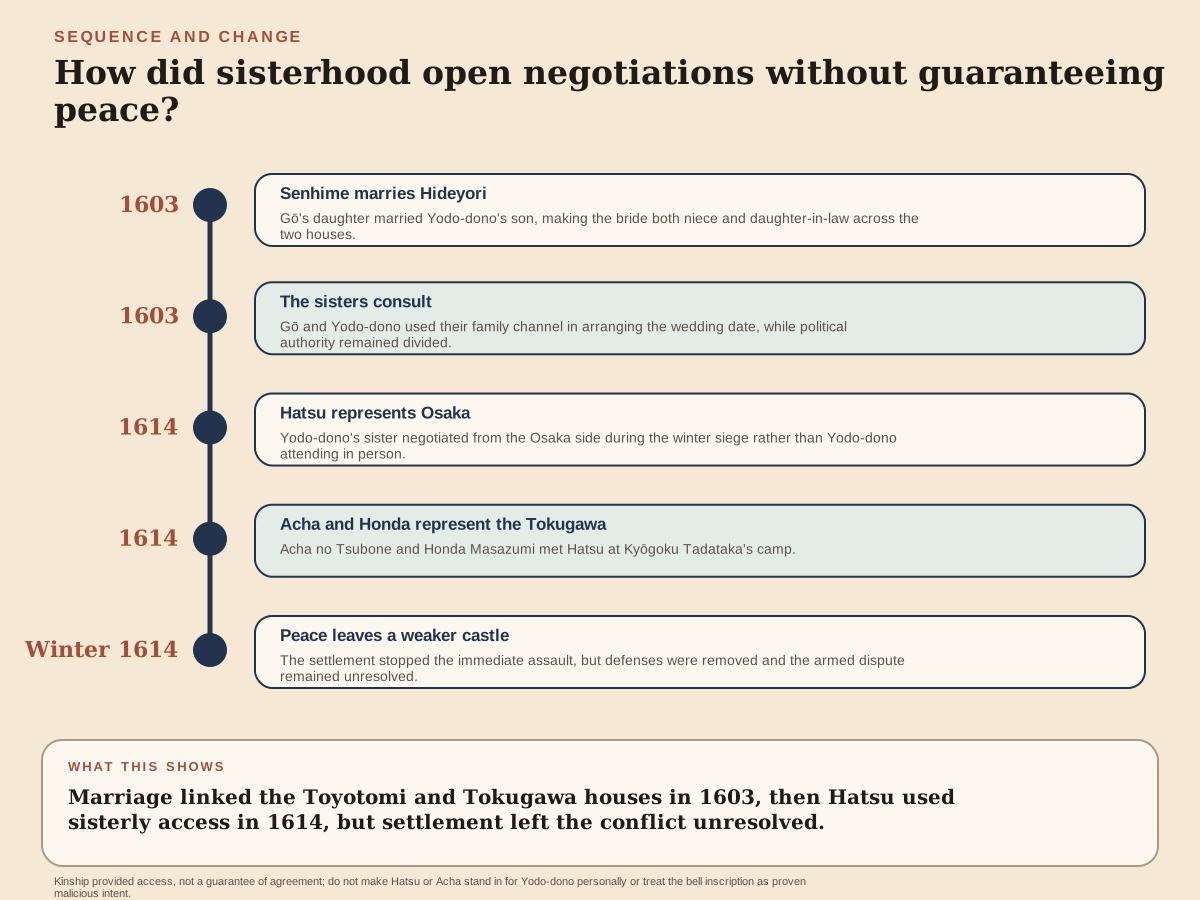
Gō, Yodo-dono’s younger sister, was married to Tokugawa Hidetada. Their daughter Senhime married Hideyori in 1603, making Yodo-dono both the groom’s mother and the bride’s aunt. The National Archives reports that Gō and Yodo-dono consulted over the wedding date. Its exhibition also presents a notice of the marriage from the monk Bonshun’s diary. The relationship was therefore expressed in a ceremony and recorded by an observer. Kinship gave the households a means to communicate, and would later provide channels for negotiation during war. [5][9][7]
In 1603 Ieyasu became shogun, the military office through which the Tokugawa established national rule. Hideyori also advanced at court, becoming Inner Minister; in 1605 he rose to Minister of the Right shortly before Hidetada inherited the shogunate. These appointments preserved very high standing for the Toyotomi heir. They did not give him the Tokugawa coalition’s control over lords and armies. Marriage and court distinction existed alongside an unresolved political relationship. For Yodo-dono, maintaining the heir’s position meant working within that combination, as both a family relationship and a question of political authority. [5][6]
The bell inscription and the accusation of a curse
The Toyotomi sponsored the rebuilding of Hōkōji in Kyoto, a temple founded by Hideyoshi. In 1614 the Tokugawa side objected to the bell inscription’s wording about peace and Toyotomi prosperity, treating the separation of characters from Ieyasu’s name as a curse. The National Archives presents the inscription through a contemporary account of Sunpu, Ieyasu’s residence. Katagiri Katsumoto, a Toyotomi retainer, had sought Ieyasu’s consent over preparations and then attempted mediation. The failure to reconcile the houses preceded the siege.
The inscription’s use in that conflict does not establish malicious intent by Yodo-dono. [6]
During the winter siege, Jōkō-in—Yodo-dono’s sister Hatsu and the widow of Kyōgoku Takatsugu—negotiated for the Osaka side. Across from her were Acha-no-tsubone, a woman of Ieyasu’s household, and the Tokugawa official Honda Masazumi. The National Archives locates their meeting in Kyōgoku Tadataka’s camp. Family and household access made the women participants in political business between armies. Yodo-dono’s position reached the negotiation through her sister, whose family connections carried political business across the divided camps. [7][1][9]
Kashiwara City’s historical account lists assurances made by Ieyasu and Hidetada in the settlement, including that Yodo-dono would not be required to go to Edo. This assurance left her place with the Osaka household intact at the time of settlement. Major defenses were subsequently destroyed or filled, leaving the castle far less secure. Peace stopped the immediate assault without settling the future of the armed Toyotomi household and the warriors seeking a place within it. [8][6]
The assurances covered more than her residence. As summarized by Kashiwara City, they also protected Hideyori’s existing holdings and promised that the warriors who had defended Osaka would not be punished for doing so. Those terms addressed the heir’s property and the survival of the people gathered around him, giving the household reasons to accept an end to the fighting. They offered no durable answer to how those warriors would obtain service afterward. The removal of defenses then changed what the household could rely on if negotiations failed again. Preserving the family’s position through a settlement and preserving its military security were different problems. [8]
After the winter settlement, Tokugawa officials reported repairs to Osaka’s defenses and the continued gathering of warriors without secure positions. Renewed demands and preparations led to the summer campaign of 1615. Kashiwara’s account connects the fighters’ hopes of employment with the instability following peace. The household contained people whose prospects depended on its continued strength, while the Tokugawa expected its submission. These conditions locate the renewed war within relations between an armed castle and the dominant government. The prospect of peace depended on the treatment of the household and its assembled fighters together. [6][8]
Toyotomi forces fought a series of engagements outside Osaka as well as the final battle around the castle. Sanada Nobushige’s troops threatened Ieyasu’s position, but could not reverse the coalition’s victory. On the eighth day of the traditional fifth month of 1615, Hideyori and Yodo-dono died by suicide. Senhime, the wife who connected the families, survived the fall. The destruction removed the central family around whom a Toyotomi claim might continue. The defeat ended the household’s resistance and exposed those who had depended on it to the consequences of conquest. [6][8][5][10]
Yodo-dono’s later designation Yodo-gimi helps distinguish remembered identity from the names used within her lifetime. The final siege can dominate the way she is recalled, yet other records preserve a consort addressed as Chacha, a mother involved in the care of an heir, a patron of a worship hall and a relative connected to negotiating women. Those records show the relationships and resources through which she acted before the final defeat. Her family had twice survived the fall of a castle before she became part of the household destroyed at Osaka. [1][2][3][4][7]