Read the article below. Interactive reading tools are available when scripts load.
Quick
The Ikeda house had gained holdings through Oda service and supported Hideyoshi after Honnōji. In 1584 Tsuneoki and Mori Nagayoshi captured Inuyama, helping establish Hideyoshi’s army in northern Owari against the alliance of Oda Nobukatsu and Tokugawa Ieyasu.
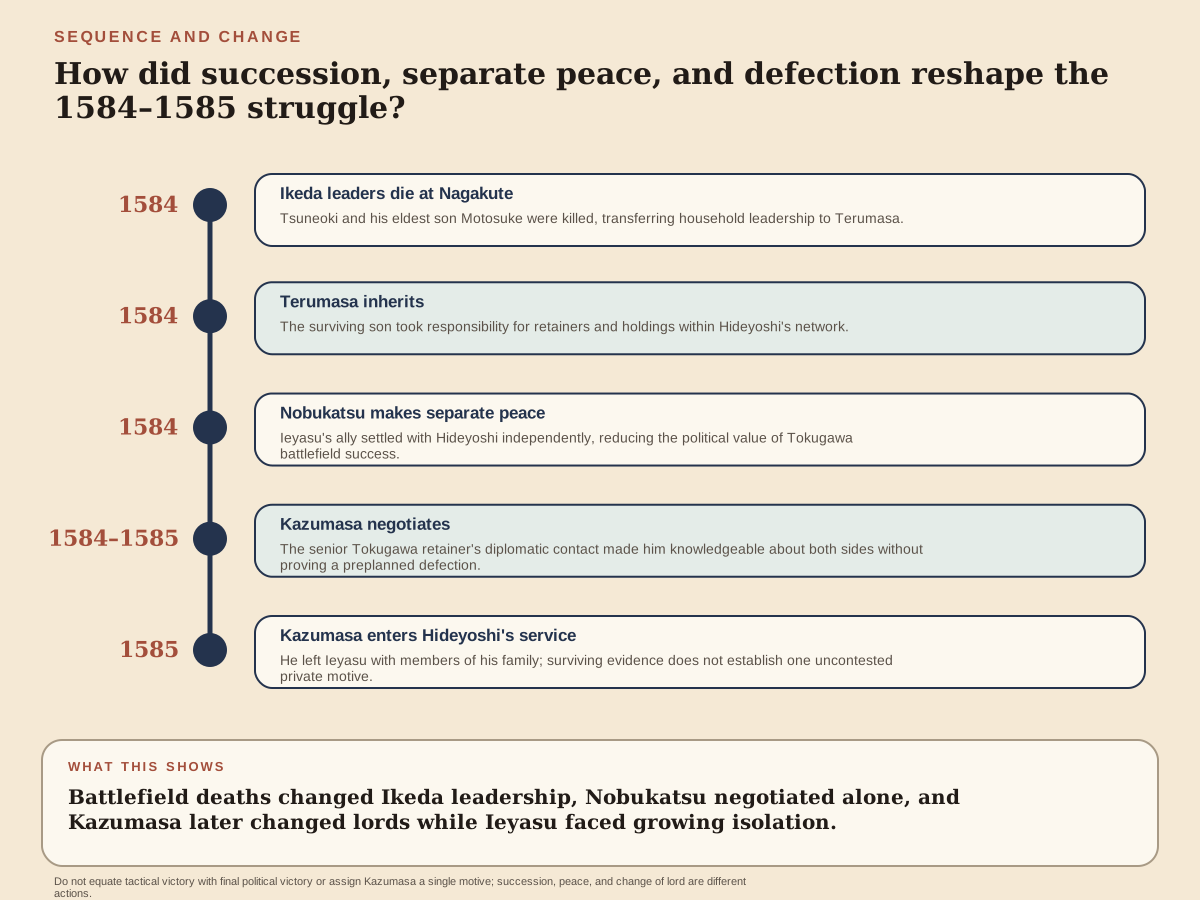
An expedition then moved toward Ieyasu’s Okazaki base. Tsuneoki, Motosuke and Nagayoshi served with the forward troops, while other contingents followed under Hideyoshi’s nephew. Ieyasu intercepted the movement. The Ikeda troops attacked Iwasaki Castle, then turned to face Tokugawa forces around Nagakute. Tsuneoki, Motosuke and Nagayoshi died in the fighting.
Losing the head and eldest son together changed the Ikeda succession. Terumasa inherited the house and its position within Hideyoshi’s network. The broader campaign continued, and Nobukatsu’s later separate peace helped end it. For the Ikeda, the central consequence was the transfer of leadership after two battlefield deaths, with existing retainers and territorial responsibilities passing to a surviving son.
The political settlement continued after the fighting. Ishikawa Kazumasa had served Ieyasu in negotiations with Hideyoshi’s side. In 1585 he left Tokugawa service and entered Hideyoshi’s camp with members of his family. The departure is documented, but surviving evidence does not establish one uncontested private motive.
Kazumasa’s defection exposed the Tokugawa organization to the loss of a senior official who knew its defenses and diplomacy. Together with the separate peace made by Oda Nobukatsu and the Ikeda succession after battlefield deaths, it shows a campaign decided through alliance, negotiation and household continuity as well as combat.
In 1584, Ieyasu allied with Oda Nobukatsu, Nobunaga’s son, against Hideyoshi. The Tokugawa won important engagements in the Komaki–Nagakute campaign, yet their ally could make terms independently. Nobukatsu’s settlement with Hideyoshi left Ieyasu with less political support than the battlefield results suggested. Kazumasa served within the subsequent negotiation network. He could carry terms and report the opposing power’s strength, but the final choice belonged to his lord.
Classic
The Ikeda house had gained holdings through Oda service and supported Hideyoshi after Honnōji. In 1584 Tsuneoki and Mori Nagayoshi captured Inuyama, helping establish Hideyoshi’s army in northern Owari against the alliance of Oda Nobukatsu and Tokugawa Ieyasu.
In 1582, Nobunaga was killed at Honnō-ji in Kyoto. Ieyasu, then away from his own territory, returned to safety as the Oda leadership broke apart. Earlier that year, Nobunaga’s forces had destroyed the Takeda house. Ieyasu now sought control in former Takeda provinces, including Kai and Shinano, inland from his Mikawa base. He had to secure former Takeda retainers’ support and contend with the Hōjō, the powerful house ruling the Kantō around what is now Tokyo. Expansion depended on agreements as well as armed occupation.
At the Oda center, Hideyoshi’s victories and political maneuvers increased his authority. Ieyasu needed information about a figure who was becoming more than another Oda commander. Later accounts associate Kazumasa with congratulatory or diplomatic missions. Such contact helps explain why he became legible to Hideyoshi’s government before 1585, but it does not prove that defection was already planned. Diplomatic familiarity creates multiple possibilities. It can improve negotiation for one’s present lord, expand personal options, or expose a messenger to suspicion. In 1582–1583, neither Hideyoshi’s national predominance nor Ieyasu’s eventual shogunate was secure.
The administrative effects of expansion were substantial. Newly accepted retainers needed rank and grants; revenue claims had to be verified; defensive arrangements and supply lines had to be revised. Knowledge became a strategic asset. A senior officer familiar with Mikawa and the new territories could represent the house effectively—and would be costly to lose.
An expedition then moved toward Ieyasu’s Okazaki base. Tsuneoki, Motosuke and Nagayoshi served with the forward troops, while other contingents followed under Hideyoshi’s nephew. Ieyasu intercepted the movement. The Ikeda troops attacked Iwasaki Castle, then turned to face Tokugawa forces around Nagakute. Tsuneoki, Motosuke and Nagayoshi died in the fighting.
Losing the head and eldest son together changed the Ikeda succession. Terumasa inherited the house and its position within Hideyoshi’s network. The broader campaign continued, and Nobukatsu’s later separate peace helped end it. For the Ikeda, the central consequence was the transfer of leadership after two battlefield deaths, with existing retainers and territorial responsibilities passing to a surviving son.
The political settlement continued after the fighting. Ishikawa Kazumasa had served Ieyasu in negotiations with Hideyoshi’s side. In 1585 he left Tokugawa service and entered Hideyoshi’s camp with members of his family. The departure is documented, but surviving evidence does not establish one uncontested private motive.
Kazumasa’s defection exposed the Tokugawa organization to the loss of a senior official who knew its defenses and diplomacy. Together with the separate peace made by Oda Nobukatsu and the Ikeda succession after battlefield deaths, it shows a campaign decided through alliance, negotiation and household continuity as well as combat.
In 1584, Ieyasu allied with Oda Nobukatsu, Nobunaga’s son, against Hideyoshi. The Tokugawa won important engagements in the Komaki–Nagakute campaign, yet their ally could make terms independently. Nobukatsu’s settlement with Hideyoshi left Ieyasu with less political support than the battlefield results suggested. Kazumasa served within the subsequent negotiation network. He could carry terms and report the opposing power’s strength, but the final choice belonged to his lord.
Hideyoshi’s strength lay partly in his ability to detach Ieyasu’s partners. Continued resistance therefore required a judgment about what the Tokugawa could sustain alone. Kazumasa’s contact with Hideyoshi’s side gave him a view of that emerging center. It also created the familiarity through which an official envoy could later become a recruit. Diplomatic contact in 1584–1585 does not establish that he already intended to change sides.
The negotiated aftermath did not instantly settle hierarchy. Pressure continued into 1585 and 1586 through alliances, family arrangements, titles, and demonstrations of submission. Thus Komaki–Nagakute should not be the triumphal prelude to inevitable Tokugawa victory. It was a moment when battlefield resilience and political isolation could exist together, placing unusual weight on the people who translated between them.
In 1585, Kazumasa left Ieyasu’s service while serving as a senior retainer and Okazaki castellan. The National Archives of Japan places the departure amid Hideyoshi’s renewed pressure for hostages and Ieyasu’s refusal to provide more. Matsumoto’s official history separately records that Kazumasa took members of his family to Osaka and entered Hideyoshi’s service. These establish a consequential change of allegiance; they do not provide a confession of motive.
Historical disagreement · Why did Ishikawa Kazumasa leave Ieyasu?
The early Edo chronicle Tōdaiki, as presented by the National Archives, suggests that Kazumasa’s third son being held as Hideyoshi’s hostage was a factor. Other explanations emphasize disagreement over accommodation, insecurity within the Tokugawa house, or the advantages Hideyoshi offered.
Several pressures may have coincided. The popular idea that Kazumasa secretly sacrificed his reputation for Ieyasu requires evidence of coordination that later Tokugawa benefit alone cannot supply.
Kazumasa knew the organization he had left. The later military writer Daidōji Yūzan’s Suruga Miyage records a change to Takeda-style military arrangements. It supports identifying that interpretation and its source, rather than claiming that every Tokugawa secret was exposed or that his departure alone caused the reforms. Hideyoshi gained an experienced officer whose acceptance also demonstrated his ability to recruit an opponent’s senior men.
Ishikawa Kazumasa’s defection from Ieyasu illuminates the instability of personal lordship and military knowledge during unification. A senior retainer could carry relationships and experience into another ruler’s service, forcing the former lord to reconsider trust and organization.
His later work at Matsumoto complicates the simple label of “traitor.” The private motive for leaving remains unresolved.
Evidence and interpretation · A reported reform is not a measured transformation
The National Archives identifies the account of adopting Takeda-style military arrangements in Suruga Miyage, a later collection by Daidōji Yūzan of Ieyasu’s words and deeds. The statement is evidence for a transmitted explanation of Tokugawa reorganization; it is not a contemporary inventory comparing the army before and after Kazumasa’s departure.
Without that comparison, the passage cannot tell us how many units changed, how quickly changes were implemented, or how much followed from the defection alone. The earlier incorporation of former Takeda territories and retainers also belongs to the chapter’s context; a single retrospective sentence cannot separate those processes.
Kazumasa’s career matters because defection and constructive domain service were two stages of the same mobile warrior expertise.
Okazaki served as a center associated with Matsudaira Nobuyasu, Ieyasu’s eldest son. In 1579, Nobuyasu was removed and ordered by Ieyasu to take his own life.
Historical disagreement · Who bore responsibility for Nobuyasu’s death?
Shiba Hiroyuki emphasizes division between Ieyasu’s Hamamatsu base and Nobuyasu’s Okazaki household. In discussing Shiba’s interpretation, Hongō Kazuto questions the picture of a decisive father–son confrontation. These readings distribute responsibility differently; they do not make the final Tokugawa order disappear.
Kazumasa’s precise role remains uncertain. His departure in 1585 cannot establish what he advised in 1579, and a proposed connection must still explain the six-year interval.
Kazumasa’s responsibility at Okazaki involved supervising people and communication on his lord’s behalf. The removal of the heir changed the center’s political position. An officer could hold authority there without controlling Ieyasu’s final decisions. Interpretations connecting Nobuyasu’s death directly to Kazumasa’s departure in 1585 must still explain the interval between the two events.