Read the article below. Interactive reading tools are available when scripts load.
Quick
Tachibana no Moroe was born in 684 as Prince Katsuragi. His father was Prince Mino, a royal descendant, and his mother was Agata Inukai no Michiyo, a woman serving the court. Michiyo later married Fujiwara no Fuhito; Katsuragi himself married Fuhito’s daughter Tabino. He received court rank in 710, served as an official concerned with land allocation in 729 and became a councillor in 731. His rise therefore began before the epidemic that would bring him to the head of government. He would enter that crisis with royal connections, family ties and existing administrative experience. [1][2][3]
In 736 Prince Katsuragi and his brother Prince Sai asked to leave the royal register and take their mother Michiyo’s Tachibana name. Permission made them Tachibana no Moroe and Tachibana no Sai, members of a subject lineage bearing the hereditary title Sukune. Michiyo had received the name as a personal honor in 708. The sons’ request gave that honor a new, inheritable family setting. The Manyōshū poetry collection associates royal praise of the evergreen tachibana tree with this grant. The new name did not erase Moroe’s ancestry or maternal relationships. It changed his registered status before the crisis of 737. [2][3][4]
In 737 smallpox killed Fujiwara no Fuhito’s four prominent sons and many other senior officials. Tachibana no Moroe became Grand Councillor, a senior council official, that year and Minister of the Right in 738. He worked with the returned monk Genbō and the scholar Kibi no Makibi, drawing on their continental learning. Emperor Shōmu’s daughter Princess Abe was designated heir in 738. In 740 Fujiwara no Hirotsugu demanded the removal of Genbō and Makibi and rebelled in Kyushu. The rebellion failed, but it challenged people on whom Moroe’s government depended. The court now faced a political crisis alongside the aftermath of disease. [1][2]
After leaving Heijō, the capital at Nara, in 740, Emperor Shōmu established his court at Kuni, beside the Kizu River in Yamashiro. Modern accounts associate Tachibana no Moroe with the choice, close to his home region. Palace buildings were transferred from Heijō to give the new capital a working ceremonial and political center. Shōmu ordered provincial monasteries and nunneries in 741 and proclaimed the Great Buddha project at Shigaraki in 743. Naniwa became the capital in 744; the court returned to Heijō in 745. Moroe remained a senior minister through these moves, whose construction and religious programs depended on many participants. [1][6][7][2]
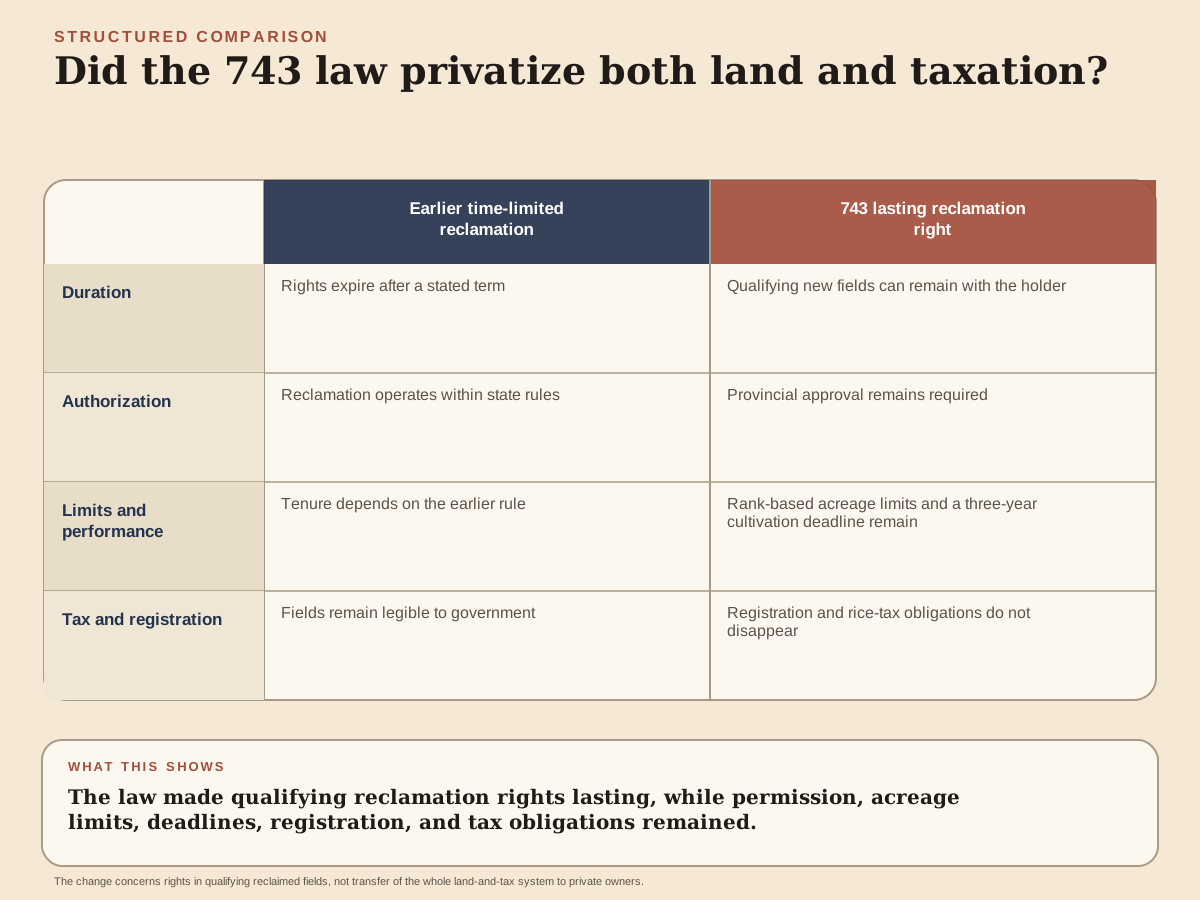
In 743, the year Tachibana no Moroe became Minister of the Left, the court changed the treatment of newly reclaimed fields. The decree removed earlier time limits on private rights to this land. It retained conditions: provincial approval, limits tied to court rank and loss of a claim left uncultivated for three years. The change encouraged investment in new fields without abolishing the allocation system for existing ones. Modern scholarship differs over its larger effect, emphasizing either growing private holdings or strengthened state regulation. Moroe served when it was issued; his precise personal role is inferred rather than fully documented. [2][8][9]
In 746 the Manyōshū poetry collection places Tachibana no Moroe among officials clearing snow at the retired Empress Genshō’s palace and then composing verse. His poem links the whiteness of snow with an aging servant’s white hair. The recorded company included Fujiwara no Nakamaro and Ōtomo no Yakamochi. After Kōken became empress in 749, Nakamaro headed the reorganized household office of her mother Kōmyō. That position gave him close access to royal authority alongside his council office. Moroe received the higher hereditary title Ason in 750, yet his practical influence was declining. Continuing honors no longer assured command of government. [5][10][1][2]
In 755 Sami no Miyamori, an attendant of Tachibana no Moroe, reported improper drunken speech while the retired Shōmu was ill. The report carried an implication of disloyalty, but Shōmu did not punish Moroe. Moroe resigned in 756 and died in 757. Later that year his son Naramaro was implicated in an alleged conspiracy and appears to have died in custody. Moroe had already died, so the case does not establish his own participation. The Manyōshū preserves another memory of him in verse. His long tenure ended before the final defeat of his son’s faction. [1][2][5]
Classic
The man later called Tachibana no Moroe was born in 684 with the royal name Katsuragi. His father, Prince Mino, belonged to the descendants of Emperor Bidatsu; his mother, Agata Inukai no Michiyo, served within the court. These were different kinds of connection with royal power. The father supplied a recognized royal genealogy, while the mother’s service linked her to the practical life of successive sovereigns and their households. Michiyo later married Fujiwara no Fuhito, who became one of the court’s most influential ministers. The children of her two marriages belonged to intersecting political families. Katsuragi’s younger maternal half sister Kōmyō, Fuhito’s daughter, would become Shōmu’s empress. A description of Moroe as simply a rival from outside the Fujiwara obscures this shared household background. [1][2][3]
Katsuragi married Tabino, Fuhito’s daughter, who is also identified as Michiyo’s daughter. On that genealogy, they shared a mother but had different fathers, an unusual union within the court’s marriage practices. Their son Naramaro would later hold office in his own right. Katsuragi received the lower grade of Junior Fifth Rank in 710. The rank placed his public standing within the court’s graded hierarchy, even while he remained a prince. His appointment in 729 placed the allocation of fields among his responsibilities, long before the major change in reclaimed-land rights issued during his ministry. He already combined family proximity with duties performed through government offices. [1][3][2][9][15]
In 731 Katsuragi became a councillor, joining the senior deliberative body at court. The appointment followed recommendations by government offices and occurred alongside those of Fujiwara no Umakai and Fujiwara no Maro. Both Fujiwara men were sons of Fuhito. The later change of leadership therefore emerged from a council in which Katsuragi had worked with members of that family. He rose to Junior Third Rank in 732. Rank and council membership gave him a recognized place among the officials who could take responsibility when vacancies appeared. His first major change was still a change of public identity, requested several years before he became chief minister. It would give Katsuragi the name by which his subsequent service is remembered. [1][2][3]
Tachibana no Moroe’s mother Michiyo received the Tachibana name in 708, when her son was still Prince Katsuragi. The grant honored her own service and was not immediately the creation of a hereditary clan for all her descendants. She died in 733. Three years later Katsuragi and his brother Sai requested permission to leave the royal register and adopt her name. Permission in 736 made them Tachibana no Moroe and Tachibana no Sai. Sukune, attached to the name, was a hereditary title distinguishing the new subject lineage. The request turned a mother’s personal distinction into a basis for her sons’ public family identity. It also shows that a lineage name need not have passed automatically through the father. [3][2]
The brothers changed registered status without ceasing to be descendants of the royal house. Moroe’s relationships with Fuhito’s household and with his half sister Kōmyō likewise continued. His mother’s influence had involved people, service and household resources as well as an honorific name.
Historical disagreement · Who claimed Michiyo’s household resources?
A later household document of 740 has attracted different readings of how those resources were organized and claimed. Yoshie Akiko reads it in relation to the household of Fuhito and the inner household of Kōmyō; she also reports Ogura Shigeji’s interpretation in terms of Muro’s household and an inheritance claim. Muro was Michiyo’s daughter by Prince Mino and Moroe’s full sister. [3][13][14]
These interpretations do not establish an exact estate share received by Moroe. The name grant is firmer evidence for the change in the brothers’ public identity than for a complete division of their mother’s property. [2][3][1]
Historical disagreement · Who composed the name-grant poems?
The Manyōshū poetry collection links a poem celebrating the evergreen tachibana tree with the name grant of 736. The note accompanying the poem places royal verse at an occasion honoring Katsuragi and others; another note associates praise poems with the retired Empress Genshō, Emperor Shōmu and Empress Kōmyō. The authorship of the individual royal poem is not certain: Genshō has been proposed as an alternative to Shōmu. A following response is attributed to Naramaro, Moroe’s son, although composition by Moroe has also been suggested. The shared image is a tree that remains flourishing despite frost or snow. It echoes language used when Michiyo received the name in 708.
The poems preserve the public language of enduring royal favor; they could not guarantee the future of the family they praised. [4][1][2]
The smallpox epidemic of 737 destroyed much of the Nara court’s senior leadership. The dead included Fuhito’s four sons, who had occupied several of its most important positions. The loss was wider than one family: other senior officials died as well. Tachibana no Moroe became Grand Councillor, a senior council official, in 737, while the surviving councillor Prince Suzuka received the office of director of the state council. Those were distinct appointments within the reconstruction of government. Moroe’s elevation to Minister of the Right followed in 738. His prior council service gave the promotion a basis beyond the mere absence of rivals. The epidemic opened positions abruptly; officials still had to fill them and conduct the court’s work. [1][2]
Genbō and Kibi no Makibi became important advisers in the new political configuration. Both had returned from Tang China, although one brought a monk’s Buddhist learning and the other a scholar’s range of texts and technical knowledge. Their usefulness crossed the boundary between formal council membership and expertise sought by ministers and royalty. The court was also arranging its succession. Shōmu’s daughter Princess Abe was designated heir in 738, at the time of Moroe’s promotion to Minister of the Right. She would later reign as Empress Kōken. Her mother Kōmyō was Moroe’s maternal half sister. Moroe’s connections with the reigning family therefore continued within the government formed after the epidemic. The new arrangement combined survival, recognized office, royal relationships and acquired learning. [1][2][10][3]
Historical interpretation · The larger aim of Hirotsugu’s challenge
Fujiwara no Hirotsugu’s challenge in 740 was directed publicly against Genbō and Makibi. Hirotsugu, a son of the deceased Umakai, demanded that they be removed and raised forces in Kyushu. Yokota Ken’ichi interprets the demand as an attempt to displace Moroe and restore Fujiwara leadership, because the two targeted men were central to Moroe’s government.
That reconstruction of the larger political aim remains an interpretation of the demand, rather than a surviving statement of all Hirotsugu’s private intentions. The uprising was defeated. Its failure did not leave the court settled in the capital. Shōmu departed on an eastern progress during the crisis and did not return directly to Heijō. Moroe’s next responsibilities would unfold around a sovereign whose political center was moving. [1][2][7][6]
Historical interpretation · Moroe’s part in choosing Kuni
Emperor Shōmu’s eastern progress in 740 ended at Kuni instead of with an immediate return to Heijō, the capital at Nara; Tachibana no Moroe was then Minister of the Right. Kuni lay beside the Kizu River, in the Sōraku district of Yamashiro, within present-day southern Kyoto. The area already had royal residences, connections with coin production and an important position in water and road transport. The new capital therefore occupied a landscape with existing links to the court. Yokota’s account associates the choice with Moroe’s planning and proximity to his home region.
Such an attribution explains a minister’s possible stake in the move, while the actual declaration of a capital belonged to Shōmu. Building a political center required more than finding a favorable location. The palace had to accommodate the sovereign, ministers and the ceremonies through which government was enacted. [1][7][6]
Major buildings and surrounding corridors were transferred from Heijō Palace to Kuni. The movement included the Great Audience Hall and the area used for court government. Reusing structures carried an existing political architecture into the new location. Excavation has identified a palace compound roughly 750 meters north to south and 560 meters east to west. Its residential area had two differently enclosed sections, although that evidence alone does not identify the individuals who occupied each. While construction proceeded, the court issued the provincial monastery and nunnery order in 741. Shōmu subsequently spent increasing time at Shigaraki in Ōmi and proclaimed the Great Buddha project there in 743. The chief minister’s work took place amid several royal undertakings, with distinct sites, materials and religious aims. Moroe was promoted to Minister of the Left in 743, giving him the higher of the two regular ministerial offices. [6][1][7][2]
Historical interpretation · Who originated the Naniwa decision?
Kuni’s construction was stopped in 743, and Naniwa became the capital in 744. Moroe transmitted the proclamation concerning Naniwa.
Yokota considers whether the decision reflected his policy, but the transmission itself does not settle the origins of the choice. The court returned to Heijō in 745, and the Great Buddha was eventually completed at Tōdai-ji there. Kuni’s Great Audience Hall was given to the provincial temple of Yamashiro in 746 and reused as its main Buddhist hall. The former center of court ceremony became part of the provincial religious system ordered during Kuni’s brief life as a capital. The surviving foundations thus preserve continuity through a change of function. The abandonment of the capital did not erase all the buildings or policies produced during Moroe’s ministry. [7][1][6][8]
The land decree of 743 was issued while Tachibana no Moroe held the senior state-council office of Minister of the Left. It addressed new fields brought into cultivation through reclamation, while the allocation rules for existing cultivated land continued. An earlier rule of 723 had recognized rights to reclaimed fields for limited periods. The eventual recovery of the land by government could reduce the incentive to maintain cultivation as the deadline approached. The new decree removed that time limit and allowed the rights to continue. For people undertaking the work of reclamation, the prospect of continued possession changed the relationship between present effort and later benefit. The policy did not operate in an institutional vacuum: permission and the recording of land remained parts of government. It also distributed opportunities unequally through the existing hierarchy of rank. [2][9][8]
The area that could be claimed ranged from 500 chō for the highest rank to ten chō for people at the bottom of the hierarchy or without rank. Chō was a unit of land area; the wide difference in permitted holdings favored people who already stood high in the court order. Special limits also applied to district officials. Applicants had to obtain the provincial governor’s permission. A claim left unreclaimed for three years could be lost and opened to another applicant. Fields reclaimed by a provincial governor during his own tenure were to revert when that tenure ended. Reclaimed land was registered and subject to land tax. Lasting private rights therefore did not mean an immediate release from every form of state supervision. The new rules could support reclamation by powerful houses and temples while giving the administration a defined procedure for claims. [8][9]
Historical disagreement · Private land or stronger state supervision?
Torao Toshiya associates the decree with Moroe’s policy intentions and emphasizes its contribution to private landholding and the later estate system. He also recognizes that the rules for newly reclaimed land could coexist with the allocation of existing fields. Yoshida Takashi places greater weight on permission, registration and taxation, arguing that state control may have been strengthened rather than simply dismantled.
The disagreement concerns the larger meaning of the institutional change, not the existence of the decree or its basic conditions. It also separates an immediate administrative measure from consequences developing over a longer period. Both readings connect the measure with institutions developing beyond Moroe’s own lifetime. His ministry belongs to the setting in which the reform was issued; an exact reconstruction of his personal authorship remains less secure. The lasting importance of the policy lies in altered rights, incentives and procedures that outlived the officials who enacted it. [9][8][2]
The Manyōshū poetry collection preserves an occasion in 746 when Tachibana no Moroe and other princes and officials cleared snow at the palace of the retired Empress Genshō. A banquet followed, with poems on the theme of snow. Moroe’s verse, numbered 3922 in the collection, brings together snow, white hair and long service to the sovereign. The aging official speaks through a public poem composed for a shared occasion. Long service becomes visible here through language addressed to the sovereign and shared with fellow officials. Other participants connected snow with hopes for an abundant harvest. The event joined labor at a royal residence, hospitality and verse among people holding differentiated court ranks. Political life had such shared settings as well as appointments, decrees and disputes. [5][2]
The named participants included Fujiwara no Toyonari, Fujiwara no Nakamaro and Ōtomo no Yakamochi. Nakamaro, whose later power would overshadow Moroe’s, could appear beside him within the same ceremonial and poetic company. The gathering was not restricted to one lineage. The collection also says that other poems were lost because they had not been written down at the time. The surviving verses therefore represent only part of the occasion. Moroe’s residences appear elsewhere as settings for gatherings whose participants probably included Yakamochi and other poets. These records connect the minister with the transmission of court poetry. A later tradition would give Moroe a larger role in the collection’s formation. [5][1][2]
Kōken’s accession in 749 changed the standing of her mother Kōmyō from empress to empress dowager. Kōmyō’s household office was reorganized as the Shibi Chūdai, an establishment outside the ordinary legal-code offices. Its work included transmitting her orders and supporting the daily operation of her household. Nakamaro became its head while also holding a senior council position. The combination connected him with formal government and with a direct channel to the royal family. Kōmyō was his aunt as well as Moroe’s maternal half sister. Their overlapping kinship ties did not give them equal access through the same offices. Moroe received the hereditary title Ason in 750, higher than the Sukune title taken in 736. He remained Minister of the Left even as Nakamaro’s influence grew. The public hierarchy still honored him, while the effective routes through which royal authority was exercised were changing. [10][1][2][3]
Evidence boundary · An accusation and a later family crisis
The report against Tachibana no Moroe in 755 came from Sami no Miyamori, an attendant close to him. It concerned improper words spoken at a drinking occasion while the retired Shōmu was ill. Sakaehara’s account notes an implication of rebellion in the allegation. Shōmu did not pursue punishment.
The transmitted accusation remains distinct from a finding that Moroe had planned a rebellion. He nevertheless resigned in 756. The decision ended a tenure at the head of ministerial government that had begun with his appointment as Minister of the Right in 738. His formal service thus continued for years after Nakamaro’s influence had begun to eclipse his own. [1][2][10]
Moroe died in 757, after retirement and before the political crisis involving his son Naramaro later that year. Naramaro’s alleged plans were exposed before they became an accomplished uprising. He appears to have died in confinement, although the precise circumstances are not securely recorded. The defeat removed people opposed to Nakamaro and intensified his ascendancy. It also affected the later memory of Moroe’s house. Yet father and son occupied different positions in the chronology: Moroe’s life had already ended. His decades of office cannot be replaced by a retrospective label drawn solely from his son’s final case. The distinction preserves both the failure surrounding the family and the service Moroe actually performed. [1][2][5][12]
Historical disagreement · Did Moroe compile the Manyōshū?
The eleventh-century Eiga Monogatari attributes the compilation of the Manyōshū to Moroe and a group of senior officials. Modern accounts instead give Ōtomo no Yakamochi an important role in the collection’s formation.
The later attribution is evidence of Moroe’s reputation in the history of poetry, rather than a contemporary record proving his sole editorship. The poems and gathering notes themselves provide a closer connection between his service and court literary life. [5][2]
Much of the political career is transmitted through the Shoku Nihongi, a court history compiled later in the eighth century, and through subsequent historical reconstruction. In the case of the drinking accusation, the named attendant’s report was followed by the retired sovereign’s decision not to punish Moroe. Moroe’s work encompassed a rebuilt council, mobile capitals and institutions whose effects continued after his retirement. The white-haired servant preserved in verse and the minister losing practical influence belong to one finite career. Capital buildings acquired new functions, reclaimed fields gained new rights, and the court’s poetry preserved occasions of his service after his authority had ended. [5][2][1][11][6][8][9][10]