Read the article below. Interactive reading tools are available when scripts load.
Classic
Russia’s occupation of Manchuria after the Boxer crisis of 1900 brought its army and railway interests closer to Korea. Japan sought predominance in Korea and opposed an indefinite Russian military presence across the border. The Anglo-Japanese Alliance of 1902 strengthened its diplomatic position, but negotiations over Korea and Manchuria failed to produce an agreement.
The disputed ports had a recent history. Japan had returned the Liaodong Peninsula after the 1895 Triple Intervention, and Russia subsequently acquired a lease at Port Arthur. The naval base protected Russian interests in southern Manchuria; for Japan, defeating its fleet was necessary to move soldiers and supplies safely across nearby seas.
Japan had to finance operations beyond its home territory while Russia could send reinforcements across the continent. Bank of Japan vice-governor Takahashi Korekiyo sought foreign loans in London and New York. Borrowing provided foreign currency for the war, while taxes and later debt service placed obligations on households beyond the fighting fronts.
Military direction involved separate offices. Yamagata Aritomo became chief of the General Staff in June 1904. Ōyama Iwao commanded the Manchurian armies, with Kodama Gentarō as chief of staff; Nogi Maresuke led the Third Army against Port Arthur. At sea, Tōgō Heihachirō commanded the Combined Fleet. Their responsibilities joined metropolitan planning to field and naval commands.
The 1902 alliance specified how British support would operate. Britain was to remain neutral if Japan fought one power and try to prevent another joining against it; intervention by additional powers would bring armed assistance. This reduced the risk of another coalition like the Triple Intervention. It did not make Britain a combatant when the war with Russia began. Foreign-currency borrowing and imported naval equipment were other forms of support, distinct from the alliance's military obligation.
The geographic stakes extended beyond either belligerent's homeland. Russia's leased port and railways stood within Qing territory, and Japan's approach through Korea used another state's ports and roads. Qing sovereignty and Korean political choices consequently mattered even though the two powers negotiated chiefly about their own interests. The military offices in Tokyo, field headquarters in Manchuria and naval bases at home coordinated operations across those inhabited territories. Yokosuka's later preservation of a flagship would represent one part of that network, rather than locating the land campaigns there.
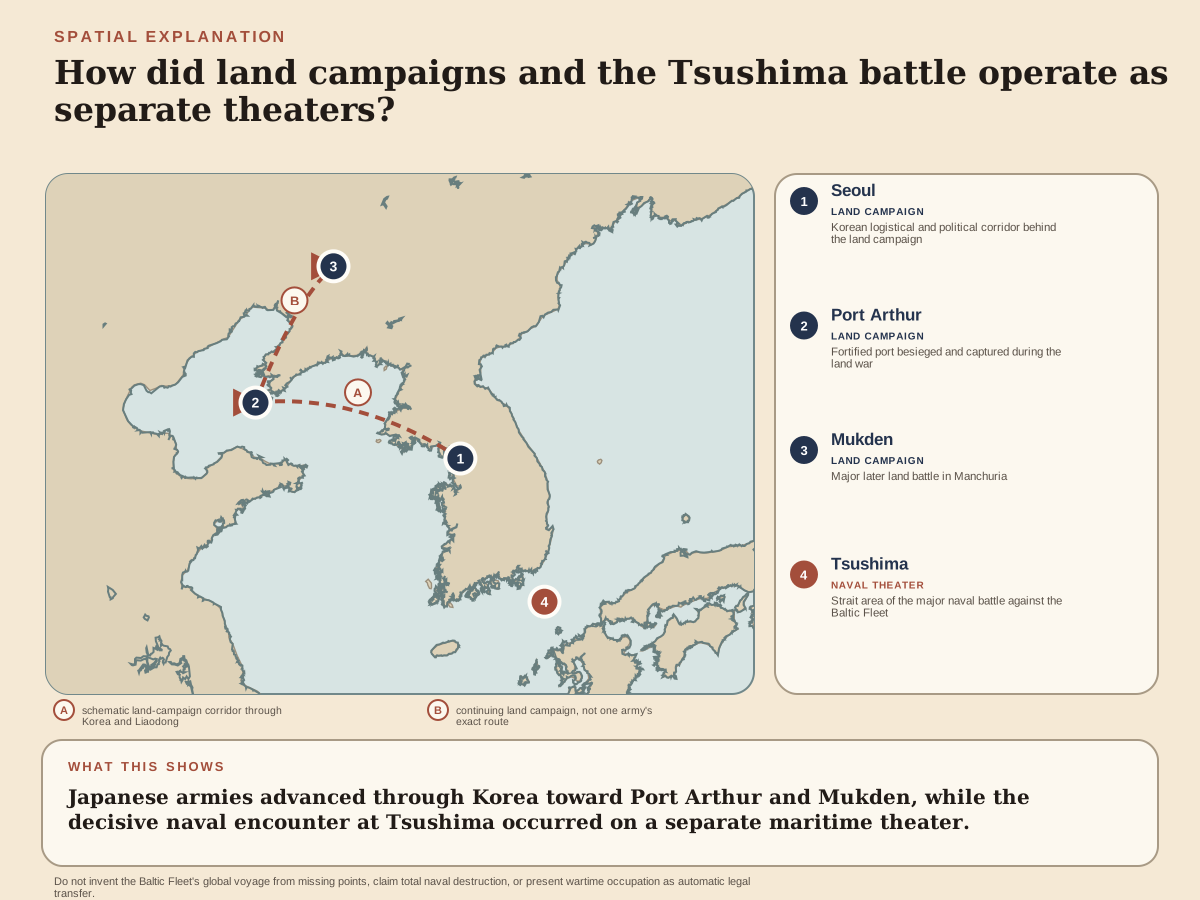
Japan broke diplomatic relations on February 6, 1904, and attacked Russian ships at Port Arthur on February 8, before the formal declaration of war on February 10. Soldiers landed in Korea and advanced toward the Yalu River. Further landings on the Liaodong Peninsula opened a second approach to Russian positions and the port.
The inland offensive and the Port Arthur siege competed for troops. Russian forces withdrew from Liaoyang in September without the destruction of their main army. Fighting along the Shahe in October failed to end the campaign. Japanese forces consequently faced a continuing inland opponent while the Third Army fought the fortified port.
Repeated assaults at Port Arthur brought heavy losses. In late November Nogi’s army shifted its immediate objective to 203-Metre Hill, using heavy howitzers and infantry attacks. Its capture on December 5 provided artillery observation over the harbor. Bombardment disabled the ships there, but other forts still had to be taken. The surrender agreement was signed on January 2, 1905.
The Third Army could then join the inland campaign. At Mukden in February–March, Japanese forces forced a Russian retreat and occupied the city, but did not annihilate the opposing army. Losses and exhaustion limited further advance. Russia retained forces north of the battlefield; Japan’s victories had not removed the cost of continuing the war.
Russia sent another fleet from Europe to recover its naval position. On May 27–28, Tōgō’s fleet defeated it in the Tsushima Strait, sinking or disabling most of its ships. That victory sharply reduced the Russian naval threat near Japan. It was the defeat of the arriving fleet, not the destruction of every Russian naval force.
Japan also landed troops on Sakhalin in July and occupied the island during the final phase of the war. The operation added territory to the subjects of negotiation. The eventual agreement divided the island: occupation of the whole did not become annexation of the whole.
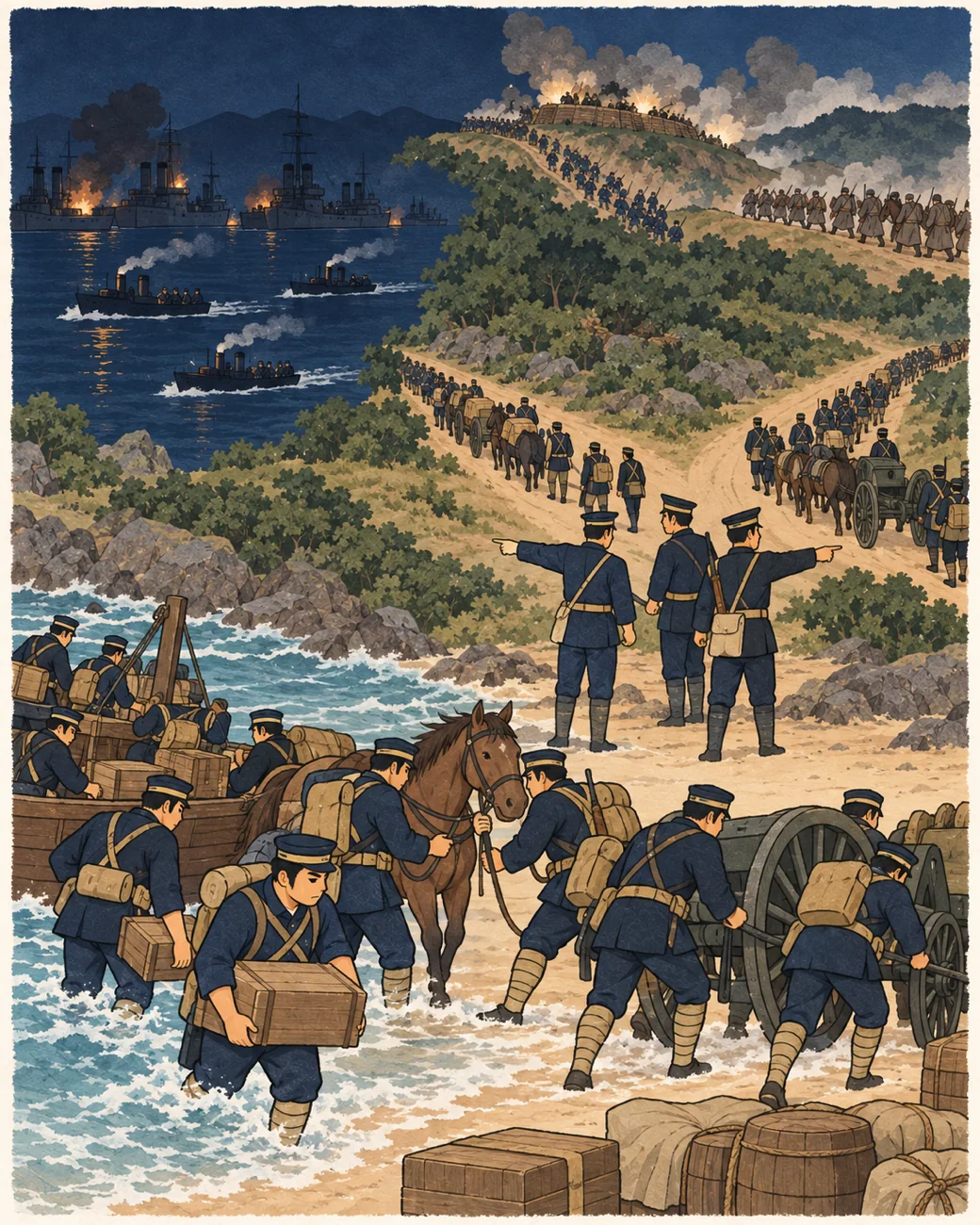
Treatment required its own movement and administrative arrangements. The Japanese Red Cross used the hospital ships Hakuai Maru and Kōsai Maru for wounded and sick men; the Army Ministry notified Russia of their protected status. Foreign doctors and nurses also worked in Japanese hospitals. These ships and facilities carried men out of combat while replacement troops and ammunition moved toward it. Artillery observation at Port Arthur and naval signals at Tsushima served different stages of operations: locating a target and transmitting an order could make force effective, but neither substituted for the supply and treatment needed to keep units operating.
Chinese residents were also displaced by the fighting. An American consul at Yingkou, involved in Red Cross relief, sought permission to send an observer inland to investigate refugees. Their needs belonged to the same theater as the celebrated battles but did not appear in a list of Japanese territorial gains. The prolonged siege, two inland retreats and the arriving Russian fleet made the war a succession of operations, with wounded soldiers and civilian refugees continuing to require help between engagements.
By spring 1905, Japan’s leaders were seeking a settlement despite their military gains. Continued casualties and the surviving Russian army made another inland offensive costly. Russia faced revolution and domestic unrest as well as defeat overseas. President Theodore Roosevelt’s mediation offered both governments a way to negotiate without first admitting unconditional surrender.
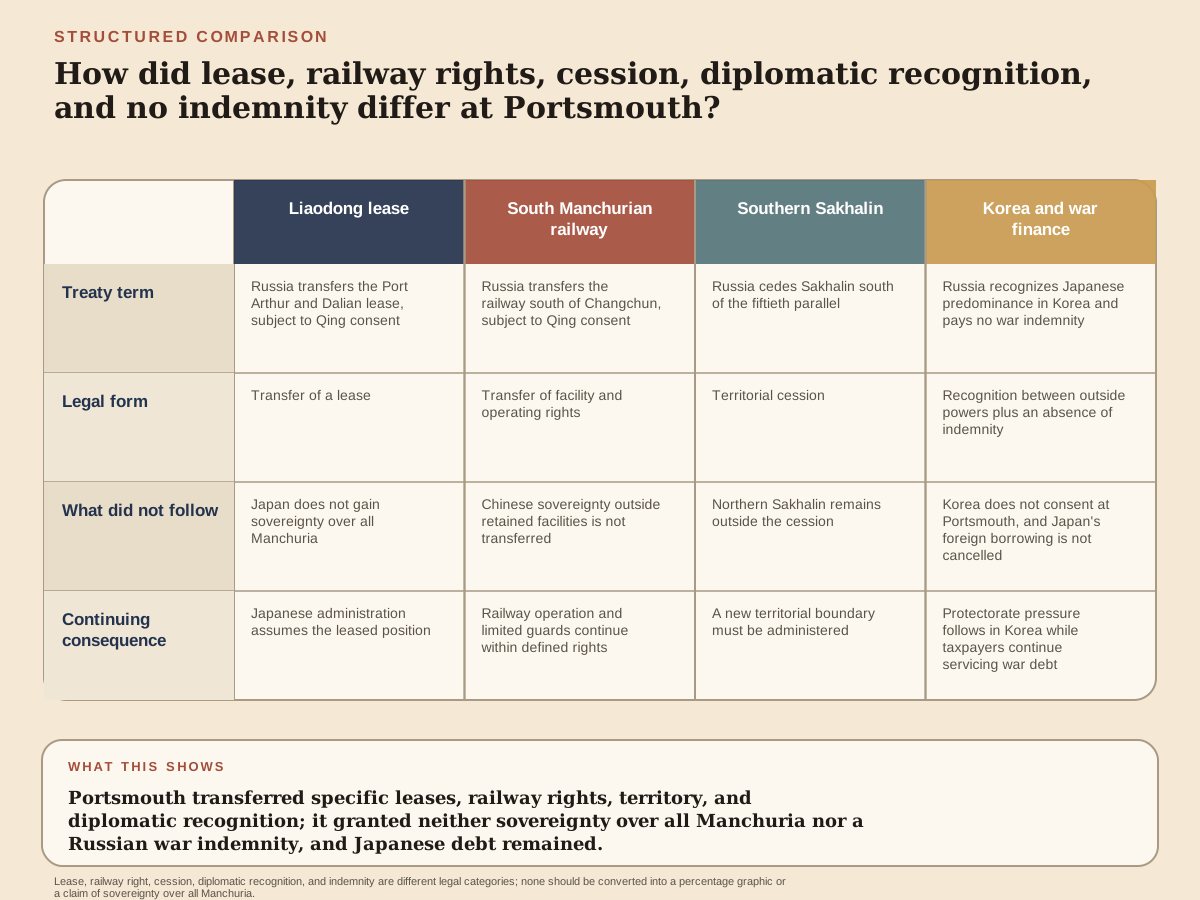
At Portsmouth, Japan’s representatives Komura Jutarō and Takahira Kogorō negotiated with Sergei Witte and Roman Rosen. The treaty signed on September 5 recognized Japan’s predominant interests in Korea. Russia transferred its Port Arthur and Dalian lease and the railway south of Changchun, subject to Qing consent, and ceded Sakhalin south of the fiftieth parallel.
The settlement required evacuation of Manchuria outside the leased territory and restoration of Chinese administration. The supplementary provisions allowed eighteen months for withdrawal and retained limited railway guards. Japan acquired particular lease and railway rights rather than sovereignty over all Manchuria. The treaty promised commercial railway use outside the leased zone.
Russia paid no war indemnity. Article 13 nevertheless provided for accounting and reimbursement of the difference in prisoner-maintenance expenses, a separate obligation. Signature also preceded legal effectiveness: under Article 14 the treaty became binding when the last ratification notification arrived, on October 15. The formal exchange of ratifications followed in November.
Three diplomatic records concerning Korea preceded or accompanied peace. The July 29 Taft–Katsura memorandum recorded a conversation on July 27. Taft expressed his personal view that Japanese control of Korea's foreign treaty-making would support peace, while stating that he lacked a mandate to assure the president's agreement. It was a conversation record, not a ratified American alliance. The revised Anglo-Japanese Alliance, signed on August 12, formally recognized Japan's paramount interests and its right to take measures of guidance, control and protection in Korea. Portsmouth recorded Russia's recognition of Japanese predominant interests. Those acts involved different governments and obligations; none was an authorization given by the Korean population.
The absence of indemnity made military and fiscal limits politically visible at home. People who had borne wartime taxes and family losses expected compensation resembling the Qing payment of 1895. The surviving Russian army, Japan's borrowing and the need to end expensive operations gave negotiators reasons to accept gains without that payment. The Hibiya disturbances revealed how sharply those terms differed from public expectations. They did not erase the specific concessions secured at Portsmouth, just as the concessions did not repay households' sacrifices.
The treaty displaced Russia from its leased naval base and southern railway position while leaving Japanese forces and administrators responsible for those interests. Korean diplomacy was not represented at Portsmouth; Russia’s recognition of Japanese predominance was an agreement between outside powers, not a Korean grant of authority. Japan imposed a protectorate agreement later in 1905.
Territorial gains did not cancel the financing required to obtain them. Foreign borrowing had made the campaign possible, and repayment continued after the fighting stopped. Soldiers and their families bore death, wounds and absence; taxpayers carried obligations that survived the battlefield victories. The war’s result therefore included continuing costs alongside the new rights.
The absence of an indemnity angered people who expected Russia to repay Japan’s sacrifices. Reports of the settlement circulated before signature. On September 5, protests in Tokyo developed into the Hibiya disturbances, with arson and attacks accompanying opposition to the peace. The government’s acceptance of the terms did not secure public acceptance.
In Manchuria, the agreement left a division between Chinese sovereign authority and foreign-controlled facilities. Evacuation promises coexisted with a retained lease and railway guards. In Korea, Japanese predominance became the basis for further coercion. The victory enlarged Japan’s imperial position through defined concessions and military leverage, while subject populations had not negotiated the settlement that affected them.
The concessions soon acquired operating institutions. In 1906 Japan created the South Manchuria Railway Company and the Kwantung administration. Railway operations, coal mines and ports gave the company economic influence; the governor-general combined administration and military command in the leasehold and could use troops to protect railway lines. Keeping a line open and defending the territory became continuing commitments after the peace settlement. They extended Japan's position through facilities and institutions within a region it had not acquired as sovereign territory.
The victory also had meanings beyond the negotiating states. Indonesian nationalist readings drew encouragement from the defeat of a European empire by Japan and from its modernization. Such inspiration could coexist with criticism of Japan's subsequent expansion. For Korea, the immediate result was instead the imposed protectorate; for Chinese inhabitants, foreign-controlled railways and guards continued. The encouragement drawn by distant anticolonial audiences and the restrictions imposed locally were consequences experienced from different positions.
Mikasa later became a memorial ship at Yokosuka in 1926, with relics, diaries and medals displayed aboard. Its preserved hull represented Tōgō's flagship and the naval victory. The land campaigns at Port Arthur and Mukden, overseas medical work and the settlement's Korean and Manchurian institutions had different locations and records. The ship's commemorative afterlife belongs alongside those histories because naval remembrance alone cannot describe the costs or territorial consequences of the war.