Read the article below. Interactive reading tools are available when scripts load.
Classic
Korea had its own political conflicts. The Donghak movement challenged official corruption and burdens on rural communities. Its uprising threatened the government, which sought Qing military assistance. Qing influence at court and Japanese commercial and strategic interests made a Korean crisis a dispute between two neighboring powers.
The 1885 Tianjin agreement had provided for the withdrawal of Qing and Japanese troops and mutual notification of any new deployment. Notification regulated their conduct toward each other; it did not give either state control of Korea’s government. Japan decided to dispatch troops in early June 1894, and both powers sent notices as their forces entered Korea.
The June truce at Jeonju reduced the immediate threat from the uprising. Qing officials proposed withdrawal, but Japan demanded a reform program and continued deploying forces. Korea’s request that both foreign armies leave failed. Diplomatic pressure now concerned the court, military communications and Korea’s relationship with Qing China.
On July 23 Japanese forces under Ōshima Yoshimasa, acting on envoy Ōtori Keisuke’s instructions, entered Gyeongbok Palace after fighting its guards. Gojong was secured and his father, the Daewongun, brought into the government under Japanese escort. The resulting regime requested action against Qing troops. Japan had gained a Korean governmental request through an armed seizure of the court.
Japan's ability to keep troops overseas depended on work at home. Ujina harbor had opened in 1889, and railway access made Hiroshima a gathering point for men, weapons and food bound for the continent. In September 1894 imperial headquarters moved from Tokyo to Hiroshima Castle. The emperor, senior officials and commanders stayed there, and an extraordinary Diet met in a temporary chamber. Rail arrivals, port loading and maritime departures connected that command center to armies operating in Korea and China. Conscription supplied soldiers; transport and expenditure sustained them after departure.
The war also reached people through purchased images. Japanese war prints circulated widely, and Qing producers issued their own pictures and leaflets. Both commonly enlarged the bravery of their own forces and diminished the opponent. Many scenes were composed from reports rather than witnessed at the front. Victorious uniforms and flags offered readers a readily recognized story of national success, while the same operations placed Korean and Chinese communities under foreign military power.
On July 25 Japanese warships fought Qing vessels off Pungdo; the British-owned transport Kowshing, carrying Qing troops, was sunk. Japanese troops defeated Qing forces at Seonghwan on July 29. These operations preceded the formal declarations of war on August 1.
Japanese columns converged on Pyongyang in September. They attacked on September 15; Qing forces evacuated during the night, and the Japanese entered the next day. On September 17 the fleets fought in the Yellow Sea. The damaged Beiyang fleet withdrew to Weihaiwei rather than being destroyed in that single battle.
The First Army moved north through Korea and crossed the Yalu on October 24 using improvised bridges. Qing forces abandoned Jiuliancheng before the scheduled attack. Inland advance strained food transport, horses and carriers; occupation of Dagushan provided a port for bringing supplies closer to the army.
Ōyama Iwao’s Second Army landed at Huayuankou on Liaodong in late October. It took Jinzhou and Dalian, then captured Port Arthur on November 21. The two armies approached the peninsula from separate routes; naval transport made the landing operation possible.
In January 1895 the Second Army landed on Shandong and attacked Weihaiwei’s defenses. Captured shore forts and naval attacks put the Beiyang fleet under pressure from land and sea. Its surrender in February removed Qing China’s principal northern naval force.
Negotiations initially failed over the Chinese delegates’ powers to conclude a treaty. Li Hongzhang and Li Jingfang arrived at Shimonoseki in March. A Japanese assailant wounded Li on March 24. The subsequent armistice excluded Taiwan and Penghu, where Japanese operations continued while the negotiators settled the peace terms.
Equipment had to follow soldiers through the changing seasons. The Fifth Division sought funds for straw sandals in June, and later requests arranged reinforced tabi and winter footwear. Akita officials forwarded an offer to manufacture snow sandals; military approvals sent blanket-lined tabi through Ujina for troops facing the northern winter. These were procurement and shipment decisions, alongside the bridges, ports and carriers used nearer the front. Winning an engagement did not supply the next march or clothe men for cold weather.
At Shimonoseki, Itō Hirobumi and Foreign Minister Mutsu Munemitsu negotiated with Li Hongzhang and Li Jingfang. The shooting of Li interrupted that process, and an armistice followed, but its territorial exclusions allowed operations around Taiwan and Penghu to continue. The delegates still negotiated under unequal military conditions. Their decision to cede territory was made by the two states; Korean and Taiwanese residents had no seat at the talks. The resulting agreement could end hostilities between its signatories while leaving another population to resist a transfer it had not authorized.
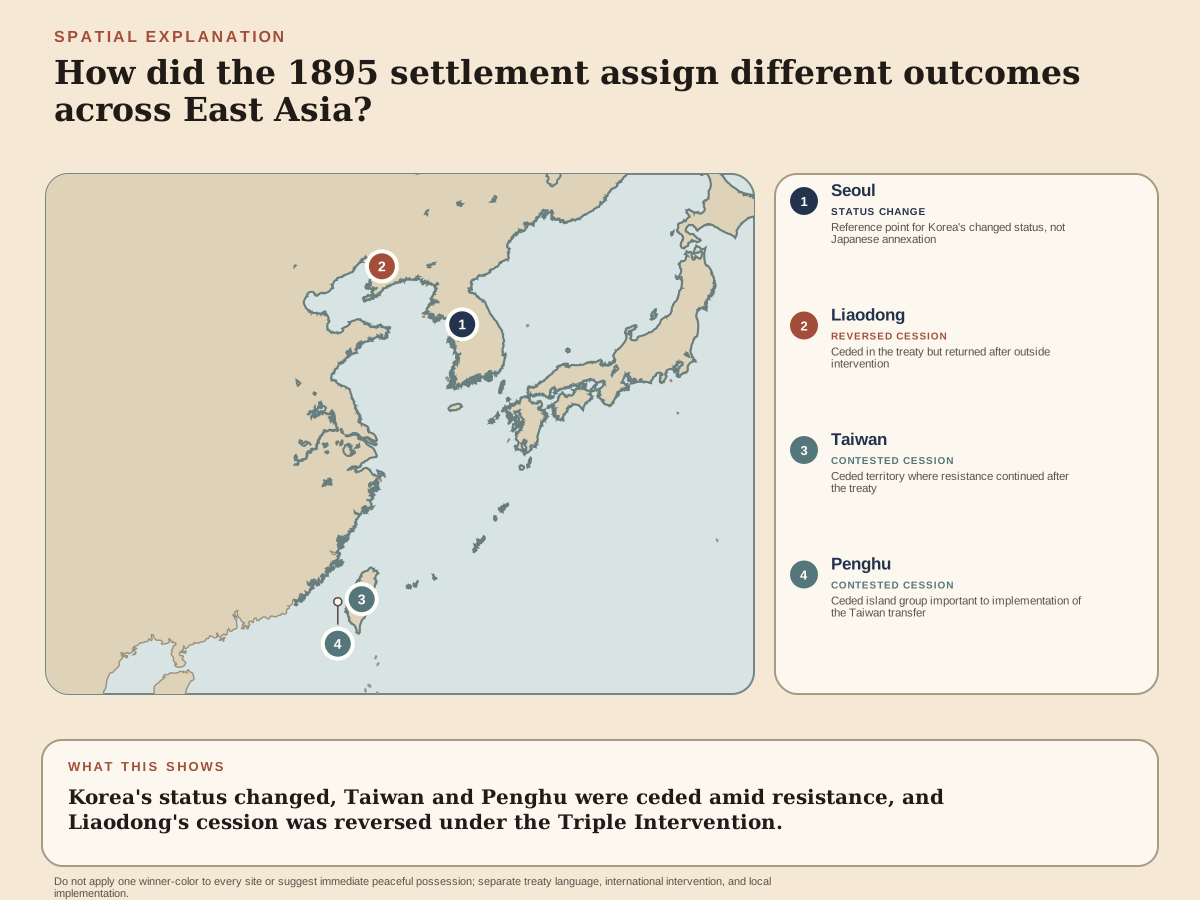
The treaty signed on April 17, 1895, recognized Korea’s independence and ended obligations of tribute to Qing China. It transferred sovereignty over Liaodong, Taiwan and Penghu to Japan, together with state property and installations. Qing China owed an indemnity of 200 million silver taels, payable under a specified installment schedule.
Commercial clauses opened Shashi, Chongqing, Suzhou and Hangzhou, expanded navigation and warehouse rights, and allowed Japanese subjects to manufacture in the opened cities. The agreement also required prisoner release and regulated Japanese withdrawal. Weihaiwei could remain occupied as security for payment; peace did not mean every Japanese force immediately left China.
Russia, Germany and France intervened on April 23, demanding the return of Liaodong. Japan accepted the demand rather than risk a confrontation with all three. Taiwan and Penghu remained ceded. Taiwan’s residents received a two-year period from ratification to dispose of property and depart; the treaty did not simply make every inhabitant Japanese on the signing day.
Occupation encountered resistance to the cession. A Republic of Taiwan was proclaimed in May. Japanese troops landed on May 29; Li Jingfang formally handed over the island on June 2. The republican leadership fractured, but local forces continued fighting. Japanese forces advanced south and entered Tainan on October 21. A November declaration of pacification did not extinguish all armed resistance.
The intervention changed one territorial clause rather than canceling the peace settlement. Japan decided to abandon Liaodong in May and received an additional payment for its return. The indemnity and Taiwan–Penghu cession remained. Qing therefore faced scheduled financial obligations even after European pressure had deprived Japan of part of its territorial gain. In 1898 Russia itself obtained lease rights at Port Arthur and Dalian. A peninsula Japan had been required to relinquish was now becoming a Russian base; the diplomatic reversal gave later arguments about military strength a concrete object.
Victory and return travel also carried costs into Hiroshima. Cholera spread among troops and through returning men, prompting traffic restrictions at Ujina and a temporary army quarantine station on Ninoshima in June 1895. Local instructions required reports when a returnee developed symptoms after quarantine. Military arrival and departure had made the city a supply center; the same movements required disinfection, isolation and communication with town offices. The home front's encounter with the campaign was not confined to cheering its victories.
Japan acquired colonial territory in Taiwan and Penghu. Administrative handover and military occupation were separate tasks: troops, supply routes and a governor-general were needed to turn the treaty’s territorial clauses into rule on the ground. Residents faced a new sovereign without participating in the treaty negotiations.
Victory also imposed losses. Cholera struck the Penghu expedition, and disease caused extensive Japanese mortality during the war. In Port Arthur, Japanese troops killed noncombatants, including women and children. Foreign correspondents and Japanese accounts reported violence, while differing testimony and later estimates leave the exact total contested.
The indemnity strengthened Japan’s financial resources. Receipts enabled gold reserves supporting the shift to the gold standard in 1897. This was a specific monetary use of the settlement, alongside the cost of sustaining forces and colonial administration; victory itself did not explain every subsequent industrial or fiscal policy.
Qing tribute ceased, but Korea did not gain freedom from competing external demands. Japanese forces had already compelled changes at its court. European intervention also limited Japan’s gains in China: the return of Liaodong demonstrated that success against Qing forces did not allow Japan to dictate the settlement to other powers.
Officials made choices about the transferred money. Postwar fiscal plans combined army and navy expansion with railway, telephone and steelworks projects. Capital expenditure used indemnity receipts and borrowing, while continuing expenses required tax revenue. Gold reserves enabled the 1897 monetary change, but the broader program still depended on domestic taxpayers and lenders. The indemnity enlarged the government's options; it did not provide a limitless fund or make every later industrial project a direct product of conquest. Yawata's government steelworks was established in 1897 and began operation in 1901, placing industrial construction after the treaty rather than on the battlefield's timetable.
Liaodong's return was remembered alongside plans for stronger forces. That grievance did not reverse Japan's rule in Taiwan or the coercion already exerted at the Korean court. Command and diplomacy were concentrated at Hiroshima and Shimonoseki, but the settlement operated through occupied ports, payment schedules and the advance through Taiwan. Military success, European intervention and colonial acquisition consequently produced different outcomes for Japan's government, Qing's treasury and residents whose territory changed hands.