Read the article below. Interactive reading tools are available when scripts load.
Classic
Furukawa Ichibē took over the Ashio copper mine in 1877. New ore discoveries in the early 1880s, followed by mechanical drilling, pumping and improved processing, increased output. The mine became part of Japan’s expanding industrial economy, supplying copper for export and manufacture. Its growth transformed the workings and settlements around Ashio.
The mine stood upstream in the Watarase River basin. Drainage from mining and waste from ore processing entered the water system. Smelting smoke damaged vegetation on surrounding slopes, contributing to loss of forest cover and erosion. Floods could then transport contaminated water and sediment into agricultural land far from the workings themselves.
By the later 1880s, declines in fish and damage to vegetation had prompted suspicions about the mine’s discharge. Downstream communities depended on the river and its surrounding land for crops, fishing and other work. In low-lying Yanaka, residents had already adapted to flooding with embankments, raised refuges and boats. Pollution added a new problem to an existing flood-prone environment.
The damage did not take the form of one explosion or spill with a single day of onset. Production, smoke, drainage, erosion and recurring floods interacted. A village downstream could suffer without containing a mine, and more than one prefecture lay within the affected watershed. That geography complicated investigation and decisions about who should provide relief.
Copper left the mine through commercial routes that linked Ashio to export markets and Japanese manufacture. Mechanization also connected the separate stages of production. A hydroelectric plant began operating at Matō in 1890, and electricity powered hoists, lighting and transport. By 1896, the main workings were joined through a network of tunnels. Raising and moving more ore enlarged the material passing through processing and smelting, where waste and fumes were generated. The mine's growing output depended on both equipment and the people operating it.
Downstream, losses crossed prefectural boundaries. Communities in Tochigi, Gunma, Saitama and Ibaraki would coordinate demands against the mine. Their work included more than rice cultivation: Yanaka households fished, raised silkworms and made reed screens and sedge hats. Damage to fields, waterways and plants therefore threatened several sources of household income. Production figures recorded at Ashio and losses recorded in these villages described different parts of the same industrial system. Bringing them together required samples, investigations and collective organization.
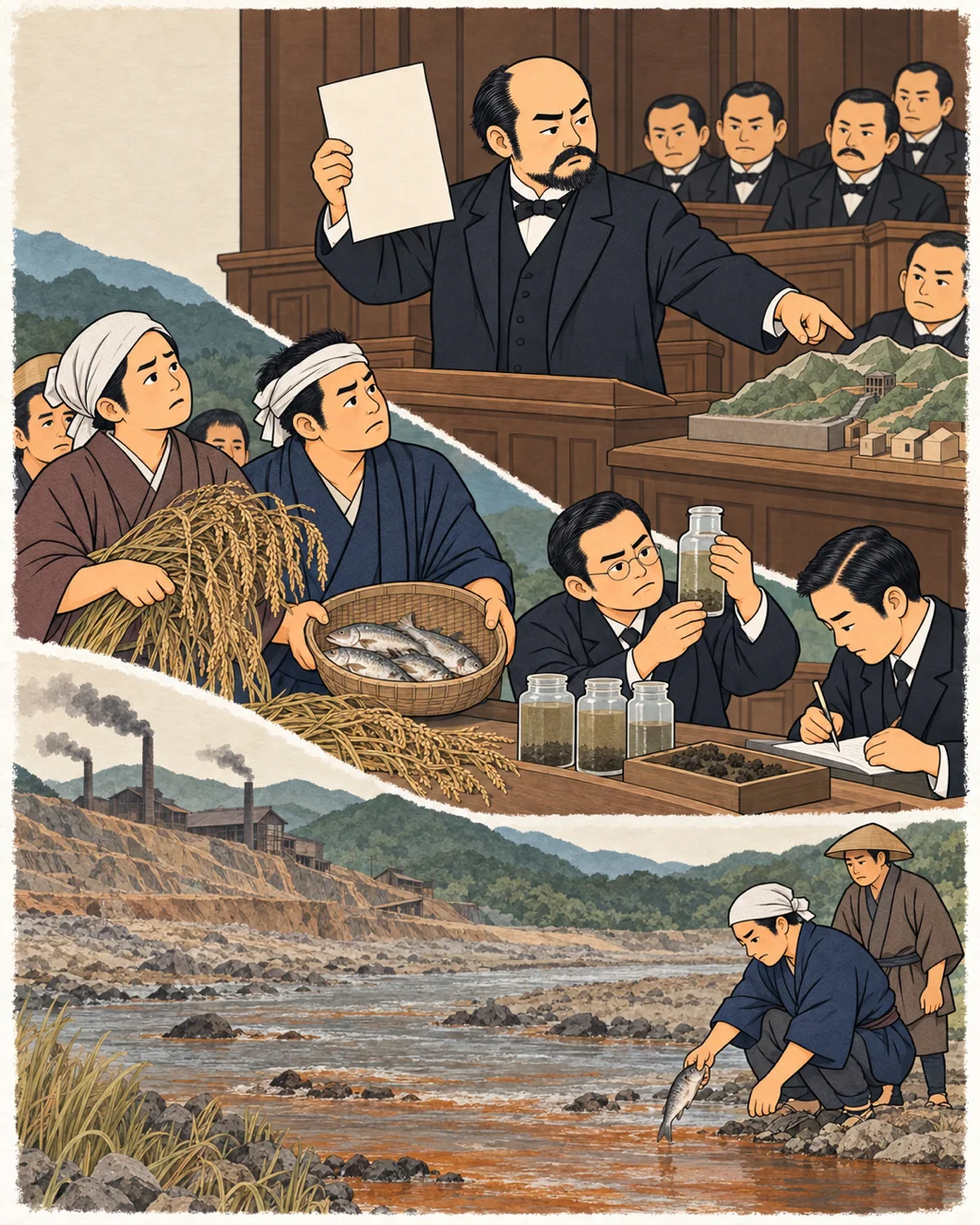
Residents organized meetings, recorded damaged crops and fisheries, and petitioned for relief and the cessation of harmful mining. Tanaka Shōzō carried the issue into the new national parliament. Elected to the House of Representatives in 1890, he questioned the government about mine pollution in 1891, invoking protections for property and provisions governing mining permission. The parliamentary record makes his demands more specific than a general appeal to nature.
Scientific investigation also involved residents directly. In 1891, farmer representatives brought soil samples to the agricultural chemist Kozai Yoshinao and asked him to analyze them. Tochigi and Gunma authorities separately sought analysis from the agricultural college. Field investigation and published results connected the copper found in damaged land to discharge from Ashio. Farmers were seeking expert tests as well as describing their own losses; prefectural officials participated in investigation while also mediating settlements.
In August 1892, mediation produced agreements between Furukawa and communities including Fujioka, Nogi, Heya and Namai. Furukawa paid settlement money and undertook flood and wastewater measures. Equipment installed in the following years recovered copper from material lost during washing, and settling ponds were added at processing plants. Some agreements subsequently became permanent settlements. Mamoru Nagai's study of the official response links acceptance partly to shortages of funds for flood works, while noting persistent opposition. Settlement did not establish that all residents considered the damage adequately remedied.
Severe floods in 1896 carried pollution across farmland and renewed the campaign. Tanaka helped establish an office in Watarase village to coordinate claims from affected areas. Residents’ collective journeys toward the capital, known as oshidashi, sought to put those claims directly before national authorities. Their pressure also drew journalists, students and other supporters to the damaged districts.
An initial pollution-prevention order was issued in December 1896. The government appointed an investigation commission in March 1897. Earlier tests of copper in Watarase sediment formed part of the evidence submitted; bottled sand samples still accompany the report preserved in the National Archives. The Agriculture and Commerce Ministry issued further orders on May 13 and May 27. The latter contained thirty requirements, with work to begin within seven days and completion deadlines varying from thirty to 180 days; delay could bring suspension of mining. These orders required Furukawa to install settling and filtration facilities, contain waste in managed deposits and address smelting fumes. Drainage and waste handling improved, while smoke damage remained unresolved and further floods renewed downstream losses.
In 1900, farmers again attempted a collective petitioning journey toward Tokyo. Police confronted them at Kawamata in Gunma and arrested petitioners. The interruption made access to national authorities part of the dispute alongside the mine’s environmental effects.
Tanaka resigned his Diet seat in 1901 and attempted to petition Emperor Meiji directly. He was stopped before he could present the document to the emperor. The attempt attracted attention and followed years of organized action by residents. Pollution and the campaign continued afterward.
The campaign also generated organized relief. Ushioda Chiseko and other women visited the severely affected Ebise district in November 1901. A women's relief association raised money and distributed supplies, arranged medical care and tried to provide education and paid work. Girls from Ebise were taken to Tokyo's Jiai-kan in December, although most were brought home by their parents within a few months. A workshop at Yanaka taught women to weave thin wood strips used for export goods. Reports of patients receiving treatment document the communities' need for care without establishing that every illness there had the same cause. Relief supported households while demands for mining suspension continued.
A second government investigation began in 1902. River-control proposals included a basin near the lower Watarase that would hold floodwater and reduce downstream flood flows. Creating it required acquiring land occupied by villages. The proposals addressed a real flood problem while the mine remained in operation, shifting official action toward the management of water and land.
The choice of land was contested. Toshima and Kawabe villages in Saitama organized against an early purchase and abolition proposal, which was withdrawn. Yanaka then became the focus of the basin plan. The government announced that plan in 1903, and Tanaka moved to Yanaka in 1904 to join residents opposing removal. Neighboring villagers and supporters also assisted the campaign.
Resistance involved alternatives to removal. In 1905, villagers repaired their damaged embankments themselves, with workers sent by Toshima and Kawabe. Neighboring communities also petitioned the presidents of both parliamentary houses against Yanaka's purchase and abolition. Sugai describes the financial pressures that weakened wider solidarity: repeated losses left many activists unable to sustain campaigning, while some farmers increasingly sought flood protection. The affected districts did not maintain a single position on a basin that would protect some places by acquiring land in others.
Tochigi prefectural authorities began purchases in 1905. Some residents left; others refused to give up the village. Yanaka was abolished as an administrative unit and merged into Fujioka in 1906. Abolition did not mean that all residents had gone. In 1907, authorities used compulsory land acquisition and forcibly demolished remaining homes.
The government's use of land-acquisition powers added a national administrative decision to prefectural purchases and demolition. Sugai identifies Home Minister Hara Takashi as responsible for approving compulsory acquisition. Hara had previously served as a vice-president of Furukawa's mining company. That career connection places a named official within both the commercial and governmental institutions involved; it does not by itself establish every decision-maker's private motive. Households facing removal included the sick, infants and elderly people, who also lost shelter when the remaining houses were destroyed.
Some residents built makeshift shelters and stayed at their former home sites. Their continued presence matters to the outcome: demolition deprived them of houses without immediately ending their effort to restore the village. A legal change, physical destruction and final departure were distinct stages.
The dispute continued in court. In July 1907, residents and supporters filed a suit contesting the compulsory-acquisition compensation. The relief association that proposed the case focused on low purchase prices, whereas residents' original demand had been to preserve the village. Suing for a larger payment consequently narrowed what could be obtained through that proceeding. Debt imposed another limit: Sugai records that much village land had already been mortgaged, leaving many departing households with little relocation money. Prices for fields and buildings did not replace the community's shared institutions or secure a new livelihood.
The mine remained in operation, and pollution-prevention equipment and river works did not restore Yanaka as a community. Residents lost productive land through contamination and homes through public works. The village’s abolition and demolition removed a settlement as well as the property recorded in land purchases.
In 1908, application of the River Law placed shelters and other structures on the former village land under official permission. Residents continued petitioning against that measure and against subsequent river works. A revised project began in 1910, but acquisition and construction proceeded while some people still lived and worked on the land. Abolishing a village, purchasing property, demolishing houses and completing an engineered basin were successive acts, each contested and with different effects.
Tanaka died in 1913. His death supplies the closing date of this account, but does not mark an end to contamination or residents’ losses. Mining, river works and struggles over damaged land continued afterward. His parliamentary advocacy and attempted imperial petition remain important within a longer history of collective action.
Tanaka's widow, Katsu, took over his part in the compensation litigation. Remaining households continued living on the former village land until a further relocation agreement in 1917. In 1918, the appeal court required the prefecture to pay the difference between its acquisition prices and a higher valuation, with interest. That result improved the financial award after the village had already been lost. River reconstruction was not completed until 1927, following revisions to the original plan. These later dates separate the end of Tanaka's life from the subsequent settlement of particular legal and engineering matters.
Ashio became a major case in Japanese pollution history because it left records of damage, investigation, protest and official response within the same industrial conflict. Residents’ petitions and parliamentary questions made losses politically visible. The National Archives’ sediment samples and reports preserve the work of testing, while the records of Yanaka’s abolition and demolition show what the authorities’ remedy required of a community.
Historian Sugai Masurō interprets the turn toward river control as a displacement of the pollution issue. Flooding was real, and communities sought protection from it; his account emphasizes how the adopted policy allowed mining to continue and made Yanaka’s removal a central response. This interpretation connects the technical remedy with the losses imposed on a downstream community.
The mine itself had a separate history of conflict over labor. In 1907, dissatisfaction with miners' treatment escalated into a riot in which the manager's residence and other buildings were attacked; troops and large numbers of police were deployed to suppress it. This was a labor dispute at the mine, distinct from the farmers' Kawamata petition and Yanaka's removal. Both histories belong to Ashio's industrial expansion, whose workings depended on workers as well as machinery and affected households beyond the mine.
Later prevention and restoration addressed different pathways of damage. Postwar smelting changes improved sulfur recovery, and sediment-control works and reforestation altered the surrounding slopes. Mining ended in 1973, but smelting continued for a time with imported ore, and drainage treatment continued after closure. Greening therefore records sustained work on damaged land, while the former workings and waste deposits retain another layer of the industrial history. Closure of extraction was not an end date for every environmental obligation.
The mine’s industrial remains and the preserved sites of Yanaka tell connected parts of the history. Shafts and machinery record production; the former village’s office, shrine and cemetery sites record a place lost through basin planning. Following the river between them explains whose losses lay outside the mine’s own grounds and why technical prevention alone did not end the dispute.
The history also continued through organized environmental work. A local tree-planting group began activity in 1996, and an environmental learning center opened at Ashio in 2000. These institutions carried the damaged mountain landscape into later public action and education. They exist alongside the material and documentary record of mining, protest and displacement. Ashio's legacy includes concrete efforts to prevent further harm, as well as the fields, households and village institutions those efforts could not restore.