Skip to content
Chronicle

Search History Omakase

Start typing to search.

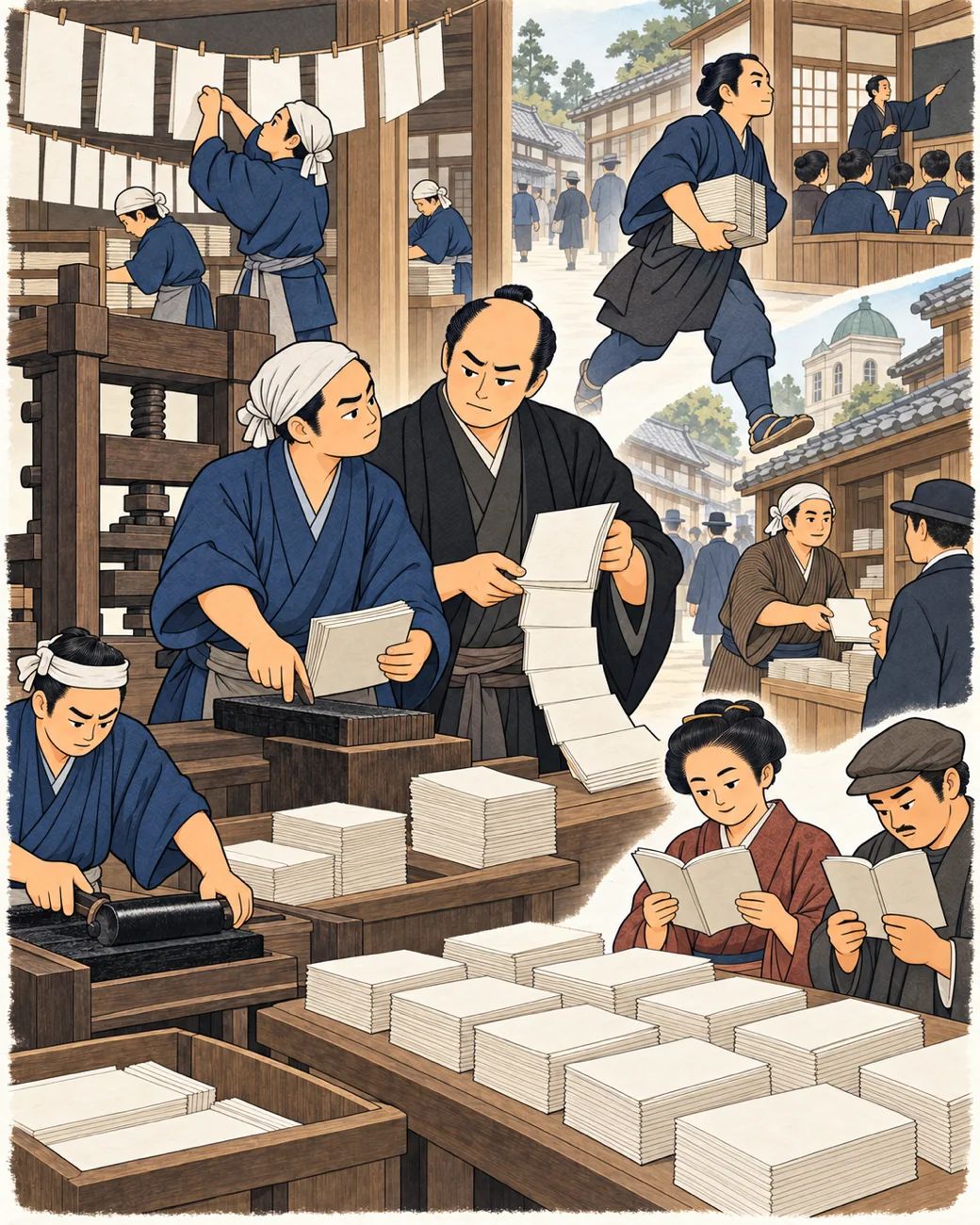
    Illustration for Publishing Gakumon no Susume

    1872–1876 | Meiji period

    Publishing Gakumon no Susume

    『学問のすゝめ』の刊行

    Choose a reading depth

    Overview

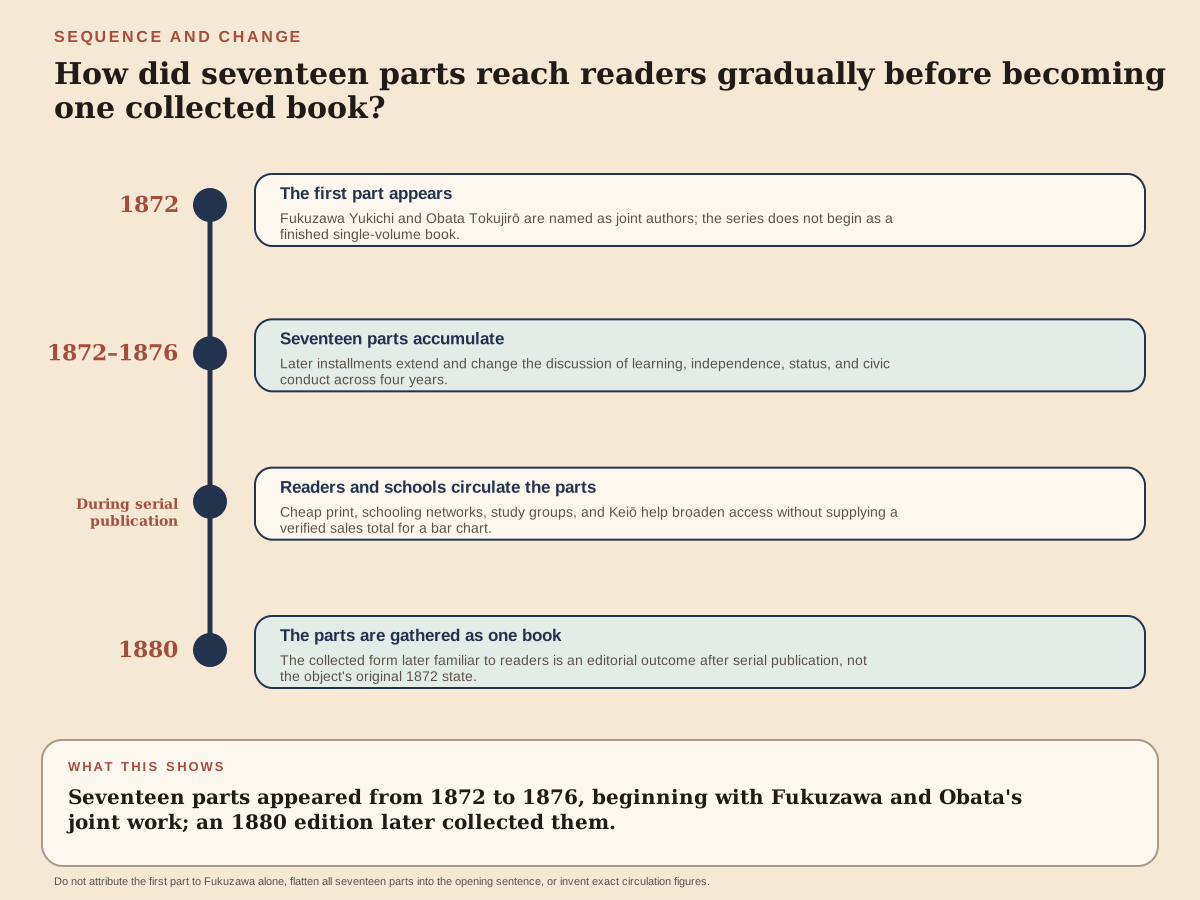
    The first pamphlet appeared in 1872 and was coauthored with Obata Tokujirō. Fukuzawa then continued the series until seventeen parts had appeared by 1876. The familiar single-volume work was assembled later, in 1880, so the text first reached readers as an evolving sequence.

    The essays rejected inherited status as a sufficient basis for authority and urged readers to acquire practical knowledge. Their language joined individual independence to the independence of the nation, reflecting the opportunities and anxieties of the early Meiji transformation.

    Cheap printed parts, schooling networks and Fukuzawa's institution at Keiō helped create an unusually large readership. The work did not make early Meiji society equal, and its arguments changed across the series. Its importance lies in making education and self-cultivation subjects of mass political and social discussion.

    Read Publishing Gakumon no Susume

    Read the article below. Interactive reading tools are available when scripts load.

    Quick

    Publishing Gakumon no Susume

    The first pamphlet appeared in 1872 and was coauthored with Obata Tokujirō. Fukuzawa then continued the series until seventeen parts had appeared by 1876. The familiar single-volume work was assembled later, in 1880, so the text first reached readers as an evolving sequence.

    The essays rejected inherited status as a sufficient basis for authority and urged readers to acquire practical knowledge. Their language joined individual independence to the independence of the nation, reflecting the opportunities and anxieties of the early Meiji transformation.

    Cheap printed parts, schooling networks and Fukuzawa's institution at Keiō helped create an unusually large readership. The work did not make early Meiji society equal, and its arguments changed across the series. Its importance lies in making education and self-cultivation subjects of mass political and social discussion.

    Question: What made Keio independent, and who remained outside that independence?

    Publication unfolded in seventeen parts, beginning with a coauthored first pamphlet. Fukuzawa repeatedly returned to practical learning, independence and civic conduct, but the series should not be read as one sentence expanded unchanged over four years.

    The 1868 name marked a new institutional claim. The school no longer appeared merely as a Nakatsu-domain class. “Gijuku” suggested a community maintained by people joined in learning.

    Relocation required money, buildings, books, and negotiation. Shiba Shinsenza supplied one stage; the 1871 move to Mita provided a more lasting site. Land is part of intellectual history because rooms determine how many can study.

    Fukuzawa's reputation attracted students, but reputation did not teach every class. Obata, Koizumi, and other colleagues prepared lessons, managed learners, translated texts, and preserved routine.

    Classic

    Conditions behind Publishing Gakumon no Susume

    The new Meiji government was dismantling status institutions while building schools, conscription and taxation. Literacy already extended beyond samurai elites, and commercial publishing supplied a route through which arguments about the new order could circulate quickly.

    The first pamphlet appeared in 1872 and was coauthored with Obata Tokujirō. Fukuzawa then continued the series until seventeen parts had appeared by 1876. The familiar single-volume work was assembled later, in 1880, so the text first reached readers as an evolving sequence.

    Question: Why was explaining foreign institutions in readable Japanese a political act rather than simple travel reporting?

    Before mass travel, overseas experience was rare. Official delegates and language specialists could monopolize information. A printed book allowed readers far from ports and ministries to compare claims.

    Fukuzawa combined several kinds of evidence. Personal observation supplied concrete detail; official documents supplied structure; foreign books extended beyond visited places; conversations suggested practice. None was sufficient alone.

    Travel memory can privilege novelty. Government documents describe formal rules more readily than corruption or exclusion. Foreign authors bring national and class assumptions. Synthesis had to choose among unequal sources.

    The 1867 United States journey was his third overseas trip, not a repetition hidden inside the first. He traveled with a commission connected to receiving a warship, gaining another chance to obtain texts and observe commerce.

    Publishing Gakumon no Susume in motion

    Publication unfolded in seventeen parts, beginning with a coauthored first pamphlet. Fukuzawa repeatedly returned to practical learning, independence and civic conduct, but the series should not be read as one sentence expanded unchanged over four years.

    The essays rejected inherited status as a sufficient basis for authority and urged readers to acquire practical knowledge. Their language joined individual independence to the independence of the nation, reflecting the opportunities and anxieties of the early Meiji transformation.

    Cheap printed parts, schooling networks and Fukuzawa's institution at Keiō helped create an unusually large readership. The work did not make early Meiji society equal, and its arguments changed across the series. Its importance lies in making education and self-cultivation subjects of mass political and social discussion.

    Question: What made Keio independent, and who remained outside that independence?

    The 1868 name marked a new institutional claim. The school no longer appeared merely as a Nakatsu-domain class. “Gijuku” suggested a community maintained by people joined in learning.

    Relocation required money, buildings, books, and negotiation. Shiba Shinsenza supplied one stage; the 1871 move to Mita provided a more lasting site. Land is part of intellectual history because rooms determine how many can study.

    Fukuzawa's reputation attracted students, but reputation did not teach every class. Obata, Koizumi, and other colleagues prepared lessons, managed learners, translated texts, and preserved routine.

    The immediate settlement

    The pamphlets sold widely and were read in schools and study groups. In 1880 they were gathered into the form later treated as a single book. That editorial history explains why quotations from the opening can overshadow the range and changes of the later parts.

    Question: Does the famous opening make the series a modern declaration of complete social equality written by Fukuzawa alone?

    Bibliography corrects sole authorship immediately. The 1872 first part names Fukuzawa and Obata Tokujirō as joint authors. Later memory attached the series overwhelmingly to Fukuzawa, making collaboration easy to miss.

    The first booklet was connected to educational work in Nakatsu. Its audience and practical purpose mattered: abstract claims about standing were joined to reasons ordinary learners should study.

    Success produced continuation. Seventeen parts appeared between 1872 and 1876. A series written across years can change emphasis; it should not be flattened into one opening sentence.

    The equality argument attacked the assumption that birth alone establishes human worth. Differences visible in society were explained through learning, circumstance, work, and institutions rather than divine hereditary rank.

    The event's longer afterlife

    The series helped establish education as a public language of modern citizenship and national competition. Its reach made Fukuzawa an influential public writer, while later readers have continued to debate who was included in its promise of independence.

    Gakumon no Susume was both a text and a publishing event. Its serial form allowed arguments to respond to a changing society and placed political language in the hands of readers beyond government office.

    The work made independence a link between personal conduct, education and national survival. Its popularity helped define the public role of the modern intellectual while leaving tensions over gender, empire and actual access to schooling unresolved.

    Question: How could a short official tour produce useful comparison without revealing Europe as a complete object?

    The mission traveled for bakufu diplomacy and information. Fukuzawa served inside an official hierarchy; he did not choose every destination or interview. His linguistic skill created access while binding him to delegation needs.

    Sources and notes

    1. 『学問のすゝめ』出版150年 · Keio University

    About these sources

    Reading preferences

    Text size
    Glossary intensity

    Choose how much explanation appears as you read.

    Saved on this device. All terms remain available in the glossary.

    Browse the glossary →
    History Omakase

    Opening reading…