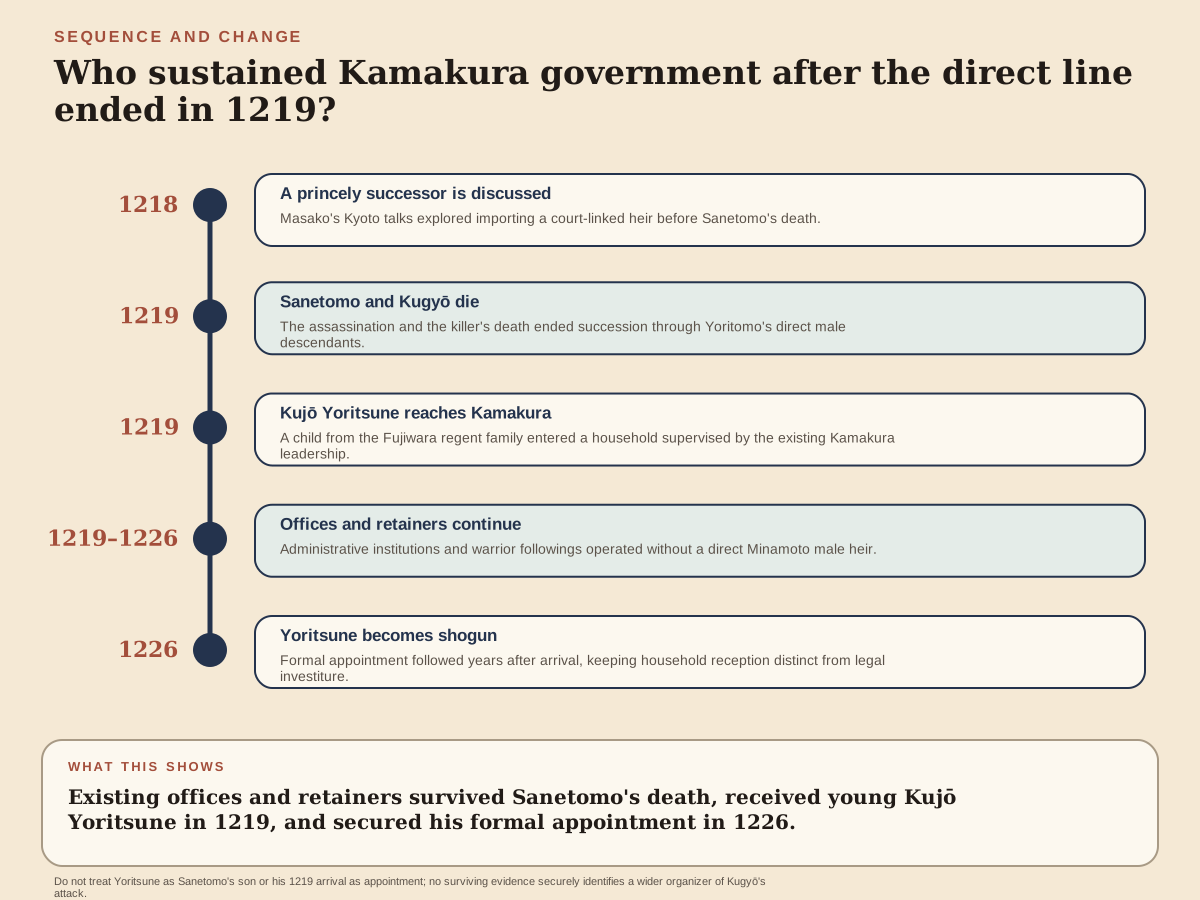
On the twenty-seventh day of the first month of 1219, Minamoto no Sanetomo attended a ceremony at Tsurugaoka Hachimangū celebrating his appointment as right minister. As he left, his nephew Kugyō assassinated him. Kugyō was Yoriie’s son and a cleric at the shrine; he was killed soon afterward. The assassination placed a succession emergency within Kamakura’s principal ceremonial center.
Sanetomo became provisional middle counsellor in 1216. His promotions accelerated in 1218, ending with appointment as minister of the right, one of the highest offices in the imperial court. Rank placed the Kamakura lord above ordinary gokenin in court society. It did not give him direct control of Yoshitoki’s military networks. The later Azuma Kagami attributes a warning about the speed of advancement to Ōe no Hiromoto, a senior Kamakura administrator.
Sanetomo's attributed reply accepts extinction of his descendants and seeks honor before the line ends. That exchange appears in Azuma Kagami, compiled under later Hōjō authority. The surviving evidence may preserve a real conversation, a summarized policy disagreement, or retrospective foreshadowing. Its perfect fit with childlessness and assassination makes source caution essential. Sanetomo's marriage had produced no child. The reason is not securely recoverable. No evidence licenses a medical diagnosis, a verdict about the marriage, or a claim that he deliberately refused descent in order to escape politics. Succession planning therefore became household and diplomatic work. Nishi-Hachijō Zenni's Bōmon kin connected the residence to Kyoto; Masako carried founder-widow and maternal authority; court intermediaries could reach Go-Toba's family. Formal title was only one carrier of authority.
His wife, later known as Nishi-Hachijō Zenni, adopted a daughter of Yoriie and maintained her connections with the Bōmon court family. Such relationships could preserve care, property and household continuity without supplying a male heir of Sanetomo's own.
Yoriie's son Kugyō entered the religious career attached to Tsurugaoka and was treated in sources as Sanetomo's quasi-son. In 1217 he returned from training and became its bettō, the head of the shrine-temple establishment, through a process involving Masako. Spiritual office placed a rival-line male at the ritual center of shogunal Kamakura. None of these relations made later violence inevitable. Quasi-filiation did not erase Kugyō's descent or grievance, but it also cannot be reduced retrospectively to camouflage. Before 1219 it organized education, dignity, obligation, and institutional location.
In 1218 Masako traveled to Kyoto and met Fujiwara Kaneko, Go-Toba’s influential nurse, often called Kyō no Tsubone. The near-contemporary Gukanshō, the monk Jien’s historical account, describes discussion of an imperial prince coming to Kamakura as a future lord. Such a successor could preserve the office despite Sanetomo’s childlessness while strengthening its court connections. The discussion preceded the assassination; it was a prospective settlement rather than a response to his death.
Sanetomo had no child. With his death and Kugyō’s killing, succession through Yoritomo’s direct male descendants ended. Masako had outlived both sons who had held the shogunal position. The government’s offices and warrior following remained, but they needed another head whose status could sustain the relationship with Kyoto and Kamakura’s retainers.
A young child from the Fujiwara regent family, later known as Kujō Yoritsune, came to Kamakura in 1219. He became a ruler whose household was supported and supervised by the existing leadership; his formal appointment as shogun followed in 1226. The change separated the continuing government from direct inheritance within Yoritomo’s own male line.
Later theories propose that Hōjō or Miura leaders directed Kugyō, but the surviving evidence does not securely establish a wider command. Sanetomo’s portraits and memorials record how he was commemorated afterward. They commemorate the event without resolving the conspiracy theories. The story of the assassin hiding near the shrine’s great ginkgo also belongs to the killing’s later memory.
On the twenty-seventh day of the first month of Kenpō 7 (1219), Sanetomo went to Tsurugaoka Hachimangū for worship associated with his appointment as minister of the right. Snow, a ranked procession and large attendance appear in the early accounts. The ceremony brought his Kyoto court office into public view in Kamakura. Court nobles and eastern warriors occupied different positions; attendants and shrine clergy organized a procession in which precedence mattered. Snow was a recorded condition, not evidence that participants knew a disaster was approaching.
Sanetomo wore and carried the material signs appropriate to high office. These objects did not disguise “real” power; they were one means by which office became socially real. Their use required capital expertise and eastern labor together. Tsurugaoka was equally composite. It was a Hachiman cult center, the shogunal family's ritual foundation, a shrine-temple complex employing clerics, and a place integrated with the avenue and government town. Kugyō's position as bettō belonged to that institution, not to a freestanding hiding place. The ascent toward the upper worship area created controlled compression. Large entourages could be organized below while a smaller ranked group advanced. Exact positions matter because early sources disagree about where Yoshitoki remained and who accompanied Sanetomo at the decisive moment.
The popular story that Kugyō hid behind Tsurugaoka’s great ginkgo is not established by the principal early accounts. The shrine itself continued to change: the present upper sanctuary was rebuilt in 1828. Its later buildings and commemorative traditions preserve the place’s importance, but cannot supply every detail of the 1219 procession.
For the participants, the visit celebrated Sanetomo’s highest court appointment. His household, gokenin and court attendants assembled around him at the shrine-temple center associated with his father’s rule. The attack interrupted that public affirmation of office.
As Sanetomo descended after formal worship, his nephew Kugyō attacked and killed him. Kugyō was Yoriie's son and the head of Tsurugaoka's shrine-temple establishment, giving him both a competing descent claim and access to the ceremony. Minamoto no Nakaakira also died. The Gukanshō indicates that he may have been struck because he was taken for Yoshitoki. Yoshitoki's location is disputed: the Azuma Kagami, compiled under later Hōjō rule, says he felt ill after a troubling sign and withdrew before the upper ceremony.
The Gukanshō, written from a different institutional position and closer in time, places him at the lower gate after Sanetomo directed a change. Neither is a camera; each organizes causation and character. The disagreement about Sanetomo's head is equally stark. One tradition says it was not recovered and that hair was used in the coffin. The other reports finding it in the snow. Kugyō's actions after the attack show that killing was not yet government. He reportedly announced himself as successor and approached Miura-linked support. Miura Yoshimura did not convert lineage claim into protection; a force killed Kugyō that night. Motives can be graded. Revenge for Yoriie's deposition and death is plausible and is attached to Kugyō in early narration.
Historical disagreement · Was someone behind Kugyō’s attack?
Kugyō’s reported attempt to claim the shogunate supports a succession motive as well as revenge for Yoriie. Theories of an organizer behind him differ. The Yoshitoki theory points to his absence at the attack; the Miura theory points to Yoshimura’s close connection with Kugyō and the support Kugyō sought afterward. Historian Sakai Kōichi argues instead for Kugyō’s group acting without either organizer: Yoshitoki had participated in the princely succession project, and Yoshimura helped have Kugyō killed.
In a 2022 account Sakai reports support from many other researchers, but that is his assessment, not proof of universal agreement. No surviving evidence conclusively establishes a larger conspiracy.
Kugyō and his associates killed Sanetomo and Nakaakira after worship; Kugyō was killed later that night.
Minamoto no Sanetomo combined shogunal office, court ambition and major waka poetry. His ranks and literary relationships gave him forms of agency that the label “Hōjō puppet” cannot capture, even though senior Hōjō and household officials constrained the government around him.
His childlessness and assassination ended the sequence of shoguns descended directly from Yoritomo and helped consolidate Hōjō control; they did not create that control in a single night. Poetry, court office and the failed ship project also show a shogun seeking authority beyond routine military administration. Later tragedy should not erase those choices.
In 1216 Sanetomo met Chen Heqing, a specialist from China's Song dynasty associated with rebuilding Tōdai-ji’s Great Buddha in Nara. The Kamakura chronicle says Chen told Sanetomo that he had been a Buddhist master in a previous life and that Chen had been his disciple. It adds that Sanetomo recalled a dream supporting the claim. These are reported religious beliefs, not a verified previous life. Chen’s association with a major temple reconstruction gave the proposal a credible bearer of technical and religious knowledge.