Read the article below. Interactive reading tools are available when scripts load.
Quick
In 794, Emperor Kanmu moved his court from Nagaoka-kyō to the city named Heian-kyō, in the Kyoto basin. He had already moved from Nara to Nagaoka in 784. The second relocation followed years of continued construction, the assassination of Fujiwara no Tanetsugu, the removal and death of Crown Prince Sawara, and problems of flooding.
Preparations preceded the sovereign's arrival. Officials inspected the new site in 793, and residential plots were assigned later that year. The eastern and western markets moved from Nagaoka in 794 before Kanmu entered. A city of government offices, households, and supplies was being assembled alongside the palace.
The plan placed the palace in the north, with Suzaku Avenue running toward Rajō Gate at the south. The Left Capital was the eastern half and the Right Capital the western half. The street grid drew on continental and earlier Japanese capital plans. Tō-ji and Sai-ji developed as state temples beside the southern approach. The planned area was roughly 4.5 kilometers east–west and 5.2 kilometers north–south.
The court arrived while construction remained unfinished. Timber, tiles, food, and labor came from beyond the basin, alongside resources still being used for northern military campaigns. In 805, Fujiwara no Otsugu argued before Kanmu for ending warfare and construction to relieve the people; the official Sugano no Mamichi argued against him. Kanmu accepted Otsugu's position. The decision curtailed major state projects rather than abandoning the occupied capital.
Heian-kyō remained the court's seat, but settlement and political activity changed within it. Wet ground hindered parts of the west, while aristocratic residence and commerce grew more strongly toward the east. Later palace fires encouraged emperors to reside in nobles' houses outside the original enclosure. Kyoto's long history followed from the continued use of this center, not from an unchanged city completed in 794.
Classic
The 794 relocation was Kanmu's second capital move. In 784, he had transferred the court from Heijō-kyō at Nara to Nagaoka-kyō, a site with access to river transport. The court remained at Nagaoka while palace and city construction continued.
The assassination of the building official Fujiwara no Tanetsugu in 785 had led to an investigation, punishments, and the removal of Kanmu's brother Sawara as crown prince. Sawara died during his transfer toward exile, and later illness and disasters were linked to his resentful spirit. The killing and succession changes were political events; the explanation through the spirit was a religious response that developed around them.
Flooding and the costs of continued building added difficulties at Nagaoka. Selecting another site meant obtaining land, laying out roads, transferring markets and offices, and relocating households again. The work would place demands on the same provinces supplying the court and its northern military campaigns.
The Kyoto basin offered a site for a planned palace city, but already contained settlements, religious places, roads, and waterways. The decision required officials and builders to fit a formal plan to that landscape. The later success of Kyoto does not identify one exclusive motive for Kanmu's choice or make the earlier city a mere temporary camp.
The tradition connecting Wake no Kiyomaro's advice to the choice of the Yamashiro basin belongs to explanations of this second move. It should not replace the recorded inspection and preparations with one decisive conversation. Nor did entering the new capital settle the treatment of Sawara. In 800, Kanmu conferred the posthumous title Emperor Sudō on his dead brother. The gesture addressed a feared source of calamity after relocation, showing that the succession conflict and its religious consequences crossed the boundary between the two capitals.
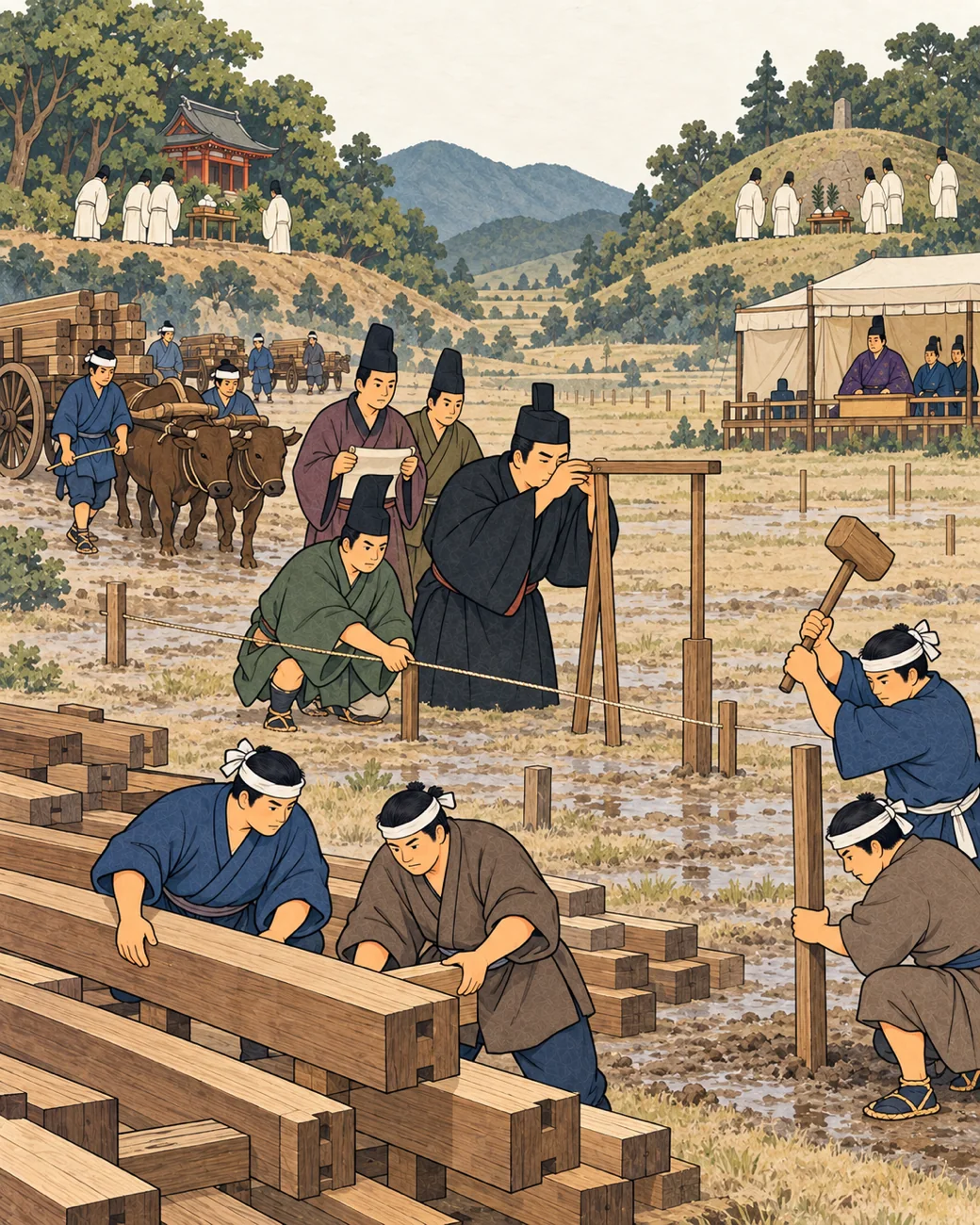
In 793, Kanmu sent officials including Fujiwara no Oguro-maro to inspect the proposed site in the Kadono district. Work began on the new capital while parts of the old palace at Nagaoka were dismantled. Kanmu used another residence as these preparations proceeded. In the second month of 793, offerings at Kamo and Ise and notification at ancestral tombs announced the planned relocation. Construction and the ritual authorization of the move were proceeding together, before the court occupied its destination.
Residential plots at the new city were assigned in 793. The eastern and western markets transferred from Nagaoka in 794, before the sovereign moved. These steps brought places for exchange and elite residence into the new center rather than waiting for a fully built city.
Kanmu entered in the tenth month of 794. A proclamation announced the relocation, and the following month the city received the name Heian-kyō. These dates use the contemporary calendar; the court's arrival was a political occupation, not the completion of every office, road, drain, and house.
The layout placed the imperial palace in the north. Suzaku Avenue formed a central axis toward the planned southern gate, with eastern and western halves called the Left and Right Capitals. Tō-ji and Sai-ji occupied sites beside the southern entrance. The grid drew on continental and earlier Japanese capital plans. Large and small streets divided the city into administrative blocks, with further divisions providing units for residential allocation. From the sovereign's viewpoint facing south, the eastern half was the Left Capital and the western half the Right. This regular scheme placed households in a hierarchy around the palace, while leaving builders the practical work of roads, drains and dwellings. Building and occupation did not progress evenly across it.
Materials, workers, and food had to reach the city from the provinces. In 805, Kanmu heard Fujiwara no Otsugu and Sugano no Mamichi debate the burdens of government. Otsugu urged an end to northern warfare and capital construction; Mamichi opposed him. Kanmu adopted Otsugu's position, and the capital-building office was abolished. Government continued in the city even as large state construction ended.
The immediate result of the move was a new seat for the imperial court. Markets, officials, and elite households had already begun to establish themselves, and Kanmu's residence made the new center the setting for government and palace ceremony.
The decision of 805 limited further state building without showing that the original plan had been fully realized. It recognized costs borne by the population through construction and military service. Maintenance and smaller changes could continue in an occupied capital after the large building program was curtailed.
Nor did relocation end the influence of Nara's major temples. They retained religious communities, estates, and relationships with the court. The new location altered the setting of royal government while leaving older institutions with resources and authority of their own.
In 810, the retired Emperor Heizei attempted to restore the court's center at Nara. Emperor Saga's government defeated that challenge. Heian-kyō's continued occupation was therefore confirmed by a later political contest, rather than guaranteed once and for all by Kanmu's arrival.
The capital's state temples also remained part of changing court relationships with Buddhism. Tō-ji and Sai-ji had been placed at the southern approach; in 823, Tō-ji was entrusted to Kūkai and became a center for Shingon teaching and ritual. The new royal setting thus supported Buddhist institutions of its own. Distance from Nara and the establishment of new centers can be described, without treating hostility to all Buddhism as the one proved motive for Kanmu's move.
An occupied city required further decisions about its land and water. Officials responsible for protecting the Kamo and Katsura rivers were established in 824. In 827, the Left and Right Capital offices were told to identify vacant land and have its owners cultivate it. These later measures addressed an inhabited, unevenly developed capital. They also distinguished the central decision to remain from the many decisions needed to keep particular districts usable.
The imperial court remained in the Kyoto basin for centuries, giving titles, ritual, aristocratic residence, and literary activity a continuing center. Food and craft supplies connected the city to its surroundings and to distant provinces. The 794 move concentrated those needs in a place that later governments repeatedly chose to retain.
The internal geography changed. Wet conditions affected parts of the western city, and population and elite activity increasingly favored the east. Yoshishige no Yasutane's Chiteiki of 982 described western decline and eastern growth. His account is a literary view of a much later city, not a census proving that every western block had been empty from the foundation.
Palace fires led emperors to use aristocratic residences as temporary palaces outside the original enclosure. Parts of the old palace subsequently declined into the area known as Uchino. Political continuity could therefore survive the replacement and abandonment of particular buildings.
Streets, archaeological remains, Tō-ji, the site of Sai-ji, and places such as Shinsen'en preserve different elements of the capital's spatial history. They belong to different periods of occupation and reconstruction. Kyoto's later form grew through those changes within and beyond the grid established for Heian-kyō.
Excavation gives one concrete alternative to reading western decline as total abandonment. At a site in Ukyō's fourth avenue, archaeologists traced a street converted into a drainage channel and later buildings constructed over a filled ditch. The buildings were repeatedly renewed between the late eleventh and early thirteenth centuries and may have served the Koizumi estate's administration. The excavators connect the waterway changes to replacement of an earlier principal drain. This is evidence for changing infrastructure and land use in one district, rather than a population history of the whole western city.
Later departures were also reversible. In 1180 the Taira moved the court to Fukuhara, but it returned to Heian-kyō that year. Court continuity therefore included interruptions and contested returns. The city's inherited houses, institutions and routes repeatedly remained useful to governments, even while specific palace buildings and sections of the grid disappeared.