Read the article below. Interactive reading tools are available when scripts load.
Quick
On the twenty-seventh day of the third month in the Japanese calendar of 1689, Matsuo Bashō and Kawai Sora left Edo. In Oku no hosomichi, friends gather before departure, accompany them by boat and see them ashore at Senju. Bashō presents his farewell verse as the beginning of the journey’s writing.
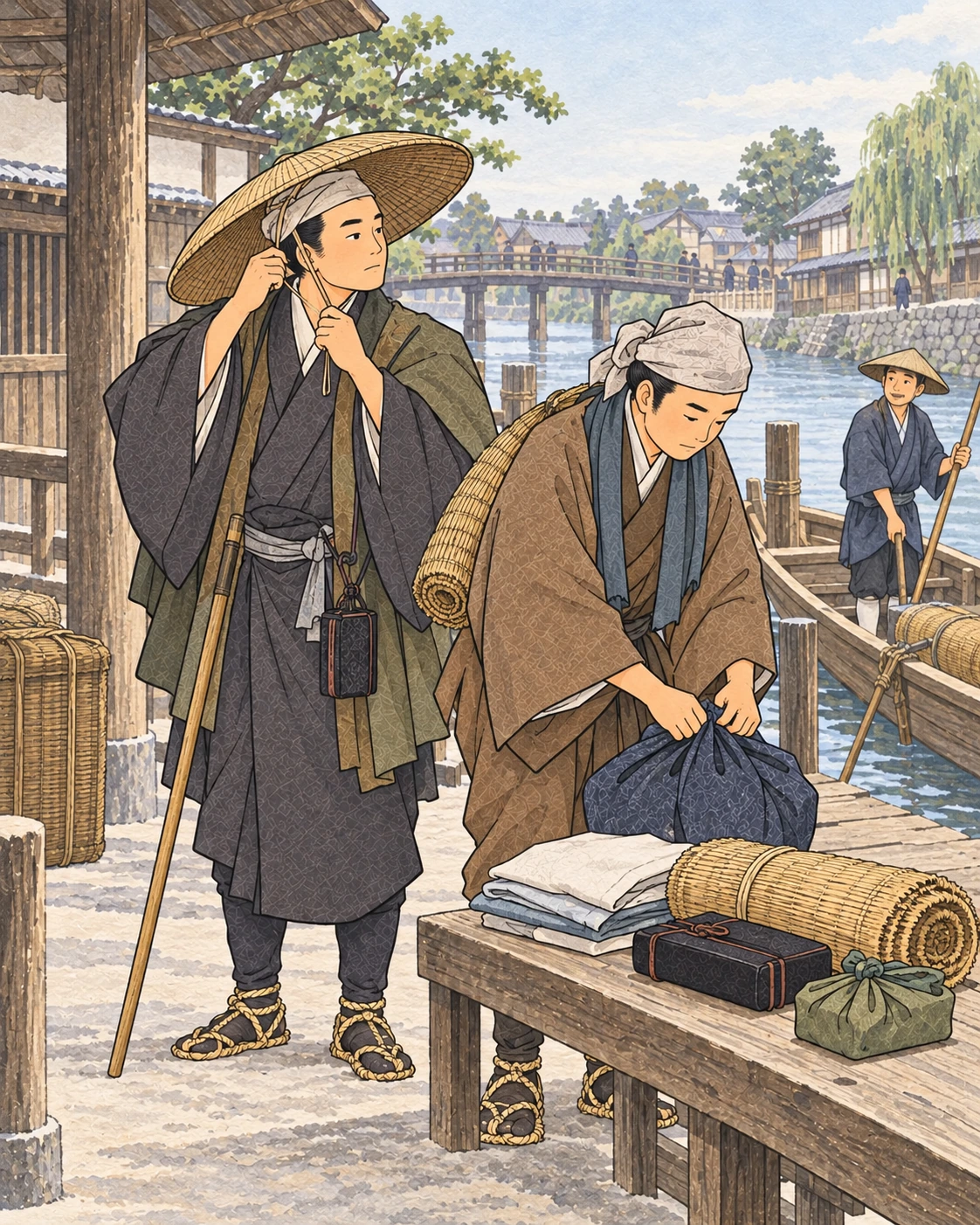
Preparations appear alongside that farewell. Bashō describes giving up his dwelling, moving temporarily to his friend Sampū’s house, repairing clothing and fastening his hat’s cord. Paper clothing, rain gear, writing materials and gifts burden the traveler who had hoped to set out lightly. Sora accompanies him toward Matsushima and other northern destinations; the book also introduces Sora’s poems and religious knowledge.
The route leads through shrines, temples and places already associated with earlier poetry and warrior history. Friends’ introductions, local advice, borrowed horses and boats help the travelers move between them. Bashō later shaped these encounters into a literary account. The departure begins both a physical journey and the sequence of remembered places from which he constructed that book.
On the twenty-seventh day of the third month of 1689 in the Japanese lunisolar calendar, corresponding to 16 May Gregorian, Bashō left Fukagawa with Kawai Sora on the northern journey later shaped into Oku no Hosomichi, The Narrow Road to the Interior. They began by boat toward Senju. Sora shared travel and contacts through most of the route and kept notes that now provide an independent record beside Bashō's literary account.
Classic
On the twenty-seventh day of the third month in the Japanese calendar of 1689, Matsuo Bashō and Kawai Sora left Edo. In Oku no hosomichi, friends gather before departure, accompany them by boat and see them ashore at Senju. Bashō presents his farewell verse as the beginning of the journey’s writing.
In 1686 Bashō composed the old-pond verse. Journeys resumed the next year: a visit to Kashima's shrine east of Edo was followed by the westward trip later represented in Oi no Kobumi, a travel work assembled from his materials.
The old-pond poem turns on an abrupt event: an old pond, a frog entering, and the sound of water. It uses the familiar poetic subject of the frog but attends to the splash rather than its voice. The short opening gives an ordinary action room to register without an elaborate description of the observer.
Kashima was a separate journey east of Edo, made with Kawai Sora, a pupil and travel companion, and another member of the circle in 1687. The westward route that followed included a return to Iga, worship at Ise and visits toward Yoshino, Nara, Suma and Akashi. Places famous in earlier poetry came with contemporary hosts and religious institutions; Bashō's attention joined inherited scenes to the circumstances of a present visit.
The 1688 Iga stay included an invitation from Yoshitada's son Yoshinaga. A verse about cherry blossoms recalls the many things that came to mind there, placing his former household connection within later composition. Travel among patrons could recover personal and literary associations while supplying new gatherings.
Kawai Otsushū later arranged Bashō's materials for the 1709 publication of Oi no Kobumi. Its prose and verse therefore preserve a journey through an editorial sequence published after his death, when he could no longer revise it. This does not erase Bashō's writing; it leaves uncertainty about how completely the published order reproduces his intentions.
Preparations appear alongside that farewell. Bashō describes giving up his dwelling, moving temporarily to his friend Sampū’s house, repairing clothing and fastening his hat’s cord. Paper clothing, rain gear, writing materials and gifts burden the traveler who had hoped to set out lightly. Sora accompanies him toward Matsushima and other northern destinations; the book also introduces Sora’s poems and religious knowledge.
The route leads through shrines, temples and places already associated with earlier poetry and warrior history. Friends’ introductions, local advice, borrowed horses and boats help the travelers move between them. Bashō later shaped these encounters into a literary account. The departure begins both a physical journey and the sequence of remembered places from which he constructed that book.
On the twenty-seventh day of the third month of 1689 in the Japanese lunisolar calendar, corresponding to 16 May Gregorian, Bashō left Fukagawa with Kawai Sora on the northern journey later shaped into Oku no Hosomichi, The Narrow Road to the Interior. They began by boat toward Senju. Sora shared travel and contacts through most of the route and kept notes that now provide an independent record beside Bashō's literary account.
The route used established roads and other transport when terrain required it. Checkpoints and travel permissions still applied to poets, while introductions and religious contacts could help them gain access. Innkeepers and hosts supplied food and shelter. Bashō's reputation made a demanding journey more practicable, without guaranteeing safe passage or good health.
Saigyō, the twelfth-century monk-poet, was an important predecessor whose places and poems Bashō sought. The 1689 journey fell in the five-hundredth memorial year of his death by inclusive commemorative reckoning. That context helps explain the literary horizon without proving a single motive for every destination. Family visits, religious access and relationships with pupils also shaped the route.
The commonly cited five months and roughly 2,400 kilometers summarize a reconstructed route to Ōgaki, including land and water travel. They are approximate, not measurements from a recorded walking trail. At Senju, the exact bank from which the overland journey began remains unresolved: library reference research allows the northern and southern banks.
The conversion of the departure date also varies in institutional explanations. Adachi's museum gives 16 May, used here; an Ōgaki library reference answer gives 17 May. Both retain the traditional third-month twenty-seventh day. The modern discrepancy should not conceal that secure calendar notation.
On the first day of the fourth month of 1689 in the contemporary calendar, Bashō and Sora reached Nikkō, a sacred mountain complex north of Edo. The date is not Gregorian April 1. Buddhist temples and worship of kami, sacred beings associated with places and lineages, long predated the Tokugawa founder Ieyasu's memorial there. By Bashō's visit, Tōshōgū, Ieyasu's shrine, gave the mountain a powerful dynastic presence.
Bashō and Sora encountered a maintained religious complex, not an uninhabited mountain. Craftspeople and temple or shrine workers kept the buildings and ritual functioning, while roads and lodgings supported visitors. Sora's religious knowledge and notes helped mediate their encounter. The brief literary passage compresses a place whose residents lived with these obligations throughout the year.
In the poem attached to his visit, an exclamation of reverence leads into green leaves, young leaves and sunlight. Nikkō's name itself means sunlight. The brightness of the foliage and the sacred place are brought together in a short opening rather than explained in a political argument. It is a concrete literary response to entering the complex.
Ōgaki City's presentation reads the verse as straightforward respect for Tōshōgū and Tokugawa authority. That public expression is visible, but it does not settle his private judgment of every government policy. Nor does subtle phrasing by itself prove concealed resistance. Ritual decorum and the poem's play on light can be read together without converting the verse into a political declaration.
The religious arrangement also differed from the later institutional separation of Buddhism and Shinto. Bashō entered an interwoven complex whose clergy, buildings and paths mediated the mountain. His visit added one literary layer to a much larger history of worship and memorial government.
Matsuo Bashō transformed haikai through revision, travel writing and networks of pupils and hosts. His poems did not emerge from solitary inspiration alone: linked-verse gatherings, correspondence, patronage and repeated rewriting turned short openings and travel episodes into a disciplined literary practice.
That practice acquired exceptional authority after his death through pupils, rival schools, editions and memorial places. Later readers increasingly detached hokku from linked verse and eventually called it haiku, giving Bashō a foundational place in the later independent genre. The name haiku became generally established in the era of nineteenth-century poet and critic Masaoka Shiki, not as Bashō's own genre label. His historical importance lies in the work and network that enabled this later transformation, not in the modern solitary-genius image.
In 1684 Bashō left Edo on the westward journey later represented in Nozarashi Kikō, a travel account whose title evokes a body exposed to the elements. He traveled along established routes to his home region, visited Ise's sacred sites and worked among regional poets. His mother's death the year before gave the return to Iga a family purpose as well as a literary one.