Read the article below. Interactive reading tools are available when scripts load.
Quick
In 1639 the Tokugawa government barred Portuguese ships, citing prohibited Christian activity and support reaching believers in Japan. The measure followed restrictions developed during the 1630s. It removed a commercial route associated with missionaries while preserving channels the government could authorize and supervise.
The 1633 instructions had combined travel licenses, Christian searches and detailed trade procedures. Overseas settlers faced restrictions on return, initially with a limited exception after investigation. In 1635 Japanese departure and return were broadly prohibited. Nagasaki merchants completed Dejima in 1636 to confine the Portuguese residents already trading there.
After their exclusion, the island stood empty until the Dutch factory moved from Hirado in 1641. The Dutch accepted restricted residence and official oversight to retain trade. Japanese interpreters handled conversations and documents; overseas reports were translated and sent to officials. Chinese merchants continued to use Nagasaki, with a separate residential enclosure established much later, in 1689.
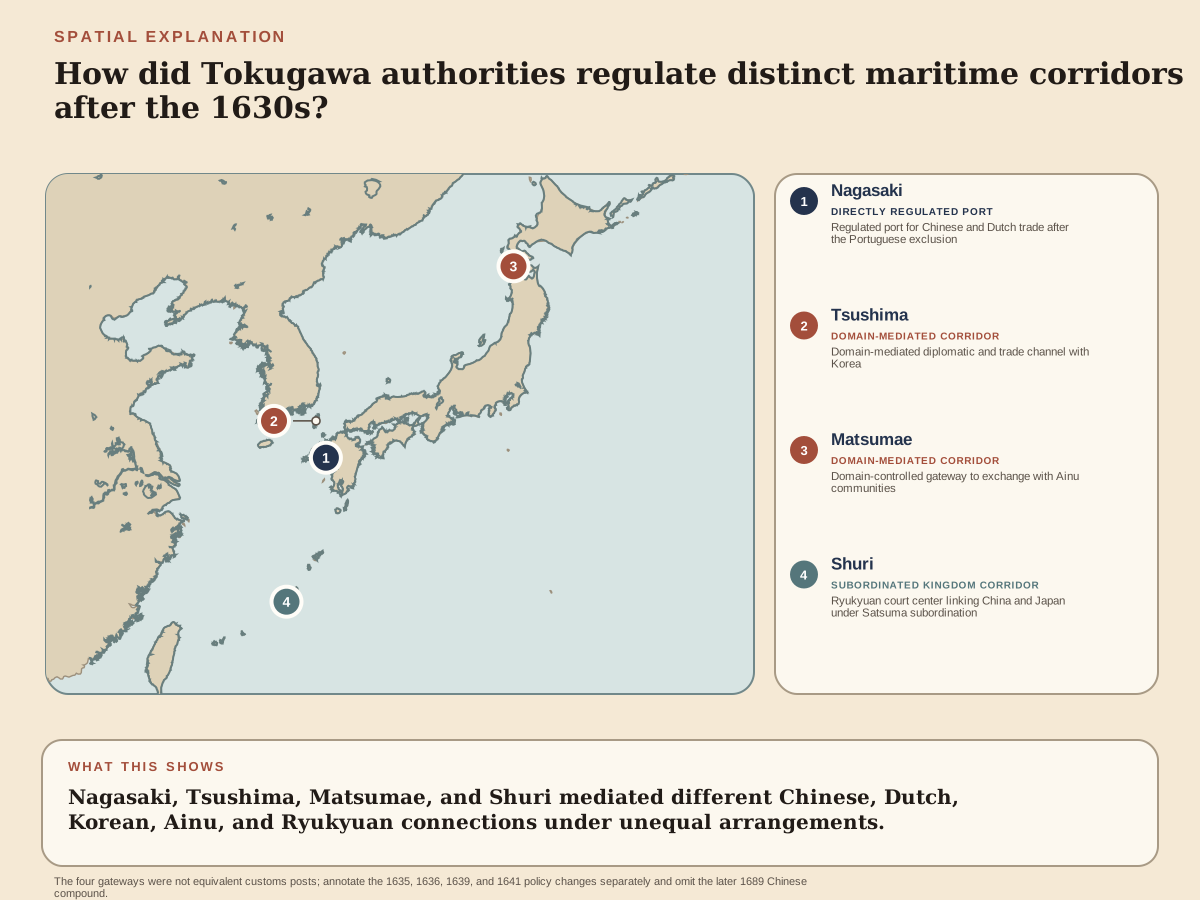
Other contacts had different arrangements. Tsushima mediated Korean embassies; Satsuma supervised Ryūkyū, whose court continued tribute relations with China under coercive constraints. Matsumae held an authorized monopoly over Japanese trade with Ainu communities. These routes did not place all their participants under one uniform form of rule.
Trade brought silk, medicines and other goods and carried overseas news, while permission to move remained restricted. Japanese seafarers abroad lost the ordinary possibility of returning, and foreign residents faced confinement. The later label sakoku came from Shizuki Tadao’s 1801 translation of part of Kaempfer’s work. The seventeenth-century measures themselves can be followed through licenses, prohibitions, commercial instructions and the particular institutions that continued handling contact.
Classic
Portuguese shipping connected Nagasaki with Asian trade and Christian missions. The Tokugawa government increasingly prohibited Christian practice while continuing to supervise maritime commerce. Restrictions developed through instructions to port officials and further orders affecting ships and residents.
In 1633 new instructions combined several concerns. They regulated Japanese travel, demanded searches for missionaries and defined procedures for imports. The commercial clauses treated silk prices, allocation, merchants’ arrival dates and foreign ships’ departure as matters for official direction.
Christian prohibition gave maritime travel a further risk. Japanese settlers abroad could face death on return, although the 1633 wording allowed an investigated exception for some who had been away fewer than five years under unavoidable circumstances. The government differentiated licensed movement from prohibited return and religious activity.
The Shimabara–Amakusa uprising of 1637–1638 intensified official concern. The 1639 prohibition cited Christian infiltration, collective resistance and supplies reaching concealed believers. Its accusations state the government’s grounds for excluding Portuguese shipping; they do not establish that every Portuguese trader had organized the revolt.
The Portuguese route was part of a larger Asian trading world. Ships and goods moved through Goa, Malacca and Macao; Japanese maritime settlements had linked businesses and families to ports overseas. The bans therefore cut across existing relationships. A family connection to a Portuguese resident could become a reason for expulsion, while an overseas Japanese household could lose the right to return. The government's category grouped traders, missionaries and their connections as a security risk without making them one organization.
Reports about missionary activity and hostile foreign powers reached officials through particular merchants and interpreters. The Dutch company itself possessed overseas powers to make treaties and use armed force. Its useful reports were consequently supplied by a commercial and imperial competitor, rather than by an observer outside the contest. That setting explains the importance of information without crediting Edo officials with complete knowledge of European or Asian affairs.
The 1633 rules required an official authorization document for ships sent abroad. Unauthorized Japanese passengers faced death; the ship and its owner were to be detained and reported. Officials also had to inspect ships for missionaries and arrange guards or detention through Ōmura.
Cargo lists went to Edo, but established trading could proceed before a reply arrived. Silk was to receive an agreed official price and be allocated among designated merchant groups. Other goods followed the silk-price decision. The instructions gave deadlines for payments, merchant arrival and ships’ departure.
In 1635 broader prohibitions replaced the earlier travel permissions and limited exceptions to return. These measures curtailed the maritime networks through which Japanese traders had lived abroad. Port officials implemented restrictions at the points where ships and passengers arrived or attempted departure.
In 1636 twenty-five Nagasaki merchants financed the artificial island of Dejima for Portuguese residence. Confinement placed this foreign community in a designated waterfront space. The names of its designer and construction supervisor remain uncertain.
The 1639 order stopped Portuguese ship arrivals. It threatened destruction of a ship and execution of those aboard if they came despite the ban. Dejima lost the residents for whom it had been built. The threat was part of the prohibition’s wording, rather than a complete account of every later arrival.
In 1640 the Dutch were ordered to demolish their Hirado warehouse, whose Christian-era date supplied an official pretext. Factory head François Caron complied. The following year the factory moved to Dejima, entering the stricter residence and inspection arrangements at Nagasaki.
The ownership arrangements connect confinement to Nagasaki's economy. The government provided the island's enclosing structures and bridge; the twenty-five investors built houses and warehouses. They received shares of the foreign residents' rent and were responsible for repairing the buildings they owned. Construction and later maintenance turned a controlled trading site into property and income for local households. The labor of making and maintaining the waterfront was necessary to this arrangement even though the engineer's identity is not established.
Moving the Dutch from Hirado changed the institutions around them. The factory now depended on Nagasaki officials, interpreters and suppliers while its personnel remained confined. The compound also employed cooks, carpenters and Asian servants, including people brought from Java. It was a working settlement connected to Asian shipping, not simply a meeting between Dutch merchants and a single shogunal official.
Access was differentiated by gender and occupation. The later posted rule excluded women except those categorized as courtesans. Those permitted to enter could conduct relationships and transactions, while a foreign merchant's permission did not extend automatically to his family. In 1817 factory head Blomhoff brought his wife and child; an appeal failed and they were ordered to leave. This later example illustrates the durable household restriction without projecting every detail of nineteenth-century practice into 1641.
Portuguese trade was excluded while Dutch and Chinese commerce continued. Dutch factory personnel could not freely leave Dejima, and Japanese access was controlled. The government retained commerce under conditions that restricted the people conducting it.
Japanese overseas settlers faced a much harsher boundary on return. The rules affected businesses and households whose members had crossed the sea before the restrictions. The 1636 measures also expelled people categorized through Portuguese family connections.
The Sō house of Tsushima continued mediating relations with Korea. Embassy parties traveled through the island and across the Seto Inland Sea, receiving lodging and protection from domains along the route. At San’nose, Asano officials supplied their reception facilities. These missions continued after the Portuguese prohibition.
Satsuma supervised Ryūkyū while its royal government maintained the Chinese tribute channel. In the north, Matsumae’s 1604 grant had reserved Japanese trade with Ainu communities to that house while declaring Ainu movement free. A trading privilege did not give the shogunate identical direct authority over every community reached by these corridors.
Historians describe these different arrangements as the four gateways: Nagasaki, Tsushima, Satsuma and Matsumae. The grouping makes continuing contact visible, but it names an analytical model rather than one seventeenth-century decree or a uniform foreign ministry. The Sō and Shimazu houses supplied diplomatic and commercial knowledge through their own officials. At Nagasaki, interpreters made commercial negotiations and reports legible to the government. Supervision still depended on people who knew the languages, routes and conventions of each corridor.
The permission to trade also created valuable privileges. Restrictions on goods, quantities and prices encouraged factory heads to petition for more favorable terms. Permitted personal cargo and clandestine sales existed alongside official transactions. Such activity identifies an incentive and a limit within the rules; it does not mean that confinement or the threat to prohibited passengers had ceased to operate. Hara Castle belongs to the uprising's security context, while Dejima was built to organize the authorized foreign community. They reveal connected policies through different functions.
Nagasaki’s authorized trade continued bringing textiles, medicines and other imports in exchange for Japanese exports. Officials regulated the transactions, and interpreters linked foreign merchants with the institutions handling them. Commercial access depended on those intermediaries.
Dutch reports also supplied overseas information. Interpreters translated it for officials, who sought news about missionary infiltration and potentially hostile powers. The same narrow channel could convey both commercial goods and intelligence while denying ordinary residents unrestricted access to foreign contacts.
Chinese residence was further regulated by the enclosure established in 1689. Other administrative arrangements also changed over time. The 1639 ban therefore belongs within a continuing sequence of controls whose mature institutions were assembled across decades.
In 1801 Shizuki Tadao translated a section of Kaempfer’s account from Dutch under the title Sakokuron. The familiar term emerged long after Iemitsu’s government issued its orders. Licenses, cargo rules, residence restrictions and surviving diplomatic routes describe the earlier arrangements more precisely than treating that later title as their original program name.
The reports followed a concrete route: an interpreter obtained news from the factory head, translated it, and the signed document passed through the Nagasaki magistrate to Edo. Officials initially sought information about Catholic powers and missionary entry. Reports were later copied beyond the small circle of recipients. Language specialists thus helped determine what officials could read, while the particular informants and selected questions limited the picture.
Goods and knowledge also moved through changing arrangements. The Dutch channel carried silk and medicines; Japanese exports shifted from precious metals toward copper as later prohibitions altered trade. Interpreters' language work supported study of medicine and other subjects, and visiting factory personnel met interested readers during authorized journeys to Edo. These exchanges cannot be dated entirely to the 1639 prohibition or treated as access enjoyed equally by everyone. They accumulated under a continuing system of permits and confinement.
Shizuki's later title made a translation term into a label for the earlier age. It can hide embassies and trading corridors if read as an airtight boundary. Yet calling the period simply open would erase persecution, expulsion and the restrictions on families and returnees. The inherited reports and expertise also mean that later foreign pressure confronted a government with experience of overseas contact. It challenged the conditions under which that contact had long been managed, rather than introducing an outside world for the first time.