Read the article below. Interactive reading tools are available when scripts load.
Quick
The Jinshin War of 672 settled a royal succession by force. Prince Ōama, the brother of the late Emperor Tenji, defeated the Ōmi court led by Tenji’s son Prince Ōtomo. The struggle extended across several provinces, rather than remaining a contest inside a palace.
Tenji had moved his court to Ōtsu in Ōmi, beside Lake Biwa. In 671, Ōama withdrew to Yoshino after renouncing his place in government, according to the Nihon Shoki. Tenji died later that year, leaving Ōtomo and the officials at Ōtsu in possession of the court. The chronicle presents subsequent military preparations and restrictions on Ōama’s followers as threats to him.
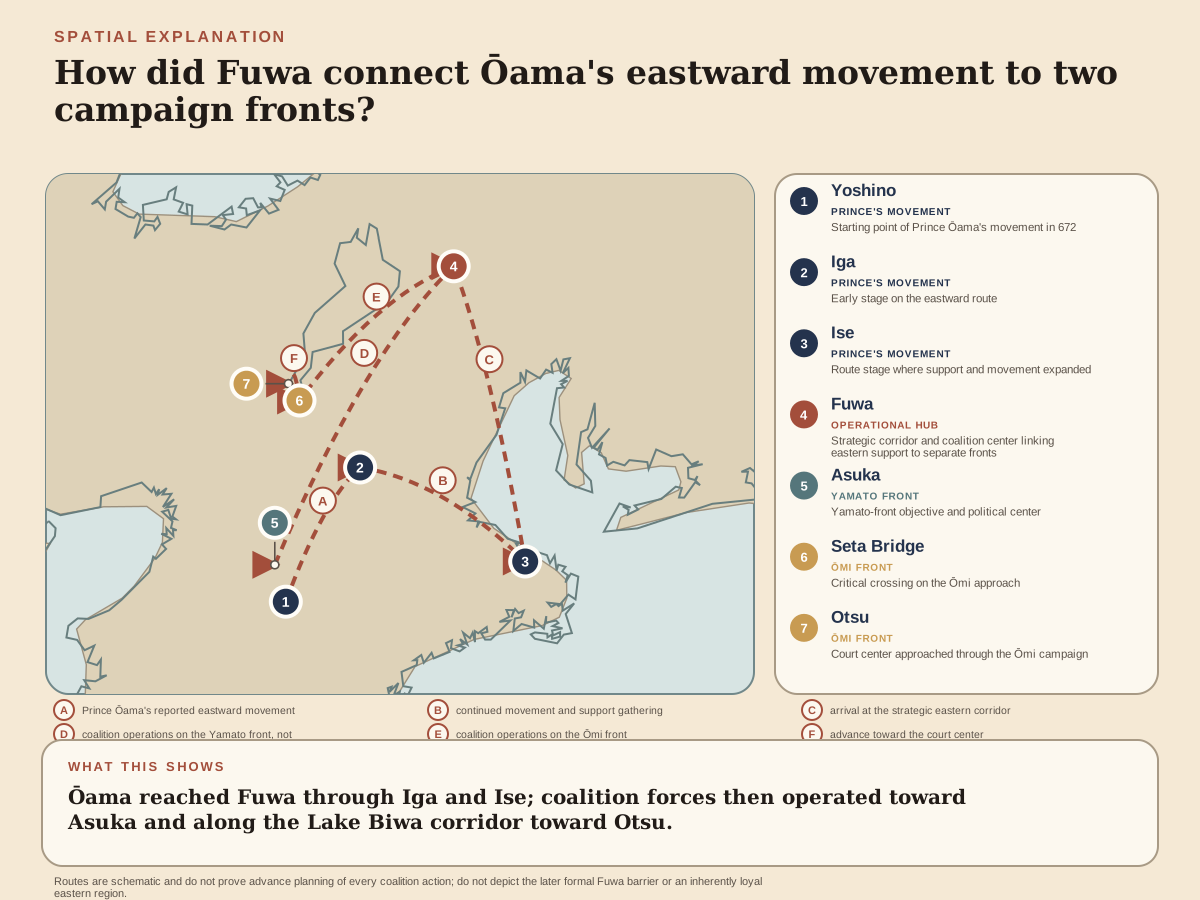
Ōama left Yoshino in 672 and traveled through Iga and Ise toward Mino. His supporters secured the route at Fuwa and called in forces from the east. Holding this corridor limited the Ōmi court’s access to eastern manpower while giving Ōama a base from which to advance.
His armies divided between the approaches to Yamato and Ōmi. Fighting in Yamato included the defeat of an Ōmi force near Hashihaka; in Ōmi, the advance reached the Seta Bridge near Ōtsu. The court’s forces collapsed and Ōtomo died by suicide. Control of routes, recruitment and separate fronts had brought Ōama’s forces to the royal center.
The victors returned to Asuka. Leading opponents were executed or exiled, while supporters received rewards and higher rank. Ōama formally took the throne as Emperor Tenmu in 673. His later program of court and administrative reform grew under the government established by this victory, rather than being enacted in a single wartime decision.
The Nihon Shoki preserves the principal narrative from the victorious dynasty’s later court. A surviving epitaph for Fumi no Nemaro, who died in 707, also identifies him through service in the war. The conflict remained part of both the dynasty’s history and the public standing of its participants.
Classic
Emperor Tenji’s court was based at Ōtsu in Ōmi, near the southern end of Lake Biwa. Royal authority relied on ministers, provincial officials and the forces their relationships could assemble. Tenji’s brother Prince Ōama and his son Prince Ōtomo occupied different positions within this order; succession had no procedure that could remove their competing claims from politics.
In 671, Ōama withdrew to Yoshino. The Nihon Shoki describes his renunciation and adoption of religious dress, followed by retirement with attendants. Tenji’s death later that year left Ōtomo at the royal center with its senior officials.
The chronicle reports that preparations ostensibly for Tenji’s burial included armed recruits in Mino and Owari, while movement of supplies to Ōama’s household was restricted. It presents these reports as the danger that led him to act. Because the account was compiled under his successors, that explanation is firmer as the victorious court’s narrative than as direct access to every participant’s intentions.
Yoshino provided distance from Ōtsu, but victory required support beyond the retreat. The roads toward Ise and Mino connected Ōama with provincial allies and manpower that the Ōmi court also sought to command.
The renunciation in the chronicle involved more than departure from a building. Ōama offered to enter religious life and surrendered his private weapons to the authorities. At Yoshino, attendants were given a choice between remaining for religious practice and returning to official service; some eventually left. The account presents withdrawal as a way of relinquishing an immediate claim, while preserving a royal household outside Ōtsu. It cannot establish whether religious commitment, protection or preparation for a future contest was foremost in his mind.
His wife, Unonosarara, the future Empress Jitō, was Tenji’s daughter. The rivalry therefore crossed relationships inside one dynasty. Rank and royal descent made the rival princes important, but support from ministers and provinces was needed to make either claim effective. Tenji’s court and the Yoshino household remained parts of the same political order, rather than the governments of two independent states.
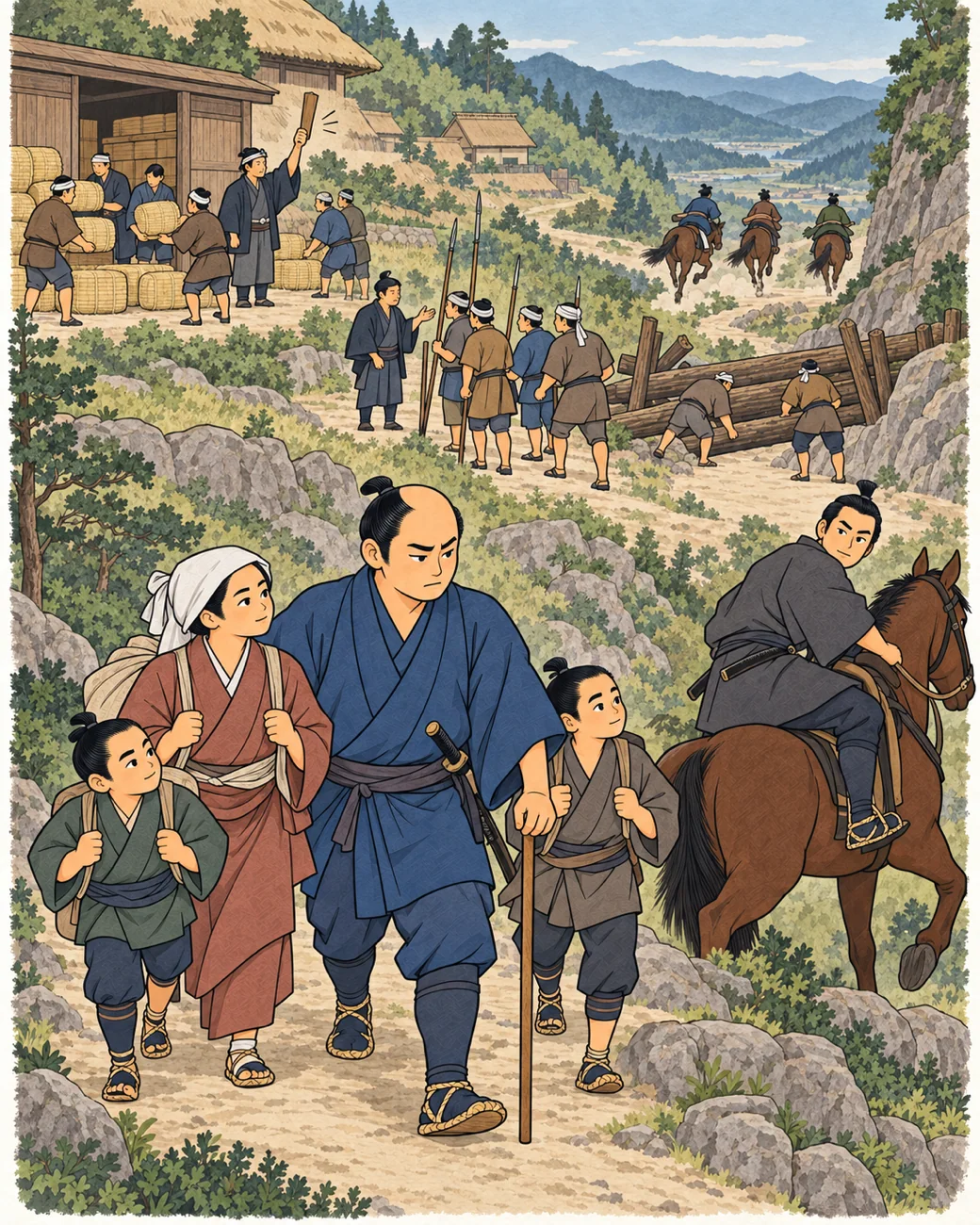
Ōama left Yoshino in 672 and moved through Iga and Ise toward Mino. Before departing, he sent three messengers to Mino with orders to contact a local official, raise troops through the provincial authorities and block the Fuwa road. His wife and sons Kusakabe and Osakabe accompanied the journey. Takechi joined along the route and was sent ahead to supervise the forces at Fuwa. The chronicle follows recruitment and provisioning through successive district centers, rather than a prince traveling east to find an army already waiting. Control of the Fuwa road established a barrier to the Ōmi court’s movement toward the east and helped secure Ōama’s access to eastern recruits.
Fuwa was a corridor and wartime position in this campaign. The Nihon Shoki describes blocking the road; the formally constructed Fuwa checkpoint known from later archaeology belongs to a subsequent institutional phase. The campaign did not depend on the later compound already being in place.
From Mino, forces advanced on separate fronts into Yamato and Ōmi. In Yamato, Ōama’s troops resisted the Ōmi army’s attempts to recover the old royal region. A battle near Hashihaka defeated a force approaching Asuka along the Upper Road.
The Ōmi front carried the offensive toward Ōtsu. Fighting reached the Seta Bridge, a critical approach to the court near the southern end of Lake Biwa. Defeat there broke the court’s remaining military position. Ōtomo died by suicide, ending the organized succession struggle.
The outcome depended on recruitment and route control as well as battlefield fighting. The principal record gives the victors a coherent sequence of warnings, mobilization and success; it does not supply equally full testimony from the defeated court.
The Ōmi court also dispatched men to raise forces in the east, Yamato, Kibi and Tsukushi. Its eastern messengers were intercepted near Fuwa. In the chronicle’s account, the Tsukushi official declined to empty a coastal-defense region of its troops. These were different failures of mobilization: blocking a route prevented one mission, while a provincial official’s response prevented another. Neither can be explained simply by who occupied the palace.
The two offensives required different commands. The force advancing toward Ōmi came out of the Fuwa base, while the Yamato struggle involved Ōtomo no Fukei and allies working around the older royal sites. Fukei suffered a defeat at Narayama before regrouping. Success near Hashihaka helped secure the Yamato front; fighting at Seta brought the other advance to Ōtsu. The victorious chronicle gives these operations an ordered narrative, but the campaign was not one uninterrupted march along a single road.
Ōama’s victory removed Ōtomo and the government centered on Ōtsu. The victors returned to Asuka and occupied the Asuka Kiyomihara Palace. Ōama’s formal accession as Emperor Tenmu followed in 673, after the military decision of 672.
The Nihon Shoki records executions and exile among leading officials of the defeated court, alongside pardons for others. It also records rewards and increases in rank for men recognized as having served the winning side. Defeat and service thus produced different places in the new political order.
Those dispositions had lasting consequences for households and officials. They were more immediate than the subsequent creation of new codes, ranks and capital arrangements. Tenmu could pursue administrative changes from a throne secured by his coalition, but their implementation required further decisions over his reign.
The costs included the deaths of combatants and the destruction of the defeated leadership’s position. A complete account of local losses and displaced people does not survive. The named punishments show the political violence of settlement without supplying a total casualty figure.
The settlement was selective rather than one punishment applied to everyone on the losing side. The eighth-month account names the execution of the right minister Nakatomi no Kane and exile of senior opponents and members of their families, while recording pardons for others. In the twelfth month, it describes increased cap ranks for men chosen for their service. The victors established a court by disposing of defeated officials and recognizing supporters, as well as by taking a palace.
The royal household remained dependent on relationships it could reorganize. Regional and lineage leaders had helped furnish the forces, and war service could now become a claim to recognition. No complete schedule of their individual land rewards follows from the later offices they held. The subsequent careers and honors must be checked against particular entries or objects, rather than assumed to have been assigned immediately in 672.
Tenmu’s reign made military service in 672 a continuing basis for recognition. The court recorded promotions and later honors for participants. Fumi no Nemaro’s bronze epitaph, made for a man who died in 707, calls him a commander in the Jinshin year and identifies his later guards office. An individual’s wartime service remained part of his official identity decades afterward.
Tenmu and his successors developed ranks, law and capital organization. The victory provided their governing position; the later measures had their own preparation and implementation. The struggle over access to eastern forces also exposed the importance of roads around the royal region, before the later institutional development of formal checkpoints.
The Nihon Shoki, compiled in 720, placed the war within the history of the dynasty that emerged from it. Its sequence, reported speeches and judgments preserve that court’s account. Archaeological objects such as Nemaro’s epitaph can corroborate a participant’s public standing, while offering much less of the battle narrative.
Ōtsu, Yoshino, the Fuwa corridor and the battle sites preserve different portions of this history: royal center, retreat, mobilization route and fighting landscape. Their later monuments and formal institutions do not all date to 672. The conflict’s memory grew through these places as well as through the victorious court’s written record.
Tenmu’s later decisions made the governing program more specific. In 681, the chronicle records orders to prepare law and record dynastic history, and the designation of Kusakabe as crown prince. In 684 it records an eight-category system of lineage titles, the yakusa no kabane. These were later acts of classification and succession management, not institutions created at the Seta battle. The older houses remained participants in government as their standing was reorganized.
The dynasty’s development also extended beyond Tenmu. Under Jitō, the administrative code was distributed in 689 and household registration followed in 690; the court moved to Fujiwara-kyō in 694. Her exercise of authority and management of heirs carried forward the victorious household, while requiring choices of their own. The outcome of 672 provided a ruling position, rather than a finished plan for her reign.
The defeated prince’s name is itself part of the later history. Ōtomo received the imperial title Kōbun in 1870. The Nihon Shoki does not record his accession as a reign between Tenji and Tenmu. That absence does not settle every question about how his court understood his status; the modern imperial title should not be mistaken for a name or universally agreed accession already documented in 672.