A Zen Monastery Founded After the Mongol Invasions
円覚寺創建
Attraction
Hōjō Tokimune founded Engaku-ji in 1282 and invited the Chinese Chan master Mugaku Sogen to serve as its first abbot. The temple's official account emphasizes prayer for those killed in the recent wars, without limiting commemoration to the Japanese side. That inclusive memorial purpose gives the monastery a historical identity more specific than a generic connection between Zen and warriors. It also places the precinct inside a wider East Asian story: attempted invasions, maritime movement of monks and teachings, and the Kamakura government's use of religious institutions all converge here. The later rank of second among Kamakura's Five Mountains formalized that importance.
Current visibility
The foundation is expressed through the functioning monastery and its commemorative landscape rather than a single surviving 1282 building.
The Yato Valley and the Rising Monastic Axis
谷戸の伽藍配置
Attraction
Engaku-ji occupies a narrow erosional valley, or yato, characteristic of Kamakura's terrain. The compound climbs gradually from Sanmon to Butsuden and onward toward the Hojo, with more than twenty temples and halls distributed along the valley and adjoining slopes. This topography is not background scenery: it shaped processional movement, separated public, residential, memorial, and training spaces, and gave major structures different elevations. A visitor can therefore read the monastery through changing levels and enclosures even when particular interiors are closed. The valley plan also explains why the Grand Bell and some sub-temples require separate ascents away from the central axis.
Current visibility
The rising valley arrangement is visible from the ordinary public paths; side compounds may have their own restrictions.
Sanmon: An Eighteenth-century Restoration Statement
山門
Attraction
The current Sanmon was rebuilt in 1785 under Seisetsu Shūchō during the temple's five-hundredth-anniversary period. Its scale makes it appear foundational, but its date belongs to Engaku-ji's early modern revival after centuries of fire and decline. The name refers to the gate of the three liberations, giving passage through it a doctrinal meaning as well as an architectural one. Images including an Eleven-Faced Kannon and the Sixteen Arhats occupy the upper level, which is a ritual interior rather than part of ordinary circulation. The gate thus combines public monumentality below with restricted sacred space above.
Current visibility
The gate exterior is fully visible on the main axis; routine access to the upper floor is not implied.
Butsuden and the Crowned Shakyamuni
仏殿と宝冠釈迦如来
Attraction
Butsuden houses Engaku-ji's principal image, a crowned Shakyamuni also interpreted through the cosmic imagery of Vairocana. The building seen today is a 1964 reconstruction: its predecessor collapsed in the Great Kantō Earthquake of 1923. That discontinuity should be kept visible in the story, because the hall demonstrates how a living monastery re-established its ritual centre after modern disaster. Inside, the principal image, imperial calligraphy, and twentieth-century white-dragon ceiling painting belong to different periods. Their coexistence makes the hall a layered devotional interior, not a reconstruction that attempts to freeze one ideal medieval moment.
Current visibility
The reconstructed hall is on the public axis; interior viewing remains governed by current temple conditions and ceremonies.
Shariden: National Treasure, Relic Hall, Restricted Precinct
舎利殿
Attraction
Shariden enshrines a tooth relic of the Buddha and is Engaku-ji's National Treasure building. Its fan-shaped rafters, curved eaves, and cusped windows make the relatively small structure a concentrated example of Zen architectural vocabulary. Behind it stands Kaisando, a worship hall for Mugaku Sogen, joining the Buddha relic and founder's memory within the same restricted precinct. Shariden is especially important for visitor guidance because significance does not equal constant access: the temple states that public entry is limited to specified annual openings. At other times, readers should expect only the degree of exterior or distant viewing permitted by the enclosure.
Current visibility
Shariden is normally not open for entry and has specified special-opening dates; current schedules must be checked with Engaku-ji.
Attraction
Engaku-ji's Grand Bell was cast in 1301 on the order of Hōjō Sadatoki, Tokimune's successor as regent. The temple identifies it as the largest bell in the Kantō region and names Mononobe Kunimitsu as its caster. Unlike many principal halls, it is a material survival from the late Kamakura period and is itself designated a National Treasure. Reaching it requires leaving the central valley floor for a higher position near Bentendo. That ascent helps explain bells as both ritual instruments and territorial voices: their sound carried monastic time beyond the immediate building in which worship took place.
Current visibility
The bell is visible after a separate uphill approach within the precinct; touching or ringing it is not implied.
Senbutsujo and the Changing Geography of Training
選仏場
Attraction
Senbutsujo was rebuilt in 1699 and formerly served as the monks' meditation hall before the principal training function shifted to Shōzoku-in in the eighteenth century. Today it is used for selected rituals and local prayer meetings, with images of Yakushi and Kannon enshrined inside. The change in use is historically valuable: Zen practice did not disappear when the institutional centre moved, and an older training building acquired new devotional functions. Its survival allows visitors to distinguish the visible memory of monastic training from the active residential and training zones that remain private elsewhere in the compound.
Current visibility
The hall is visible in the public precinct; use and interior access may be limited by current ritual activity.
Hojo, Shinji Pond, and a Restored Release Pond
方丈・心字池・妙香池
Attraction
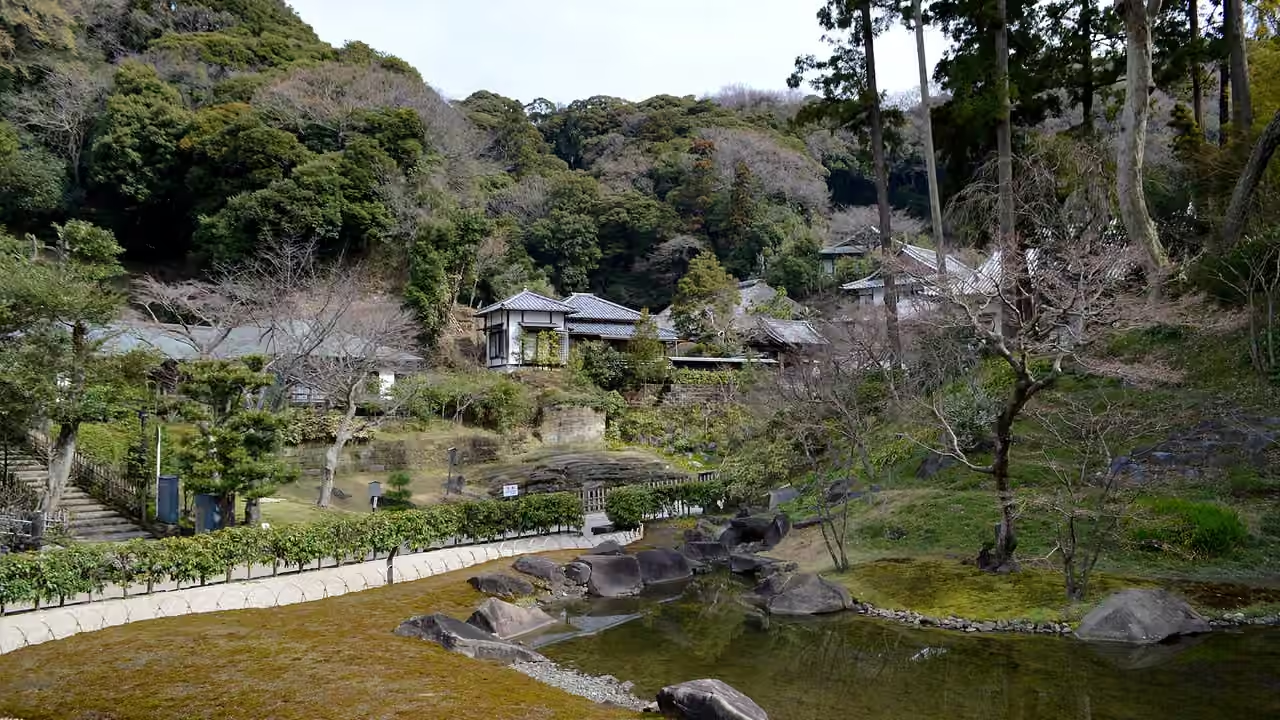
The Hojo developed from an abbot's dwelling into a building used for memorial services, sermons, Zen meetings, and other communal functions. The Hojo has front and rear gardens, with a Shinji Pond shaped like the Chinese character 心 (heart) in the rear garden, while nearby Myōkō Pond began as a release pond for living creatures. The temple notes that Myōkō Pond's present appearance was restored using an old picture map, an important warning against treating every visible landscape as continuously unchanged. Together these spaces show two forms of institutional memory: the Hojo remains active through teaching and ceremony, while the pond landscape was deliberately reconstructed from documentary evidence.
Current visibility
The Hojo area and ponds may be viewed under general precinct conditions, but ceremonies can affect entry; Myōkō Pond's present form is a documented restoration.
Lay Zen from the Meiji Period to Kojirin
居士禅と居士林
Attraction
Engaku-ji became a major centre for lay Zen in the modern period through teachers including Imakita Kōsen and Shaku Sōen, whose networks carried the temple's influence beyond the resident monastic community and eventually beyond Japan. Kojirin was established in 1922 as a dedicated practice space for laypeople, giving that movement a physical institutional home. The temple's current grounds information has identified the building as under reconstruction, so it should not be described as an assured visitor interior. Its historical value lies in showing that Engaku-ji's modern significance came from new communities of practice as well as preservation of medieval memory.
Current visibility
Kojirin's current construction and access status should be checked; the Highlight does not promise entry to a lay-practice session.