Three Historical Castles at the Aizu Site
Attraction
Castle history here begins centuries before Matsudaira Katamori. Ashina Naomori established the early stronghold in 1384; Gamo Ujisato created a major stone castle and tower in the 1590s; Kato Akinari rebuilt the tower into the five-story form in 1639. By Katamori's time the architecture already carried a long political history. The keep visible today belongs to another layer again: a reinforced-concrete keep was completed in 1965 after the Meiji government demolished the remaining buildings in 1874.
Current visibility
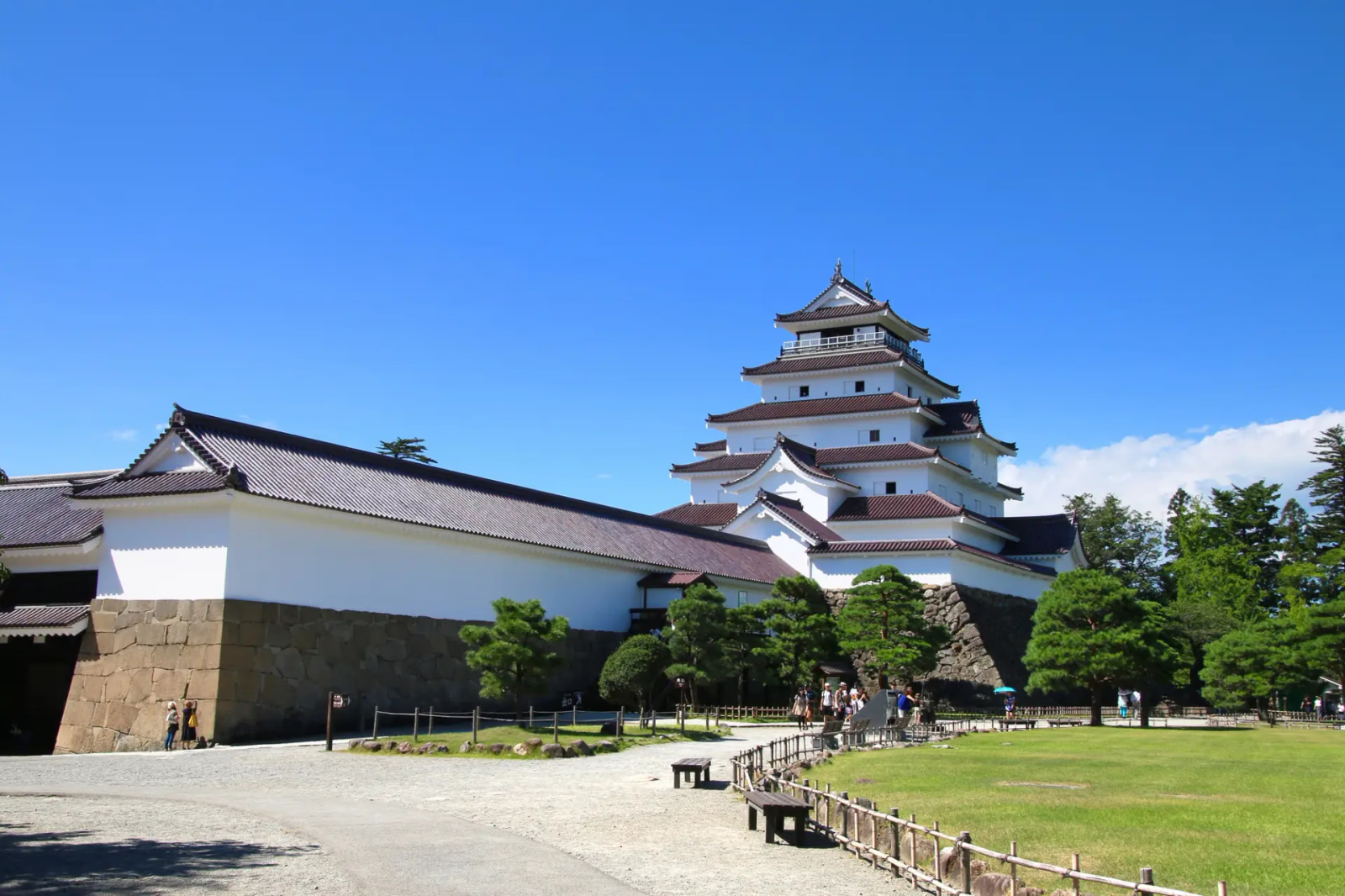
The current keep is the 1965 reinforced-concrete reconstruction on a site shaped by earlier Ashina, Gamō, and Katō castles; those historical phases do not survive as three standing towers.
Attraction
After the defeat of former shogunate forces in early 1868, war moved north. Aizu became a principal target, and Tsuruga Castle endured roughly a month of siege before the domain surrendered. Katamori’s earlier political role in Kyoto connects the siege to the wider collapse of the Tokugawa order. The 1868 story is a prolonged political-military siege, not only a heroic episode.
Current visibility
At Tsuruga Castle, “The 1868 Siege of Aizu” is grounded in present on-site evidence—the battlefield terrain and the castle compound—without implying that every historical layer survives as fabric.
Matsudaira Katamori and the Castle Context
Attraction
Katamori had become Kyoto Shugoshoku in 1862 and was deeply tied to the shogunate's attempts to control Kyoto. By 1868 that political role returned with consequences to Aizu. The castle is therefore an appropriate place to connect his political biography to its military consequences, but it should not be rewritten as 'Katamori's castle' in an architectural sense. Most of the form he defended had been built by earlier regimes; his significance here is political and military, concentrated in the final defense. A person can dominate a site's historical memory without being the builder of the site.
Current visibility
“Matsudaira Katamori and the Castle Context” can still be read at Tsuruga Castle through the castle compound; the visibility claim concerns that setting, not a past moment preserved intact.
The 1965 Keep and the 2011 Red Roof
Attraction
The current reinforced-concrete keep was completed in 1965 after strong local pressure to restore the castle landmark. It is therefore not a surviving Edo tower. In 2011 its roof was changed from dark tiles to red-glazed tiles because records indicated that the late-Edo tower had used red roofing suited to Aizu's cold climate. This creates a useful three-layer object: seventeenth-century form, twentieth-century reconstructed structure, and twenty-first-century restoration of a nineteenth-century appearance.
Current visibility
The visible keep is the 1965 reinforced-concrete reconstruction, with red roof tiles adopted in 2011 to evoke the late-Edo appearance.
Byakkotai within the Wider Aizu War
Attraction
Their deaths at Iimoriyama occurred within a broader military collapse involving domain forces, civilians, neighboring alliances and the month-long defense of Tsuruga Castle. If a specific claim about what the youths saw or believed is not strongly sourced, it should remain out of the account. The castle itself keeps attention on the scale of the conflict.
Current visibility
At Tsuruga Castle, “Byakkotai within the Wider Aizu War” is grounded in present on-site evidence—the castle compound—without implying that every historical layer survives as fabric.
Castle Site, Demolition and Political Memory
Attraction
The 1874 demolition erased the surviving castle buildings, but it did not erase the place from Aizu's political memory. The stonework, enclosure and urban position preserved the site, while twentieth-century reconstruction restored a skyline symbol and twenty-first-century work refined its late-Edo appearance. Tsuruga Castle therefore tells two histories at once: the destruction of a defeated domain's architecture and the later civic decision to recover the castle as a regional emblem. Loss and reconstruction are themselves part of the post-1868 history of the place.
Current visibility
Stonework, enclosures, and the castle's urban position preserve the site, while the skyline keep is a twentieth-century reconstruction; no surviving 1874-demolished building is claimed.