The Kannon Sanctuary and the Temple's Founding Memory
本堂内陣と清水観音
Attraction
Kiyomizu-dera's institutional story begins in 778, when the monk Enchin is said to have reached the pure spring on Mount Otowa. The temple's official history credits Sakanoue no Tamuramaro and Miyoshino Takako with building a sanctuary for the Eleven-Headed Thousand-Armed Kannon. The principal image remains a hidden image in the innermost sanctuary, not an object routinely placed on open display. Visitors normally encounter the cult through prayer at the outer part of the Main Hall, while rare special occasions permit closer access. This distinction matters: the temple is not merely a viewpoint, but an active sacred institution organized around a deity that is usually concealed.
Current visibility
The outer worship area is part of the public visit, but the inner and innermost sanctuaries and the principal image are normally restricted; special access must be checked with the temple.
The 1633 Main Hall and Its Timber Stage
本堂と清水の舞台
Attraction
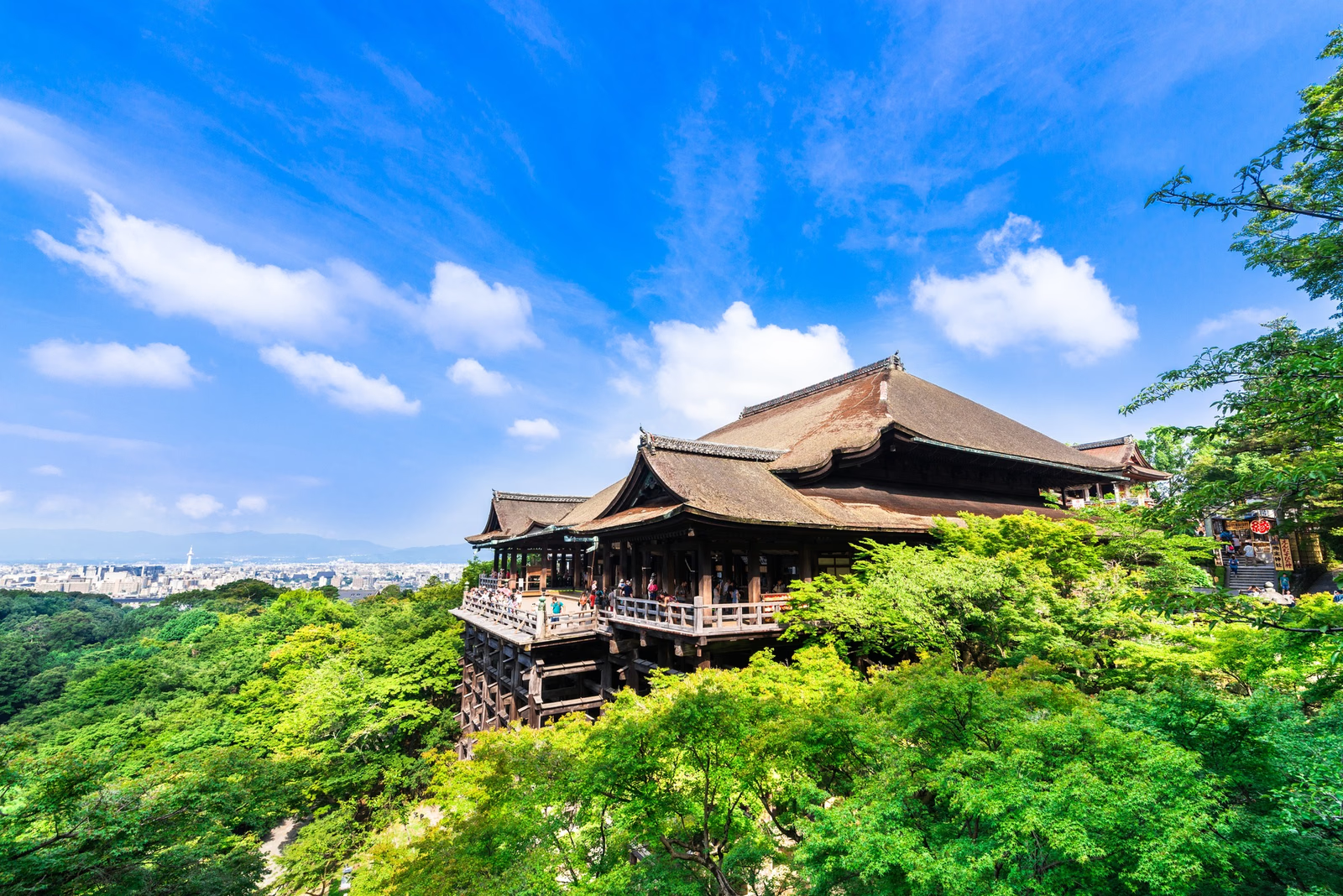
The Main Hall now standing on the steep slope was reconstructed in 1633. Its broad stage projects outward on a dense timber framework whose tall pillars rise from the hillside without turning the building into a modern observation deck detached from worship. The temple explains that the stage was made for sacred performances offered to Kannon; the celebrated city view is historically secondary to that ritual purpose. The floor was renewed during the major restoration completed in the twenty-first century, while the underlying structural principle remains traditional. Read together, the sanctuary, stage, and slope show how architecture converted difficult terrain into a place for collective devotion and performance.
Current visibility
The Main Hall and stage are visible on the ordinary precinct visit; access remains subject to temple opening conditions.
Otowa Waterfall: The Source Behind the Name
音羽の滝
Attraction
Otowa Waterfall is not an ornamental afterthought below the halls. The spring is central to the temple's origin story, and the name Kiyomizu—pure water—refers to it. Today the water descends in three narrow streams, where worshippers use long-handled ladles in acts associated with purification and the fulfillment of prayers. The physical relationship is unusually clear: Okunoin stands above the fall, the Main Hall occupies the adjacent slope, and the flow gathers visitors at the base. This surviving ritual use makes the water a living historical object rather than only a natural feature remembered in a foundation legend.
Current visibility
The waterfall and ladle area are normally visible within the paid precinct; ritual use may be managed according to current conditions.
Nio-mon and the Rebuilt Entrance After the Ōnin War
仁王門
Attraction
The red Nio-mon establishes the ceremonial threshold at the top of Kiyomizu-zaka. It burned during the warfare that reached Kyoto in 1469 and was reconstructed around 1500, more than a century before the better-known 1633 rebuilding of the Main Hall. The gate therefore preserves a different layer of the temple's recovery from conflict. Its two-story mass and guardian figures announce entry into sacred ground, while the date prevents a misleading single-phase reading of the precinct. Kiyomizu-dera is a composite of structures rebuilt at different moments, not one coordinated seventeenth-century creation.
Current visibility
The gate is visible at the principal entrance; upper internal spaces are not represented as publicly accessible.
The West Gate, Bell Tower, and Three-storied Pagoda
西門・鐘楼・三重塔
Attraction
The entrance terrace contains a compact group of structures with distinct histories. The West Gate was reconstructed in 1633 and is associated with sunset contemplation directed toward the Pure Land. Nearby, the bell tower was moved and rebuilt in its present position in 1607, preserving elaborate carved details characteristic of its period. The roughly thirty-metre Three-storied Pagoda, reconstructed in 1632, is one of the precinct's most conspicuous markers from the city below. Together they frame Kiyomizu-dera before the Main Hall appears, linking Pure Land visualization, sound, esoteric imagery, and Kyoto's distant view of the temple ridge.
Current visibility
The exteriors are prominent in the entrance precinct; no routine upper-floor or interior access is implied.
Okunoin and the Reverse View of the Main Hall
奥の院
Attraction
Okunoin stands directly above Otowa Waterfall and was rebuilt in 1633, at approximately the same time as the present Main Hall. It has its own stage-like timber projection, but its historical value is also spatial: from here the visitor can understand the Main Hall as a building suspended against the wooded slope rather than as a flat façade. The reciprocal views between the two halls reveal the planned relationship among sanctuary, water, ravine, and city horizon. Okunoin's restoration completed in 2017 also reminds readers that the appearance of a historic structure depends on continuing conservation, not passive survival.
Current visibility
The exterior and public approach are normally visible; this does not promise entry to restricted devotional spaces.
Zuigu-do and the Tainai-meguri Practice
随求堂と胎内めぐり
Attraction
Zuigu-do, constructed in 1735, houses a concealed image of Daizuigu Bodhisattva and other deities associated with concerns such as safe birth and child rearing. Its best-known visitor practice is tainai-meguri, a passage through a dark space beneath the hall understood as a symbolic journey through a womb. The building adds an embodied form of devotion to a precinct often described only through scenic views. Because participation arrangements can change, the durable point is the relationship between the hall, its hidden image, and the underground ritual space; readers should verify whether the passage is operating on the day of a visit.
Current visibility
The hall exterior is visible, but participation in the underground tainai-meguri requires a current check with the temple.
Jojuin and the Periodically Open Moon Garden
成就院と月の庭
Attraction
Jojuin began as quarters associated with Gana, the priest credited with rebuilding Kiyomizu-dera after wartime destruction, and later served as a sub-temple responsible for the maintenance and finances of the wider complex. This administrative history gives the building an importance distinct from the public halls. Its garden, commonly called the Moon Garden, is celebrated for a composition meant to be experienced from the building, but it is not part of unrestricted daily circulation. Limited openings turn the garden into a useful example of why a historically significant feature can belong in the Guide without being promised as an always-available stop.
Current visibility
Jojuin's garden is opened only during announced limited periods; current dates and conditions must be checked.
The Thousand Stone Buddhas and the Meiji Religious Upheaval
千体石仏群
Attraction
The group of stone Buddhas on the grounds records a history very different from the monumental halls. According to the temple, many images had once been maintained in Kyoto neighbourhoods and were brought here by residents during the anti-Buddhist destruction of the early Meiji period rather than abandoned. Their varied scale and weathered surfaces reflect multiple local origins, not a single sculptural commission. The group therefore connects national religious policy and urban community action to objects a visitor can still see. Continued replacement of their cloth bibs also shows that rescue, relocation, and present devotion form one historical sequence.
Current visibility
The stone images are visible together in the precinct, but many were relocated from neighbourhood settings during the Meiji period.
Koyasu Pagoda Across the Valley
子安塔
Attraction
Koyasu Pagoda occupies the southern side of the valley, separate enough from the Main Hall to clarify the true breadth of the precinct. The present three-storied structure was reconstructed in 1500 and enshrines a form of Kannon associated with safe childbirth. Its distant position makes it part of the famous view from the Main Hall, yet approaching it reverses the composition and places the larger sanctuary across the ravine. The pagoda combines a specific devotional history with a landscape function: it marks the far edge of Kiyomizu-dera's sacred topography rather than serving merely as a picturesque silhouette.
Current visibility
The reconstructed pagoda is visible on the southern side of the precinct; the interior is not presented as routinely open.