Read the article below. Interactive reading tools are available when scripts load.
Quick
Tsugaru Nobuhira was born in 1586, the third son of Tsugaru Tamenobu. His family ruled in northern Honshū, in what is now Aomori Prefecture. Tamenobu had built power through conflict with the Nanbu, a competing warrior house. Recognition by Toyotomi Hideyoshi, the ruler bringing Japan's lords under his authority, was still being secured. Nobuhira had two elder brothers and no certain claim to inherit. Tamenobu obtained recognition after Hideyoshi's 1590 victory at Odawara. Military attendance subsequently took the family far from Tsugaru; by 1598 both father and son had residences at Fushimi near Kyoto. Hideyoshi's death that year unsettled the government that had confirmed their northern holdings. [2][3][10]
In 1600 Tamenobu answered a request from Tokugawa Hidetada, Ieyasu's son, to join the Tokugawa side. The house also had older connections across the rival coalitions: municipal history cites a later account naming Ishida Mitsunari as Nobutake's coming-of-age sponsor. Disorder at Horikoshi threatened the family's home base. Nobuhira was about fourteen, not a documented commander at Sekigahara. Tokugawa victory subsequently strengthened the family's tenure.
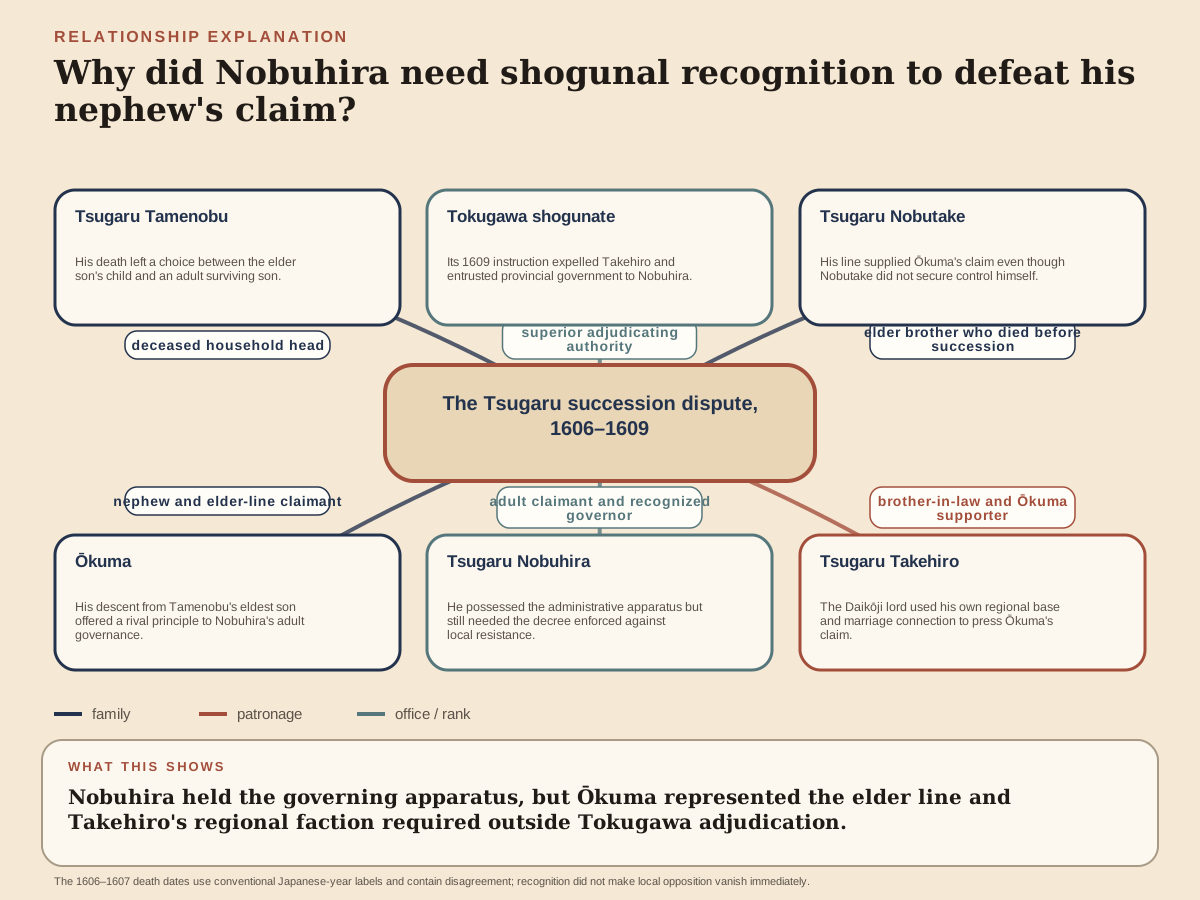
After the deaths of his elder brother Nobutake and their father, Nobuhira became household head with recognition from the Tokugawa shogunate—the warrior government led by the shogun. His nephew Ōkuma claimed inheritance through the eldest son's branch. Tsugaru Takehiro, Tamenobu's son-in-law, supported the nephew and petitioned the central government in 1608. Takehiro's expulsion in 1609 and an order entrusting government to Nobuhira settled the recognized succession. Nobuhira still had to enforce that decision within Tsugaru.
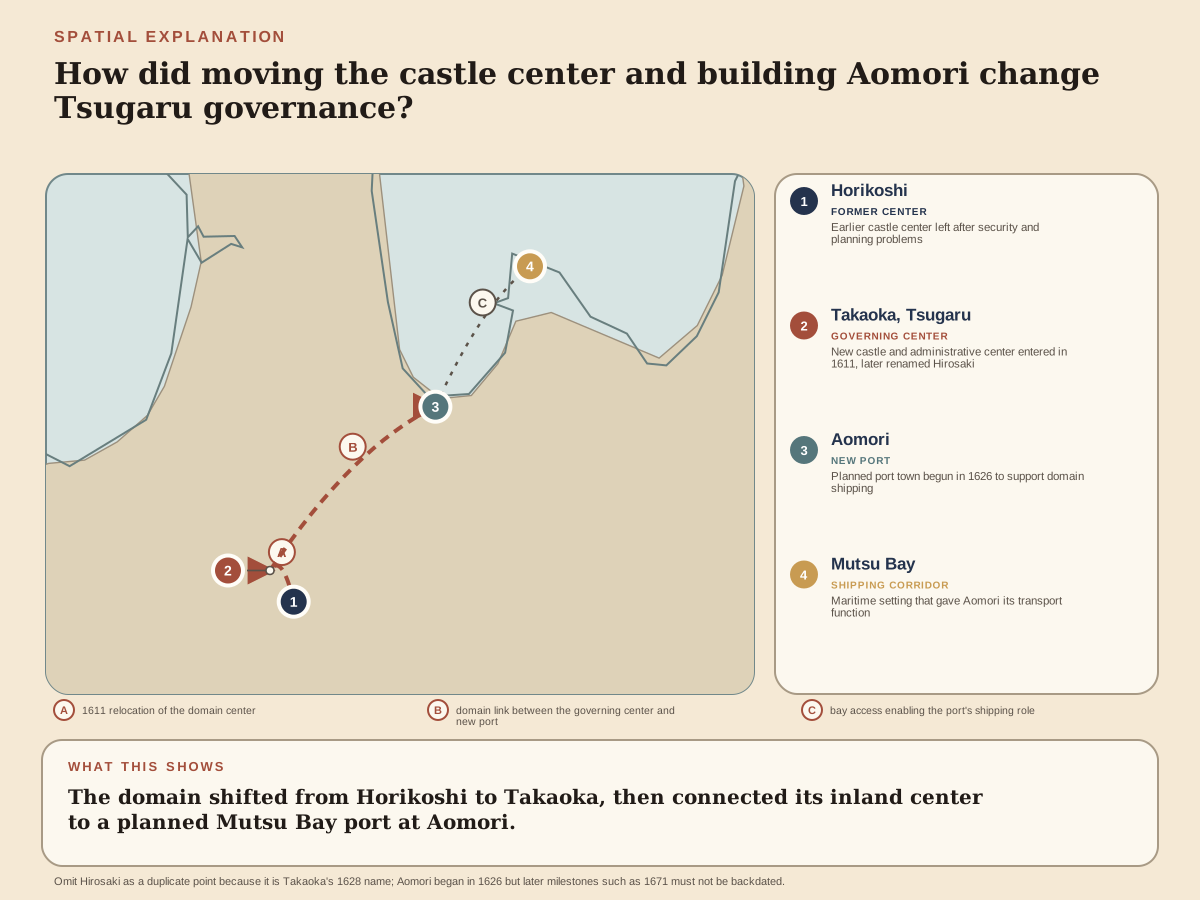
Tamenobu had planned a new castle at Takaoka but died before the main building began. Nobuhira started construction in 1610, and the complex was substantially complete in 1611. The original five-story tower stood above a fortified governing seat. Retainers organized work that depended on skilled builders and local labor. Tamenobu selected the site; Nobuhira brought the plan into use. In 1611 the government moved from Horikoshi, its seat for seventeen years, to Takaoka. Officials and household records needed new quarters; suppliers and retainer families followed, while construction of the surrounding town continued.
In 1611 Nobuhira married Mantenhime, an adopted daughter of Ieyasu, as his principal wife. She had previously been married into the Fukushima family. The union strengthened Tsugaru ties to the Tokugawa, but the succession also depended on the earlier wife Tatsuhime: her son Nobuyoshi would become the next lord. Later accounts credit the monk Tenkai with arranging the marriage; that mediation is not securely documented. Continuing internal conflict culminated in the killing of the retainer Kōsaka Kurando in 1612.
While Takaoka Castle was being built, temples and shrines relocated toward the new town. Chōshōji anchored a southwestern district of thirty-three Sōtō Zen temples—a Buddhist tradition associated with seated meditation. Religious and funerary functions coexisted with defense. A southern reservoir was built in 1612–1614; the temple district's defensive works followed in 1615. Fire and replanning after Nobuhira's death altered the layout.
Building a castle required income from the surrounding plain. Nobuhira's government allocated land income to retainers and ordered new-field development at Marisawa in 1609. Village dues and irrigation connected these policies to cultivating households. Assessed rice yield was an administrative expectation, not a guarantee of the harvest. Cold, flood and competing demands for labor could leave villagers less secure even when the domain expected higher revenue.
The central government required service even from distant northern lords. Municipal history records Nobuhira's work for Takada Castle in 1613 and participation in the Osaka winter campaign in 1614, against the surviving Toyotomi center. Travel and provisioning drew on resources also needed for the new castle town. His participation is documented more clearly than any individual feat in battle.
In 1625 the shogunate permitted Tsugaru rice shipments toward Edo, the Tokugawa seat now called Tokyo. Nobuhira's 1626 order to his retainer Moriyama Yashichirō began formation of Aomori town on Mutsu Bay. An inhabited trading shore already existed there. Moriyama worked on the early phase; development continued under successors, with a domain residence completed in 1671. Shipping permission and a finished port town were different stages of the project.
Hirosaki's municipal account attributes the destruction of the five-story tower in 1627 to lightning. The castle continued to function. In 1628 Takaoka became Hirosaki; later tradition links the name to Tenkai, but his role and the exact motive are less secure than the change itself. The replacement three-story tower was not built until 1810, under the ninth lord, Tsugaru Yasuchika.
Nobuhira died in 1631, and his son Nobuyoshi succeeded him. Hirosaki was a functioning governing center, while Aomori's port-town project remained young. The successor inherited continuing responsibilities. Nobuhira's mortuary building, the Hekigandai at Chōshōji, is dated to about 1631 in the national cultural-property record.
Successors altered the castle and its surroundings. Major stone-wall work took place in 1694–1699; domain abolition in 1871 ended hereditary Tsugaru rule. In 1897 the carpenter Horie Sakichi moved the later tower after a wall collapse threatened it. By 1912 the grounds had acquired public uses. Nobuhira's achievement endured in the established seat, not in an unchanged set of buildings.
Classic
Tsugaru Nobuhira was born in 1586, the third son of Tsugaru Tamenobu. The family ruled in northern Honshū, in the region now called Aomori Prefecture. Tamenobu had broken from the Nanbu, a competing warrior house, and expanded his holdings through war. His territorial position was still contested when Nobuhira was born. Two elder brothers stood ahead of the child. Birth into the ruling family offered protection and opportunities for service, but no certain inheritance. The same conquests remembered as Tamenobu's achievement had deprived other houses of land and authority. [2][3][10]
The Tsugaru plain faced the Sea of Japan and the strait separating Honshū from the island now called Hokkaidō. Coastal traffic connected the region to markets and communities beyond its land boundaries. Distance from Kyoto and Osaka made a lord's attendance costly, yet those centers increasingly determined whether local possession would be recognized.
Toyotomi Hideyoshi, the ruler bringing Japan's warrior lords under his authority, defeated the Hōjō at Odawara in 1590, bringing a new settlement to northern Japan. Tamenobu sought confirmation of Tsugaru holdings within it. His conflict with the Nanbu meant that recognition would also decide whose account of territorial rights carried authority. [3]
Military service carried the family far from Tsugaru. In 1592 Hideyoshi summoned the northern lords to Nagoya in Hizen, in western Kyūshū, the staging center for his invasions of Korea. Tamenobu attended there and sent further personnel as service continued. By 1598, residence evidence also places Tamenobu and Nobuhira at Fushimi near Kyoto. The younger son's education in lordship included dependence on a distant ruler and travel away from the region that sustained the household. [2]
Hideyoshi's death in 1598 unsettled the hierarchy through which the house had obtained recognition. Relationships built under Toyotomi rule would now have to survive a struggle over who could speak for that government. Japanese records use variant written forms of Nobuhira's name, including 信枚 and 信牧, for this same lord.
In 1600 Tokugawa Ieyasu and the coalition associated with Ishida Mitsunari mobilized against one another. Tamenobu answered the Tokugawa side. A request from Ieyasu's son Hidetada survives in the municipal chronology, dated to the eighth month of the old Japanese calendar.
Older ties crossed the opposing coalitions. Hirosaki municipal history cites a later genealogical account naming Ishida Mitsunari as Nobutake's ceremonial sponsor at his coming of age. Such a relationship helps explain the family's connections without making every member an Ishida partisan. Unrest at Horikoshi Castle also threatened Tamenobu's governing center. [2]
The municipal chronology places Tamenobu's service at Ōgaki, a castle in central Japan, and records disorder at Horikoshi during his absence. Answering a national summons therefore carried a local security risk. Nobuhira was still a boy within the serving household, not a documented commander at the battle of Sekigahara.
The Tokugawa victory strengthened Tsugaru tenure. In 1601 Tamenobu received an additional two thousand koku in Kōzuke, a province in what is now Gunma Prefecture. Koku measured assessed rice yield and served as a measure of domain income; the grant was territorial and fiscal recognition.
The settlement rewarded the family's public service but did not settle which son would eventually succeed. The Tokugawa could confirm Tamenobu's holdings while leaving the household's seniority intact. Nobuhira's opportunity came later, through deaths within the family and a contested transfer of authority.
Nobutake, Tamenobu's eldest son, died before inheriting secure control of the domain. His son Ōkuma represented the elder branch, while the adult Nobuhira stood ready to govern. The death date is not uniform across the surviving accounts: the city history notes conflicting dates but favors the twelfth month of Keichō 11, conventionally labeled 1606, on the evidence of later anniversary observances. These are Japanese calendar dates, not converted Gregorian dates. [2]
Tamenobu died at Yamashina in Kyoto in Keichō 12, conventionally labeled 1607. The Tokugawa shogunate, the warrior government headed by the shogun, recognized Nobuhira as household head. Supporters of his nephew resisted a succession that bypassed the eldest son's line. [1]
Ōkuma's descent supplied a clear rival principle: he represented the eldest son's line. Nobuhira had the advantage of adulthood and possession of the governing apparatus. Retainers choosing between them also risked their own positions under whichever head prevailed.
In 1608 Tsugaru Takehiro, lord of Daikōji and Tamenobu's son-in-law, appealed to the shogunate for Ōkuma's succession. The challenge thus came from a man with his own regional base and marriage connection, not merely from an isolated child claimant. [1]
In 1609 the central government ordered Takehiro's expulsion. A joint instruction to Tsugaru senior retainers entrusted the province's government to Nobuhira. The order gave those expected to administer the domain an external authority for serving him. [1]
Recognition needed enforcement within Tsugaru. The municipal chronology records a further confrontation with Takehiro's faction after the expulsion order. Nobuhira's administration could not rely on a decree while rival command remained active. [1]
The intervention also established dependence. Nobuhira held regional power as a daimyō, a territorial warrior lord, but the choice of household head was now subject to superior Tokugawa authority.
Tamenobu had planned the new seat at Takaoka before his death. After the succession was stabilized, Nobuhira began the main construction in 1610. The castle was substantially complete in 1611. Its original five-story tower rose above a fortified complex that also had to accommodate government and the ruling household. [1][3]
Earthworks and moats required labor on a different scale from the carpentry of gates and residences. Materials had to reach the site while the workforce was fed. These demands drew construction into the domain's wider economy and competed with ordinary cultivation and maintenance. The lord's authorization was decisive, but it did not supply all the skills needed to make the complex usable. Retainers supervised work whose physical execution depended on specialists and local labor.
Horikoshi, the former seat, had been an active governing site. Excavations there have found buildings and workshops as well as imported ceramics and weapons-related material. The move to Takaoka replaced a working center with one intended for a larger spatial organization. In 1611 Nobuhira transferred his seat from Horikoshi to Takaoka. The old castle had served the family for seventeen years. Government moved with the lord: officials needed places to work, and the household's records and stores had to remain accessible. [1][4]
Retainer plots brought warrior households closer to command and made rank visible within the town. Merchants and artisans needed customers at the new center, while temples had to reestablish buildings and connections with the communities they served. Occupation of the castle began before every part of the town had reached its final form. The transfer redistributed demand. Takaoka gained residents and privileged business that Horikoshi could no longer expect simply from being the lord's seat.
Hirosaki would remain the Tsugaru governing center for roughly 260 years, until domain rule ended in the nineteenth century. That duration depended on successors maintaining and remaking the place. Nobuhira fixed the seat; the continuing town grew through the work of households that settled around it.
In 1611 Nobuhira married Mantenhime as his principal wife. Born in 1589, she was the daughter of Matsudaira Yasumoto and an adopted daughter of Tokugawa Ieyasu. The adoption enabled Ieyasu to arrange a marriage through his own family network without erasing her natal relationship. [5][10]
Mantenhime had previously married Fukushima Masayuki. Her return to the Tokugawa network and subsequent move to Tsugaru connected an already experienced woman to a recently disputed northern house.
The union strengthened Nobuhira's access to the Tokugawa family, but it also changed the Tsugaru household. His earlier wife Tatsuhime retained a place in its lineage: her son Nobuyoshi would succeed him. Rank among the lord's partners therefore mattered to the political future of their children.
Later accounts credit the monk Tenkai with arranging the marriage. His mediation remains an attribution rather than a securely documented contemporary role.
Hirosaki's designated portrait shows Mantenhime in costly clothing with prayer beads. Its painter and creation date are unknown; the city also identifies probable later additions. The picture preserves her commemoration, not direct evidence of what she privately believed.
In 1612 Kōsaka Kurando, a retainer who had helped secure Nobuhira's position, came into conflict with him and was killed inside the castle. A favorable central ruling and a prestigious marriage had not ended danger within the household.
Alongside castle construction, Nobuhira continued the town planning begun under Tamenobu. Orders in 1610 moved temples and shrines toward the new seat, giving it institutions beyond the ruling household. [3]
Warrior residences and commercial plots served different demands. Their arrangement brought suppliers near concentrated customers and retainers near the authority that paid and commanded them.
Chōshōji anchored a concentration of thirty-three Sōtō Zen temples near the southwestern approach. Sōtō is a Buddhist tradition associated with seated meditation; these temples also served local congregations and funerary needs. Their religious functions coexisted with the defensive value of their location. [3]
The southern reservoir was constructed in 1612–1614. Work on the Chōshōji district's defensive earthworks and approaches followed in 1615. These were distinct projects, not a single construction campaign. A fire in the temple town in 1649, after Nobuhira's death, led to further relocation and replanning. [3]
Relocation required households to rebuild around a hierarchy chosen by the domain. Concentrated business could benefit selected merchants, while villages supplied materials and food. The town's growth therefore distributed opportunity and expense unevenly.
A plotted warrior residence contained an entire household. Women and dependents also moved into the new urban order, even though most administrative records identify the titled man at its head.
The castle depended on revenue from the Tsugaru plain. Assessment stated what land was expected to produce; a poor harvest could leave collection far below the figure on the register. Snow and a short growing season limited what the domain could demand from northern agriculture. [1][9]
Village officials apportioned dues and communicated orders. They stood between the administration seeking revenue and communities responsible for producing it. Water control made that relationship practical: irrigation required cooperation among settlements sharing the same channels.
Irrigation could favor upstream fields at the expense of those below them. Flood works could protect one settlement while redirecting danger toward another. The domain's authority included judging such conflicts, not simply ordering new acreage cultivated.
The town's retainer households depended on rural income. Transport and storage connected their maintenance to the harvest, while construction and fuel demand drew on the region's timber. Administrative growth increased pressure on resources already used by villages.
Fiscal work had begun before the move. The municipal history records retainer land assignments and new-field development at Marisawa in 1609. A museum description supplies a concrete example: Nobuhira's grant to Jin Samanosuke assigned income from land at Tateda village. Such allocations supported service households; irrigation and reclamation helped sustain the revenue on which they depended.
Higher assessed output did not necessarily mean that each cultivating household became more secure. It could increase the dues expected from communities whose harvests remained exposed to climatic and water-related risk.
Nobuhira's recognized position carried obligations outside Tsugaru. The municipal history records work for Takada Castle in 1613 and his participation in the Osaka winter campaign in 1614. The Tokugawa were attacking the surviving Toyotomi center; the campaigns of 1614–1615 ended that rival house's political power. [1]
The distance from Tsugaru increased the burden of movement. Provisioning forces and preserving administration during absence drew on the same resources needed for the new castle town.
The Toyotomi defeat removed the principal rival dynastic center. Nobuhira gained security within an order whose central government could also regulate his family's marriages and succession. The settlement strengthened the hierarchy he served; it did not free him from its demands.
These demands coincided with building at home: reservoir construction continued through 1614, and defensive work around the Chōshōji district followed in 1615. Administration had to continue during the lord's absence. Orders from the center and the needs of the new town drew on a shared base of labor and income.
The municipal account establishes Nobuhira's winter-campaign participation without supplying a detailed battle narrative. It does not justify assigning him a particular combat feat or treating evidence of household service as proof of his individual actions in both campaigns. [1]
In 1625 the shogunate permitted shipping from Tsugaru toward Edo, the Tokugawa seat now called Tokyo. Nobuhira used that opening to establish a new port town on Mutsu Bay. In 1626 he issued a black-seal order to Moriyama Yashichirō, his retainer, initiating town formation under the name Aomori. [6]
The city's anniversary chronology distinguishes shipping permission from town construction and places Moriyama's involvement chiefly in the first two or three years. Nobuhira authorized a project that took much longer than his own remaining lifetime to complete.
The coast already had residents and maritime activity. Aomori's growth reorganized an inhabited shore rather than creating exchange on empty land. Rural rice could now move toward Edo through a port whose merchants and sailors bore risks that the permission document could not remove. [6]
The Tsugaru Strait linked the coast to the Matsumae domain and Ezochi, the historical name for territories including much of present-day Hokkaidō. Ainu communities, an Indigenous people of northern Japan and neighboring areas, participated in northern exchange under increasingly unequal relationships. Aomori joined networks that were older and wider than its town plan.
The new port gave the domain an outlet distinct from inland Hirosaki. Residents who developed it would have commercial interests of their own, not simply those of the castle administration.
Town formation continued in stages after Nobuhira's death. Aomori City's chronology places completion of a major administrative phase in 1671, when a domain residence was established there. The 1626 order began a process whose later extent belonged to successors and settlers as well as its initiating lord.
The original five-story tower burned in 1627. Hirosaki's municipal history attributes the fire to lightning. Only sixteen years had passed since the castle's completion, but the domain did not immediately replace its largest building. Government continued in the surrounding complex. [7]
In 1628 Takaoka was renamed Hirosaki. The change gave an established governing center a new name after the loss of its most conspicuous building. [7]
A later tradition connects the name to consultation with Tenkai, a Buddhist monk influential around the Tokugawa court, and an auspicious interpretation. The renaming is documented; his role and the exact motive remain less secure.
The tower's absence left a fortified seat with a changed skyline. A lord could still issue orders and receive service there without the original keep. The long interval before its replacement also separates Nobuhira's construction from the building later generations came to associate with Hirosaki.
A replacement was finally built in 1810 under the ninth lord, Tsugaru Yasuchika. That three-story tower was smaller than Nobuhira's original five-story structure. The continuity lies in the governing site, while the tower itself belongs to a later ruler's rebuilding. [7]
Nobuhira died in 1631. His son Nobuyoshi, born to Tatsuhime, succeeded him. The transfer brought a new generation into a household shaped by the earlier succession dispute and Mantenhime's powerful marital position. [10]
Projects stood at different stages. Hirosaki was a functioning seat, its original tower had burned, and the Aomori port town was only a few years old. The successor inherited continuing work and responsibilities, not a completed regional system.
Officials kept government operating as the head changed. Retainer allocations and port orders could continue through institutions already established under Nobuhira.
The Hekigandai at Chōshōji commemorates him among the Tsugaru family's mortuary buildings. The national cultural-property database dates it to about 1631. Its existence records commemoration by those who survived him, followed by maintenance and repair through later generations. [8][11]
Early gates and corner towers preserve other parts of the complex. They stand within a landscape repeatedly altered by repair, rebuilding and loss.
Stonework was extended long after Nobuhira: the city dates a major campaign to 1694–1699. Domain abolition in 1871 ended Hirosaki's role as the Tsugaru lord's seat and brought military administration. Public-park uses subsequently gave the grounds another purpose. [7]
A stone-wall collapse in 1896 put the later tower at risk. In 1897 the carpenter Horie Sakichi moved it westward so repairs could proceed. By 1912, preservation already required intervention rather than merely leaving an inherited building untouched.
The surrounding town also changed through fires and replanning. Hirosaki retained a governing and cultural center, while Aomori developed around its maritime and later administrative position.
By 1912 the castle had already passed through domain abolition and new public uses. Nobuhira's work endured chiefly in the location of the center and the institutions that successors could remake. The later tower makes that continuity visible without being his original building.