Read the article below. Interactive reading tools are available when scripts load.
Quick
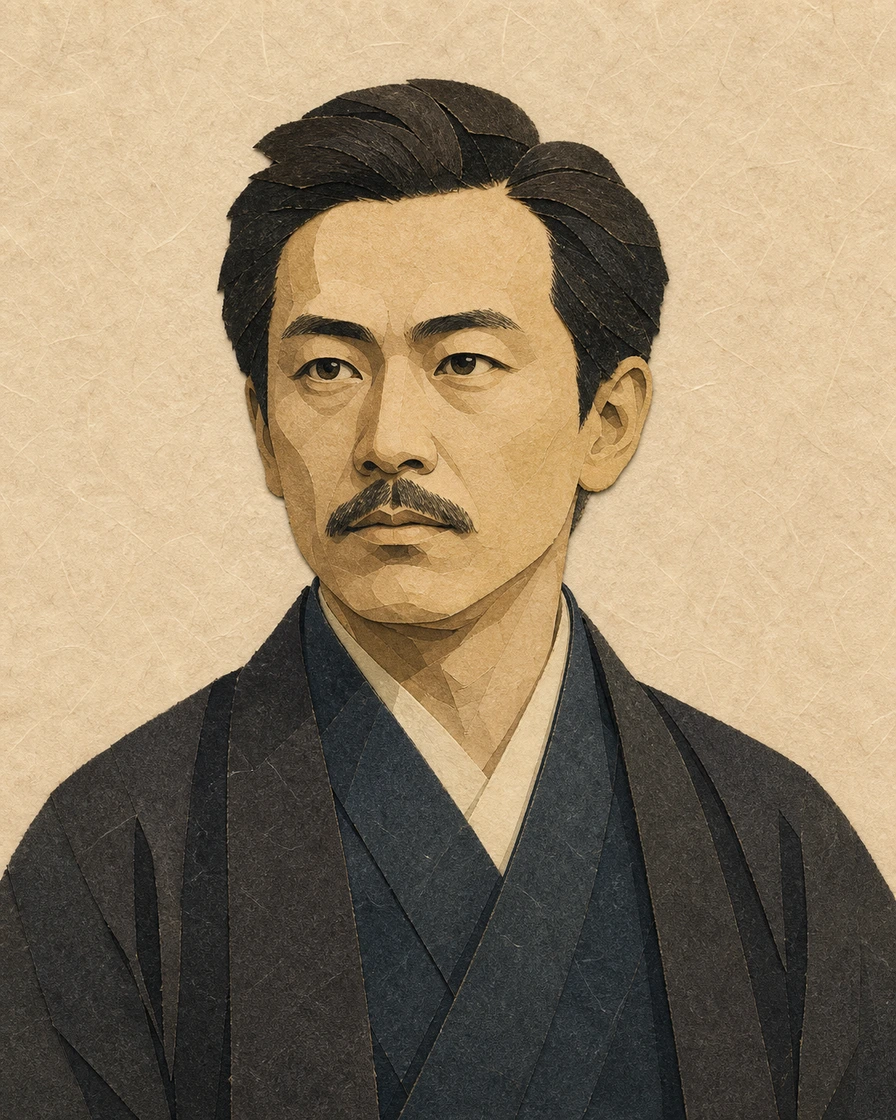
Mikimoto Kōkichi was born in Toba in 1858 to a local merchant household. The coastal setting exposed him to marine products, travelers, and small-business exchange, but it did not automatically create pearl culture. His later enterprise combined market judgment, borrowed expertise, family labor, capital, regulation, and repeated biological experiment.
Toba faced Ise Bay and the Pacific approaches at a time when Japan was being drawn into new national and international markets. Mikimoto did not begin as a trained zoologist or engineer. His first useful education was the commercial life of a port town: learning what goods people valued, how uncertain supply affected price, and how much risk a household could carry.
As a young merchant, Mikimoto tried several trades within Toba's changing Meiji economy rather than following an elite bureaucratic or academic route. Buying and selling taught him to judge quality, uncertain supply, customer demand, and the cost of credit. These skills later mattered to pearl culture, although the early ventures were not a planned apprenticeship for one product.
Pearl farming would pose the same risks on a slower biological clock: Mikimoto had to spend money and support workers long before he knew how many oysters would survive or what they would contain.
Mikimoto encountered the pearl trade during travel to Tokyo and Yokohama in 1878, then developed marine-product businesses closer to home. Natural pearls commanded high prices because suitable finds were rare and unpredictable. He began to see unstable supply not merely as luck but as a commercial problem that managed shellfish cultivation might address. [1]
The potential market was much larger than Toba, but the raw material came from local waters. This joined two kinds of knowledge that rarely appear together in an inventor story: the urban merchant's sense of demand and the coastal worker's understanding of oysters, seasons and seabeds. Mikimoto could coordinate those worlds, but he could not replace the expertise within either one.
Heavy collection threatened local stocks of the akoya, a small pearl oyster native to Japanese coastal waters. Mikimoto increasingly connected oyster cultivation with induced pearl formation. Protecting brood and maintaining farms served long-term production as well as conservation of a commercial resource.
Cultivation meant reserving water, controlling access and deciding when shellfish could be taken. Those measures could preserve productive stocks while also concentrating commercial rights. The important change was practical: pearls would no longer depend only on finding an exceptional wild oyster if a business could raise large numbers under managed conditions.
Around 1888 Mikimoto began cultivating pearl oysters in Ago Bay. By 1890 he was pursuing artificial pearl experiments, encouraged by scientific advice associated with zoologist Mitsukuri Kakichi. Raising oysters and inducing pearl material were different tasks: farms could improve stock survival without yet producing a marketable cultured pearl. [1]
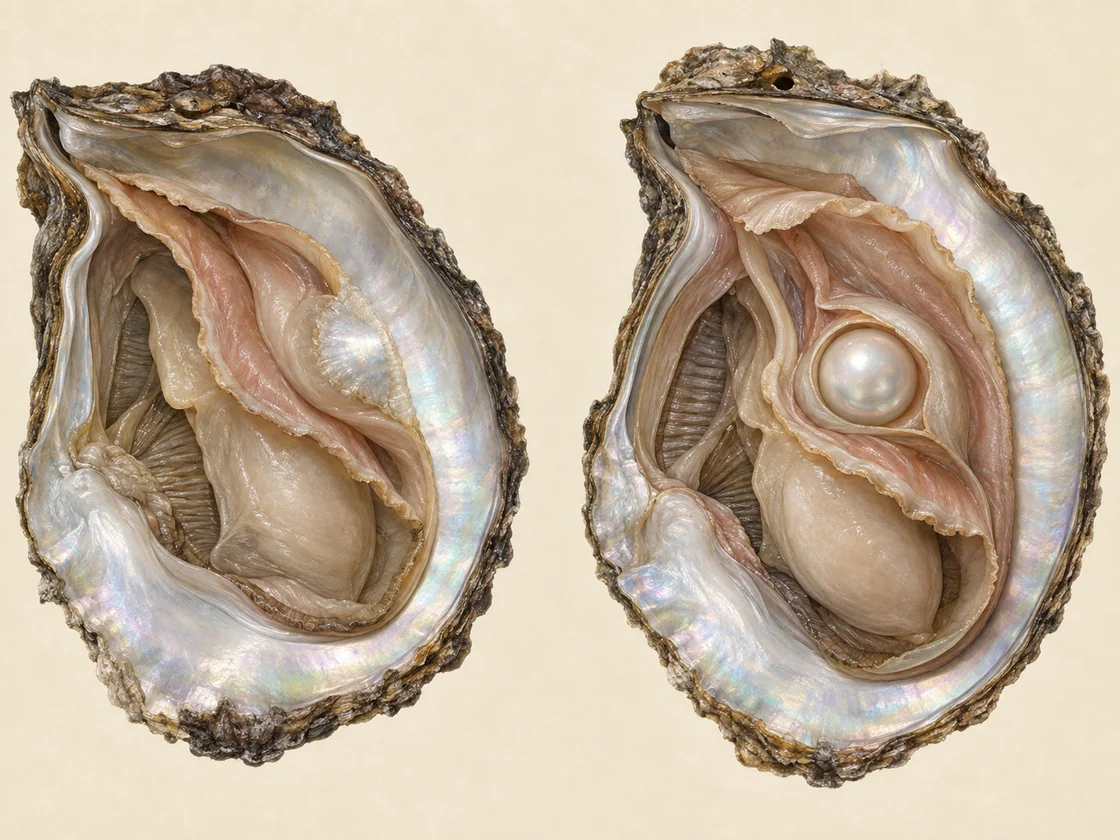
Experimenters had to place an irritant or other material without killing the animal, then wait while living tissue deposited nacre—the iridescent shell material that forms a pearl—around it. Survival, placement, water quality and time all mattered. Scientific advice could suggest a biological mechanism; farm workers still had to turn that idea into repeated operations in variable coastal conditions.
Early trials suffered mass oyster deaths, including red-tide events in which algal blooms deprived or poisoned marine life, as well as severe financial pressure. While divers and farm workers carried the marine labor, Mikimoto's wife Ume managed the household and children and encouraged him to continue through years of risk. [6]
Each loss consumed borrowed money and months of work. Ume died in 1896, before the enterprise had achieved the later round-pearl system associated with the Mikimoto name.
In July 1893, at Ojima in Toba, Mikimoto's operation harvested cultured half pearls attached to oyster shells. This demonstrated that human intervention could produce marketable nacreous pearl forms. It was not yet the free, fully spherical cultured pearl later used for uniform strands; that distinction controls every later priority claim. [1][4]
Half pearls could be cut with part of the shell and mounted in jewelry, allowing an intermediate technique to earn money while harder experiments continued. The 1893 harvest proved that cultivation could yield a saleable product; patent no. 2670, granted in 1896, gave legal protection to a related claim. Neither achievement solved every step of spherical pearl production.
After the half-pearl harvest, Mikimoto expanded his farms and obtained patent protection. Official local accounts place the establishment of the Tatoku Island farm in either 1893 or 1896, perhaps describing different stages; by the mid-1890s it had become a major site. Larger farms let the enterprise repeat operations across more oysters, sort uneven results, and keep marketable pearls moving toward buyers despite mortality and failed batches. [2][3]
The move from attached half pearls to free spherical pearls involved placing a nucleus together with living mantle tissue so that nacre could form around it. Mise Tatsuhei and Nishikawa Tōkichi developed important methods and filed claims in 1907. Nishikawa was Mikimoto's son-in-law and conducted research at the Mikimoto farm, while Mise worked on a separate line of experiment.
Patent applications, later grants, and successful production did not occur at the same moment, and the surviving secondary accounts disagree over some numbers and method names. The secure point is that no single 1908 patent represents the whole technical history or makes one person the sole inventor of spherical pearl culture. [1][4]
Mikimoto opened a Tokyo sales base in 1899 and moved onto Ginza’s main commercial stage by 1902. Production remained rooted in Ise-Shima, while the shop addressed urban consumers, jewelers, media, and international visitors. Retail, design, grading, display, and explanation were necessary to make cultured pearls a trusted luxury.
Customers had to be persuaded that a pearl produced through human intervention was still genuine nacre rather than a glass imitation. A metropolitan shop allowed buyers to compare products and return to a known seller. Toba supplied oysters and the story of origin; Ginza supplied visibility, reputation and access to wider markets.
Patent law gave pearl experimenters commercial control over specified procedures. For Mikimoto, that protection helped turn long and expensive trials into an advantage that could be licensed, defended, and shown to officials or investors. Its value increased because it was joined to farms, trained workers, oyster care, grading, capital, the Ginza shop, and sustained promotion. Patents protected parts of this system; they did not settle every question of inventive credit.
Mikimoto used industrial exhibitions, product displays, and publicity from the 1890 National Industrial Exhibition onward. Such venues connected scientific legitimacy, craft spectacle, and sales. Cultured pearls faced doubts that human intervention made them false or inferior, so public comparison and consistent quality were part of creating the market, not publicity added after it.
Exhibitions placed the new product beside other claims about Meiji industry and national progress. They could attract officials, investors, journalists and foreign buyers at the same time. Publicity succeeded only if farms and workshops could supply pearls of sufficiently dependable quality; spectacle and production had to reinforce each other.
As sales and publicity expanded, Mikimoto acquired the image later summarized as the “Pearl King.” The label reflected entrepreneurial scale, showmanship, and media repetition rather than a formal scientific title. Before 1912, metropolitan and overseas connections were developing, but later worldwide retail expansion must not be projected backward as already complete.
The persona concentrated a collaborative enterprise into one memorable founder. It helped customers associate cultured pearls with a guarantee of quality, but it also pushed Mise, Nishikawa, Ume, advisers and marine workers toward the edge of the story. The public image is historically important because it became part of how the product was sold.
By 1912 pearl cultivation was linking Ise-Shima farms with intervention work, oyster care, sorting, jewelry production, Tokyo retail, and foreign demand. Mikimoto’s enterprise was central, not solitary. Women divers and other marine workers performed essential labor, while farms claimed coastal space and remained vulnerable to water conditions. Later regional effects must not be backdated. [5]
Industrial growth reorganized both work and sea use. Crews moved and monitored stock, specialists operated on oysters, and sorters and jewelers turned uneven biological results into graded goods. Mikimoto coordinated ownership, capital, and markets; the industry itself existed through this divided labor.
In 1912 Mikimoto was fifty-four and actively expanding cultured-pearl production and markets. Half pearls, competing spherical methods, patents, farms, Ginza retail and growing international commerce were already connected, while the later worldwide business was not yet complete.
Mikimoto lived until 1954, so 1912 marks a boundary in this account rather than the end of his working life. By then he had already shown how an experimental marine product could become an organized industry and a recognizable brand.
Classic
Mikimoto Kōkichi was born in Toba on 10 March 1858, the eldest son of a household that ran an udon shop known as Awako. Toba was a coastal town in present-day Mie Prefecture, with fishing, marine products, local trade and travelers moving through the region. This was a modest commercial setting, not an established pearl company waiting for an heir.
Growing up in a family business could teach a child how goods reached customers and why price, credit and spoilage mattered. Food service and small trade depended on repeated purchases, dependable suppliers and the ability to judge what people would buy. Such knowledge later mattered to Mikimoto's career. It was practical commercial training, although it did not give him an understanding of pearl biology or a ready-made plan for international expansion.
The coast connected Toba to markets beyond the town. Boats carried people, products and information, while pilgrimage and regional travel created passing demand. During Mikimoto's youth, the Meiji Restoration began replacing domain government with a centralized state, and new transport, exhibitions and commercial law gradually changed the distances across which a provincial product might be sold. These changes expanded opportunity without selecting cultured pearls as an inevitable outcome.
Pearl culture would eventually require knowledge that no childhood shop could supply: keeping oysters alive, managing farms, inducing pearl formation, surviving disease and red tide, sorting saleable grades and persuading buyers that a cultivated pearl was genuine. Scientists, officials, rival experimenters, family members and marine workers all contributed to that history. Mikimoto's later strength lay in connecting experiment to finance, production and markets over many years of failure.
This distinction matters because “Pearl King” became an effective commercial identity. Read backward, it turns every childhood encounter with the sea into an omen and credits one man with an industry before the work began. The evidence supports something more ordinary and more useful: Mikimoto started with local relationships and experience of small trade, not inherited industrial capital or formal scientific office.
His adult direction began to become visible in the 1870s. A journey to Yokohama in 1878 exposed him to the pearl trade at a larger market, helping turn a general merchant's interest into a specific commercial problem. The story of cultured pearls properly starts with that developing market judgment, not with an invented childhood revelation on the shore.
As a young merchant, Mikimoto tried business within Toba’s changing Meiji economy rather than following an elite bureaucratic or academic route. Commerce taught him to compare supply, demand, quality, and risk. These skills later shaped pearl culture, but varied early ventures should not be rewritten as a straight apprenticeship for one predetermined product.
Why emphasize merchant formation? Because invention histories often separate an idea from the economic practices that keep it alive. A biological experiment may show promise, yet it cannot become an industry without sites, materials, labor, credit, patience, legal access, and buyers. Mikimoto’s early commercial experience trained him to see these relationships before he possessed a successful pearl method. Meiji markets were expanding unevenly. Urban consumers demanded new and old luxuries; transport and communication improved; national exhibitions brought provincial products into comparative display. At the same time, a small trader remained vulnerable to price changes, limited capital, local competition, and personal credit. Kōkichi’s lack of elite credentials was not romantic freedom. It meant he had to persuade people who controlled money, knowledge, or permissions.
Early-business anecdotes require source discipline. Later corporate biography tends to select episodes that foreshadow persistence and salesmanship. Such stories may preserve real memory, but their polished dialogue and moral lessons cannot be treated like contemporary account books. Commercial knowledge also included failure. Perishable goods could be lost; customers could reject a price; borrowing could narrow future choices. Those experiences help explain why unstable natural-pearl supply appeared as both problem and opportunity. They do not prove that every setback taught precisely the lesson later success required. Outcome bias should not convert ordinary uncertainty into an entrepreneurial curriculum designed by history.
Toba itself participated in the business. Travelers, suppliers, household members, carriers, and consumers enabled transactions. A merchant could coordinate exchange and capture profit, but he did not personally produce every good or route. This distributed model anticipates the pearl farms: Mikimoto’s leadership was real, while production depended on people whose labor a founder-centered brand could later hide. Kōkichi learned to ask whether scarcity came from genuine rarity, unstable collection, damaged resources, poor distribution, or consumer perception. That question would later make pearls more than beautiful accidents. If supply could be influenced, quality sorted, and trust created, a local marine object might enter a much larger market.
The 1878 journey provides the firmest early anchor. The Japan Patent Office records that Mikimoto travelled to Tokyo and observed the pearl trade at Yokohama. It showed him prices, sorting, and demand, but not how to make a pearl. A decade still separated that encounter from his first oyster-cultivation work. The intervening ventures are unevenly documented and should not be filled with polished lessons borrowed from later motivational biographies. [1]
Mikimoto encountered the pearl trade during travel to Tokyo and Yokohama in 1878, then developed marine-product businesses closer to home. Natural pearls commanded high prices because suitable finds were rare and unpredictable. He began to see unstable supply not merely as luck but as a commercial problem that managed shellfish cultivation might address.
Why would an expensive natural object encourage cultivation rather than discourage it? High prices signal more than prestige. They may reveal that supply cannot meet demand, that extraction is uncertain, or that traders bear large search costs. Natural pearls occurred without a producer controlling when, where, or in what shape they formed. Harvesting many oysters might yield few usable pearls. A merchant who could influence that probability would not simply find more treasure; he could change the structure of the market.
The Japan Patent Office places Mikimoto’s 1878 journey and his observation of pearl dealing in Yokohama near the beginning of his engagement with the product. The episode is valuable as a dated contact, not as proof of an instantaneous revelation. Seeing trade could demonstrate prices, sorting, and demand. It could not by itself teach the biology of pearl formation or guarantee that artificial intervention was possible. Mikimoto’s commercial route continued through marine products and local ventures. These activities put him nearer the practical questions of acquiring oysters, maintaining access to water, hiring or coordinating labor, and selling valuable output. The phrase “he noticed pearls were scarce” compresses a chain of observation: oysters were living resources; natural finds were irregular; intensive collection could damage the stock; and luxury buyers demanded trustworthy quality. [1]
Scarcity also had multiple meanings. A rare object may remain profitable precisely because it is rare, so increased supply could lower prices. Cultivation was not automatically a rational success. Mikimoto had to imagine that more predictable production could expand demand, create new grades and uses, or yield enough saleable material to offset lower unit scarcity. That market judgment became as important as technical experiment. The natural-pearl trade was already a network. Divers and fishers gathered shellfish; traders sorted and moved goods; jewelers interpreted quality; consumers assigned cultural and monetary value. Mikimoto did not invent pearls or their desirability. His intervention aimed to reorganize production before the point of sale. It depended on knowledge and labor from the existing network even as it threatened to change who captured value.
Natural pearls form through biological processes, but collection, grading, and exchange already shaped their commercial life. Cultivation added another intervention: manage oysters and induce pearl formation more predictably. By the late 1880s Mikimoto had defined a question worth risking capital on—whether enough oysters could be kept alive and made to produce attractive pearl material. He did not yet have an answer.
Nor did scarcity mean natural pearls lacked grading. Shape, surface, luster, size, and color already affected price, so increasing the number of nacreous objects would not make every result valuable. From the beginning, the technical goal included quality distribution, not sheer output. This later justified investment in sorting, matching, and retail explanation as integral parts of production.
Heavy collection threatened local akoya oyster stocks and made a stable pearl trade difficult. Mikimoto increasingly connected oyster cultivation with induced pearl formation. Protecting brood and maintaining farms served long-term production, but it should not be recast as modern environmentalism detached from profit, ownership, and resource control.
Pearl culture is sometimes told as a conservation victory from its first conception: the entrepreneur sees depleted nature, rescues it through farming, and establishes harmony between business and the sea. Resource preservation did matter, but the moral sequence is too smooth. Mikimoto needed living oysters because dead or exhausted stocks could not support future pearls. Protecting supply was therefore inseparable from commercial continuity. That does not make protection unreal. A collection economy that rewarded immediate extraction could deplete reproductive stock and increase search effort. Cultivation required a different time horizon. Oysters had to survive long enough for experiments and harvest; farms needed usable water and some control over interference; investment tied the operator to future conditions. These requirements encouraged management instead of pure short-term removal.
Yet aquaculture is not absence of environmental pressure. Concentrating shellfish, manipulating sites, moving oysters, and claiming access to coastal waters alter ecological and social relations. Disease, food availability, temperature, storms, and harmful blooms remain beyond full control. Other marine users may be affected by exclusive or regulated grounds. A responsible history should not treat cultivated water as empty property or assume all local people welcomed the new allocation. Mikimoto’s innovation was partly organizational. He sought permissions and access, committed resources over multiple seasons, and connected biological survival to market expectation. Scientists and fishery officials could advise on feasibility; local workers and divers understood handling and water; family members helped sustain the enterprise. No single insight converted extraction to culture without these relations.
The question of motive must remain layered. Profit, prestige, concern about exhaustion, and fascination with technical possibility can coexist. Later commemorative sources emphasize perseverance and preservation, but they do not allow us to quantify what he valued most at every moment. The modern relevance of sustainability should also remain outside his presumed language. A bounded reconstruction can recognize that dead oysters end the business; it cannot make him speak a century of environmental policy in advance. Mikimoto moved toward farming because unstable and pressured natural supply limited enterprise. Keeping oysters alive became the first technical condition of pearl culture. This was a meaningful change in how humans organized the resource, but it remained a commercial, ecological, and legal intervention rather than a simple rescue of nature.
Terms such as “near extinction,” common in commemoration, should be treated as resource-pressure language unless supported by a measured contemporary stock assessment. Declining or threatened beds can be historically significant without a precise population estimate.
Around 1888 Mikimoto began cultivating pearl oysters in Ago Bay. By 1890 he was pursuing artificial pearl experiments, encouraged by scientific advice associated with zoologist Mitsukuri Kakichi. Raising oysters and inducing pearl material were different tasks: farms could improve stock survival without yet producing a marketable cultured pearl. [1]
“He began pearl culture” can hide two distinct technologies. The first is aquaculture: obtaining juvenile or adult oysters, placing or moving them, maintaining grounds, and keeping enough alive. The second is pearl induction: introducing a stimulus or object in a way that leads the mollusk to deposit nacre in a useful form. Success at the first does not prove success at the second. The Japan Patent Office dates Mikimoto’s oyster cultivation in Ago Bay to 1888 and his focused pearl research to 1890. It also records the significance of encouragement from Mitsukuri Kakichi at the Third National Industrial Exhibition. This contact matters because it joined entrepreneurial persistence to zoological possibility. It does not mean the scientist handed over a finished recipe, nor that Mikimoto became a formally trained zoologist.
Experiment required iteration. Operators had to decide where and how to introduce material, how much injury an oyster could survive, when to intervene, how long to wait, and how to identify failure. They needed control groups or at least comparative observation, records, and enough oysters that mortality did not end the project. Even a nacre deposit might be irregular, attached to the shell, discolored, thin, or commercially useless. The labor behind these experiments was distributed. Oysters had to be collected, transported, opened or manipulated, returned to water, protected, inspected, and harvested. Boats and coastal facilities were necessary. Family members helped support risk, while local marine workers contributed practical handling. The archive does not preserve every person equally; that inequality must not be transformed into proof that Mikimoto’s hands alone performed the research.
Capital and time were experimental instruments. A failed agricultural or marine cycle could not always be rerun immediately. Seasons passed, oysters grew, storms intervened, and funds were consumed before results appeared. Mikimoto’s commercial ability helped maintain this long sequence. Persistence was not merely a personality trait; it was the capacity to keep sites, labor, credit, and permission aligned after disappointing harvests. Nor was a “secret” waiting to be found whole. Pearl culture became a system in which biological response, surgical intervention, husbandry, site conditions, selection, and later marketing interacted. Improvements could occur at different points. This structure helps explain why multiple inventors and patent claims later mattered: one party might improve implantation while another controlled oyster management or a legal method claim.
Mikimoto began with oysters before he could reliably produce pearls. Scientific counsel made the objective plausible; repeated work tested it. The distinction between cultivating the animal and cultivating the gem keeps the chronology honest and prepares readers to understand why 1893’s attached half pearls were a major success without being the final spherical technology. The exhibition connection also demonstrates reciprocal roles. Mikimoto brought commercial attention and marine material to a national venue; Mitsukuri supplied scientific authority that cultivation might be possible. Neither relation proves a finished transfer. It shows how modern institutions connected a provincial entrepreneur to expertise. That bridge, rather than an isolated laboratory identity, is part of the innovation.
Early trials suffered mass oyster deaths, environmental shocks, and financial pressure. Red-tide accounts belong to the real difficulty, but later perseverance stories can overconcentrate agency in Mikimoto. Marine labor belonged to divers and farm workers. Mikimoto's wife Ume managed the household and children and encouraged him to continue through years of financial risk.
Mass mortality meant lost stock, debt, time, and danger to household security. Mikimoto decided to continue, but he did not bear every consequence alone. Harmful plankton blooms can reduce oxygen or damage shellfish, and historical accounts connect such red-tide losses to his early farms. Exact totals vary in later retellings; the secure point is that environmental shocks repeatedly threatened both experiment and capital before the 1893 harvest.
Ume's role is especially vulnerable to founder biography. The available Toba educational account remembers her managing the household and children, encouraging Mikimoto to continue, and dying before the enterprise's full later success. It does not document her managing accounts or pearl-farm operations. Family economic exposure remained part of the venture, while marine workers carried specialized burdens. Divers gathered or handled oysters, boats moved them, and attendants maintained grounds and responded to changing conditions. Mie's own cultural interpretation stresses women divers' indispensable work in collecting, releasing, and moving pearl oysters, particularly around risk from red tide and storms. That evidence restores a labor category without assigning Ume an operational role the source does not establish. [6]
Financial persistence involved outside relationships. Creditors, investors, officials, and suppliers had to tolerate delayed results. Borrowing transferred risk rather than eliminating it. Later success can make these commitments seem obvious; at the time, further investment might rationally have appeared wasteful. Mikimoto’s ability to persuade was therefore a production capacity, not merely marketing added after invention. Failure also generated information only when observed carefully. Were oysters dying from handling, location, season, water, or the implanted material? Did survival produce nacre? Could a partial result be sold? A catastrophe that killed nearly everything might teach less than a small controlled difference. “He learned from every failure” is too strong; some failures destroyed evidence along with stock.
Mikimoto supplied commitment, direction, and commercial persuasion. Ume sustained the household and offered moral encouragement. Workers performed marine labor; advisers provided knowledge; oysters and water imposed biological limits. Chronology limits the emotional story as well. Ume's illness, death, and presumed hopes must not be narrated through invented last words, and Mikimoto's later success cannot be placed inside her mind as consolation.
In July 1893, at Ojima in Toba, Mikimoto’s operation harvested cultured half pearls attached to oyster shells. This was a historic demonstration that human intervention could produce marketable nacreous pearl forms. It was not yet the free, fully spherical cultured pearl later used for uniform strands. The distinction controls every later priority claim. [1][4]
Why insist on “half pearl”? Because the shape identifies the technical achievement. Mikimoto’s 1893 products formed against the inner shell, producing a blister-like or hemispherical object. Once removed or worked with backing, such pieces could serve jewelry and ornament. They demonstrated cultured nacre and commercial possibility. They did not prove that a round nucleus could remain within the oyster’s tissue and acquire nacre evenly on all sides. Official accounts from Toba, Mie, the National Diet Library, and the Patent Office converge on 1893 as the half-pearl success. Some commemorative timelines vary in how they phrase the start of experimentation or later patent milestone, so event language must remain precise: success in producing half pearls in 1893; patent no. 2670 granted in 1896; later spherical work and rights are separate.
This precision protects Mikimoto’s achievement rather than diminishing it. A partial technical solution can transform what researchers believe possible. Before the harvest, artificial pearl production remained speculative and financially dangerous. After it, Mikimoto could show nacreous results, seek legal protection, attract buyers, and justify farm expansion. The success converted experiment into a product path. The harvest was not a solitary discovery scene. Oysters had been handled, maintained, inspected, and recovered through collective work. A famous founder could recognize and commercialize the result, but the biological production belonged to living animals under managed conditions, and the human production belonged to a farm.
Authenticity became a new problem immediately. A cultured pearl was biologically nacreous, yet buyers accustomed to natural rarity could classify human intervention as falsification. Half pearls also differed visibly from ideal round forms. Mikimoto needed to explain not only that he had succeeded, but what exactly had been made and why it deserved value. Marketing therefore began inside technical description. “World first” claims should be item-specific and authority-labeled. Japanese public institutions describe the 1893 achievement as the world’s first successful cultured half pearls. Wider histories of pearl experimentation can involve earlier attempts and different products.
It validates years of risk, but it does not end research. The half pearl created revenue and reputation while revealing the remaining challenge: a free sphere. Later brand history sometimes compresses both into one miracle. The exact place matters as well. Ojima in Toba—later branded as Mikimoto Pearl Island—is the 1893 success site in Toba’s authority. Tatoku Island in Ago Bay belongs to later expansion. Collapsing the two islands creates an attractive but false single-place origin. Place precision matters.
After the half-pearl harvest, Mikimoto expanded his farms and obtained patent protection. Official local accounts differ on the Tatoku Island date: a Mie history places the farm's creation in 1893, while a Toba chronology uses 1896. The difference may reflect separate stages of acquisition, establishment, or expansion; until the underlying records are checked, the narrative should say that Tatoku became a major site by the mid-1890s. [2][3]
One attractive half pearl proved possibility, not a reliable yield. Expansion forced Mikimoto's organization to turn improvisation into routines: maintain oyster stocks, monitor water, repeat interventions, sort uneven results, and coordinate access to larger coastal grounds. A larger farm increased production capacity while also increasing exposure to disease, storms, harmful blooms, and debt.
Oyster management occurred on a biological clock. Stock had to reach appropriate condition; intervention had to avoid excessive mortality; recovery and growth required monitoring; harvest could not simply be accelerated to meet a cash crisis. Variability meant that two apparently similar oysters might yield different surfaces, colors, or no usable pearl. Sorting converted biological diversity into commercial grades, but it also produced waste and losses hidden by photographs of perfect products. Workers made scale possible. Divers and boat crews handled oysters and moved stock; farm attendants observed water and equipment; skilled operators performed delicate interventions; sorters and craftspeople prepared outputs. The founder’s name organized ownership and brand, not every hand movement. A product history that restores labor does not deny Mikimoto’s coordination—it explains what coordination meant.
Patent no. 2670, granted in 1896 for cultured pearls, offered a legal asset. A patent could help attract capital, deter copying of a claimed method, and support publicity. It did not make oysters behave consistently, establish that every technique was exclusively Mikimoto’s, or end later disputes. Legal protection and production competence were different sources of advantage. Sales mattered at this stage because half pearls had to finance continued work. Jewelry design could accommodate attached forms, allowing partial technology to create a real market while spherical research continued. This is an important innovation pattern: an intermediate product can support development rather than waiting for a perfect final invention. [1]
Sales now became part of the production problem. Mikimoto opened a Tokyo sales base in 1899 and moved onto Ginza's main commercial street in 1902. Half pearls had to finance continued spherical-pearl research, and urban buyers had to be taught why a cultured pearl was genuine nacre rather than a glass imitation. Ojima remained the 1893 breakthrough site; Tatoku belonged to farm expansion; Tokyo and Ginza supplied retail reach. Keeping those places separate makes the growth of the enterprise visible.
The move from shell-attached half pearls to free spherical pearls was not a second version of the same procedure. A nucleus and a small piece of living mantle tissue had to be placed so that a pearl sac could form around the nucleus. The oyster then had to survive long enough to cover it with nacre. Placement, tissue condition, aftercare, water quality, and time all affected the result.
Several experimenters worked on this problem. Tatsuhei Mise developed insertion techniques and filed patent claims in 1907. Tōkichi Nishikawa, a fisheries researcher who became Mikimoto's son-in-law and conducted research at the Mikimoto farm, filed related claims in the same year. Mikimoto and workers at his farms also tested techniques for producing free pearls. Their work belonged to a competitive field in which ideas, family relationships, facilities, and legal claims overlapped.
Patent chronologies often confuse filing with grant, and the available secondary accounts do not agree on how every number maps to a particular method. The Japan Patent Office records Mikimoto receiving protection in 1908, while Nishikawa's related grants came later. Until the original patent records are reconciled, the text should not attach a disputed number or method description to one decisive “round-pearl patent.” [1][4]
Patent records answer a legal question: who claimed a specified method at a particular time. They do not by themselves reveal the first private experiment or every person's contribution at a farm. Nor does later commercial success settle technical priority. Mikimoto's distinctive achievement was to connect long experimentation with oyster stocks, farms, capital, quality control, retail, and promotion. That combination helped turn cultured pearls into an industry, but it did not make Mise and Nishikawa merely assistants in a single inventor's story.
By 1912, spherical-pearl culture remained a field of competing methods and incompletely settled rights. The secure conclusion is narrower: Mikimoto was a central experimenter and organizer; Mise and Nishikawa made distinct technical and patent contributions; and industrial production emerged from intersecting work rather than one uncontested moment owned by one man. Details of the priority dispute and later agreements should enter the reader text only after the original legal records have been checked.
Mikimoto opened a Tokyo sales base in 1899 and moved onto Ginza’s main commercial stage by 1902. Production remained rooted in Ise-Shima, while the shop addressed urban consumers, jewelers, media, and international visitors. Retail, design, grading, display, and explanation were necessary to make cultured pearls a trusted luxury.
Why sell in Ginza if the pearl came from Toba and Ago Bay? Luxury value is not completed at harvest. Buyers need to see, compare, authenticate, imagine use, and associate the object with a reliable seller. Ginza concentrated affluent customers, modern retail display, press attention, travelers, and proximity to national commercial networks. It performed a function the farm could not. Mie’s historical record distinguishes an 1899 Tokyo sales shop from the 1902 move onto Ginza’s main street. That sequence corrects the convenient phrase “he opened Ginza in 1899.” A business may establish a metropolitan presence before obtaining the location later central to brand memory. Precise phases prevent a famous address from erasing earlier retail work.
The shop also confronted category uncertainty. Natural-pearl value rested partly on rarity and the story of accidental discovery. Cultured pearls were genuine nacre made by living oysters under human intervention, but customers could hear “artificial” as “imitation.” Glass beads and other substitutes made the distinction commercially dangerous. Retail staff and exhibitions had to teach consumers why cultivation did not make the material fake. Branding answered an information problem. A recognizable Mikimoto name could promise that sorting, matching, workmanship, and return to a known seller stood behind the product. That promise required quality systems. If uneven or misleading goods carried the same name, publicity would magnify disappointment. The brand was therefore not only decoration; it was an institution for concentrating trust and liability.
Design and craft retained separate agency. Pearls became wearable through drilling, setting, metalwork, matching, and aesthetic choice. Mikimoto could direct a house and commission products, but jewelers and artisans made the objects. A cultured pearl industry joined aquaculture to decorative arts. The store connected those production worlds to consumers. Urban success also changed the relation to place. Toba supplied origin authenticity and technical narrative; Tokyo supplied prestige and circulation. Neither should consume the other. International possibility entered through Tokyo before a full overseas network existed. Foreign residents, visitors, exporters, and exhibitions could encounter the product. Suspicion and competition remained, and spherical supply was still developing.
Mikimoto did not merely carry an established natural luxury to market. His organization had to explain a new production method, defend authenticity, grade biological variation, and create desire. Ginza converted technical proof into something consumers could trust, wear, and discuss. The 1902 shop should not be illustrated with a later flagship facade unless the image is clearly dated.
Patent law gave pearl experimenters a way to claim specified procedures, but no single certificate settled who first conceived every part of spherical-pearl culture. Chapter 9 distinguishes the 1907 applications associated with Mise, Nishikawa, and Mikimoto from the later grants. Here the important point is what legal protection could—and could not—do for a growing firm.
Patents answered a limited legal question: whether a described claim qualified for protection and who held that right. They did not disclose every trial made before filing, every contribution by farm workers, or the full exchange of information among competitors. Nor could a certificate keep oysters alive. Commercial advantage still depended on careful operations, healthy shellfish, skilled insertion, long aftercare, capital, grading, and sales.
For Mikimoto, legal protection mattered because experimentation required years of investment and because cultured pearls still had to win public trust. A patent could help reassure officials, investors, and customers that the product rested on a recognized technique rather than deception. His organization combined that legal position with farms, trained workers, quality control, a Ginza shop, and sustained promotion. This capacity to connect invention with production and demand was a major achievement even when technical priority remained divided.
By 1912, legal rights and working methods were still developing. Later agreements and patents helped stabilize the industry, but they cannot be projected backward to make the Meiji chronology cleaner than it was. Mikimoto's durable advantage lay in combining protected claims with farms, trained workers, quality control, retail, and promotion.
Mikimoto used industrial exhibitions, product displays, and publicity from the 1890 National Industrial Exhibition onward. Such venues connected scientific legitimacy, craft spectacle, and sales. Cultured pearls faced doubts that human intervention made them false or inferior, so public comparison and consistent quality were part of creating the market, not publicity added after it.
An unfamiliar product must often establish its category before it can compete within one. Cultured pearls encountered a linguistic hazard: “artificial” could refer either to induced biological production or to imitation materials with no nacreous formation in an oyster. Opponents and anxious buyers could exploit that ambiguity. Mikimoto’s exhibitions sought to make cultivation visible while preserving the claim of genuine pearl material. The 1890 Third National Industrial Exhibition belongs early in the sequence, before the 1893 half-pearl success. Mikimoto displayed pearls, oysters, and pearl-bearing objects and encountered expert encouragement. Later exhibitions could show cultured outputs and increasingly elaborate jewelry. Keeping these appearances distinct prevents the false impression that every display celebrated a completed round-pearl system.
Exhibitions were hybrid institutions. Officials classified and judged products; scientists could confer credibility; newspapers turned objects into stories; visitors compared national and foreign manufacture; businesses gathered orders. A prize or favorable display mattered because it translated private assertion into public recognition. Yet juries judged submitted objects, not every farm practice or future claim. Spectacle served education. Viewers could see oysters, stages of production, and finished ornament. This visual chain helped explain how nacre remained biological even when humans initiated formation. It also allowed Mikimoto to associate the product with national industrial progress. Meiji audiences were invited to see a coastal luxury as evidence that Japan could produce modern science, industry, and design.
National framing carried risks. “Japanese invention” could erase local Ise-Shima workers and multiple inventors; “Mikimoto pearl” could absorb a sector; “scientific” could hide ecological variability. The exhibition story should therefore be read as strategic representation as well as evidence. What a firm chose to display tells historians how it wanted the public to understand production. Quality proof could not depend on argument alone. Luster, surface, thickness, shape, matching, and workmanship had to withstand comparison. A poor object advertised under grand claims could strengthen skepticism. Selection therefore made exhibitions unrepresentative by design: they displayed the best products. This does not invalidate them, but it prevents showcase quality from becoming an assumed farm average.
It explains the commercial program in original language, leaving quotation study to sourced research layers. Mikimoto had to demonstrate what the product was, who stood behind it, and why cultivation deserved rather than destroyed value. Exhibitions joined teaching to persuasion. They were laboratories of public trust, even though the objects on display had already survived strict selection. This logic also distinguishes education from proof of natural equivalence. A demonstration could establish nacre, oyster origin, and workmanship; it could not make cultured and natural pearls identical in formation history. Market legitimacy did not require erasing the difference. Mikimoto’s stronger position was that cultivation produced a genuine pearl category whose controlled origin could be disclosed rather than concealed.
Disclosure is part of trust.
As sales and publicity expanded, Mikimoto acquired the image later summarized as the “Pearl King.” The label reflected entrepreneurial scale, showmanship, and media repetition rather than a formal scientific title. Before 1912, metropolitan and overseas connections were developing, but later worldwide retail expansion must not be projected backward as already complete.
What kind of fact is a nickname? “Pearl King” does not describe a legal office or settle priority. It records reputation. Newspapers, customers, employees, exhibitions, and the businessman’s own performances could reinforce it until the title appeared natural. As evidence, it tells us that Mikimoto himself became part of the product’s meaning. Personal branding solved a trust problem. Cultured pearls were variable, technical, and unfamiliar. A visible founder could personify guarantee: the same energetic merchant who claimed to master the process would answer for quality and keep improving it. The strategy also concentrated historical credit. Customers remembered a face more readily than oyster technicians, patent rivals, divers, sorters, or shop staff.
Later biographies preserve witty encounters and bold declarations, but polished quotations may be retrospective or repeatedly edited. International sales also depended on exporters, foreign jewelers, tourists, exhibitions, shipping, currency, and fashion. A Ginza store and foreign orders did not mean that London, Paris, and New York immediately accepted cultured pearls on equal terms with natural ones. Trust grew transaction by transaction.
By 1912 Mikimoto had a metropolitan retail platform, patent claims, exhibition experience, production capacity, and international sales or aspirations. His public persona linked Toba and Ise-Shima, presented as the product's marine origin, to Ginza, presented as its modern luxury stage. That persona magnified real organizing achievements while concentrating credit that also belonged to technicians, divers, sorters, jewelers, and rivals.
The famous statement about adorning the necks of women around the world expresses that global ambition, but its wording and date vary across later corporate and biographical retellings. Until an early source is identified, it should be paraphrased rather than presented as a verbatim quotation.
By 1912 pearl cultivation was linking Ise-Shima farms with intervention work, oyster care, sorting, jewelry production, Tokyo retail, and foreign demand. Mikimoto’s enterprise was central, not solitary. Women divers and other marine workers performed essential labor, while farms claimed coastal space and remained vulnerable to water conditions. Later regional effects must not be backdated.
A pearl bay may look like scenery to a visitor, but cultivation turns water into scheduled work. Oysters occupied sites; rafts, baskets, boats, and shore facilities organized movement; interventions and inspections followed biological cycles. Before her death in 1896, Mikimoto's wife Ume managed the household and children and encouraged him during years of financial risk. The available source does not establish that she managed farm operations or accounts.
Women divers were also indispensable. Mie cultural materials identify ama work in collecting akoya oysters, returning operated stock to the sea, and moving oysters away from red tide or storms. Ama names historically specific diving communities, not every female worker on a pearl farm, and the later Pearl Island demonstrations belong to tourism history rather than the 1890s. [5]
Gendered labor and corporate memory did not distribute fame equally. The founder, patent holders, and male managers were more likely to appear in institutional records; divers, household workers, sorters, and care labor could become picturesque background. Restoring their categories is not symbolic addition. The oyster survives or dies through handling, and the product reaches market through repeated bodily work. The environmental relation was similarly unequal. A firm gained privileged access and income from waters whose conditions it could influence only partly. Harmful blooms, storms, temperature, disease, and water exchange affected stock. Cultivation encouraged attention to oyster health, but commercial density could also create pressures. Modern ecological research should not be projected wholesale into 1912, yet biological dependence was already undeniable.
Industrial clustering developed through more than farms. Technicians learned procedures, processors graded and matched pearls, jewelers mounted them, merchants financed and moved them, and retailers explained them to buyers. Ojima would later become Mikimoto Pearl Island, and diver demonstrations would become heritage performance; those institutions were not yet fully present in 1912. Mikimoto contributed capital, organization, patents, publicity, and market coordination. Many others supplied marine knowledge, handling, craft, and sales labor.
By the cutoff, Ise-Shima had become identifiable with a new industry, yet its transformation was unfinished. The historically accurate image is neither untouched nature nor one man's factory. It is a managed seascape in which biological life, gendered work, legal access, and distant luxury demand were being tied together.
In 1912 Mikimoto was fifty-four and actively expanding cultured-pearl production and markets. The ending is therefore a scope boundary, not a completed-life verdict: half pearls, spherical competition, patents, farms, Ginza retail, and growing international commerce were established, while much remained unfinished.
Biography normally promises a death, retrospective legacy, and final judgment. He had more than four decades still to live. Important refinements, overseas retail expansion, public controversies, wartime changes, postwar recovery, honors, and the mature corporate memory all lie beyond the boundary. Including them here because they make a satisfying ending would violate the project’s scope. The correct question is not “What was his ultimate legacy?” but “What existed by 1912?” The half-pearl breakthrough had demonstrated cultivation. Round-pearl work had become a shared Japanese technical and patent field. Mikimoto’s organization possessed farms, legal claims, growing production routines, Ginza sales, exhibition practice, and international commercial connections. Ise-Shima was entering an industrial identity. These are substantial facts without borrowing later outcomes.
Much remained unresolved. Production consistency continued to improve; technical rights and rival contributions remained complex; foreign acceptance was incomplete; and the ecological and labor effects of scale would unfold over later decades. The firm's later global footprint cannot be treated as present simply because its foundations existed.
The open ending shows that “Meiji innovation” did not stop neatly with the Meiji emperor's death. Businesses, techniques, workers, and environmental problems crossed the era boundary. Mikimoto had become a central cultured-pearl entrepreneur and public figure within a multi-actor industry, but his greatest expansion still lay ahead.